The Ding Surname and Its Remarkable Multicultural Origins
Imagine discovering that your last name connects you not only to ancient Chinese nobility but also to Viking-era Scandinavia and medieval Muslim scholars. That is the reality for bearers of the Ding surname. Few last names in the world carry genuinely independent origin stories rooted in completely separate civilizations, yet Ding does exactly that. Its threads reach into Shang dynasty China, Old Norse occupational language, Germanic given-name traditions, and the Arabic-speaking Muslim communities that settled along China's Silk Road.
Most surname origin guides trace a single cultural line. They follow one language family, one migration path, one ancestral figure. The Ding surname origin breaks that mold entirely. This name emerged independently in at least four distinct cultural contexts, each with its own etymology, historical documentation, and geographic footprint. The result is a surname shared by millions of people whose ancestors never crossed paths.
Why the Ding Surname Has Multiple Origin Stories
At the heart of the Chinese lineage sits the character 丁, a deceptively simple two-stroke symbol ranked #35 among the top 100 most common Chinese surnames. The character carries multiple semantic layers. It can mean a nail or spike, an adult male registered for service, a unit for counting population, or the fourth position in the ancient Heavenly Stems calendar system. Each of these meanings gave rise to different adoption paths across Chinese history, from Zhou dynasty nobles taking the name of their ancestor Ding Gong to Hui Muslim families shortening Arabic names ending in "-din" into the single character 丁.
Meanwhile, in northern Europe, an entirely unrelated Ding surname developed from Old Norse roots describing a physical landscape feature or from a Germanic personal name. These Western bearers of the name have zero etymological connection to the Chinese character. The spelling is identical. The origins could not be more different.
A Surname Shared Across Cultures
The Ding surname stands as one of the rare cases where a single spelling represents genuinely independent multicultural origins rather than branches of a shared etymological root.
Global population estimates place the Ding surname among tens of millions of bearers worldwide, with the vast majority concentrated in China's Shandong, Jiangsu, and Hubei provinces. The ching meaning embedded in related Chinese phonetics sometimes causes confusion with neighboring surnames, but 丁 maintains its own distinct identity. Beyond China, diaspora communities across Southeast Asia romanize the same character differently depending on dialect. Hokkien speakers write it as Teng, Cantonese speakers as Ting, and Hakka speakers as Ten. Each variation represents the same two-stroke character adapted to local pronunciation.
What makes this surname so compelling for genealogical research is precisely this layered complexity. Whether your family line traces back to the fire-associated cosmological symbol in Chinese tradition or to a Norse valley settlement, the path to understanding your Ding ancestry depends entirely on which origin thread you follow. The character 丁 itself holds the first clues, and its four distinct meanings open four distinct doors into Chinese history alone.
Understanding the Chinese Character 丁 Beyond the Surname
Those four distinct doors mentioned above all hinge on a single char in Chinese writing: 丁. At just two strokes, it ranks among the simplest characters in the entire script system. Yet its semantic range is surprisingly wide, and each layer of meaning played a role in how different families came to carry this surname across centuries of Chinese history.
Think of 丁 less as a word with one definition and more as a symbol that accumulated cultural weight over three millennia. Its meanings shifted depending on context: a physical object in one sentence, a demographic category in another, a cosmological marker in a third. Understanding these layers is essential for anyone tracing the ding surname origin through Chinese genealogical records, because the reason your ancestor adopted the name may connect to any one of them.
The Four Meanings of the Character 丁
Each meaning of 丁 carried real-world significance in ancient Chinese society, and each created a distinct pathway toward surname adoption. Here they are laid out together:
| Meaning | Historical Context | Connection to Surname Adoption |
|---|---|---|
| Nail or spike (physical object) | The original pictographic meaning, depicting a flat-headed fastener. Used in everyday material culture from the Shang period onward. | Occupational association. Families involved in metalwork or construction may have been identified by this object, similar to how the English surname "Naylor" derives from nail-making. |
| Adult male (demographic term) | Imperial census records classified able-bodied men as 丁, marking them eligible for labor conscription and military service. | Identity marker. A man registered as a 丁 in government rolls could pass that designation to descendants as a family identifier, especially during periods of heavy taxation. |
| Population counting unit (丁口) | The compound 丁口 referred to the total number of registered persons in a household. Local officials used this figure to assess tax obligations. | Administrative origin. Families whose household registration prominently featured this term sometimes adopted it as a surname when formalized naming became required. |
| Fourth Heavenly Stem (天干) | Part of the ancient ten-stem calendrical system first attested around 1250 BCE during the Shang dynasty. 丁 occupies the fourth position, associated with fire and the yin polarity. | Cosmological naming. Families born under or ritually connected to the 丁 stem day adopted it as a lineage marker, a practice documented in Shang royal naming conventions. |
The "adult male" meaning deserves special attention. In Chinese, the character 人 (ren meaning "person") is broad and gender-neutral, while 丁 specifically denoted a man of working age. This precision made 丁 a powerful identity marker in imperial bureaucracy. When a government official recorded your household, the number of 丁 determined your family's obligations to the state. Over time, that administrative label became inseparable from family identity itself.
From Oracle Bones to Modern Surname
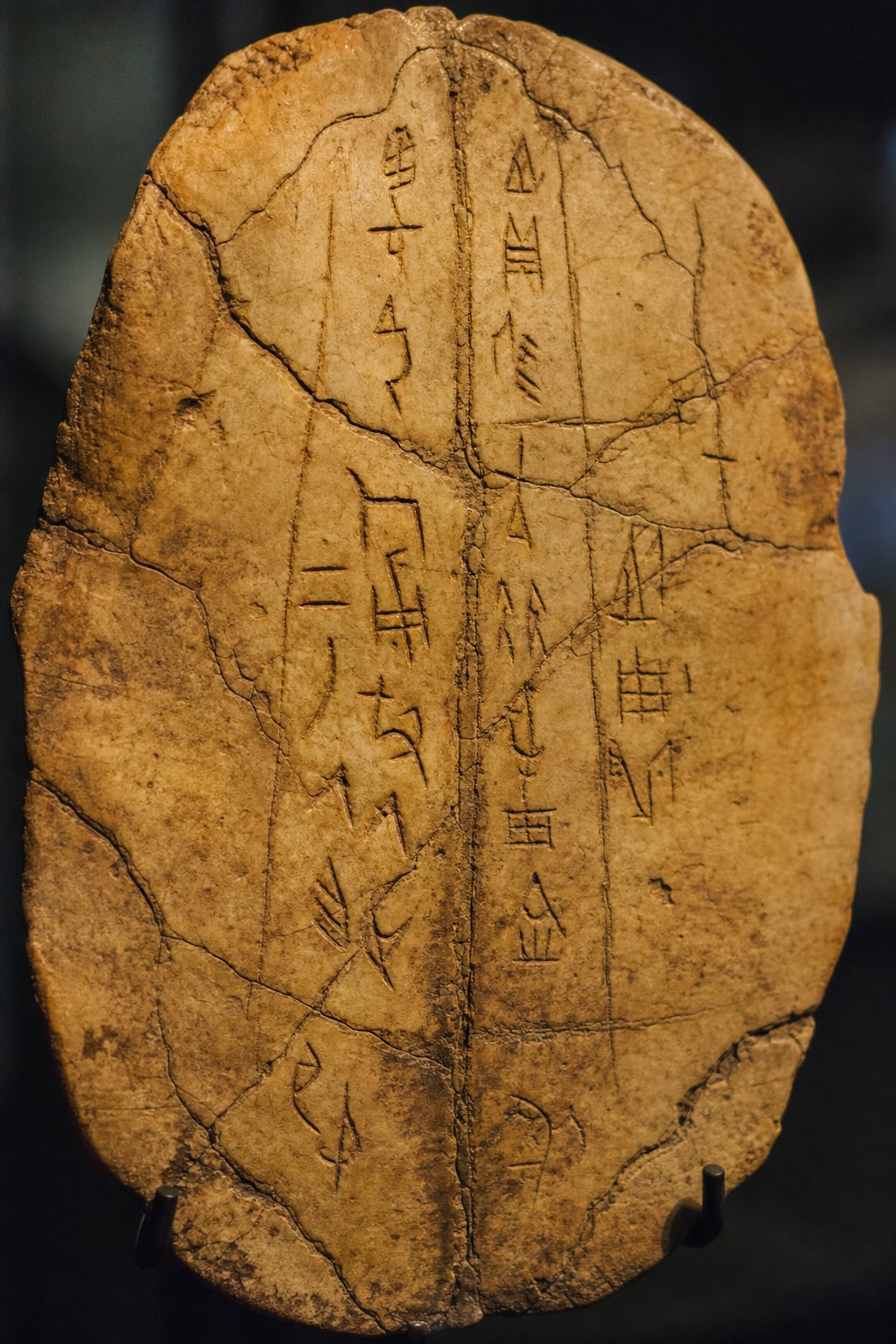
The earliest known form of 丁 appears on oracle bone inscriptions dating to roughly 1250-1000 BCE. In these ancient scripts, scholars have identified two distinct pictographic origins: one depicting the walls of a city (later written as the separate character 圍) and another depicting a nail. The nail form is what survived into the modern character.
The evolution moved through several stages. Bronze script from the early Western Zhou period (around 1000 BCE) shows a recognizable nail shape. By the time of the Seal script recorded in the Shuowen dictionary around 100 AD, the form had simplified further. The Clerical script of the Eastern Han dynasty (25-220 AD) brought it close to the modern shape you see today. The classical dictionary Shuowen Jiezi offers its own interpretation, stating that 丁 represents the moment in summer when all things become solid and full, connecting the character to ideas of maturity and completeness.
This association with fullness and maturity reinforced the "adult male" meaning. A man who had reached his prime was 丁, robust and capable. In the naming conventions of the Shang royal house, stems like 丁 appeared in posthumous temple names. The name ming (given name) of a deceased king would incorporate a Heavenly Stem to mark which day of the ten-day week his ritual sacrifices would be performed. The fourth stem, 丁, carried connotations of vigor and striking force.
The xi meaning of "evening" or "setting" in Chinese (夕) provides an interesting contrast. Where 夕 suggests endings and twilight, 丁 in its cosmological role suggests active energy and midpoint vitality. This symbolic richness made it an attractive surname choice for families who wanted their lineage name to carry connotations of strength and endurance rather than mere administrative convenience.
All four meanings coexisted for centuries, and different families latched onto different associations when they formalized their surnames. A metalworker's descendants might trace their name to the nail. A conscript's family might trace it to the census rolls. A noble clan might trace it to the Heavenly Stems and their ritual calendar. The character remained the same. The stories behind it multiplied.
These multiple adoption paths explain why the Ding surname appears across so many distinct lineages in Chinese genealogical records, each claiming a different founding ancestor and a different historical moment of origin. The dynasties that produced those founding moments are where the story turns next.
Chinese Origin Paths Through the Dynasties
Each founding moment left a paper trail. Chinese genealogical records, particularly the zupu (族谱) clan books compiled over centuries, trace the Ding surname back to specific ancestors whose posthumous names became permanent family identifiers. These weren't random choices. In ancient China, a posthumous name honored a ruler's character or achievements, and descendants who carried that name forward were making a deliberate claim about their lineage.
The chronological sequence of documented origin paths looks like this:
- Shang-to-Zhou transition (c. 1046 BCE) - Descendants of the Jiang (姜) clan adopt Ding from the posthumous name of Qi's second ruler, Ding Gong (丁公).
- Early Zhou Dynasty (c. 1000 BCE) - Descendants of Duke Ding of Song (宋丁公), from the Zi (子) surname lineage of the former Shang royal house, adopt Ding independently.
- Mid-Zhou period (c. 800-500 BCE) - Branches of the Ji (姬) surname, the Zhou royal clan itself, produce additional Ding lineages through various enfeoffed nobles bearing the posthumous title.
- Han and Tang Dynasties (206 BCE - 907 CE) - Administrative and cultural shifts bring new adoption waves, including families from non-Han backgrounds who take the surname through official registration.
The Jiang Clan and Shang Dynasty Roots
The most widely cited origin connects to Jiang Ziya (姜子牙), the legendary strategist who helped King Wu of Zhou overthrow the Shang dynasty around 1046 BCE. As a reward, Jiang Ziya received the fief of Qi in what is now Shandong province. His son, Lü Ji (吕伋), succeeded him and ruled as the second Duke of Qi. After his death, Lü Ji received the posthumous name Ding Gong, meaning "Duke Ding." His descendants adopted Ding as their surname, drawing directly from that honorific title.
This makes the Jiang-to-Ding lineage one of the oldest documented surname transitions in Chinese history. The Qi state itself became a major power during the Spring and Autumn period, and families bearing the Ding name from this line spread across northern China as the state's influence grew. Genealogical texts like the Yuanhe Xingzuan (元和姓纂), compiled during the Tang dynasty, confirm this as the primary origin path.
Zhou Dynasty Branches and the Qi State Connection
A parallel origin emerged from the Song state. When the Zhou dynasty conquered the Shang, the victors established Song as a vassal state for Shang royal descendants, allowing them to maintain ancestral rites. Duke Ding of Song, sometimes romanized in older texts as Soong (soong chinese sources use this spelling), received his posthumous name through the same honorific system. His descendants formed a second, independent Ding lineage with roots in the Shang royal house rather than the Jiang clan.
The Ji (姬) surname branches are less precisely documented but appear in later genealogical compilations. Several minor nobles of the Zhou royal house received "Ding" as a posthumous designation, and their descendants in states like Cheng and Qiu adopted it over subsequent generations. The character yong (永), meaning "eternal," appears in some clan records as a generational marker within these Ji-descended Ding families, distinguishing them from the Jiang-descended lines.
Later Adoptions During the Han and Tang Periods
By the Han dynasty (206 BCE - 220 CE), the Ding surname had already diversified beyond its aristocratic origins. Census records from this period show Ding families across multiple provinces with no documented connection to either the Qi or Song ducal lines. Some scholars attribute this spread to the "adult male" meaning of 丁 discussed earlier, where families registered under the character in government rolls eventually formalized it as a hereditary surname.
The Tang dynasty (618-907 CE) brought another wave. As the empire expanded and absorbed frontier peoples, families from Turkic, Xianbei, and other backgrounds adopted Chinese surnames for administrative purposes. The Yuwen clan and other northern lineages sometimes chose single-character surnames like Ding during this period of cultural integration. The chung of ritual bells echoing through Tang court ceremonies marked an era when surname adoption became tied to political loyalty as much as blood descent.
These layered origins explain a puzzle that genealogists encounter repeatedly: two Ding families from the same province may share absolutely no common ancestor within recorded history. Their surname converged on the same character through entirely different historical mechanisms, separated by centuries and social class. The cosmological dimension of 丁, rooted in the Heavenly Stems system, adds yet another layer to this already complex picture.
The Heavenly Stems Connection and Cosmological Significance
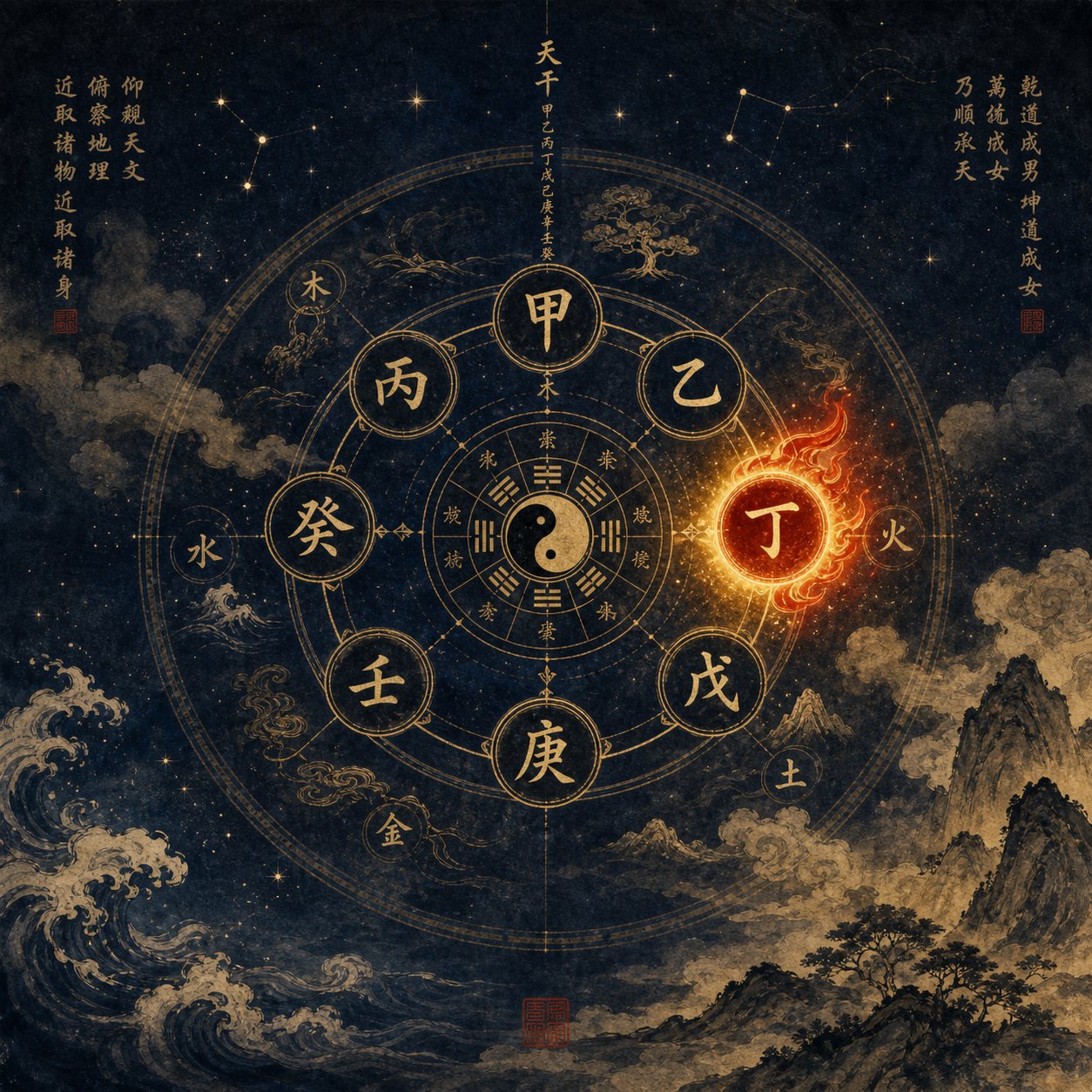
The cosmological dimension of 丁 runs deeper than a simple calendar position. In the Heavenly Stems system, each of the ten stems carries elemental associations, directional alignments, and symbolic qualities that shaped how ancient Chinese families understood identity itself. For the Ding surname, this meant inheriting a name charged with fire energy, southern orientation, and connotations of striking vitality.
The Heavenly Stems System Explained
Picture a ten-unit cycle that the Shang dynasty used to organize time, ritual, and cosmic order. The Heavenly Stems (天干) are ten characters, each paired with one of the five elements in alternating yin and yang polarities. They are: 甲 (jiǎ), 乙 (yǐ), 丙 (bǐng), 丁 (dīng), 戊 (wù), 己 (jǐ), 庚 (gēng), 辛 (xīn), 壬 (rén), and 癸 (guǐ). Combined with the twelve Earthly Branches (地支, or di zhi), they form the sexagenary cycle, a sixty-unit system that has tracked years, months, days, and hours in Chinese culture for over three thousand years.
丁 occupies the fourth position. Its elemental assignment is yin fire, the gentler, more internalized form of the fire element compared to its yang counterpart 丙. In directional cosmology, it aligns with the south. In seasonal terms, it corresponds to the height of summer's energy turning inward. The character sheng (生), meaning birth or growth, appears frequently in classical texts describing the generative power associated with this stem position. Where 丙 represents a blazing furnace, 丁 represents a candle flame or a forge fire: controlled, purposeful, and enduring.
How Cosmological Symbols Became Family Names
Shang dynasty kings provide the clearest evidence of stems becoming identity markers. Royal temple names like Wu Ding (武丁) incorporated the stem of the day on which ancestral sacrifices were performed. The practice of zhen (贞), meaning divination through oracle bones, determined these ritual assignments. A king whose sacrificial day fell on a 丁 day carried that stem into his posthumous identity permanently. His descendants, honoring that cosmological link, could adopt the stem as a surname.
In Chinese cosmology, 丁 carried the symbolic weight of controlled fire, southern vigor, and purposeful energy, making it far more than a calendar marker for the families who chose it as their lineage name.
This pattern extended beyond royalty. Families whose founding ancestor was born on a 丁 day, or whose clan rituals centered on that stem in the ten-day week, sometimes formalized the connection into a hereditary name. The practice parallels how other stems entered the surname system. The character jián (甲), the first stem, also became a surname through similar cosmological adoption, though far less commonly than 丁.
What made 丁 particularly attractive as a hao (号), or formal designation, was its symbolic richness. A family claiming 丁 wasn't just claiming a calendar slot. They were claiming fire's transformative power, the south's warmth, and the quiet intensity of yin energy at its peak. These associations gave the Ding surname a layer of meaning that purely administrative or occupational origins could never match. Yet the cosmological path represents only one thread within China's borders. Beyond the Han Chinese naming system entirely, a separate adoption story unfolded as Muslim communities arrived along the Silk Road and faced the question of how to translate their identities into a single Chinese character.

Arabic and Muslim Origins Through Sinicization
That question of translation, of compressing a multi-syllable Arabic or Persian name into a single Chinese character, shaped an entirely separate branch of the ding surname origin. When Muslim merchants, scholars, and soldiers settled in China during the Yuan (1271-1368) and Ming (1368-1644) dynasties, they faced a practical problem. Chinese bureaucratic systems required surnames that fit the one-or-two-character format. Names like Shams al-Din, Nasir al-Din, or Jamal al-Din needed to become something a local registrar could write in a single brushstroke.
The solution was elegant. The Arabic suffix "-din" (الدين), meaning "faith" or "religion" in names like Nur al-Din ("light of faith"), sounded remarkably close to the Chinese character 丁 (ding). Families carrying these compound Arabic names simply adopted 丁 as their Chinese surname, preserving a phonetic echo of their original identity while conforming to Han naming conventions. This wasn't random. It was a deliberate act of cultural negotiation, keeping one foot in each world.
Muslim Communities and the Adoption of Chinese Surnames
The historical context stretches back further than most people realize. Arab and Persian traders had been reaching Chinese ports since the Tang dynasty (618-907 CE), establishing communities in Guangzhou, Quanzhou, and other coastal cities. But the major wave of Muslim settlement came under Mongol rule during the Yuan dynasty, when Central Asian administrators, soldiers, and craftsmen were deployed across China in large numbers. These communities, known collectively as Semu people (色目人), occupied a privileged social tier under Mongol governance.
When the Ming dynasty replaced Mongol rule, the political landscape shifted dramatically. The new Han Chinese government encouraged, and sometimes mandated, cultural assimilation. Muslim families who had maintained Arabic or Persian names for generations now adopted Chinese surnames to navigate the new social order. The character 丁 became one of the most popular choices precisely because of that phonetic link to "-din." A family named Kamal al-Din might become the Ding family of their village within a single generation.
This pattern mirrors what happened across Southeast Asia and East Asia more broadly. Just as Vietnamese surnames like Huynh and Hoang reflect centuries of Chinese cultural influence on naming systems, and just as Cong Vietnamese families trace naming conventions to administrative integration, China's Muslim communities adapted their identities to fit the dominant system while preserving subtle markers of origin. The process wasn't unique to the Ding surname either. Muslim families also adopted Ma (马, from Muhammad), Bai (白, from various Arabic names), and Ha (哈, from Hassan), creating a recognizable cluster of "Muslim-origin" Chinese surnames.
Ethnic Minorities and the Ding Name Through Sinicization
Muslim communities weren't the only non-Han group to adopt the Ding surname. Across different centuries and political contexts, several ethnic minorities incorporated 丁 into their family naming systems:
- Hui (回族) - The largest group of Muslim-origin Ding bearers. Hui families descending from Arab, Persian, and Central Asian settlers adopted 丁 primarily through the phonetic "-din" connection. Concentrated in Ningxia, Gansu, Yunnan, and Shandong provinces, Hui Ding families often maintain awareness of their Islamic heritage alongside their Chinese surname.
- Manchu (满族) - During the Qing dynasty (1644-1912), Manchu bannermen with multi-syllable clan names were encouraged to adopt single-character Chinese surnames after the dynasty's fall. Some Manchu clans whose names contained a syllable approximating "ding" chose 丁 as their simplified surname during this transition.
- Mongol (蒙古族) - Mongol families who remained in China after the Yuan dynasty's collapse sometimes adopted Chinese surnames for administrative convenience. Those with names phonetically close to "ding" or those who had served in roles associated with the character's meanings occasionally chose 丁.
- Miao (苗族) and other southern minorities - In China's southern provinces, government-led registration campaigns during the Ming and Qing periods assigned Chinese surnames to communities that had previously used patronymic or clan-based naming systems. Some of these families received or chose 丁 during this process.
- Western Asian descendants (西域后裔) - Families tracing ancestry to Silk Road merchants from Bukhara, Samarkand, and other Central Asian cities who settled permanently in China. Their adoption of 丁 often combined phonetic convenience with the character's connotation of "adult male" or "population unit," reinforcing their status as registered members of Chinese society.
The parallel to surname adoption patterns elsewhere in Asia is striking. Thai surnames, for instance, were only mandated by law in 1913, forcing families to create or adopt hereditary names where none had existed before. Thai last names today often reflect that relatively recent moment of formalization, much like how China's minority Ding families trace their surname to a specific political moment of required registration rather than ancient lineage. Similarly, Vietnamese families bearing names like Luu adopted Chinese-influenced surnames through centuries of administrative overlap, a process structurally identical to what happened with China's Muslim and minority communities.
What distinguishes the Muslim-origin Ding families is the intentionality of their choice. Unlike minorities who were assigned surnames by officials, many Hui families actively selected 丁 because it preserved a phonetic thread connecting them to their ancestral faith. The character became a quiet marker of identity, invisible to outsiders but meaningful within the community. A Ding family in Ningxia and a Ding family in Shandong might share the same surname while descending from completely different civilizations, one tracing back to Duke Ding of Qi and the other to a 13th-century merchant from Baghdad.
This convergence of unrelated lineages under a single character is what makes Chinese surname research so complex and so rewarding. But the complexity doesn't end at China's borders. Thousands of miles to the west, in medieval Scandinavia and the Germanic-speaking lands of northern Europe, an entirely separate Ding surname was taking shape from roots that had nothing to do with Chinese characters, Muslim merchants, or Heavenly Stems.
Western Origins in Old Norse and Germanic Traditions
Those Scandinavian and Germanic roots developed in complete isolation from anything happening in China. No cultural exchange, no shared linguistic ancestor, no trade-route borrowing. The Western Ding surname grew from its own soil, shaped by Old Norse vocabulary and medieval European naming customs that happened to produce an identical spelling through pure coincidence.
Old Norse Occupational Roots
The primary Western etymology traces to the Old Norse word dengja, which meant to hammer or beat. In Old Swedish it appeared as dangia, and in Old Danish as daenge. According to surname origin research documented by SurnameDB, this likely functioned as an occupational name for a smith, a metal-beater, or someone who assisted in forge work. Picture a medieval village where your trade defined your identity. A man known for hammering metal all day became "Ding" the same way an English baker became "Baker."
This occupational logic mirrors how many Norse-derived surnames formed across Scandinavia and the British Isles. Just as the borg meaning of "fortress" or "castle" produced surnames for people living near strongholds, and just as guthrie meaning "windy place" identified families by landscape, the hammering sound or action of dengja identified a craftsman by his daily work. The name carried the rhythm of the forge in its single syllable.
Germanic Given-Name Derivation and Early Records
A second interpretation places the surname as a variant of "Deng," itself derived from "Thon," an aphetic form of the given name Anthony. This path is documented in Switzerland and Germany, where the name also appears as "Ting." The logic here is straightforward: Anthony shortened to Thony, then to Thon, then eroded further into Deng or Ding through regional pronunciation shifts. Similar phonetic compression shaped countless European surnames, much like how understanding the downing meaning reveals a patronymic origin from "Dunn" through the same kind of gradual sound change.
Early parish records anchor these origins in specific dates and places. The first recorded spelling appears as Patrick Dyng, dated September 14, 1586, in a marriage record at St. Mary Somerset, London. In Germany, Moritz, son of Jacob and Burg Ding, was christened on May 5, 1558, at Neckarkreis, Feuerbach, Wuerttemberg. Later records show Lancelot and Ursula, children of Johis Dinge, christened at the Church of St. Luke, Chelsea, London in 1597 and 1598. A 1622 marriage record from Birkenfeld, Oldenburg documents Catharina Dinges, and a 1729 christening at Aach, Rheinland records Johannes Jacobus Ting.
These records reveal something important: the Western Ding surname existed in multiple spelling variants simultaneously. Dyng, Dinge, Dinges, and Ting all appear in the same centuries across England and German-speaking regions. This kind of orthographic fluidity is typical of pre-standardized European naming, where a single family might be recorded differently by each new parish clerk. Researchers tracing surnames like seaver meaning "dweller by the lake" or graf meaning "count" or "steward" encounter the same challenge of variant spellings across medieval documents.
The contrast with the Chinese Ding surname could not be sharper. Here is how the two traditions compare side by side:
| Feature | Chinese Ding (丁) | Western Ding |
|---|---|---|
| Origin Region | Northern China (Shandong, Henan) | Scandinavia, England, Germany, Switzerland |
| Etymology | Multiple: nail, adult male, Heavenly Stem, phonetic adoption from Arabic "-din" | Old Norse dengja (to hammer) or aphetic form of Anthony |
| Earliest Records | Oracle bone inscriptions, c. 1250 BCE; genealogical texts from Zhou dynasty | Parish christening records, 1558 CE (Germany); marriage records, 1586 CE (England) |
| Core Meaning | Cosmological, demographic, or phonetic identity marker | Occupational (metalworker) or patronymic (from a given name) |
| Writing System | Single Chinese character with fixed form for 3,000+ years | Latin alphabet with multiple spelling variants (Dyng, Dinge, Ting) |
The reich meaning of "kingdom" or "realm" in Germanic naming traditions reminds us that European surnames often encoded social structure, geography, or occupation into a single word. The Western Ding surname fits squarely within that tradition, whether it pointed to a forge worker's hammering or a family's descent from a man named Anthony. Much like how linklater meaning "heather slope" placed a family in a specific Scottish landscape, these names were practical identifiers first and inherited surnames second.
What unites both the Chinese and Western Ding surnames is not etymology but timing. Surnames became hereditary in both cultures during periods when governments needed to track populations for taxation and conscription. In England, the Poll Tax drove surname formalization. In China, imperial census systems accomplished the same goal centuries earlier. The identical spelling is an accident of romanization meeting Old Norse phonetics, nothing more. Yet for modern bearers of the name, that accident creates a fascinating genealogical puzzle: which Ding are you?
The answer often depends on geography, and geography is exactly what shifted as Chinese Ding families began migrating far beyond their ancestral provinces.
Global Distribution and Dialect Variations of the Ding Name
Geography didn't just determine which origin story a Ding family carried. It also determined how the name sounded, how it was spelled in Latin letters, and whether anyone outside the community recognized it as the same surname at all. As Chinese Ding families moved beyond their ancestral provinces in Shandong, Jiangsu, and Hubei, the single character 丁 fractured into a constellation of romanized spellings, each tied to a specific dialect and a specific migration route.
Migration Waves and Global Spread
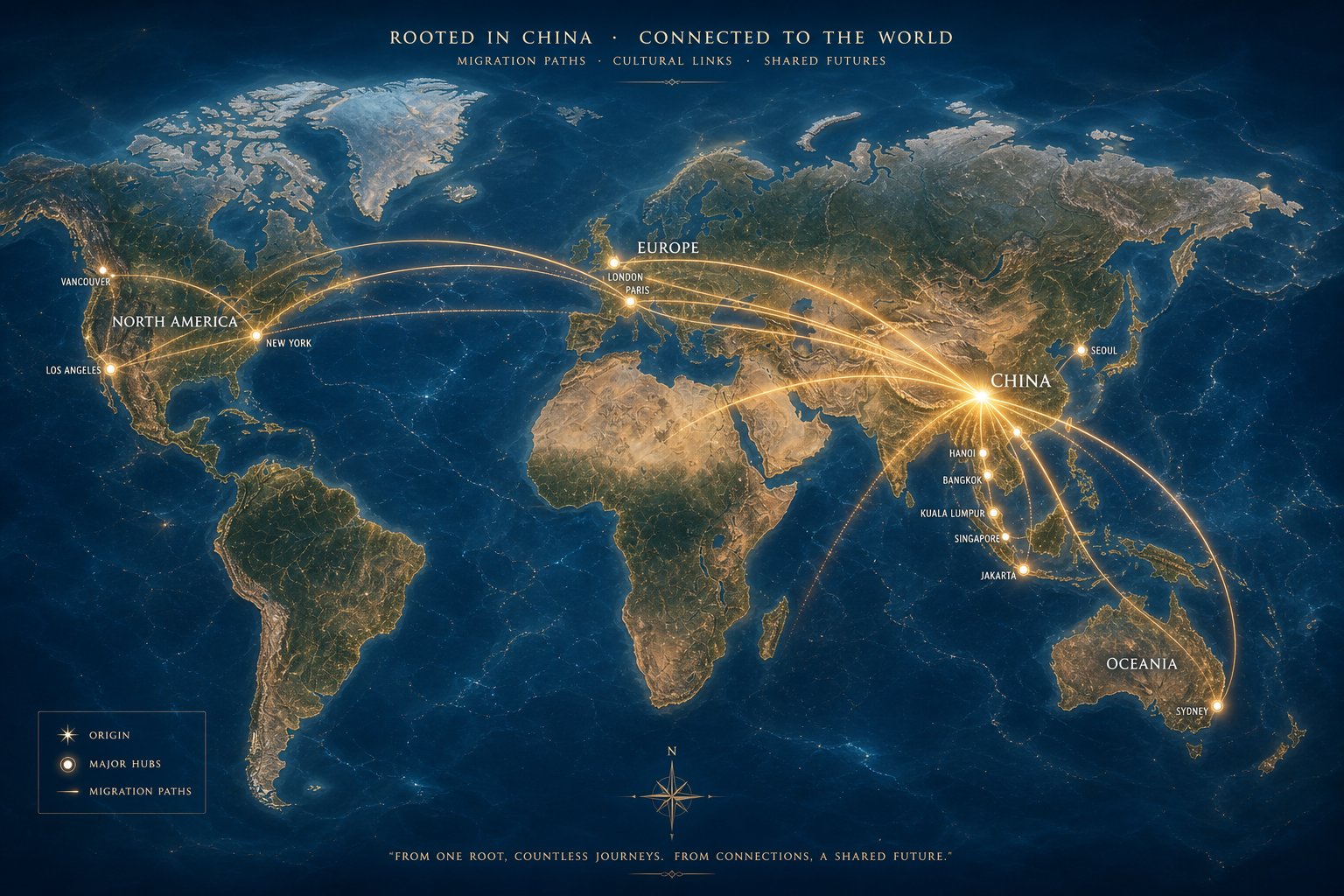
The Ding last name traveled outward from China in three major waves, each driven by different forces and landing in different regions.
The first wave began during the late Qing dynasty (mid-1800s to 1912), when economic hardship and political instability pushed millions of southern Chinese overseas. Hokkien and Cantonese speakers from Fujian and Guangdong provinces boarded ships for Southeast Asia, settling in what are now Singapore, Malaysia, Thailand, Indonesia, and the Philippines. These emigrants carried 丁 with them, but they pronounced it according to their home dialects rather than Mandarin. A Hokkien speaker arriving in Singapore registered as "Teng." A Cantonese speaker landing in Malaysia might appear in colonial records as "Ting." The character was identical. The paperwork looked completely different.
The second wave came with 20th-century political upheaval. The Chinese Civil War (1927-1949), the establishment of the People's Republic, and the Cultural Revolution (1966-1976) drove successive groups of educated professionals and political refugees toward Taiwan, Hong Kong, and eventually North America, Europe, and Oceania. These migrants often spoke Mandarin or had been educated in it, so their surname appeared in pinyin as "Ding" in immigration documents. Global surname data shows approximately 6.2 million bearers worldwide, with the United States recording over 7,400, Canada over 2,400, and Australia over 1,600.
The third wave, still ongoing, reflects modern professional mobility. Since China's economic opening in the 1980s, students, engineers, researchers, and entrepreneurs have dispersed globally. Unlike earlier migrants who clustered in ethnic enclaves, these families often integrate into broader professional communities where the Ding spelling in pinyin has become standard. The surname's growth in Western countries has been dramatic. In the United States alone, the Ding last name expanded over 12,000 percent between 1880 and 2014, and in England it grew over 500 percent between 1881 and 2014.
Southeast Asia remains the densest concentration outside mainland China. Singapore hosts over 8,100 bearers (roughly 1 in 677 residents), while Malaysia records nearly 8,000 and Thailand over 10,500. Taiwan, with its mix of Hokkien-speaking locals and post-1949 Mandarin-speaking arrivals, counts nearly 46,000 Ding surname holders. These numbers reflect layered migration histories where different dialect groups arrived in different decades, each bringing their own pronunciation of the same character.
Regional Pronunciations and Romanization Variations
Here's where things get complicated for genealogical research. Imagine two cousins, one who emigrated to Singapore from Fujian and another who moved to San Francisco from Beijing. Their surname character is identical: 丁. But one family's records say "Teng" and the other's say "Ding." Without knowing the dialect connection, a researcher might never link them.
The variations follow predictable phonological patterns tied to each Chinese dialect group:
| Dialect | Romanization | Primary Region | Approximate Speakers of Dialect |
|---|---|---|---|
| Mandarin (普通话) | Ding | Mainland China, Taiwan (post-1949 migrants), global diaspora | 900+ million |
| Cantonese (粤语) | Ting / Deng | Guangdong, Hong Kong, Macau, overseas Cantonese communities | 85+ million |
| Hokkien (闽南语) | Teng | Fujian, Taiwan, Singapore, Malaysia, Philippines | 50+ million |
| Teochew (潮州话) | Teng / Dêng | Eastern Guangdong, Thailand, Cambodia | 15+ million |
| Hakka (客家话) | Den / Tang | Eastern Guangdong (Meizhou), Taiwan, Indonesia, Suriname | 45+ million |
The Hakka dialect deserves particular attention. Hakka speakers are scattered across eastern and northern Guangdong, Fujian, Jiangxi, and several other provinces, plus an estimated 7 million emigrants in Thailand, Malaysia, and Indonesia. Their pronunciation of 丁 differs from both Cantonese and Hokkien, creating yet another romanization layer. A Hakka Ding family in Suriname (where over 45 bearers are recorded) might spell their name differently from a Hakka family in Indonesia, depending on which colonial administration first transcribed it.
This romanization fragmentation parallels what happened with other Chinese diaspora surnames. Families bearing names like Kwok, Chau, or Yeh in overseas communities are often carrying the same characters as mainland families who spell them Guo, Zhou, or Ye in pinyin. The spelling difference isn't a different name. It's a different microphone pointed at the same sound. Similarly, surnames like Vong in Cantonese communities, Tey among Hokkien speakers, or Seet in Teochew families all represent characters that would look completely different in Mandarin pinyin. The Ding surname simply happens to be short enough that its variations are fewer, but the principle is identical.
For anyone researching their family history, this means a critical first step: determine which dialect your ancestors spoke. A "Teng" in Singapore colonial records and a "Ding" in a modern American phone book may be the same family separated by one generation and one romanization system. The character 丁 hasn't changed in three thousand years. Only the ears listening to it have.
These dialect threads and migration paths eventually produced notable individuals whose achievements brought the Ding name into public recognition far beyond genealogical circles.
Notable Figures and Researching Your Ding Ancestry
Public recognition often follows individual achievement, and bearers of the last name Ding have left marks across scholarship, science, military leadership, and the arts. These figures span the full geographic and cultural range of the surname's origins, from ancient Chinese officialdom to modern international careers. Tracing which lineage tradition they belong to reveals how the multiple origin paths discussed throughout this article played out in real lives.
Historical Figures Who Shaped the Ding Legacy
The Ding surname appears in Chinese historical records as early as the Spring and Autumn period, and its bearers have occupied roles ranging from imperial advisors to revolutionary leaders. Here are notable figures organized by era and field:
- Ding Gong (丁公, c. 1000 BCE) - Second ruler of the Qi state and the founding ancestor of the primary Jiang-clan Ding lineage. His posthumous name became the surname itself.
- Ding Fei (丁妃, Han Dynasty) - Consort documented in Han court records, reflecting the surname's presence among elite families by the early imperial period.
- Ding Ruchang (丁汝昌, 1836-1895) - Commander of China's Beiyang Fleet during the First Sino-Japanese War. His family traced roots to Anhui province, within the traditional heartland of Jiang-descended Ding clans.
- Ding Ling (丁玲, 1904-1986) - Pen name of Jiang Bingzhi, one of modern China's most celebrated female authors. Her adoption of "Ding" as a literary name reflects the character's cultural resonance beyond strict genealogical inheritance.
- Ding Junhui (丁俊晖, b. 1987) - Professional snooker player from Jiangsu province who became the youngest Asian Games gold medalist in the sport. His family's roots in Jiangsu align with one of the surname's densest concentration areas.
- Ding Ning (丁宁, b. 1990) - Olympic table tennis champion and multiple-time World Champion, representing the surname on the global sporting stage.
- Ding Yanyuhang (丁彦雨航, b. 1993) - Professional basketball player who became one of the Chinese Basketball Association's top scorers, bringing the Ding name into international sports media.
These individuals reflect the surname's geographic spread from Shandong and Anhui to Jiangsu and Heilongjiang. They also demonstrate how the name moved from aristocratic lineage marker to a surname carried across all social strata. Much like how researchers studying the nguyen name origin discover that Vietnam's most common surname spread through royal decree and political consolidation rather than a single bloodline, the Ding surname's prevalence reflects multiple adoption mechanisms rather than descent from one ancestor.
Tracing Your Own Ding Family History
If you carry the last name Ding and want to trace your specific lineage, the path depends on which origin thread your family follows. For Chinese-origin Ding families, the most valuable resource is the zupu (族谱), or clan genealogy book. These handwritten volumes, compiled by local clans over centuries, can contain lineage records stretching back dozens of generations. According to Legacy Tree Genealogists, a zupu may include detailed ancestor names, biographies of prominent clan members, migration histories, clan rules, and generation poems that guided naming conventions across centuries.
Finding your family's zupu starts with identifying your ancestral village. Many village names have changed over the past century, so contacting local Chinese government offices may be necessary. Once confirmed, village leadership can verify whether a zupu still exists and whether your ancestor's name appears inside. If the village copy was lost during the Cultural Revolution, when many genealogical books were destroyed, alternatives exist. FamilySearch's Chinese genealogy collection hosts digitized clan books, and provincial libraries in Guangdong, Fujian, Shanghai, and Beijing maintain growing databases. Clan associations in Southeast Asian countries like Malaysia and Singapore also preserve zupus for overseas members.
For those researching the nguyen last name origin or the origin of nguyen last name alongside their Ding research, the methodological parallels are instructive. Both surnames require researchers to identify which specific adoption path their family followed, since multiple unrelated lineages converge under the same name. The nguyen origin story, like the Ding story, involves royal decree, political consolidation, and voluntary adoption across different historical periods. The research tools differ, but the genealogical logic is the same: start with what you know, identify the dialect and region, then work backward through available records.
For Western-origin Ding families, parish christening and marriage records from England, Germany, and Scandinavia provide the earliest documentation. Resources like county record offices, church archives, and digitized databases of pre-1900 European vital records are your starting points. The spelling variants (Dyng, Dinge, Dinges, Ting) mean casting a wide net across multiple orthographic forms.
Regardless of which branch you belong to, the ding surname origin story reminds us that a name is never just a label. It is a compressed history, carrying within its strokes or letters the echoes of forge hammers, imperial census rolls, cosmological calendars, or the quiet faith of a merchant far from home.
Frequently Asked Questions About the Ding Surname Origin
1. What does the Chinese character 丁 mean?
The character 丁 carries four core meanings in Chinese: a nail or spike (physical object), an adult male eligible for labor or military service, a population counting unit used in imperial census records (丁口), and the fourth position in the Heavenly Stems calendar system (天干). Each meaning contributed to different families adopting 丁 as a surname across various historical periods, from Shang dynasty royal naming conventions to Han dynasty administrative registration.
2. Is the Ding surname Chinese or European?
It is both, but from completely independent origins. The Chinese Ding surname (丁) dates back over 3,000 years to Zhou dynasty nobility and Shang dynasty cosmology. The Western Ding surname developed separately from Old Norse 'dengja' (meaning to hammer, an occupational name for metalworkers) and from a Germanic shortening of the given name Anthony. The identical spelling is a coincidence of romanization meeting Old Norse phonetics, with no shared etymological root between the two traditions.
3. Why do some Muslim families in China have the surname Ding?
During the Yuan and Ming dynasties, Arab and Persian Muslim settlers in China needed to adopt single-character Chinese surnames for bureaucratic registration. Many families whose Arabic names ended in '-din' (meaning 'faith,' as in Nur al-Din or Shams al-Din) chose the character 丁 because it sounded nearly identical to that suffix. This phonetic adoption allowed Hui Muslim families to conform to Han naming conventions while preserving an audible connection to their ancestral Islamic names.
4. How common is the Ding surname worldwide?
Global estimates place the Ding surname at approximately 6.2 million bearers worldwide. It ranks around 35th among the most common Chinese surnames, with the heaviest concentrations in Shandong, Jiangsu, and Hubei provinces. Outside China, significant populations exist in Taiwan (nearly 46,000), Singapore (over 8,100), Malaysia (nearly 8,000), Thailand (over 10,500), and the United States (over 7,400). The surname grew over 12,000 percent in the US between 1880 and 2014.
5. Why is the Ding surname spelled differently in different countries?
The spelling variations stem from dialect differences among Chinese emigrants. Mandarin speakers romanize 丁 as 'Ding,' Cantonese speakers write it as 'Ting' or 'Deng,' Hokkien speakers use 'Teng,' and Hakka speakers may write 'Den' or 'Tang.' When families emigrated to Southeast Asia or the West, colonial administrators transcribed the name based on how it sounded in the speaker's dialect. Two cousins from the same clan could end up with different surname spellings simply because one spoke Hokkien and the other Mandarin.