The Chinese Character for Sun and Its Core Meanings
Imagine a single character that can mean the blazing star in the sky, a calendar day, and the concept of "daily" all at once. That character is 日 (ri, fourth tone), and it sits at the heart of written Chinese.
What Does 日 Mean in Chinese
The sun Chinese character 日 carries three core meanings that branch into hundreds of everyday words:
日 (ri) means sun, day, and daily. One character, three meanings, and a gateway to understanding how Chinese builds vocabulary from simple visual roots.
As a standalone word, 日 can refer to the physical sun in literary or classical contexts. In modern compounds, it overwhelmingly signals time and routine: 生日 (shengri, birthday), 日期 (riqi, date), 日常 (richang, daily life). It also functions as Radical 72 in the Chinese dictionary system, appearing inside characters related to light, weather, and the passage of time, such as 明 (ming, bright), 晴 (qing, clear sky), and 早 (zao, early morning).
Because the chinese character for the sun doubles as a radical and a high-frequency word, you'll encounter it constantly in reading, calendars, and conversation.
Why 日 Is One of the First Characters Learners Master
There is a practical reason teachers introduce this sun in chinese character early. With only four strokes, 日 is simple to write. Its meaning is concrete and visual, easy to remember. And once you know it, you can start decoding dozens of compound characters on sight. Recognizing 日 inside an unfamiliar character immediately tells you the word likely relates to sunlight, time, or brightness.
This article walks through the full story of 日: its evolution from an ancient pictograph to its modern rectangular form, correct stroke order, lookalike characters that trip up beginners, the radical system it anchors, essential compounds and idioms, and the cultural mythology woven around the chinese character for sun across East Asia.
Four strokes. Three thousand years of history. Let's start at the beginning.

How 日 Evolved From an Ancient Pictograph to Its Modern Shape
Three thousand years ago, someone scratched a small circle with a dot inside it onto a piece of turtle shell. That mark represented the sun. Today, the same concept lives inside a neat rectangle with a horizontal line through its center: 日. The journey between those two shapes tells you a lot about how Chinese writing works and why the origin of the chinese sun character still echoes in its modern form.
Oracle Bone Script to Modern Form
The ancient chinese character for sun first appeared during the late Shang Dynasty (around the 14th to 11th century BC) as part of Oracle Bone Script, the earliest systematic form of Chinese writing. Diviners carved these characters onto tortoise shells and animal bones, and the sun looked exactly like what it was: a circle with a dot or short line in the center, mimicking the solar disc as seen in the sky.
Each subsequent script stage nudged that circle closer to the rectangle you write today. Here is the full timeline:
| Script Type | Approximate Period | Visual Description |
|---|---|---|
| Oracle Bone Script (甲骨文) | 14th-11th century BC | A circle (or slightly oval shape) with a dot or short horizontal line in the center, representing the sun disc |
| Bronze Inscriptions (金文) | 11th-3rd century BC | Rounder and thicker strokes; the circle is more uniform, the inner mark more clearly a horizontal line; overall more pictographic and decorative |
| Seal Script (篆书) | 3rd century BC (Qin unification) | The circle begins to square off into a rounded rectangle; strokes become smoother and more standardized; the inner line is centered |
| Clerical Script (隶书) | 221 BC - 220 AD | Fully rectangular; strokes are straight and angular; the character is wider and flatter with clear horizontal emphasis |
| Regular Script (楷书) | 220 AD - present | The modern form: a slightly tall rectangle with a horizontal stroke through the middle; four clean strokes; proportions are standardized |
Notice the pattern. The original round shape gradually squared off as writing tools changed. Oracle bones required sharp, angular scratches on hard surfaces, so curves were rough. Bronze inscriptions allowed rounder, cast forms. When brush and ink on bamboo strips became standard around the 5th century BC, speed and efficiency pushed characters toward straighter lines. The Qin Dynasty's standardization of writing in 221 BC cemented the shift from curves to angles, and clerical script completed the transformation into the rectangular shape we recognize today.
One detail learners appreciate: the sun traditional chinese character and the simplified version are identical. Unlike many characters that differ between the two systems, 日 has remained unchanged. Whether you are reading a text from Taiwan, Hong Kong, or mainland China, the character looks the same.
Is 日 a Pictograph or an Ideograph
Chinese linguists classify characters into six categories (六书, liushu), and 日 falls squarely into the pictograph group (象形字, xiangxingzi). A pictograph directly depicts the physical object it represents. The original circle-with-a-dot was a literal drawing of the sun, not an abstract symbol for a concept.
So is the chinese character for sun an ideograph? Strictly speaking, no. An ideograph (指事字, zhishizi) uses abstract indicators to suggest a meaning that cannot be drawn directly, like 上 (up) or 下 (down), which use a line and a mark to show relative position. The sun, by contrast, is a visible, drawable object, and the earliest scribes drew it. The dot inside the circle may have indicated the sun's brightness or solidity, but the character as a whole remains a picture of a thing rather than a symbol for an idea.
That said, 日 does carry abstract meanings (day, daily) in addition to its concrete one (the physical sun). These extended meanings developed over centuries of use, not from the character's visual design. The shape still points back to a picture of the sun. Etymology and function are two different layers, and keeping them separate helps you understand how Chinese characters actually work.
This visual DNA is exactly what makes 日 so useful as a building block. When it appears inside other characters, it carries a whisper of its original meaning: light, warmth, time. Recognizing that whisper is the key to reading characters you have never studied before.
How to Write the Chinese Character for Sun Step by Step
Knowing the history behind 日 is one thing. Putting brush or pen to paper and producing it correctly is another. The good news: with only four strokes, this is one of the simplest characters you will ever learn. The challenge is getting the proportions and closure right so it looks like 日 and not something else entirely.
The chinese character sun pinyin is ri, pronounced in the fourth (falling) tone. You start high and drop sharply, like saying a firm "no." In Mandarin, this tone gives the syllable a decisive, downward energy.
Stroke Order and Correct Proportions
When learning how to write the chinese character for sun, stroke order matters more than you might expect. Consistent stroke order builds muscle memory, improves speed, and helps other readers recognize your handwriting. Here is the mandarin stroke order for the chinese character for sun, broken into its four strokes:
- Left vertical stroke (竖) - Start at the top-left corner and draw straight down to the bottom-left corner. This forms the entire left side of the rectangle.
- Top horizontal and right vertical (横折) - Begin at the top-left corner (connecting to stroke one), draw horizontally to the right, then turn the corner and continue straight down to the bottom-right. This single continuous stroke creates the top and right side of the box.
- Inner horizontal stroke (横) - Draw a short horizontal line from left to right inside the rectangle, roughly at the midpoint. This divides the interior into two equal sections, echoing the ancient dot that once represented the sun's core.
- Bottom horizontal stroke (横) - Close the rectangle by drawing a horizontal line from left to right along the bottom, connecting the two vertical sides.
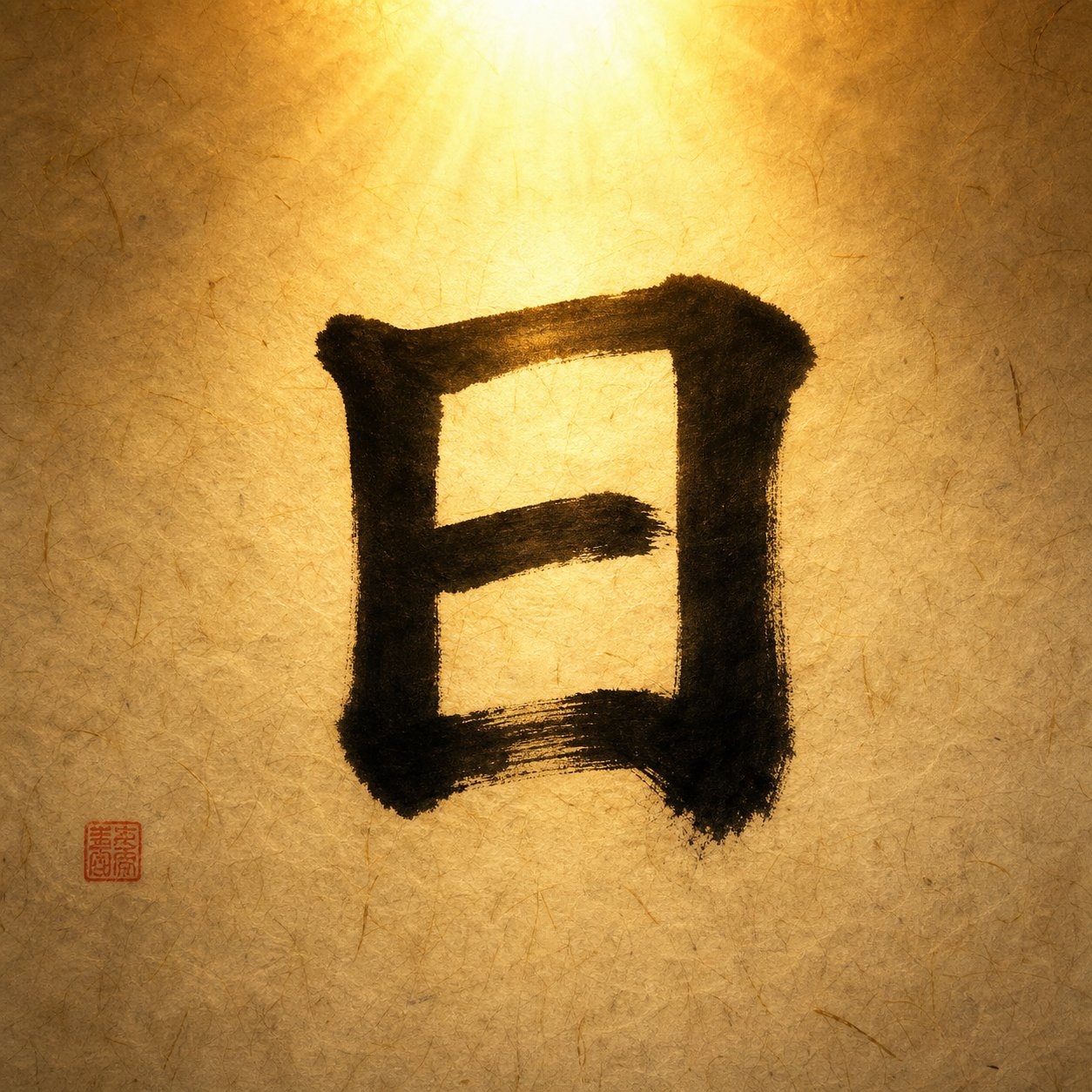
A key proportion to remember: 日 should be slightly taller than it is wide. Imagine a rectangle with a height-to-width ratio of roughly 4:3. This vertical emphasis is what separates it visually from lookalike characters. If you are exploring sun chinese character calligraphy, you will notice that even in artistic brush styles, this taller-than-wide proportion remains consistent across centuries of practice.
Common Writing Mistakes and How to Avoid Them
Four strokes sounds simple, but beginners run into a few recurring problems:
Making it too square. When you draw 日 as a perfect square, it starts to resemble 曰 (yue, "to say"), which is intentionally short and wide. Always keep 日 noticeably taller than it is wide. A helpful mental image: think of 日 as a tall window, not a TV screen.
Leaving gaps at the corners. The bottom horizontal stroke should meet both vertical sides cleanly. Gaps make the character look unfinished and can confuse it with poorly written variants. In sun chinese character calligraphy traditions, closed corners signal precision and control.
Confusing 日 with 曰. This is the most common mix-up. Both characters have four strokes and a horizontal line through the middle. The difference is entirely in proportion: 日 is tall and narrow, while 曰 is flat and wide. If your character looks like it could hold a landscape painting inside, it is probably 曰. If it looks like a portrait frame, you have 日.
Placing the inner horizontal stroke too high or too low. The middle line should sit at the visual center of the rectangle. Pushing it upward makes the character look top-heavy; pulling it down creates an unbalanced feel.
A simple mnemonic for the stroke order: think "frame first, fill second." You build the outer structure (left side, top-and-right side, bottom) and tuck the interior line in before sealing the box. Some learners remember it as "walls, then window pane, then floor."
Once you can write 日 confidently and consistently, you have a foundation that transfers directly to dozens of compound characters. Every time 日 appears as a component inside a larger character, it follows these same proportions and stroke rules, just scaled down. The real test comes when you encounter characters that look almost identical to 日 at a glance but carry completely different meanings.
Characters That Look Like 日 and How to Tell Them Apart
You have the proportions down and the stroke order memorized. Then you open a textbook and see 目, 白, and 曰 sitting on the same page. Suddenly, the chinese sun character does not look so unique anymore. These four characters share a rectangular body and interior horizontal lines, which makes them some of the most easily confused characters in the entire writing system.
The good news? Each one has a clear visual signature once you know what to look for.
日 vs 目 vs 白 vs 曰 at a Glance
The differences between these four characters come down to proportion, stroke count, and one or two distinguishing structural details. Here is a side-by-side breakdown:
| Character | Pinyin | Meaning | Stroke Count | Distinguishing Visual Feature |
|---|---|---|---|---|
| 日 | ri (4th tone) | Sun / day / daily | 4 | Tall and narrow rectangle with one inner horizontal line dividing it into two equal sections |
| 目 | mu (4th tone) | Eye | 5 | Tall and narrow like 日, but has two inner horizontal lines creating three sections (like the segments of an eye) |
| 白 | bai (2nd tone) | White | 5 | Similar rectangular body, but a short stroke (撇, pie) extends above the top-left corner, like a small hat or accent mark |
| 曰 | yue (1st tone) | To say / to speak | 4 | Short and wide rectangle, noticeably flatter than 日, like a wide-open mouth speaking |
When you look at the sun character chinese learners write in practice, the most frequent error is producing something that accidentally matches one of these three lookalikes. The fix is always the same: check the proportions first, then count the interior lines.
Mnemonic Tips for Telling Them Apart
Visual mnemonics work better than rote memorization for characters this similar. Here are practical ways to lock each one into memory:
日 (sun/day): Think of a tall window with one crossbar. The sun shines through a single pane. One interior line, tall frame. That is your sun.
目 (eye): Picture an eye turned sideways. The two inner horizontal lines represent the pupil and iris dividing the eye into three layers. If you see three sections stacked vertically inside a tall rectangle, you are looking at "eye," not "sun." An easy check: 目 has one more stroke than 日.
白 (white): The little stroke poking above the rectangle is the key. Imagine a candle with a small flame on top, glowing white. That extra mark above the box is what separates 白 from the chinese characters for sun. No other character in this group has anything extending beyond the main rectangle.
曰 (to say): This is the trickiest pair because 曰 and 日 share the same stroke count. The only difference is shape. Think of 曰 as a wide-open mouth, stretched horizontally because it is speaking. If your rectangle looks wider than it is tall, you have written "to say" instead of "sun." A quick rule: 日 is a portrait frame, 曰 is a landscape frame.
One more practical tip: context almost always resolves ambiguity in reading. You will rarely encounter 曰 in modern texts outside of classical Chinese quotations, while 日 appears constantly in dates, weather, and time expressions. But in handwriting and character recognition drills, these proportion differences are what keep your answers accurate.
Mastering these distinctions does more than prevent mix-ups. It trains your eye to notice the subtle structural cues that Chinese characters use to encode meaning. That same skill becomes essential when 日 stops standing alone and starts functioning as a component inside larger, more complex characters.
The Sun Radical and How 日 Builds Other Characters
A single character sitting on a flashcard is useful. A character that unlocks the meaning of dozens of others is powerful. That is exactly what 日 becomes when it steps into its role as Radical 72 (日部) in the Chinese dictionary indexing system. Every chinese character with sun radical carries a trace of the original meaning: sunlight, warmth, time, or brightness. Learning to spot that trace turns unfamiliar characters into puzzles you can partially solve on sight.
How 日 Works as Radical 72
Chinese dictionaries organize characters by radicals, which are recurring structural components that serve as indexing keys. The Kangxi Dictionary, the traditional standard, lists 214 radicals total. 日 is number 72, and it indexes 453 characters in that dictionary alone. In simplified Chinese dictionaries used in mainland China, 日 serves as the 75th indexing component with the associated forms 曰 and ⺜ grouped alongside it.
When 日 appears inside a compound character, it almost always contributes a semantic clue. That clue typically falls into one of three categories:
- Light and brightness - characters related to sunshine, radiance, or visibility
- Time and duration - characters marking periods of the day, seasons, or temporal concepts
- Weather and warmth - characters describing atmospheric conditions tied to the sun
This is what makes chinese characters with sun radical so learner-friendly. You do not need to memorize each one from scratch. The radical hands you a starting point: if you see 日 tucked inside an unfamiliar character, you can reasonably guess the word relates to time, light, or weather. That guess will be correct more often than not.
Recognizing the Sun Radical in Unfamiliar Characters
Here is where things get practical. The 日 radical does not always sit in the same spot. It shifts position depending on the character's structure, and knowing where to look helps you identify it faster. Below are common examples grouped by the position of the sun radical:
- Left side (日字旁, rizipang)
- 明 (ming, bright) - the sun and moon chinese character, combining 日 on the left with 月 (moon) on the right. Sun plus moon equals brightness. This is one of the most elegant examples of how radicals build meaning visually.
- 时/時 (shi, time) - 日 on the left signals a time-related concept. The right component 寺 (si, temple) provides the phonetic hint.
- 晴 (qing, clear weather) - 日 on the left tells you this involves sunlight. The right side 青 (qing, blue/green) gives both the pronunciation and a color association with clear skies.
- 暖 (nuan, warm) - 日 on the left connects warmth directly to the sun's heat. The right component provides the sound.
- 晚 (wan, evening/late) - even the fading of daylight gets marked with the sun radical, because evening is defined in relation to the sun's position.
- Top position (日字头, rizitou)
- 早 (zao, early/morning) - 日 sits on top of 十 (ten). Think of the sun rising above the horizon at the start of the day.
- 昌 (chang, prosperous/flourishing) - two 日 stacked, suggesting abundant sunlight and thriving energy.
- 星 (xing, star) - 日 on top with 生 (sheng, life/birth) below. Celestial bodies share the sun's radical family.
- Bottom position
- 暮 (mu, dusk/twilight) - the sun sinks to the bottom of the character, visually echoing its descent below the horizon at day's end.
- 智 (zhi, wisdom/intelligence) - 日 at the bottom, connecting knowledge to clarity and illumination.
Notice the pattern in the sun and moon in chinese character pairings like 明. When 日 (sun) and 月 (moon) combine, the result points to maximum visibility: brightness. This logic extends throughout the radical system. The sun radical does not just label a character; it actively shapes its meaning.
A practical decoding exercise: the next time you encounter an unfamiliar character containing 日, ask yourself three questions. Is the meaning related to time? To light or visibility? To weather? One of those three will almost always apply. Characters like 晨 (chen, morning), 暑 (shu, summer heat), 晶 (jing, crystal/sparkling), and 曙 (shu, dawn) all follow this pattern. You may not know the exact pronunciation yet, but you already have a meaningful foothold.
This decoding skill compounds over time. The more chinese characters with sun radical you recognize, the faster you process new ones. And 日 is just one of 214 radicals. Once you internalize how it works, you can apply the same logic to water (氵), fire (火), wood (木), and every other radical in the system. The bright sun in chinese character form is not just a word to memorize. It is a key that opens a much larger door.
Of course, recognizing the radical inside individual characters is only half the picture. The real vocabulary explosion happens when 日 combines with other full characters to form compound words and four-character idioms that Chinese speakers use every day.
Essential Compounds and Idioms Built From 日
Recognizing 日 as a radical gives you a head start with unfamiliar characters. But the real payoff comes when 日 pairs with other characters to form compound words you will hear in daily conversation, read on calendars, and encounter in literature. These compounds fall into clear categories, making them easier to absorb in batches rather than one at a time.
Time, Nature, and Everyday Compounds
Most compounds containing 日 relate to time, natural phenomena, or routine activities. You will notice that the character's triple meaning (sun, day, daily) determines which category a compound lands in. Here is a categorized overview:
| Compound | Pinyin | Literal Meaning | English Translation |
|---|---|---|---|
| Time-Related | |||
| 日期 | riqi | sun/day + period | Date |
| 日历 | rili | day + calendar | Calendar |
| 生日 | shengri | birth + day | Birthday |
| 星期日 | xingqiri | week + sun/day | Sunday |
| 节日 | jieri | festival + day | Holiday |
| 每日 | meiri | every + day | Every day / daily |
| Nature-Related | |||
| 日出 | richu | sun + emerge | Sunrise |
| 日落 | riluo | sun + fall | Sunset |
| 日食 | rishi | sun + eat | Solar eclipse |
| 日光 | riguang | sun + light | Sunlight |
| Abstract / Everyday | |||
| 日常 | richang | day + ordinary | Daily routine |
| 日益 | riyi | day + increase | Increasingly / day by day |
| 日记 | riji | day + record | Diary |
| 日用 | riyong | daily + use | Daily necessities |
A few of these deserve sentence-level context. When you greet someone on their birthday, you say 生日快乐 (shengri kuaile, "happy birthday"), one of the first full phrases most learners memorize. Checking a date on your phone? You are looking at the 日期. And the rising sun character chinese speakers use in literary contexts, 日出, appears in classical poetry and modern weather reports alike. Its counterpart, the chinese character setting sun compound 日落, carries the same poetic weight, often paired with descriptions of evening skies.
The morning sun in chinese character compounds shows up in words like 旭日 (xuri, "rising morning sun"), a term you will find in formal writing and place names. Meanwhile, setting sun in chinese characters appears as 落日 (luori), which reverses the word order of 日落 for a more literary register.
Notice how the chinese characters for sun and moon frequently appear together in these time-related words. The pairing of 日 (sun/day) and 月 (moon/month) structures the entire Chinese calendar system: 日 marks individual days, while 月 marks months. This sun moon chinese character pairing reflects an ancient cosmological logic where the two celestial bodies divide and measure all of time.
Sun-Related Idioms and Four-Character Phrases
Four-character idioms (成语, chengyu) are where 日 takes on literary depth. These fixed expressions pack entire stories or philosophical observations into four syllables, and several of the most commonly used ones feature 日 prominently:
| Idiom | Pinyin | Literal Meaning | Contextual Translation |
|---|---|---|---|
| 日新月异 | ri xin yue yi | day new, month different | Changing and progressing rapidly |
| 日积月累 | ri ji yue lei | day accumulate, month pile up | Built up gradually over time |
| 日月如梭 | ri yue ru suo | sun and moon like a shuttle | Time flies |
| 如日中天 | ru ri zhong tian | like the sun at midday | At the peak of power or success |
| 日丽风和 | ri li feng he | sun beautiful, wind gentle | Fine weather; a lovely day |
| 日出而作,日入而息 | ri chu er zuo, ri ru er xi | rise with the sun, rest when it sets | Live by a natural routine |
The idiom 日新月异 is especially common in modern Chinese. You will hear it in news broadcasts describing technological progress or urban development. Its structure pairs the sun moon chinese characters 日 and 月 to express continuous, rapid change, literally "new each day, different each month." Similarly, 日月如梭 uses the sun-and-moon pair as a metaphor for the shuttle of a loom, weaving time forward at unstoppable speed.
Another idiom worth noting is 日积月累, which describes how small daily efforts compound into significant results over months and years. It is a favorite in educational contexts and motivational writing. And 如日中天, literally "like the sun in the middle of the sky," describes a person or business at the absolute height of their influence.
These idioms reveal something deeper about how Chinese culture conceptualizes time. The sun and moon are not just astronomical objects; they are the fundamental units of temporal measurement. The sun moon chinese character pairing in idioms like 日月如梭 and 日新月异 treats 日 and 月 as twin engines driving the passage of time forward. This cosmological framework, rooted in yin-yang thinking where the sun represents yang (bright, active, forward) and the moon represents yin (reflective, cyclical, quiet), still shapes how modern Mandarin expresses change, progress, and impermanence.
With this vocabulary foundation in place, a natural question arises: if 日 means "sun," why do Chinese speakers in everyday conversation almost always say 太阳 instead?
太阳 vs 日 and When to Use Each Word for Sun
The answer is register. Chinese has two ways to express the sun in chinese character form, and choosing the wrong one in the wrong context sounds either overly literary or oddly stiff. Think of it like the difference between "the sun" and "sol" in English. Both refer to the same star, but you would never tell a friend, "Sol is really bright today."
太阳 for Speaking and 日 for Writing
In modern Mandarin, 太阳 (taiyáng) is the standard everyday word for the physical sun. It is what children learn first, what weather forecasts use, and what you hear in casual conversation. When someone steps outside and says "the sun came out," the natural sentence is 太阳出来了 (taiyang chulai le), not 日出来了. Using 日 alone in that spoken context would sound like quoting a classical poem.
日 (ri), by contrast, thrives in written compounds, literary expressions, and fixed phrases. You already know dozens of these: 日出 (sunrise), 日常 (daily), 生日 (birthday), 日新月异 (changing rapidly). In these compounds, 日 carries its meaning quietly inside a larger word rather than standing alone as a spoken reference to the glowing object in the sky.
The distinction matters for learners searching for the chinese character name for sun. If you want the single-character label that represents the sun as a concept, a radical, and a building block, that is 日. If you want the word people actually say when pointing at the sky, that is 太阳. Both are correct. They simply operate in different registers.
Register and Context Differences
Here is a practical comparison across the dimensions that matter most:
| Dimension | 太阳 (taiyang) | 日 (ri) |
|---|---|---|
| Register | Colloquial, informal, everyday | Literary, formal, classical |
| Typical context | Spoken conversation, weather talk, children's language | Written compounds, idioms, poetry, calendars |
| Example sentence | 太阳很晒。(The sun is scorching.) | 日出而作,日入而息。(Rise with the sun, rest when it sets.) |
| Frequency in speech | Very high; default spoken choice | Rare as a standalone; common inside compounds |
| Frequency in writing | Moderate; used in informal writing | Very high; appears in hundreds of compound words |
One detail worth noting: the word 太阳 itself contains a clue about Chinese cosmology. The character 阳 (yang) is the same yang from yin-yang philosophy, representing the bright, warm, active principle. So 太阳 literally means something like "the great yang" or "supreme brightness." The sun chinese name character 日 is older and more compact, but 太阳 wears its philosophical meaning on its sleeve.
A simple rule for learners: if you are speaking and you mean the physical sun, say 太阳. If you are reading or writing and encounter 日 inside a word, recognize it as the chinese characters sun component signaling day, time, or sunlight. Mixing them up will not cause misunderstanding, but using each in its natural habitat makes your Mandarin sound polished rather than textbook-stiff.
This register split between a classical single character and a colloquial two-character word is not unique to the sun. It reflects a broader pattern in Chinese where ancient monosyllabic words survive inside compounds while spoken language favors disyllabic clarity. Understanding that pattern here prepares you to notice it everywhere, from 水 vs 水分 to 火 vs 火焰. But 日 carries an additional layer that goes beyond linguistics: thousands of years of mythology, symbolism, and cross-cultural influence that shaped not just Chinese civilization but the very name of a neighboring country.
Cultural Mythology and the Japan Connection
A character that has survived three millennia of continuous use does not just carry linguistic meaning. It carries stories, symbols, and entire worldviews. The sun held a sacred place in ancient Chinese civilization long before anyone standardized the writing system, and that reverence left deep marks on mythology, art, and even the names of neighboring nations.
Myths and Symbols of the Sun in Chinese Culture
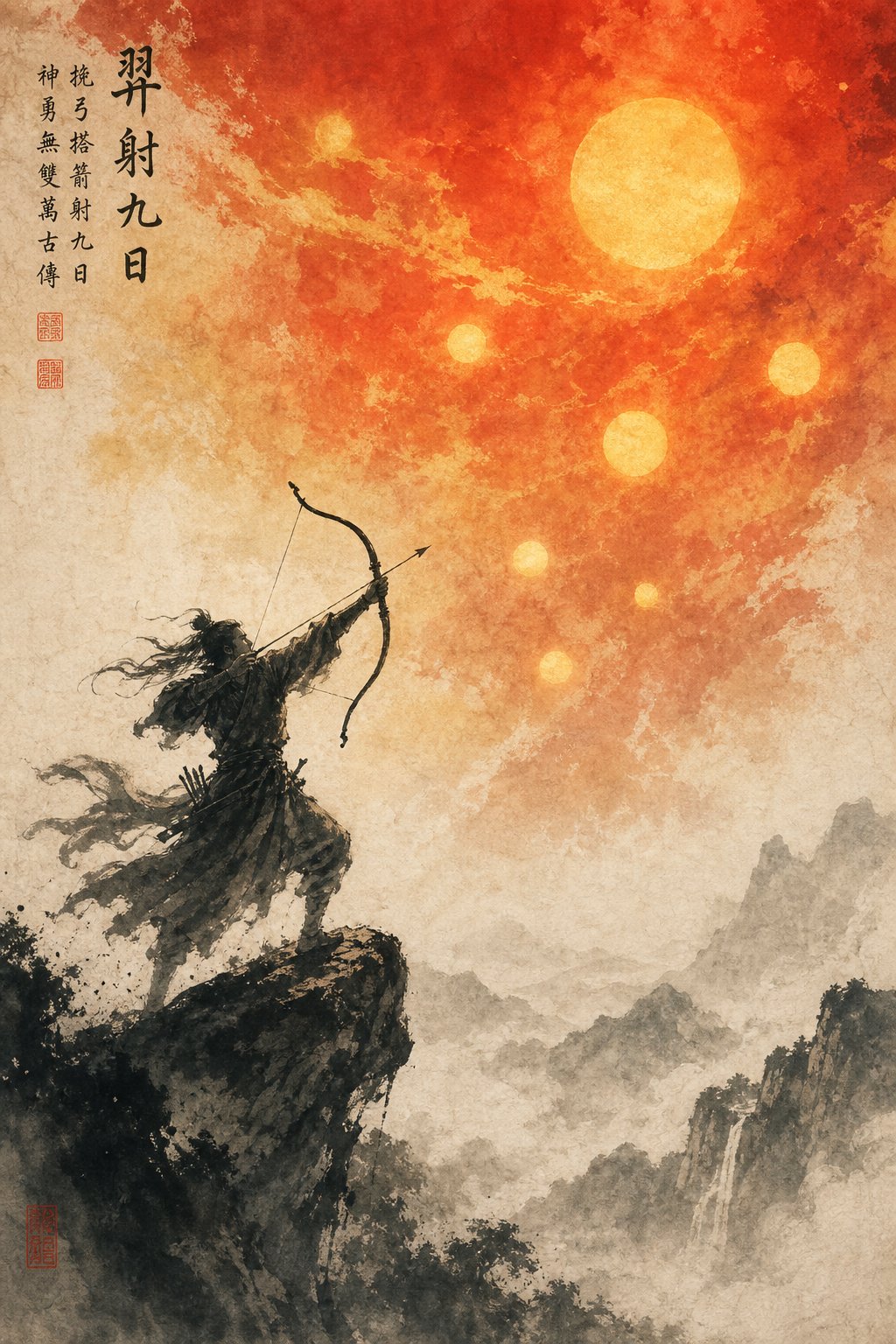
The most famous sun myth in Chinese tradition is the story of Houyi shooting the suns. Imagine ten suns blazing in the sky simultaneously, scorching crops, killing vegetation, and leaving people with nothing to eat. That is the crisis described in the Huainanzi, a Western Han Dynasty text that preserves the earliest full account of the legend.
Emperor Yao dispatched the divine archer Houyi to save humanity. Houyi drew his bow and shot nine arrows in succession, each striking down one of the ten suns. The world returned to normal with a single sun remaining, and the people rejoiced.
This myth reflects how ancient Chinese people imagined humanity's struggle against overwhelming natural forces. The ten suns were sometimes depicted as carried across the sky by three-legged crows (三足乌), a solar symbol that appears frequently in Han Dynasty tomb art, lacquerware, and bronze mirrors. A painted lacquer box unearthed from the Tomb of Marquis Yi of Zeng (circa 433 BC) even depicts the Houyi scene alongside these crow motifs, confirming that sun worship and solar mythology were deeply embedded in ritual culture thousands of years ago.
The three-legged crow served as the sun's avatar in ancient Chinese cosmology. Where Western traditions might place a chariot or a god driving the sun across the sky, Chinese mythology gave the sun a living creature as its spirit. This image persisted across dynasties and eventually traveled to Korea and Japan, where it became the Yatagarasu of Shinto legend.
Why Japan Is Called 日本 and Cross-Linguistic Connections
Perhaps the most visible cultural legacy of 日 outside China is the name of Japan itself. The word 日本 (Riben in Mandarin, Nihon or Nippon in Japanese) literally means "origin of the sun" or "where the sun comes from." This name reflects China's geographic perspective: Japan lies to the east, the direction from which the sun rises each morning.
The term first appeared in diplomatic correspondence around the 7th century. Prince Shotoku (574-622) sent a letter to the Chinese emperor that opened with: "The Son of Heaven in the country where the sun rises addresses a letter to the Son of Heaven in the country where the sun sets." From that point forward, 日本 became the standard name, and it has remained unchanged for over 1,400 years. Japan's national flag, the Hinomaru (日の丸, "circle of the sun"), carries this same solar identity into the modern era.
For learners studying both Chinese and Japanese, 日 offers a useful bridge. The character is identical in both writing systems. In Japanese kanji, it carries multiple readings: "nichi" and "jitsu" (on'yomi readings derived from Chinese pronunciation) and "hi" or "ka" (kun'yomi, native Japanese readings). You will encounter sun kanji chinese characters like 日 across both languages in words for Sunday (日曜日, nichiyoubi), diary (日記, nikki), and sunlight (日光, nikko). The shared character creates a vocabulary overlap that benefits anyone studying both languages simultaneously.
The 孫 Misconception: Sun Wukong, Sun Yat-sen, and Sun Tzu
Here is a question that trips up many English speakers: do famous Chinese figures with "Sun" in their names have any connection to the sun character 日? The short answer is no.
When you see sun wukong in chinese characters, the name is written 孫悟空. That first character, 孫 (sun, first tone), means "grandson" or "descendant." It is a common Chinese surname with no etymological link to 日 (ri, fourth tone) whatsoever. The romanization "Sun" in English just happens to look like the English word for our star. The same applies to sun yat sen in chinese characters: his name is written 孫逸仙 (or 孫中山 in his more commonly used Chinese name), using the same surname character 孫. And the military strategist known in English as Sun Tzu? His name in sun tzu chinese characters is 孫子, again using 孫.
The chinese last name sun character 孫 belongs to a completely different radical family (子部, the "child" radical) and carries meanings related to lineage and descendants. Confusing it with 日 is understandable given English spelling, but the two characters share nothing in pronunciation, meaning, or visual form. The sun wukong chinese character 孫 has 10 strokes and a complex internal structure, while 日 has just four strokes and a clean rectangular shape. Once you see them side by side, the difference is unmistakable.
This distinction matters because it highlights a broader lesson about Chinese: romanization can be misleading. Two completely unrelated characters may share the same pinyin spelling (with different tones), and English transliterations strip away tonal information entirely. The character 日 connects to sunlight, time, and celestial mythology. The surname 孫 connects to family lineage. They exist in entirely separate semantic universes, brought together only by the accident of English spelling conventions.
Frequently Asked Questions About the Sun Chinese Character
1. What is the Chinese character for sun and how is it pronounced?
The Chinese character for sun is 日, pronounced 'rì' in the fourth (falling) tone in Mandarin. It carries three core meanings: the physical sun, a day, and the concept of 'daily.' In modern spoken Chinese, people typically use the two-character word 太阳 (tàiyáng) to refer to the physical sun, while 日 appears more commonly inside written compounds like 生日 (birthday), 日出 (sunrise), and 日常 (daily routine).
2. How do you write the Chinese character for sun step by step?
The character 日 is written in four strokes following a specific order: first, draw the left vertical stroke downward; second, draw the top horizontal connected to the right vertical in one continuous stroke; third, add the inner horizontal line at the midpoint; fourth, close the bottom with a horizontal stroke. The finished character should be slightly taller than it is wide, resembling a portrait-oriented rectangle with one crossbar through the middle.
3. What is the difference between 日 and 太阳 in Chinese?
Both mean 'sun,' but they operate in different registers. 太阳 is the colloquial, everyday spoken word used in conversation and informal writing, such as 太阳出来了 (the sun came out). 日 is literary and classical, primarily appearing inside compound words, idioms, poetry, and formal writing. Using 日 alone in casual speech would sound like quoting ancient text, while 太阳 in a classical poem would feel out of place.
4. Is the Chinese character for sun the same in simplified and traditional Chinese?
Yes, 日 is identical in both simplified and traditional Chinese writing systems. Unlike many characters that have different forms between the two systems, 日 has remained unchanged. Whether you are reading texts from mainland China, Taiwan, or Hong Kong, the character looks exactly the same. This makes it especially convenient for learners navigating both systems.
5. Why is Japan called 日本 in Chinese characters?
日本 (Rìběn in Mandarin) literally translates to 'origin of the sun' or 'where the sun comes from.' The name reflects China's geographic perspective, since Japan lies to the east, the direction from which the sun rises each morning. This name entered diplomatic use around the 7th century and has remained the standard designation for over 1,400 years, also giving rise to Japan's well-known epithet 'Land of the Rising Sun.'