What Is Feng Shui Name Vibration and Why It Matters
Have you ever wondered whether your name carries more weight than just identification? In Chinese metaphysical tradition, every sound, character, and number in numerology holds a distinct energetic frequency. Feng shui name vibration is the concept that your name functions as an energetic signature, one that actively interacts with qi (life energy) flowing around and within you. It sits at the crossroads of feng shui philosophy and numerological analysis, treating names not as arbitrary labels but as living forces that shape how energy moves through your life.
Feng shui name vibration is the practice of analyzing the vibrational frequency carried by the sounds, strokes, and numerical values of a name to determine how it influences the flow of chi and personal harmony within the framework of Chinese metaphysical principles.
What Feng Shui Name Vibration Actually Means
Imagine your name as a tuning fork. Every time someone speaks it, writes it, or even thinks it, that fork resonates at a specific frequency. In this tradition, that frequency either harmonizes with your personal energy or creates subtle friction against it. The core idea is straightforward: names carry vibrations that influence how chi circulates in your environment and within your own energetic field.
This goes beyond simple symbolism. Chinese numerology assigns energetic properties to each character based on stroke count, phonetic tone, and elemental association. In Western adaptations, each letter corresponds to a number, and that number connects to one of the Five Elements (Wood, Fire, Earth, Metal, Water). The resulting profile reveals whether your name supports balance or introduces disharmony. Much like feng shui numbers applied to spaces and addresses, name vibrations are believed to set an energetic tone that follows you everywhere.
Why This Concept Is Misunderstood
Most people confuse this practice with generic numerology. You'll find plenty of calculators online that reduce your name to a single digit and hand you a personality description. That approach barely scratches the surface. Authentic feng shui name vibration analysis is rooted in Chinese metaphysical systems that consider yin-yang balance, Five Element interactions, and the directional flow of qi, not just a number on a chart.
Think of it this way: standard numerology tells you what number your name produces. Feng shui name vibration asks whether that number, combined with its sound and elemental quality, creates harmony with your innate energy profile. It is a holistic assessment rather than a single calculation. The same principle applies to feng shui and house numbers, where a street address is not just lucky or unlucky in isolation but evaluated against the occupants' elemental needs and the building's directional orientation.
This distinction matters because it determines whether you are working with a complete system or a fragment of one. Feng shui house numbers, for instance, follow the same logic: the number itself is only meaningful when placed in context with the people living there and the surrounding environment. Your name operates under identical principles. It is not the number alone that matters but how that vibration interacts with everything else in your energetic landscape.
What follows is an educational exploration of this traditional practice, tracing its philosophical roots and explaining how practitioners apply these principles across cultures and naming conventions.
The Ancient Philosophy Behind Name Energy
Every naming tradition carries assumptions about how the universe works. In the case of feng shui name vibration, those assumptions stretch back thousands of years into Taoist cosmology, where sound, number, and vibration are not separate categories but threads in a single energetic web. Understanding where this practice comes from reveals why it operates so differently from Western numerology or casual name-meaning lookups.
Roots in Chinese Cosmology and the I Ching
The philosophical foundation begins with the I Ching (Yi Jing), one of the oldest texts in Chinese metaphysics. Dating back roughly 5,000 years, the I Ching presents the universe as a system in constant flux, where yin and yang energies generate all phenomena through their interaction. Nothing is fixed. Everything vibrates, transforms, and flows between states.
Within this framework, names are not passive identifiers. They are part of what Taoist philosophy calls the "cosmic web" of interconnection, where qi comprises both yang energy (active, powerful) and yin energy (passive, gentle), and the balance between the two is always shifting. The I Ching itself uses numerical patterns, hexagrams built from combinations of broken and unbroken lines, to map these energetic states. China numerology grew directly from this tradition, where numbers represent dynamic forces rather than static quantities.
This is why lucky numbers in asian culture carry such weight. Is 8 a lucky number in Chinese tradition? Yes, because its phonetic quality in Cantonese and Mandarin resembles the word for prosperity. Is 4 a lucky number? Quite the opposite, since it sounds like the word for death. These associations are not superstition in the traditional sense. They reflect a worldview where sound and number are energetically alive, capable of attracting or repelling specific qualities of qi. The same logic extends to questions like whether is 14 a lucky number, since it combines the vibrations of 1 and 4, with the latter's phonetic association creating an inauspicious resonance in Chinese-speaking cultures.
How Tonal Qualities Carry Energy in Chinese Language
Here is where feng shui name vibration diverges most sharply from Western approaches. Mandarin Chinese has four distinct tones, and each tone changes not just the meaning of a syllable but its energetic signature. As Temple University's Center for Chinese Language Instruction explains, the syllable "ma" means "mom" in the first tone, "trouble" in the second, "horse" in the third, and "to scold" in the fourth. Same consonant-vowel combination, four completely different vibrations.
In traditional Chinese naming, this phonetic dimension matters as much as written meaning. A name pronounced in a rising tone carries different qi than the same characters spoken with a falling tone. Cantonese, with its six to nine tonal distinctions, adds even more layers of vibrational complexity. Parents and naming practitioners evaluate how a name sounds when spoken aloud, whether its tonal pattern creates a flowing, harmonious sequence or an abrupt, clashing one.
Consider the practical example: the name Wang Wen (王问) in the fourth tone suggests intelligence and curiosity. Mispronounced in the second tone, it could evoke "mosquito." The vibration shifts entirely. This is why authentic feng shui name analysis treats phonetic resonance as a primary factor, not an afterthought. The sound you hear repeated throughout your life is, in this tradition, a continuous energetic broadcast shaping how qi responds to your presence.
This tonal dimension explains why simple letter-to-number conversion can never fully capture what Chinese metaphysics means by name vibration. The system was built for a language where sound itself carries layered meaning, and where the vibrational quality of a spoken name is inseparable from its power to harmonize or disrupt personal energy.
How Five Elements Connect to Your Name Energy
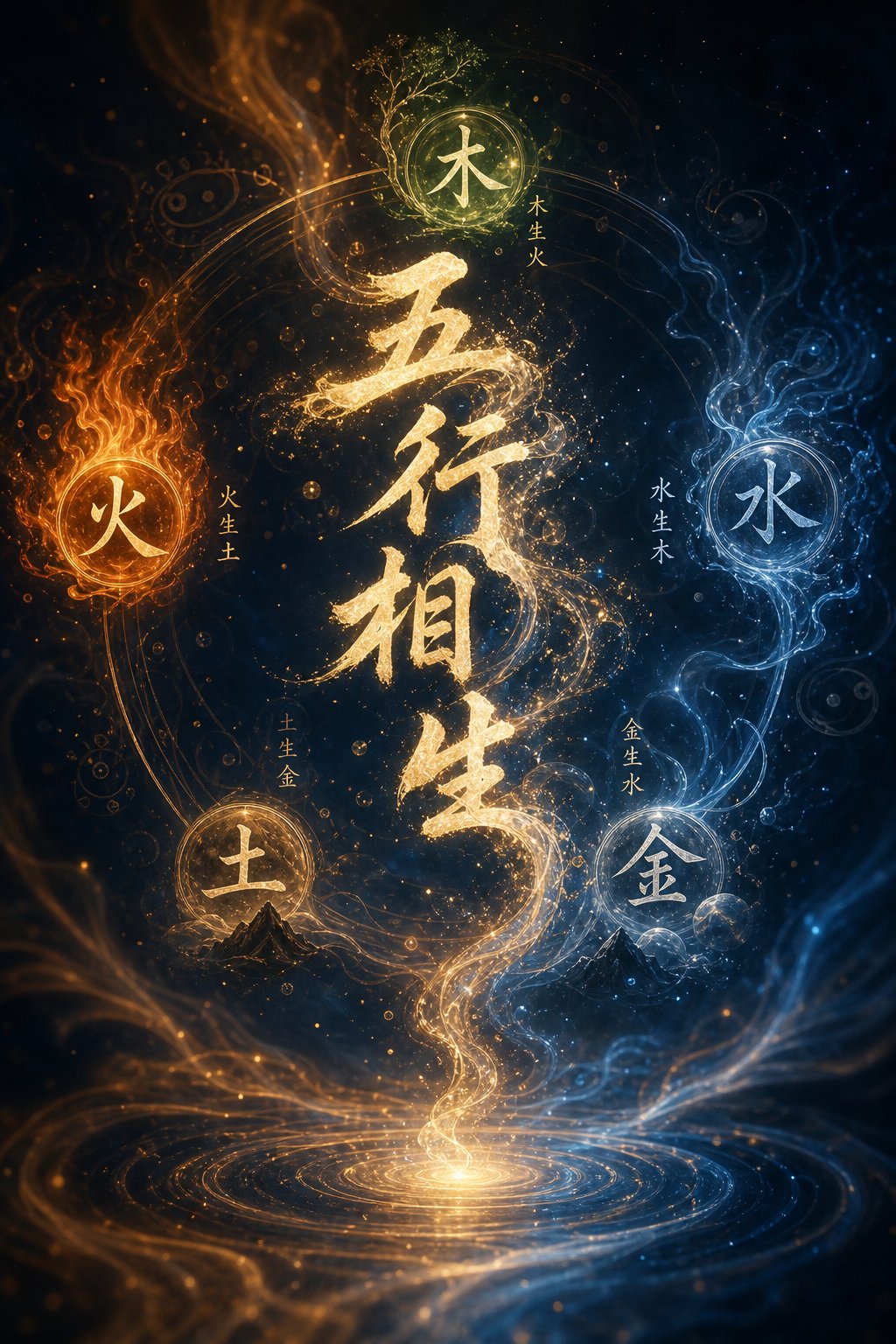
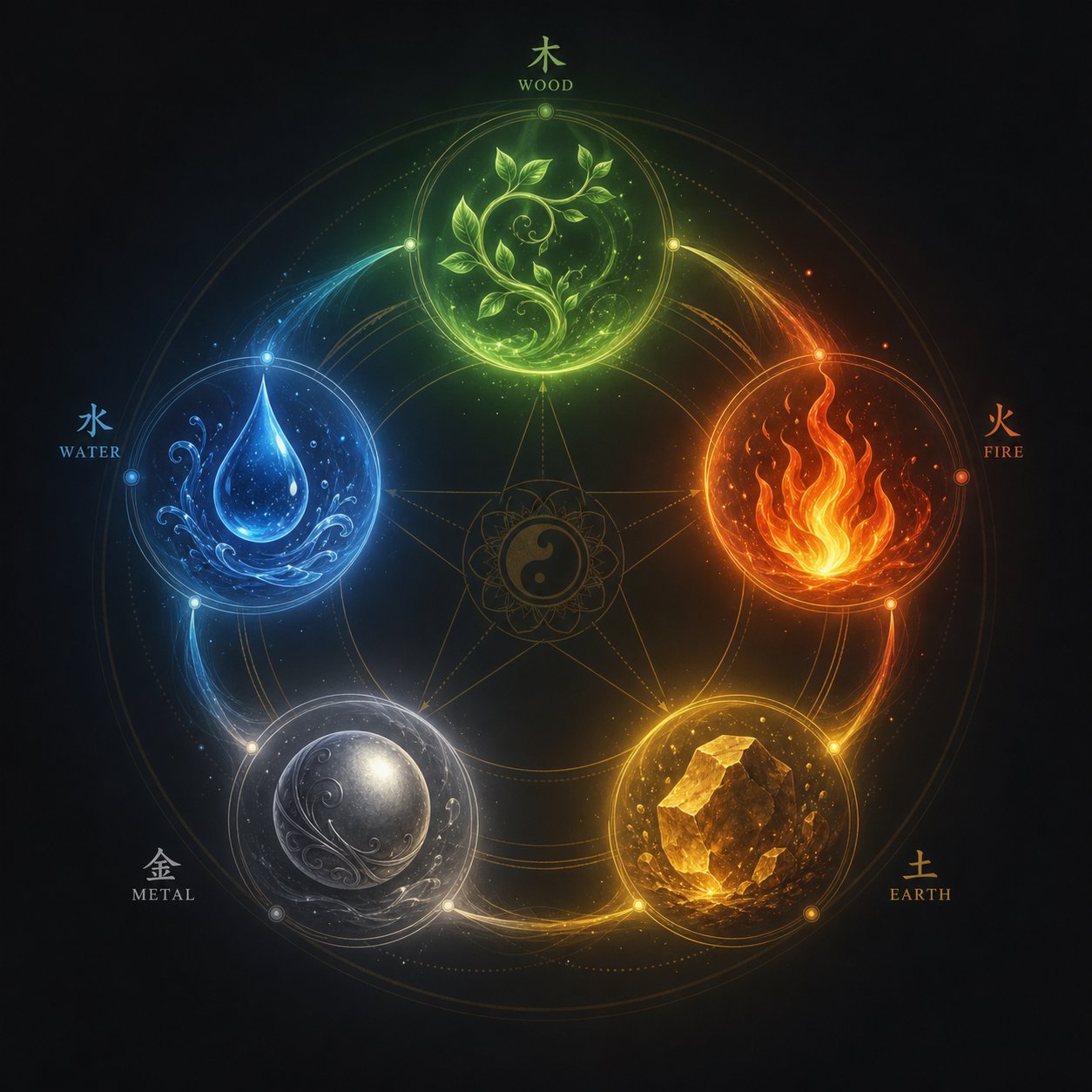
Sound and number create vibration, but vibration alone does not explain how a name influences your life. The mechanism that bridges feng shui philosophy and name energy is the Five Elements system, a framework that maps every number, sound, and stroke to one of five elemental forces. This is where the practice moves from abstract concept to structured analysis.
Five Elements and Their Role in Name Selection
In Chinese metaphysics, everything in existence corresponds to Wood, Fire, Earth, Metal, or Water. Your birth chart reveals which elements dominate your innate constitution and which ones you lack. A well-chosen name compensates for those gaps. According to traditional nameology principles, if your Ba Zi (Four Pillars of Destiny) shows excessive Wood energy, a name carrying Metal attributes can temper that imbalance, since Metal restricts Wood in the generative-restrictive cycle.
Each stroke count in a name maps to a specific element. The Chinese Name Numerology system assigns these correspondences based on numerical groupings that have remained consistent across centuries of practice:
| Element | Associated Numbers | Sound Quality | Energetic Character | Direction |
|---|---|---|---|---|
| Wood | 1, 2, 3, 4 | Rising, expansive tones | Growth, creativity, flexibility | East |
| Earth | 5, 6 | Grounded, steady tones | Stability, nurturing, balance | Center |
| Metal | 7, 8 | Sharp, clear tones | Precision, authority, decisiveness | West |
| Fire | 9 | Bright, ascending tones | Passion, completion, idealism | South |
| Water | 10 (0) | Flowing, descending tones | Wisdom, adaptability, depth | North |
You'll notice that feng shui lucky numbers are not universally lucky. Whether a number brings good fortune depends entirely on what your personal elemental profile needs. Is 9 a lucky number? In Chinese tradition, nine represents completion and fulfillment, belonging to Fire energy. For someone whose birth chart lacks Fire, it can be a numerologically lucky number that brings warmth and drive. For someone already overloaded with Fire, it risks amplifying impulsiveness and burnout.
The same contextual logic applies to other digits. Is 5 a lucky number? Five belongs to Earth and symbolizes change and adaptation, making it favorable for those needing grounding energy but potentially stagnating for someone whose chart already carries heavy Earth. Is 6 a lucky number? Six also corresponds to Earth, carrying qualities of harmony and responsibility. Its value as one of the good luck numbers depends on whether your elemental makeup benefits from more stability or already has too much of it.
Yin-Yang Balance in Name Vibration
Beyond elemental assignment, every number and sound carries either yin or yang polarity. Odd numbers (1, 3, 5, 7, 9) are yang, active and outward-moving. Even numbers (2, 4, 6, 8, 10) are yin, receptive and inward-drawing. A name composed entirely of yang-dominant strokes and sharp, ascending sounds projects aggressive energy. One built from all yin qualities may feel passive or withdrawn.
Practitioners assess this balance by examining the full name structure. In the Three Talents and Five Formations system, the Heaven, Human, and Earth stroke values each carry their own yin-yang charge. The ideal configuration creates a dynamic interplay rather than uniformity. Imagine a name where the Heaven stroke is yang, the Human stroke is yin, and the Earth stroke is yang. That alternating pattern mirrors the natural rhythm of expansion and contraction, activity and rest.
Phonetic qualities layer onto this assessment. Vowel-heavy syllables tend toward yin energy, soft and open. Consonant-heavy syllables lean yang, direct and percussive. When a practitioner evaluates feng shui name vibration, they listen for whether the spoken name creates rhythmic balance or monotone repetition.
Qi Flow and the Vibration Strength Concept
Not all name vibrations carry equal force. Practitioners refer to "vibration strength" as the degree to which a name actively influences qi flow rather than sitting neutrally. Three factors determine this strength:
- Stroke count alignment: When the stroke values across all five formations (Heaven, Human, Earth, External, Total) form generating relationships rather than restrictive ones, the name's vibration gains coherence and power.
- Phonetic resonance: Names whose syllables flow naturally when spoken aloud, without tonal clashes or awkward pauses, carry stronger vibrational presence. A name that people enjoy saying gets repeated more often, reinforcing its energetic broadcast.
- Elemental alignment with birth chart: The strongest vibration occurs when a name's elemental profile directly supports the "Useful God" identified in a person's Ba Zi analysis, the element most beneficial to their destiny.
A name with weak vibration strength is not necessarily harmful. It simply means the name functions as a neutral label rather than an active energetic tool. Strong vibration, whether harmonious or discordant, produces more noticeable effects in the traditional framework. This is why practitioners emphasize that a poorly chosen name with strong vibration can create more disruption than a mediocre name with weak resonance.
The interplay of these three factors, elemental correspondence, yin-yang polarity, and vibration strength, forms the complete mechanism behind feng shui name vibration. But knowing the mechanism raises a practical question: how do different numerological traditions actually calculate and interpret these values? The answer depends on which system you are working within.
Three Numerology Systems and Their Unique Approaches
Not all name vibration analysis works the same way. Three distinct systems dominate the landscape, each rooted in different philosophical traditions and using entirely different calculation methods. Understanding how numerology is calculated within each framework helps you recognize what you are actually measuring when you assess a name's energy.
Western Pythagorean System and Name Numbers
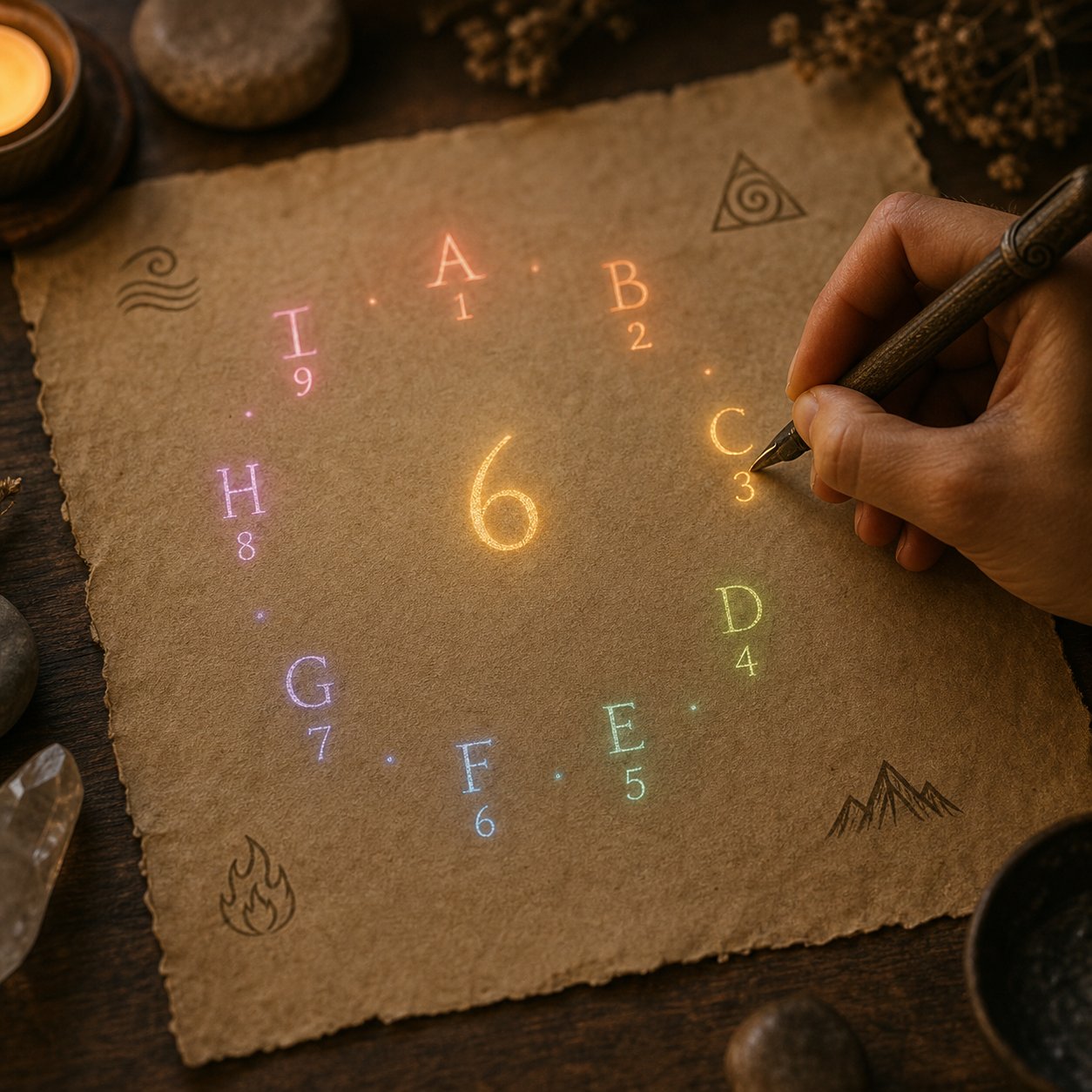
The most widely accessible system traces back to the Greek philosopher Pythagoras, who believed numbers are the building blocks of the universe. The Pythagorean method assigns each letter of the alphabet a value from 1 to 9 in sequential order: A=1, B=2, C=3, continuing through I=9, then cycling back so J=1, K=2, and so on through Z=8.
From your full birth name, this system produces several core numbers. The Expression Number (calculated from all letters) reveals your natural talents and outward projection. The Soul Urge Number (vowels only) uncovers inner desires. The Personality Number (consonants only) describes how others perceive you. Each calculation follows the same logic: assign values, add them together, and reduce to a single digit unless you hit a master number (11, 22, or 33).
For someone trying to figure out how to figure numerology using this approach, the process is straightforward. Take the name "Maria Santos": M=4, A=1, R=9, I=9, A=1, S=1, A=1, N=5, T=2, O=6, S=1. Add everything together (40), then reduce (4+0=4). The Expression Number is 4, associated with structure and practicality.
The meaning of numbers in numerology under this system focuses on personality archetypes and life themes. Number 1 signals leadership. Number 7 points toward introspection. Number 9 carries humanitarian energy. It is a psychological and spiritual framework, but it does not account for elemental balance, environmental harmony, or birth chart compatibility.
Eastern Chinese Numerology and Name Analysis
Chinese numerology operates on fundamentally different principles. Rather than converting letters to numbers sequentially, it evaluates names through stroke counts, phonetic values, and the Lo Shu magic square, a 3x3 grid containing numbers 1 through 9 where every row, column, and diagonal sums to 15.
The Lo Shu square originated in Chinese mythology as a pattern discovered on the back of a turtle emerging from the Luo River. Its mathematical structure maps the distribution of energies across time and space, with each number occupying a specific directional position. The number 5 sits at the center, representing balance. The remaining digits correspond to the eight cardinal directions, each carrying distinct elemental and energetic qualities.
When practitioners use a chinese numerology calculator to assess a name, they examine the total stroke count of each character, the relationships between stroke values in different name positions, and how those numbers interact within the Lo Shu framework. A name whose stroke values create generating cycles (Water feeds Wood, Wood feeds Fire) carries harmonious energy. One whose values form clashing relationships (Fire melts Metal, Metal chops Wood) signals potential conflict.
This approach also weighs phonetic resonance heavily. As discussed in the previous section on tonal qualities, the sound of a name in Chinese carries energetic weight independent of its numerical value. A numerology calculator chinese practitioners use would factor in both the written structure and the spoken vibration, something the Pythagorean system never considers.
How the Feng Shui Approach Differs From Both
Here is the distinction that rarely gets made clearly: feng shui name vibration is not simply Chinese numerology applied to names. It integrates environmental harmony principles that neither standalone system addresses. Where Pythagorean numerology asks "what does this number mean?" and Chinese numerology asks "how do these stroke values interact?", the feng shui approach asks a broader question: "does this name create harmony between the person, their environment, and their innate destiny?"
This means a feng shui practitioner evaluates name vibration against spatial energy (the directions and elements present in your living space), temporal cycles (the current feng shui period and its dominant energy), and personal birth data (your Ba Zi elemental composition). A name that scores well in pure numerology might still create disharmony if it clashes with the dominant energy of your home's facing direction or the current twenty-year feng shui period.
The table below highlights how these three systems differ across key dimensions:
| Dimension | Pythagorean (Western) | Chinese Numerology | Feng Shui Name Vibration |
|---|---|---|---|
| Calculation Method | Letter-to-number conversion (A=1 through Z, reduced to single digits) | Stroke counts, Lo Shu grid placement, phonetic tonal values | Stroke counts + elemental mapping + birth chart + environmental factors |
| Philosophical Basis | Greek mathematics and universal number archetypes | Taoist cosmology, yin-yang, Five Elements | Taoist cosmology integrated with spatial and temporal energy analysis |
| What It Prioritizes | Personality traits, life purpose, inner desires | Elemental harmony, phonetic resonance, lucky/unlucky associations | Holistic alignment between name, person, space, and time |
| Birth Data Used | Birth date (for Life Path only); name is primary | Birth date for elemental profile; name stroke analysis | Full Ba Zi (Four Pillars) chart as foundation for all name assessment |
| Environmental Factors | None | Minimal (directional associations) | Central: home direction, current period, spatial qi flow |
| Sound Analysis | Not considered | Tonal meaning and phonetic associations | Full phonetic vibration assessment including yin-yang quality of sounds |
The practical takeaway? If you want to understand how to figure numerology at a basic level, the Pythagorean system offers the simplest entry point. But if your goal is genuine energetic alignment, the feng shui approach provides the most comprehensive framework because it refuses to evaluate a name in isolation. Your name does not exist in a vacuum. It interacts with your birth energy, your living space, and the broader cycles of time, and only a system designed to account for all those variables can assess whether your name truly supports you.
This layered complexity raises a natural follow-up: if the feng shui system requires so many inputs, how does a person actually begin calculating their own name vibration number?
How to Find Your Name Vibration Number
You understand the theory. You know the three systems. But how do you actually calculate your number in numerology and apply a feng shui lens to the result? The process starts simpler than you might expect, and it builds in layers. The Pythagorean system provides the accessible entry point, and feng shui principles add depth on top of that foundation.
Calculating Your Name Number Step by Step
How do you calculate your number in numerology using the Pythagorean method? You assign each letter a value based on its position in the alphabet, cycling from 1 to 9 repeatedly. Then you add and reduce. Here is the complete process:
- Write out your full birth name exactly as it appears on your birth certificate, including first, middle, and last names. Nicknames and married names create secondary vibrations but do not replace the original.
- Assign each letter its Pythagorean value: A=1, B=2, C=3, D=4, E=5, F=6, G=7, H=8, I=9, J=1, K=2, L=3, M=4, N=5, O=6, P=7, Q=8, R=9, S=1, T=2, U=3, V=4, W=5, X=6, Y=7, Z=8.
- Add all the numerical values together. For example, the name "David Chen" would be: D=4, A=1, V=4, I=9, D=4 (total: 22) + C=3, H=8, E=5, N=5 (total: 21). Combined sum: 43.
- Reduce to a single digit by adding the digits of your total together. In this example: 4+3 = 7. Your name vibration number is 7.
- Watch for master numbers. If your reduction produces 11, 22, or 33 at the final step, do not reduce further. These carry amplified spiritual significance and remain as double-digit values.
- Layer the feng shui analysis. Take your single digit (or master number) and identify its elemental correspondence, yin-yang polarity, and directional association using the Five Elements framework covered earlier.
Sounds complex? The basic calculation takes about two minutes. The interpretation is where depth enters. If you are wondering how do I get my numerology number without manual math, the Pythagorean name numerology system follows this exact sequential assignment, making it accessible for beginners to verify their results.
One important note: how to find your numerology number accurately depends on using your complete birth name. Shortened versions or preferred names produce different values. Many practitioners recommend calculating both your birth name and your commonly used name to see how the two vibrations interact.
Interpreting Your Result Through a Feng Shui Lens
A standard numerology reading stops at personality descriptions. The feng shui approach goes further by mapping each number to its elemental energy and asking whether that energy supports your innate constitution. Here is what each resulting number signifies when viewed through this framework:
- Number 1 (Water/Yang): Independence, pioneering energy, self-direction. Carries initiating force. Supports those whose birth charts need Water or active forward momentum.
- Number 2 (Earth/Yin): Cooperation, sensitivity, diplomacy. Gentle and receptive. Benefits those needing grounding or relational harmony in their elemental profile.
- Number 3 (Wood/Yang): Creative expression, communication, optimism. Expansive and outward-moving. Strengthens those lacking growth energy or creative outlets.
- Number 4 (Wood/Yin): Structure, discipline, practicality. Steady and foundational. Provides stability for those whose charts show scattered or unfocused energy.
- Number 5 (Earth/Yang): Change, adventure, adaptability. Dynamic center energy. Suits those who need flexibility but may overwhelm people already prone to instability.
- Number 6 (Metal/Yin): Nurturing, responsibility, service. Harmonizing and protective. Supports those needing refinement and relational depth.
- Number 7 (Metal/Yang): Introspection, analysis, spirituality. Inward-cutting clarity. Benefits those whose charts call for discernment and intellectual sharpness.
- Number 8 (Earth/Yin): Material mastery, ambition, authority. Accumulating and powerful. Resonates with those needing manifestation energy and structural achievement.
- Number 9 (Fire/Yang): Compassion, completion, universal vision. Expansive and illuminating. Supports those lacking warmth, passion, or a sense of purpose.
Notice how each number carries both a personality theme and an elemental charge. The numerology number 10, when it appears before final reduction, carries Water energy (1+0=1) but with the added quality of completion cycling back to beginning. Master numbers 11, 22, and 33 amplify the base vibration of 2, 4, and 6 respectively, carrying intensified spiritual potential alongside proportional challenges.
Here is the critical piece that separates feng shui name vibration from basic numerology: your result only becomes meaningful when compared against your birth chart data. A name vibration of 9 (Fire) sounds wonderful in isolation, full of passion and humanitarian vision. But if your Ba Zi analysis reveals you were born with excessive Fire already dominating your Four Pillars, that name vibration adds fuel to an element that needs tempering, not reinforcement.
Professional feng shui name analysis involves layers beyond basic calculation: Ba Zi (Four Pillars of Destiny) assessment of innate elemental composition, comparison of name vibration against the birth chart's "Useful God" element, phonetic resonance evaluation, and alignment with current temporal cycles. The number itself is only the starting point.
This is why how to find your number in numerology is a different question from how to determine whether that number actually serves you. The calculation gives you raw data. The interpretation, especially through a feng shui lens, tells you whether that data points toward harmony or friction. And friction between your name vibration and your innate energy profile produces recognizable patterns in daily life, patterns that practitioners have cataloged across centuries of observation.
Recognizing Misaligned Name Energy in Your Life
Friction between your name vibration and your innate energy does not announce itself with a neon sign. It shows up in subtler ways, patterns that repeat across years, areas of life where effort never seems to gain traction, or a persistent feeling that your name does not quite fit who you are. Practitioners of feng shui name vibration have identified specific indicators that suggest misalignment, and understanding them starts with knowing what to look for.
Signs Your Name Vibration May Be Working Against You
In traditional practice, misaligned name energy tends to manifest as recurring stagnation in specific life domains rather than general bad luck. Think of it this way: if your name carries excessive Metal energy but your birth chart already overflows with Metal, the resulting imbalance might show up as rigidity in relationships, difficulty adapting to change, or chronic tension in areas governed by the elements Metal restricts (Wood, which relates to growth and creativity).
Practitioners typically look for these patterns:
- Persistent stagnation in one life area despite consistent effort, such as career plateaus, repeated relationship breakdowns, or financial cycles that never stabilize.
- A felt disconnect between your name and identity, where hearing or writing your name produces subtle discomfort or a sense that it belongs to someone else.
- Elemental imbalance symptoms that correspond to the dominant element in your name: excessive Fire may correlate with burnout and impulsiveness; excessive Water with indecision and emotional overwhelm; excessive Earth with inertia and over-caution.
- Timing patterns where difficulties intensify during years or periods governed by the same element your name already overloads.
None of these indicators guarantee that your name is the cause. Traditional practitioners view them as signals worth investigating, not definitive diagnoses. The framework is probabilistic, not deterministic. A name vibration that clashes with your elemental profile creates conditions where certain challenges become more likely, not inevitable.
The Role of Ba Zi Birth Chart in Name Assessment
How does a practitioner determine whether your name actually conflicts with your energy? The answer lies in Ba Zi analysis, sometimes called the Four Pillars of Destiny. This system uses your exact birth date and time to construct a chart revealing your innate elemental composition. It is essentially chinese life prediction by date of birth and time, mapping which of the Five Elements dominate your constitution and which ones you lack.
Your Ba Zi chart produces a birth date numerology chart of sorts, though it functions very differently from Western life path calculations. Where numerology and date of birth intersect in Western systems through simple digit reduction, Ba Zi assigns Heavenly Stems and Earthly Branches to your year, month, day, and hour of birth. Each pillar carries elemental weight. The resulting profile might reveal, for example, that you were born with strong Water and Wood but almost no Fire or Earth.
From this profile, practitioners identify what is called the "Useful God" (Yong Shen), the element most beneficial to your overall balance. Your name vibration ideally supports this element. If your Useful God is Fire but your name carries heavy Water energy, you have a direct conflict: the name actively suppresses the element you need most.
Each elemental excess or deficiency suggests specific name adjustments:
- Lacking Fire: Name vibration should include Fire-associated numbers (9) or ascending, bright phonetic qualities.
- Lacking Water: Names benefit from flowing sounds and numbers associated with Water energy (1, 10).
- Excessive Metal: Avoid sharp, cutting phonetics and Metal-associated stroke counts; introduce Fire elements to melt the excess.
- Excessive Wood: Metal-associated name vibrations can provide the restrictive balance needed.
- Lacking Earth: Grounding, steady phonetics and Earth-associated numbers (5, 6) stabilize the profile.
This is why numerology based on date of birth alone cannot provide a complete picture. The birth data reveals what you need. The name analysis reveals what you are currently broadcasting. Only by comparing the two can a practitioner assess whether harmony or conflict exists.
When People Typically Seek Name Vibration Analysis
Curiosity about feng shui name vibration tends to peak at specific life transitions. Each scenario carries different considerations and urgency within the traditional framework:
Baby naming is the most common context. Parents consult practitioners before registering a birth name, using the newborn's Ba Zi chart (derived from numerology based on date of birth and birth hour) to select characters whose stroke counts, phonetic qualities, and elemental associations support the child's Useful God. Timing matters here because the name must be chosen before official registration, and the birth chart cannot be calculated until the exact birth time is known.
Business naming follows similar logic but adds complexity. The business name must harmonize not only with the founder's elemental profile but also with the industry's dominant element (restaurants relate to Fire, financial services to Metal, creative agencies to Wood) and the current feng shui period's prevailing energy.
Legal name changes represent the most significant personal intervention. Adults who feel persistent misalignment sometimes pursue formal name changes after comprehensive Ba Zi and name vibration analysis. Practitioners typically recommend living with a new name informally for several months before making it legal, observing whether the shift in vibration produces noticeable changes in energy flow and life patterns.
Pen names and brand names offer a lower-stakes entry point. Writers, artists, and entrepreneurs can adopt professional names that carry specific vibrational qualities without altering their legal identity. This allows experimentation with different elemental energies in targeted life areas.
Across all these scenarios, timing plays a role. Traditional feng shui considers not just what name to choose but when to begin using it. Certain dates and periods carry more supportive energy for initiating change, and practitioners often recommend specific activation dates aligned with favorable elemental cycles.
Whether the analysis confirms harmony or reveals friction, the question that follows is practical: can these principles apply to names outside the Chinese language system? The answer requires bridging two very different linguistic worlds.
Applying Feng Shui Name Vibration to Any Language
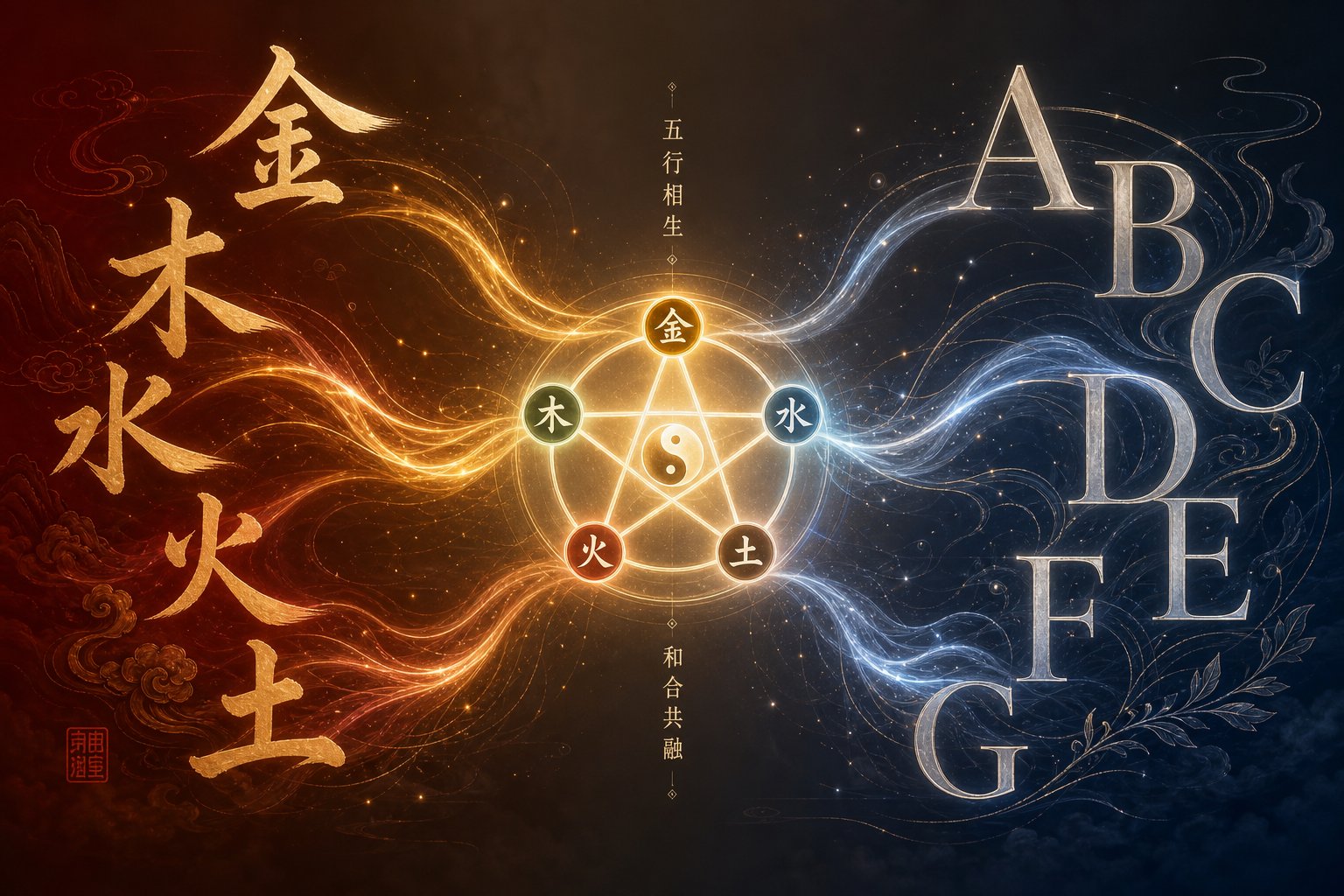
Chinese characters carry stroke counts, tonal values, and embedded elemental meaning all within a single written form. English letters do not. So how does a system built for one linguistic world translate into another? Modern practitioners have developed several cross-cultural methodologies, though not without debate about what gets preserved and what gets lost in translation.
Adapting Feng Shui Principles to Non-Chinese Names
When practitioners apply feng shui name vibration analysis to English or other Western names, they work through three primary channels: numerical conversion, phonetic energy assessment, and elemental mapping.
Numerical conversion is the most straightforward layer. Using the Pythagorean letter-to-number system, a practitioner determines what are my numbers numerology produces from a Western name, then maps those values onto the Five Elements framework. The resulting number carries the same elemental associations regardless of language. A name reducing to 7 corresponds to Metal energy whether the name is written in English, Spanish, or German.
Phonetic analysis adds the second layer. Even without Chinese tonal structure, vowels and consonants carry distinct energetic qualities. Vowels tend toward yin energy, open and receptive. Consonants lean yang, direct and structured. A name heavy in soft vowel sounds ("Olivia," "Aurora") broadcasts different vibrational energy than one dominated by hard consonants ("Patrick," "Victor"). Practitioners assess whether the phonetic balance of a spoken name creates harmony or monotony, applying the same yin-yang principles used in Chinese naming but adapted to non-tonal languages.
Elemental mapping ties everything together. Once you know how to work out your numerology value and identify its element, a practitioner compares that result against your Ba Zi birth chart, exactly as they would with a Chinese name. The elemental logic transcends language boundaries because it operates on universal principles of balance rather than language-specific rules.
For someone exploring how to know numerology within this cross-cultural framework, the process combines Western calculation methods with Eastern interpretive philosophy. You use the Pythagorean system to generate numbers, then read those numbers through the Five Elements lens rather than through Western personality archetypes alone. The numerology number meaning shifts depending on which interpretive system you apply.
Cultural Context and Authentic Practice
Honesty matters here. Not all practitioners agree that feng shui name vibration can be meaningfully applied outside Chinese-language names. Purists argue that the system was designed for characters with inherent stroke counts and tonal values, and that converting English letters to numbers strips away the very layers that make the analysis meaningful. From this perspective, true feng shui naming requires Chinese character analysis, period.
Modern practitioners counter that the underlying principles, elemental balance, yin-yang harmony, birth chart alignment, are universal. The calculation method adapts, but the philosophy holds. They point out that qi does not recognize language boundaries, and that a name's vibrational impact operates through sound and repetition regardless of the writing system.
Skeptics, of course, question the entire premise. From a scientific standpoint, no controlled studies have demonstrated that name vibrations influence life outcomes. This is worth acknowledging openly. What practitioners offer is a traditional framework for intentional naming, one that has guided Chinese families for centuries and that modern adaptations extend to other cultures. Whether you view it as metaphysical reality or as a meaningful ritual for setting intention, the framework provides structure for a decision most people make without any guiding philosophy at all.
If you are considering applying these principles across languages, keep these key factors in mind:
- Numerical value is transferable — the Pythagorean conversion provides a workable bridge between alphabetic names and Five Element analysis.
- Phonetic assessment requires adaptation — without tonal structure, practitioners focus on vowel-consonant balance, syllable rhythm, and the felt quality of a name spoken aloud.
- Stroke count analysis does not translate directly — this layer is specific to Chinese characters and cannot be meaningfully applied to Latin-alphabet names.
- Birth chart compatibility remains the anchor — regardless of language, Ba Zi analysis provides the reference point against which any name vibration is evaluated.
- Cultural authenticity varies by practitioner — some blend Western numerology with feng shui branding loosely, while others maintain rigorous adherence to traditional Chinese metaphysical methodology.
- Intention carries weight in the tradition — choosing a name with conscious awareness of its energetic qualities is itself considered a meaningful act within this philosophical system.
The cross-cultural question ultimately comes down to what level of analysis you seek. A basic elemental assessment of a Western name is accessible to anyone willing to learn the calculation and mapping process. A comprehensive feng shui name vibration analysis that integrates phonetic depth, temporal cycles, and spatial harmony requires either Chinese character engagement or a practitioner skilled in bridging both worlds.
Either way, the practical question remains the same: what concrete steps can you take right now to explore your own name's vibrational profile and determine whether it supports or undermines your personal energy?
Practical Steps to Explore Your Name Vibration
You have the theory, the history, and the cross-cultural framework. What can you actually do with all of it? Building your own name vibration profile does not require a professional consultation to start. It does require honest self-assessment and a willingness to sit with the results before drawing conclusions.
Building Your Own Name Vibration Profile
Think of this as a four-layer process. Each layer adds depth, and you can stop wherever your curiosity or comfort level dictates:
Layer 1: Calculate your basic name number. Use the Pythagorean letter-to-number conversion on your full birth name. Add all values together and reduce to a single digit (or master number). This gives you your foundational vibration value. If you are wondering how do you find your lucky number within this system, it is this result — the number your name naturally resonates with.
Layer 2: Identify the elemental association. Map your name number onto the Five Elements framework. Numbers 1 and 2 correspond to Water, 3 and 4 to Wood, 5 and 6 to Earth, 7 and 8 to Metal, and 9 to Fire. This tells you what elemental energy your name broadcasts into your environment every time it is spoken or written.
Layer 3: Compare against your birth date energy. Your birth date carries its own vibrational signature. Reduce your full birth date to a single digit using the same addition-and-reduction method. Compare the element of your birth number against the element of your name number. Do they generate each other (Water feeds Wood, Wood feeds Fire)? Or do they clash (Water extinguishes Fire, Metal chops Wood)? Lucky numbers by birth date are not universally lucky — they are personally lucky when they complement your existing elemental profile.
Layer 4: Assess phonetic qualities. Say your name aloud several times. Listen for the balance between soft vowel sounds (yin) and hard consonant sounds (yang). Notice whether the syllables flow or create abrupt stops. A name that feels rhythmically natural when spoken carries stronger vibrational coherence than one that catches in the throat or feels awkward to pronounce.
This self-analysis gives you a working framework. You will know your name's number, its element, whether that element supports or conflicts with your birth energy, and how its sound quality contributes to its overall vibration. What it cannot tell you is how your name interacts with temporal cycles, spatial energy, or the full complexity of a Ba Zi chart. That is where professional depth enters.
What to Look for in Authentic Feng Shui Name Analysis
Not every service offering name vibration analysis delivers genuine feng shui methodology. Many reduce the practice to a single number and a paragraph of generic personality traits. If you decide to seek professional guidance, here is what distinguishes thorough analysis from surface-level numerology:
- Five Elements integration: The practitioner maps your name to specific elements and explains the generating or restrictive relationships between them, not just what your number "means."
- Ba Zi (Four Pillars) consideration: Your birth date, birth time, and resulting elemental composition form the baseline against which your name is evaluated. Any analysis that skips this step is incomplete.
- Phonetic and tonal assessment: The practitioner evaluates how your name sounds when spoken, considering vowel-consonant balance, syllable rhythm, and (for Chinese names) tonal flow.
- Contextual evaluation: Your name is assessed in relation to your life circumstances, goals, and environment rather than interpreted in isolation.
- Temporal awareness: The current feng shui period and annual energy cycles factor into recommendations, since a name that serves you well in one period may need adjustment in another.
- Honest limitations: A credible practitioner acknowledges what the system can and cannot predict, framing results as traditional guidance rather than guaranteed outcomes.
If someone offers you lucky numbers by birth date without asking about your birth time, elemental profile, or current life context, you are getting a fragment of the system rather than the whole picture. The question "what's my lucky number" has a different answer depending on whether you are asking Western numerology, Chinese numerology, or feng shui — and only the last one integrates all the variables that determine whether a number actually supports your specific energy.
Feng shui name vibration is a holistic system combining sound, number, elemental correspondence, and birth chart analysis. It is not a single calculation but a multi-layered assessment of how your name's energy interacts with your innate constitution, your environment, and the broader cycles of time.
Whether you stop at self-calculation or pursue professional analysis, the value lies in approaching your name with intentionality. Most people inherit their names without any energetic consideration. Simply becoming aware of your name's vibrational profile — how to know your lucky number, what element it carries, whether it harmonizes with your birth energy — shifts your relationship with something you hear and see every single day. That awareness alone, in the traditional view, begins to change how qi responds to your presence.
Frequently Asked Questions About Feng Shui Name Vibration
1. How do I calculate my feng shui name vibration number?
Assign each letter in your full birth name a Pythagorean value (A=1 through I=9, then cycling J=1 through R=9, and S=1 through Z=8). Add all values together and reduce to a single digit by summing the digits of your total. Then map that number onto the Five Elements framework: 1-2 correspond to Water, 3-4 to Wood, 5-6 to Earth, 7-8 to Metal, and 9 to Fire. This elemental association reveals what energy your name broadcasts and whether it supports your birth chart profile.
2. What is the difference between feng shui name vibration and regular numerology?
Standard numerology reduces your name to a number and provides personality descriptions. Feng shui name vibration goes further by integrating Five Elements theory, yin-yang polarity, phonetic resonance, Ba Zi birth chart compatibility, and environmental factors like spatial energy and temporal cycles. It evaluates whether your name creates holistic harmony between you, your environment, and your innate destiny rather than simply interpreting a single number in isolation.
3. Can feng shui name vibration be applied to English names?
Yes, though with adaptations. Practitioners use Pythagorean letter-to-number conversion to determine elemental associations, assess vowel-consonant balance for yin-yang energy, and compare results against Ba Zi birth charts. However, stroke count analysis specific to Chinese characters does not translate directly. Some purists maintain that authentic feng shui naming requires Chinese character analysis, while modern practitioners argue the underlying elemental principles are universal and transcend language boundaries.
4. How do I know if my name vibration is misaligned with my energy?
Traditional practitioners look for recurring patterns such as persistent stagnation in one life area despite consistent effort, a felt disconnect between your name and identity, elemental imbalance symptoms that match your name's dominant element, and difficulties that intensify during periods governed by the same element your name overloads. These are considered signals worth investigating rather than definitive diagnoses within the traditional framework.
5. What role does the Ba Zi birth chart play in feng shui name analysis?
Ba Zi (Four Pillars of Destiny) uses your exact birth date and time to reveal your innate elemental composition, identifying which of the Five Elements dominate and which you lack. Practitioners then determine your Useful God, the element most beneficial to your balance. Your name vibration ideally supports this element. If your name carries energy that suppresses your Useful God element, it creates a direct conflict that may manifest as recurring challenges in specific life areas.