Understanding the Five Elements Overcoming Cycle
You've seen it called the "destructive cycle," the "control cycle," and maybe even the "conquest cycle." Search for five elements overcoming cycle names and you'll find a dozen different labels scattered across acupuncture textbooks, feng shui guides, and martial arts manuals. Which one is correct? All of them — and that's exactly the problem this article solves.
The Wu Xing system, often translated as the five elements or Five Phases, describes how Wood, Fire, Earth, Metal, and Water relate to one another through continuous interaction. These chinese elements don't sit in isolation. They move through two primary cycles: the generating cycle (sheng), where each element nourishes the next, and the overcoming cycle (ke), where each element restrains another. Think of the generating cycle as a parent nurturing a child, and the overcoming cycle as a grandparent keeping that child in check.
What Is the Overcoming Cycle in Wu Xing
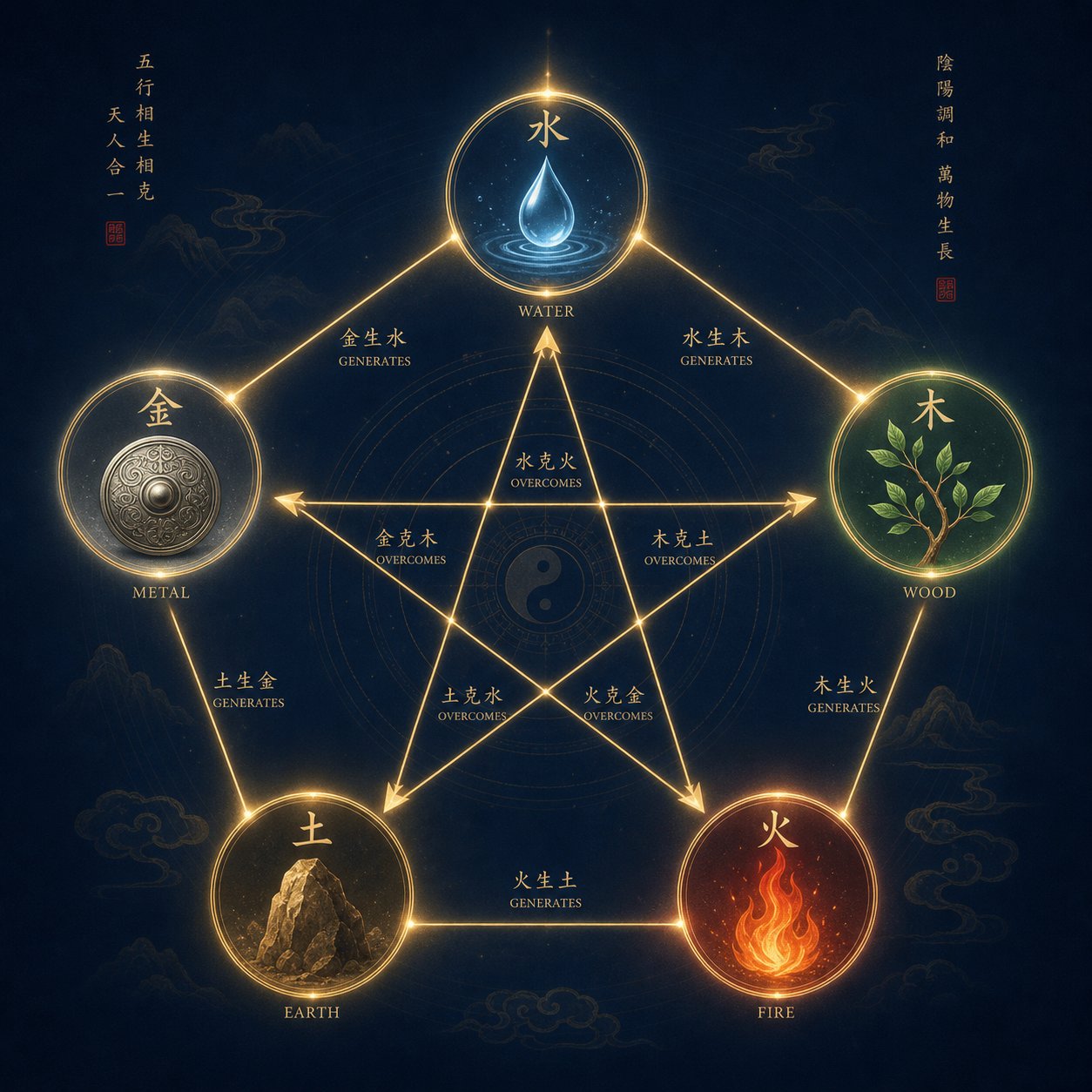
The overcoming cycle describes how each element naturally restrains another to maintain systemic balance — Water extinguishes Fire, Fire melts Metal, Metal chops Wood, Wood parts Earth, and Earth dams Water.
This cycle isn't about destruction. It's about regulation. Without it, any single element would grow unchecked and throw the entire system out of harmony. The five elements need both promotion and restraint to function as a coherent whole, much like an ecosystem needs both predators and prey.
Why So Many Names Exist for One Concept
So what are the five elements doing in this cycle, exactly? They're controlling each other — but the Chinese character 克 (kè) carries layered meanings: to overcome, to restrain, to conquer, to check. Translators working in different disciplines chose different English words based on the nuance most relevant to their field. A TCM practitioner emphasizes gentle regulation. A martial artist emphasizes dominance. An academic sinologist emphasizes literal accuracy. The result? One concept, over a dozen English names, and widespread confusion about whether these terms are interchangeable.
What are the 5 elements actually called in this restraining relationship? You'll find the answer — every single variation — consolidated below. No other single resource currently gathers all these naming conventions, their origins, and their discipline-specific contexts into one reference. That gap ends here.
Original Chinese Characters and Pinyin for the Ke Cycle
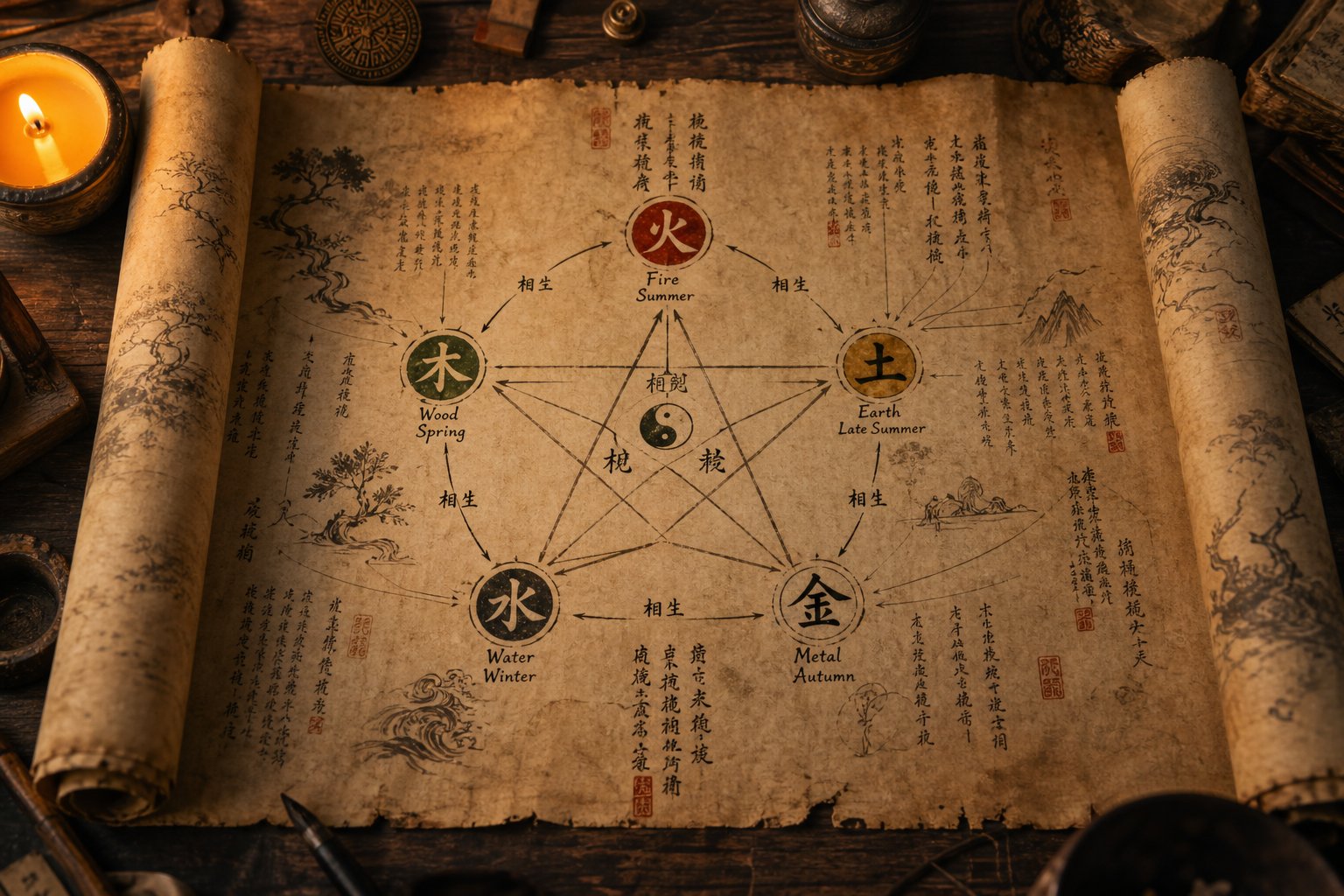
The confusion around English naming starts at the source language itself. When you look at the five elements in chinese, the overcoming cycle has one primary term: 相克 (xiāng kè). Two characters, each carrying specific weight. Understanding what they actually mean — individually and together — reveals exactly why translators have splintered into so many English variations.
Breaking Down 相克 Xiāng Kè Character by Character
The first character, 相 (xiāng), means "mutual" or "each other." It signals that the action flows in both directions across the system — not a one-way assault, but a reciprocal dynamic where every element both restrains and is restrained. You'll encounter 相 in the generating cycle too (相生, xiāng shēng), reinforcing that these are always mutual, systemic relationships.
The second character is where things get interesting. 克 (kè) carries a cluster of related meanings: to overcome, to restrain, to conquer, to subdue, to check. Classical Chinese dictionaries list all of these as valid readings. A translator choosing "overcome" leans toward the literal. One choosing "restrain" emphasizes regulation. Another choosing "conquer" highlights dominance. Same character, different philosophical emphasis — and that single point of divergence has produced over a dozen English names for the same cycle.
Put them together and 相克 (xiāng kè) means "mutually overcoming" or "mutually restraining." The Wu Xing system, known in academic circles as wuxing, treats this mutual restraint as essential to balance rather than as conflict or destruction.
Full Terminology in Classical Chinese Texts
In classical sources, you'll often encounter the complete phrase 五行相克 (wǔ xíng xiāng kè). Breaking this down:
| Character | Pinyin | Literal Meaning | Common English Rendering |
|---|---|---|---|
| 五 | wǔ | five | five |
| 行 | xíng | movement, phase, agent | element / phase |
| 相 | xiāng | mutual, each other | mutual / inter- |
| 克 | kè | overcome, restrain, conquer | overcoming / controlling / destructive |
Notice that 行 (xíng) itself is a source of translation debate. It literally means "to move" or "to walk," which is why some scholars prefer "Five Phases" or "Five Agents" over "Five Elements." The word implies dynamic processes rather than static substances. When you read wu xing in academic literature, this distinction matters — it frames the overcoming cycle as an interaction between moving forces, not a clash between fixed objects.
You'll also see the paired phrase 五行相生相克 (wǔ xíng xiāng shēng xiāng kè), meaning "the five phases mutually generating and mutually overcoming." This combined form appears frequently in traditional Chinese medicine texts and Taoist philosophy because the two cycles are always discussed as complementary halves of one system. Isolating 相克 without 相生 is like describing an exhale without acknowledging the inhale.
For practitioners reading source material across traditions, recognizing these characters on sight eliminates guesswork. Whether a text uses 相克 alone or the full 五行相克, you're looking at the same cycle — the one that English has fractured into a dozen competing labels. Those labels, and the specific disciplines that favor each one, deserve their own dedicated breakdown.
Every Alternative English Name for the Overcoming Cycle
Here's the reality: if you've studied the five elements chinese philosophy describes, you've almost certainly encountered multiple names for the ke cycle without realizing they all point to the same relationship. A TCM textbook says "control cycle." A feng shui manual says "destructive cycle." A martial arts instructor says "conquest cycle." You assume these are different concepts — but they're not. They're different translations of 相克, each filtered through the priorities of a specific discipline.
What follows is the single most complete reference for every English name this cycle goes by, why each name exists, and which field you'll most likely encounter it in.
Complete Reference Table of All English Names
The table below consolidates every documented English translation of the ke cycle. You'll notice that some names emphasize gentle regulation, others imply force, and a few sit somewhere in between. That range reflects the breadth of 克 (kè) itself — a character that can mean anything from "to check" to "to conquer" depending on context.
| Name | Primary Discipline | Nuance Emphasized | Source Context |
|---|---|---|---|
| Overcoming Cycle | Academic sinology | Literal translation of 克 as "to overcome" | Scholarly texts, university courses on Chinese philosophy |
| Control Cycle | Traditional Chinese Medicine (TCM) | Healthy physiological regulation between organ systems | Acupuncture textbooks, clinical TCM literature |
| Controlling Cycle | TCM, Five Element acupuncture | Active, ongoing regulatory process | Five Element constitutional acupuncture training |
| Destructive Cycle | Feng shui | Energetic conflict requiring remediation | Feng shui guides, space-clearing manuals |
| Conquest Cycle | Martial arts, military strategy | Strategic dominance of one force over another | Wushu theory, classical military texts |
| Restraining Cycle | TCM, Taoist philosophy | Gentle limitation that prevents excess | Taoist medical texts, qigong theory |
| Dominating Cycle | Martial arts, some TCM texts | Hierarchical power relationship | Internal martial arts manuals, older TCM translations |
| Checking Cycle | Integrative medicine, general reference | Checks-and-balances metaphor | Introductory holistic health texts |
| Ke Cycle | Cross-disciplinary | Untranslated pinyin to avoid bias | Practitioners who prefer original Chinese terminology |
| Xiangke Cycle | Cross-disciplinary | Full pinyin preserving "mutual" meaning | Academic papers, bilingual teaching materials |
| Acting Cycle | Some TCM lineages | One element "acting upon" another | Certain English translations of Nei Jing commentaries |
| Subjugation Cycle | Classical translation, historical texts | Forceful submission of one element by another | Older sinological translations, dynastic succession theory |
Twelve names. One cycle. Every single one refers to the same set of five relationships where Water restrains Fire, Fire restrains Metal, Metal restrains Wood, Wood restrains Earth, and Earth restrains Water.
Which Name Each Discipline Prefers and Why
The naming choice isn't random — it reflects what each field needs the concept to do. Imagine you're a clinician treating a patient. You don't want to tell them their Liver is "destroying" their Spleen. You want language that conveys healthy regulation, a system keeping itself in balance. That's why TCM practitioners gravitate toward "control cycle" or "restraining cycle." The Control/Ke Cycle in clinical settings represents relationships that prevent any element from becoming overwhelming — like a legislative checks-and-balances system.
Feng shui practitioners face a different situation. When the chinese 5 elements clash within a physical space — say, a Fire-dominant kitchen directly facing a Metal-heavy living room — the practitioner needs language that communicates urgency to clients. "Destructive cycle" does that work. It signals a problem that requires a remedy, whether through color adjustments, material changes, or spatial rearrangement.
Martial artists and military strategists historically used the wuxing elements as a framework for understanding tactical advantage. In that context, "conquest" and "domination" carry the right connotations. One force doesn't gently regulate another on a battlefield — it overcomes it decisively. The five phases become a map of strategic superiority rather than systemic harmony.
Academic sinologists, meanwhile, tend to favor "overcoming cycle" because it stays closest to the literal meaning of 克 without importing connotations from any applied discipline. It's neutral, precise, and doesn't presuppose whether the relationship is healthy or pathological.
Then there are practitioners who sidestep English entirely. Using "Ke cycle" or "Xiangke cycle" avoids the translation problem altogether. You'll find this approach among experienced clinicians and teachers who work across traditions and don't want their terminology to carry unintended baggage. When discussing the 5 chinese elements with students from mixed backgrounds, untranslated pinyin keeps everyone on the same page.
The practical takeaway? None of these names is wrong. But using "destructive cycle" in a clinical setting or "control cycle" in a martial arts context creates confusion — not because the terms are inaccurate, but because they carry discipline-specific connotations that don't transfer cleanly. Knowing which name belongs where lets you read across traditions without misinterpreting what an author actually means.
That said, a name only tells you that a relationship exists. It doesn't tell you what's actually happening between each pair of elements — the specific logic of why Water overcomes Fire or why Metal overcomes Wood. Those individual pairings, and the natural-world reasoning behind each one, carry their own explanatory weight.
All Five Overcoming Pairs Named and Explained
Each of the twelve English names discussed above describes the same five relationships. But what are those relationships, specifically? Knowing that a "control cycle" exists is one thing. Understanding exactly which element restrains which — and why nature dictates that particular pairing — is where real comprehension begins.
The overcoming cycle follows a fixed sequence. It never varies, regardless of which tradition or discipline you're studying. Here are all five pairs in their cyclical order:
- Water overcomes Fire — 水克火 (shuǐ kè huǒ)
- Fire overcomes Metal — 火克金 (huǒ kè jīn)
- Metal overcomes Wood — 金克木 (jīn kè mù)
- Wood overcomes Earth — 木克土 (mù kè tǔ)
- Earth overcomes Water — 土克水 (tǔ kè shuǐ)
Notice the pattern: each element restrains exactly one other element, and each element is restrained by exactly one other. No element dominates two, and no element escapes being checked. The system is perfectly symmetrical. Let's walk through each pair individually.
Water Overcomes Fire and Fire Overcomes Metal
The first pair is the most intuitive. Water — 水 (shuǐ), or "water in chinese" as many learners first search it — extinguishes fire. Pour water on a campfire and the flames die. This isn't abstract philosophy; it's observable physics. The character for water in mandarin, 水, even looks like flowing liquid in its original pictographic form, reinforcing the idea of a force that smothers and cools.
In a real-world analogy, think of a sprinkler system in a building. The water doesn't destroy the building — it controls the fire to prevent greater damage. That's the ke relationship: targeted restraint, not wholesale destruction.
The second pair follows the same observable logic. Fire — 火 (huǒ), or fire in chinese characters — melts metal. Place a gold bar in a forge and it liquefies. A blacksmith's furnace transforms rigid iron into something pliable and shapeable. The 14th-century text Sanming Tonghui captures this vividly: "If exhausted Metal comes upon Fire, it will melt." Fire doesn't eliminate metal entirely — it changes its state, softening its rigidity and dissolving its structure.
Imagine a jeweler's torch. Controlled flame reshapes metal into something new. Uncontrolled flame destroys the piece entirely. The difference between healthy ke and pathological overacting lives in that distinction.
Metal Overcomes Wood and Wood Overcomes Earth
Metal overcomes Wood because an axe chops a tree. The metal wuxing element — 金 (jīn) — represents sharpness, precision, and cutting force. A saw blade slices lumber. Pruning shears trim branches. Metal tools shape and control wood's growth, preventing it from expanding without limit.
Think of a gardener with steel shears. Without pruning, a hedge grows wild and formless. The metal tool doesn't kill the plant — it directs its growth, keeping it within useful boundaries. That's restraint in action.
Wood overcomes Earth because roots break apart soil. A tree's root system penetrates compacted ground, splitting rock and displacing dirt. You've seen sidewalks cracked by tree roots or retaining walls pushed apart by persistent growth. In the chinese zodiac elements, wood vs earth represents this exact tension — expansive growth versus stable ground.
The real-world analogy here is agricultural. Farmers plant cover crops specifically because root systems break up hardpan soil that has become too compacted for water to penetrate. Wood's living energy literally restructures earth's solidity.
Earth Overcomes Water to Complete the Cycle
The final pair closes the loop. Earth overcomes Water because soil absorbs and dams flowing water. Build a levee from packed earth and it holds back a river. Fill sandbags during a flood and they redirect the current. Earth contains water's tendency to flow everywhere without boundary.
Consider a riverbank. Without earthen walls, water spreads into a shapeless marsh. The bank gives the river direction and purpose — channeling its energy rather than eliminating it. As the Sanming Tonghui notes, "Earth can control Water; if Water is too much, Earth will erode" — a reminder that even the controlling element has limits when the relationship becomes imbalanced.
Together, these five pairs form a closed pentagonal loop. Water checks Fire. Fire checks Metal. Metal checks Wood. Wood checks Earth. Earth checks Water — which brings the cycle back to its starting point. Every element both controls and is controlled, creating a self-regulating system where no single force can dominate indefinitely.
The elegance of this structure raises a deeper question: where did these specific pairings come from? They weren't assigned arbitrarily. Ancient observers derived each relationship from watching nature itself — and those natural metaphors carry more explanatory depth than a simple list can convey.
Natural Metaphors That Explain Why Each Element Overcomes Another
The five overcoming pairs aren't philosophical abstractions invented in a scholar's study. They're observations pulled directly from the natural world — patterns so obvious that anyone watching a river erode a hillside or a forest fire melt bronze tools would recognize them immediately. Understanding the chinese elements meaning at this level transforms the ke cycle from a memorized list into something you can feel intuitively.
Nature-Based Logic Behind Each Overcoming Pair
Each pairing maps to a specific natural phenomenon. When you ask what does water represent in this system, the answer isn't just "a liquid" — it's the cooling, extinguishing, absorbing force observable everywhere in nature. The same principle applies to every element. Here's each pair with the metaphor that makes it click:
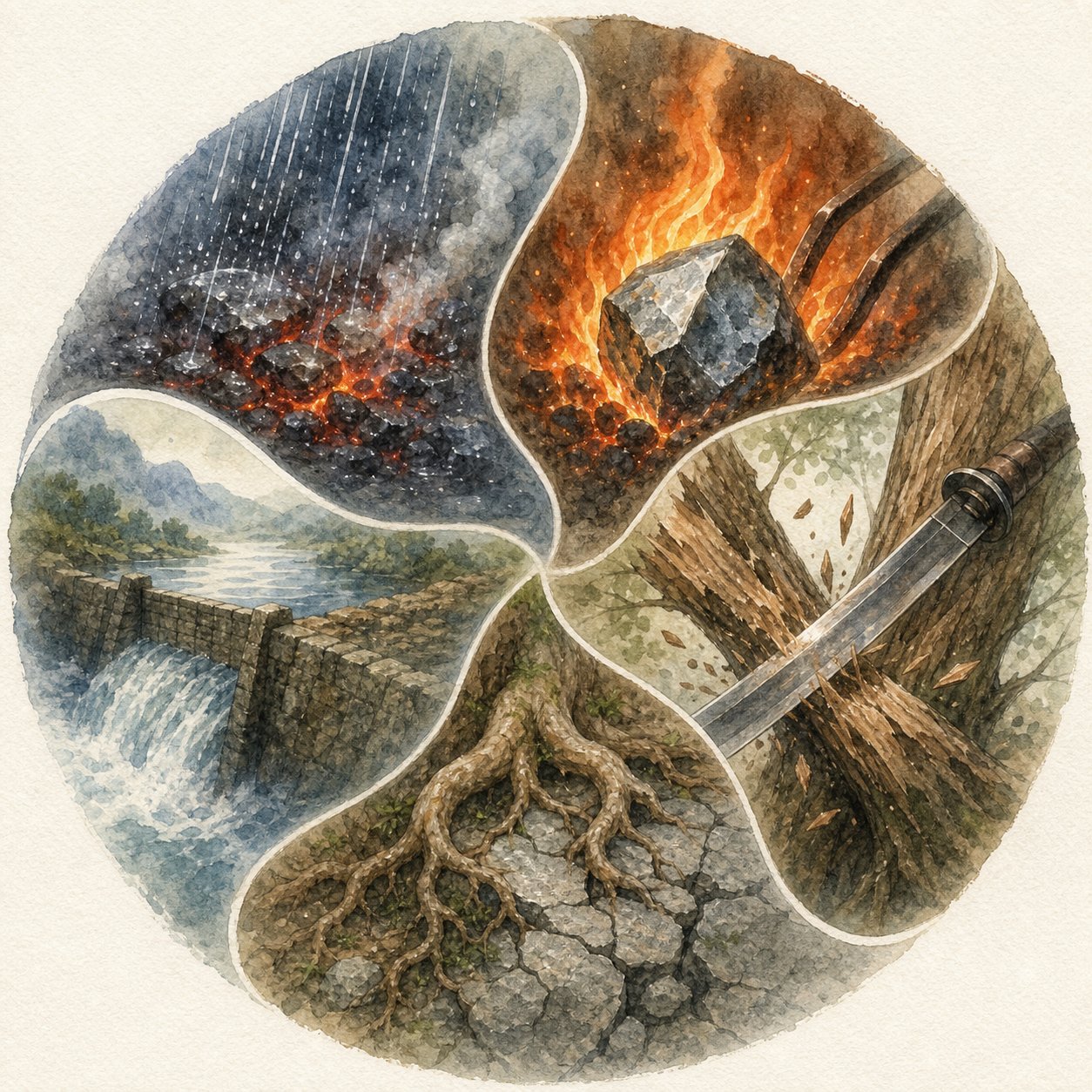
- Water extinguishes Fire — Rain douses a wildfire. A bucket of water kills a candle flame. Water's cooling nature directly opposes fire's heat, smothering combustion by removing the thermal energy fire needs to sustain itself.
- Fire melts Metal — A forge liquefies iron ore. Volcanic heat softens rock containing metal deposits. Fire's intensity overwhelms metal's rigidity, transforming solid structure into flowing liquid.
- Metal splits Wood — An axe fells a tree. A saw cuts lumber into planks. Metal's sharpness and density overcome wood's fibrous resistance, shaping and limiting its growth.
- Wood breaks apart Earth — Tree roots crack bedrock. Bamboo shoots push through packed clay. Living growth penetrates and destabilizes compacted soil, restructuring what seemed immovable.
- Earth dams Water — Riverbanks channel a current. Sandbags hold back floodwater. Levees redirect entire rivers. Earth's mass and stability absorb and contain water's formless flow.
These aren't poetic flourishes. They're empirical observations — chinese meanings and symbols grounded in what people actually witnessed happening around them every day.
How Ancient Observers Derived the Cycle from the Natural World
Han dynasty scholars didn't invent these relationships. They formalized what generations of farmers, metalworkers, and flood engineers already knew from direct experience. The Wu Xing framework emerged from watching seasonal patterns: spring growth breaking winter's frozen earth, summer heat transforming autumn's metals, water collecting where earth channeled it. If you've ever studied an earth seasons diagram showing how each element corresponds to a time of year, you've seen this observational logic mapped visually.
The spiritual meaning of 5 in Chinese cosmology connects directly to this completeness — five elements, five seasons (including late summer), five directions, five organ systems. The number itself represents a closed, self-regulating whole. Five is the minimum number of elements needed to create a cycle where every member both controls and is controlled without any element being either all-powerful or defenseless.
This matters because it reveals something important about the ke cycle's purpose. The natural metaphors aren't describing violence or destruction. Water doesn't hate fire. An axe doesn't resent the tree. These are impersonal, regulatory forces maintaining equilibrium — which is precisely why "destructive cycle" can be such a misleading translation. The natural world shows restraint, not annihilation. A riverbank doesn't eliminate water; it gives water direction. An axe doesn't erase wood; it shapes it.
That distinction — between healthy regulation and harmful excess — turns out to be the single most important nuance in the entire system. The same ke relationship that maintains balance can, under certain conditions, tip into something pathological.
How Naming Differs Across TCM, Feng Shui, and Martial Arts
The line between healthy restraint and harmful excess isn't just a clinical distinction — it's the exact reason different disciplines chose different names for the ke cycle in the first place. A practitioner's word choice reveals what they believe the cycle does. And what they believe it does depends entirely on how they use it professionally.
TCM and Acupuncture Naming Conventions
In five elements acupuncture and broader TCM practice, the ke cycle describes how organ systems regulate each other. The Liver (Wood) controls the Spleen (Earth). The Kidneys (Water) control the Heart (Fire). These aren't adversarial relationships — they're the body keeping itself in check. That's why TCM clinicians overwhelmingly prefer "control cycle" or "restraining cycle." The language needs to communicate balance, not damage.
Imagine explaining a diagnosis to a patient. Telling someone their Kidney energy is "destroying" their Heart energy sounds alarming. Telling them the Kidney is failing to properly "restrain" the Heart — that sounds like something you can fix. The terminology shapes patient understanding and clinical communication. When practitioners reference a chinese meridian chart showing the five element relationships between organ networks, the arrows between elements represent regulation, not aggression.
Some Five Element acupuncture lineages use "acting cycle" instead, framing the relationship as one element "acting upon" another. This phrasing stays neutral — it doesn't presuppose whether the action is beneficial or harmful, leaving room for clinical judgment in each individual case.
Feng Shui and Martial Arts Terminology Differences
Feng shui operates in a completely different context. When a practitioner analyzes a space using the feng shui bagua — the octagonal map that divides environments into directional sectors — elemental clashes represent real problems. A Metal-heavy west-facing entrance conflicting with a Wood-dominant east sector creates energetic tension that occupants can feel as discomfort or stagnation. Every school has their own translation, as one feng shui educator notes, but many practitioners gravitate toward "destructive cycle" because it communicates urgency to clients who need to take corrective action.
The thunder bagua — the trigram Zhen, associated with Wood energy and the east direction — illustrates this nicely. When Metal energy from an adjacent sector "attacks" the thunder bagua's Wood zone, a feng shui consultant needs language that motivates the client to rearrange, recolor, or remediate. "Destructive" does that rhetorical work far better than "restraining."
Martial arts traditions take yet another angle. In wushu theory and internal arts like baguazhang, the ke cycle maps strategic advantage. One fighting style overcomes another the way Water overcomes Fire — completely and decisively. "Conquest cycle" and "dominating cycle" carry the combative weight these contexts demand. Taoism symbols found in martial arts lineages — the taijitu, the bagua trigrams, the five element star — all encode these power relationships as tactical knowledge rather than medical theory.
| Discipline | Preferred Term | Reasoning | Practical Context |
|---|---|---|---|
| TCM / Acupuncture | Control Cycle, Restraining Cycle | Implies healthy physiological regulation | Organ system diagnosis, patient communication |
| Five Element Acupuncture | Controlling Cycle, Acting Cycle | Emphasizes ongoing process without implying harm | Constitutional treatment, emotional balancing |
| Feng Shui | Destructive Cycle, Weakening Cycle | Signals energetic conflict needing remediation | Space analysis, elemental cures, client consultations |
| Martial Arts | Conquest Cycle, Dominating Cycle | Reflects strategic superiority and tactical advantage | Fighting theory, style-vs-style analysis |
| Academic Sinology | Overcoming Cycle, Ke Cycle | Literal translation or untranslated pinyin avoids bias | University courses, scholarly papers, cross-tradition teaching |
| Taoist Philosophy | Restraining Cycle, Checking Cycle | Frames restraint as natural cosmic law | Cosmological texts, qigong theory, meditation traditions |
The pattern is clear: each discipline selects the name that best serves its communicative purpose. A TCM practitioner and a feng shui consultant can be discussing the identical elemental relationship — say, Metal controlling Wood — and use entirely different terminology without either being wrong. The confusion only arises when someone reads across disciplines without recognizing that the vocabulary shifted along with the context.
This cross-disciplinary awareness also clarifies something subtler. When a term like "destructive cycle" appears in a clinical text, it usually signals that the author is describing something gone wrong — a ke relationship that has exceeded its normal regulatory function and tipped into pathology.
When Overcoming Becomes Pathological: Control Versus Balance
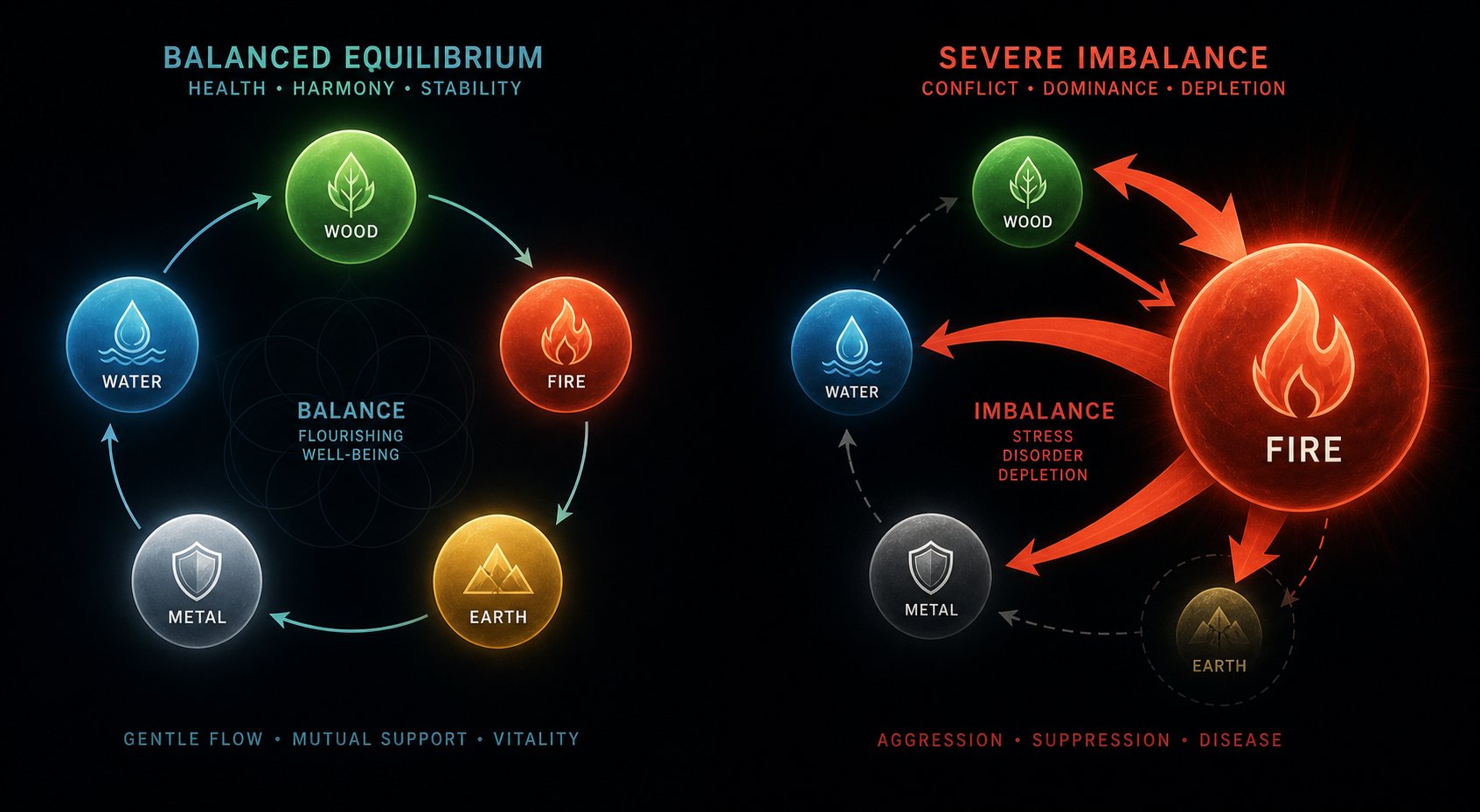
A healthy chinese element cycle keeps every element in check without weakening it. Wood restrains Earth just enough to prevent stagnation. Water cools Fire just enough to prevent overheating. The system hums along in equilibrium. But what happens when that restraint goes too far — or reverses direction entirely?
This is where five elements theory chinese medicine makes its most clinically important distinction. The ke cycle isn't a single phenomenon. It operates on a spectrum, and the terminology shifts depending on where you land on that spectrum.
Normal Control Versus Pathological Overacting
In its healthy state, the 5 element cycle functions like a thermostat. Each element applies just enough pressure to keep the next one from growing out of proportion. The Liver (Wood) gently regulates the Spleen (Earth). The Kidneys (Water) gently cool the Heart (Fire). No damage occurs. Balance is maintained.
The overcoming cycle in its healthy form maintains balance rather than causing destruction — which is precisely why translating 相克 as the "destructive cycle" can mislead practitioners into thinking the normal ke relationship implies harm.
Pathology enters when that gentle regulation becomes excessive. TCM calls this 相乘 (xiāng chéng) — overacting. The character 乘 (chéng) means "to take advantage of" or "to bully." When Wood overacts on Earth, it doesn't just regulate the Spleen — it damages it. Think of a grandmother element that stops setting healthy boundaries and starts exerting inappropriate, excessive control over the grandchild element. The relationship follows the same directional pathway as normal ke, but the intensity crosses a threshold from regulatory into harmful.
Clinically, this looks like a Liver that's too strong overwhelming a Spleen that's already weak — producing digestive symptoms driven by emotional stress. The 5 elements of life remain in the same structural arrangement, but the force between them has become disproportionate.
The Insulting Cycle as Reverse Overcoming
Even stranger is what happens when the cycle reverses. TCM calls this 相侮 (xiāng wǔ) — the insulting cycle. The character 侮 (wǔ) means "to insult" or "to bully back." Here, the element that should be controlled rebels against its controller. Instead of Earth obediently being restrained by Wood, a pathologically strong Earth turns the force back on Wood — like a river flooding its banks and washing away the very soil that was supposed to contain it.
Imagine a child who has grown stronger than the grandparent trying to discipline them. The structural relationship still exists on paper, but the power dynamic has flipped. Water should control Fire, but if Fire becomes excessively strong, it can "insult" Water — evaporating it rather than being extinguished by it.
These two pathological patterns — overacting (chéng) and insulting (wǔ) — explain why naming matters so much. When someone calls the ke cycle "destructive," they may unknowingly be describing the overacting cycle rather than the normal control cycle. The healthy 5 element cycle regulates. Only the pathological versions destroy. Conflating the two leads to fundamental misunderstandings about how the system actually works — and obscures the fact that the generating and overcoming cycles depend on each other to maintain the whole.
The Overcoming Cycle as a Check on the Generating Cycle
The pathological patterns described above — overacting and insulting — only make sense when you see the ke cycle in relation to its counterpart. The generating cycle (相生, xiāng shēng) and the overcoming cycle don't operate independently. They function as two halves of a single self-regulating engine. Remove either one and the system collapses.
How the Generating and Overcoming Cycles Balance Each Other
The generating cycle promotes growth. Wood feeds Fire. Fire creates Earth (ash). Earth bears Metal (minerals). Metal collects Water (condensation on metal surfaces). Water nourishes Wood. Each element acts as a "mother" nurturing the next in the five elements generating cycle wood fire earth metal water order. Left unchecked, this nourishing sequence would produce runaway growth — Fire burning hotter and hotter, Wood expanding without limit, Water flooding everything in its path.
That's where the overcoming cycle steps in. It applies a brake at every point where the generating cycle could spiral out of control. Fire generates Earth, but Water controls Fire before it can produce too much Earth. Wood generates Fire, but Metal controls Wood before it can overfeed the flames. The two cycles interlock like gears — one accelerating, one decelerating — producing dynamic equilibrium rather than static balance.
Picture it this way: every element simultaneously receives nourishment from its mother, provides nourishment to its child, restrains one element, and is restrained by another. Four relationships per element, ten total connections across the system. The five elements generating cycle wood fire earth metal water creates forward momentum; the ke cycle governs its speed.
Why Both Cycles Are Necessary for Systemic Harmony
You can't fully understand the overcoming cycle's names without seeing how they contrast with generating cycle terminology. The sheng cycle goes by "generating," "creative," "nourishing," or "mother-child" cycle — all words implying support and growth. The ke cycle's names — "controlling," "restraining," "overcoming" — exist specifically as counterweights to that generative language. One set of names says "promote." The other says "regulate." Together they describe a complete system.
The table below shows how both cycles intersect at every element, making the five elements cycle diagram wood fire earth metal water visible as a network rather than a simple loop:
| Element | Generated By (Mother) | Generates (Child) | Controlled By | Controls |
|---|---|---|---|---|
| Wood | Water | Fire | Metal | Earth |
| Fire | Wood | Earth | Water | Metal |
| Earth | Fire | Metal | Wood | Water |
| Metal | Earth | Water | Fire | Wood |
| Water | Metal | Wood | Earth | Fire |
Notice the wood & water relationship in this table. Water is Wood's mother in the generating cycle — it nourishes Wood's growth. But Wood also controls Earth, which in turn controls Water. So wood & water are linked through both direct generation and indirect regulation, illustrating how deeply interconnected the two cycles really are.
This dual-cycle architecture is why experienced practitioners insist that isolating the ke cycle from the sheng cycle distorts both. The names we assign to the overcoming cycle — whether "control," "restraint," or "conquest" — only carry their full meaning when understood as the regulatory counterpart to generation. Without something to regulate, the concept of "overcoming" has no purpose. Without something generating growth, there's nothing to overcome.
Grasping this relationship intellectually is one thing. Retaining the full sequence — which element generates which, which controls which, and in what order — is another challenge entirely. That's where dedicated memory techniques become invaluable.
Memory Aids and Mnemonics for Learning the Five Element Cycle
Knowing the theory is half the battle. Recalling the exact order of transformations — which element overcomes which, in what sequence, and under which name — is where most students hit a wall. The five element cycle contains ten directional relationships (five generating, five overcoming), twelve English names, and five natural metaphors. That's a lot to hold in working memory without a system.
The good news? A few targeted mnemonic devices can lock the entire overcoming sequence into long-term recall. These techniques work whether you're studying 5 elements chinese medicine, preparing for a feng shui certification, or simply trying to list 5 elements and their relationships from memory.
Mnemonic Devices for the Overcoming Sequence
The overcoming cycle follows one fixed order: Water, Fire, Metal, Wood, Earth. Every element in that sequence overcomes the one immediately after it. Here's how to remember it:
- Use the phrase "Wise Farmers Make Wheat Every-day." The first letter of each word maps to the sequence: Water, Fire, Metal, Wood, Earth. Say it once or twice and the order sticks. The agricultural theme even connects to the natural-world logic behind the cycle itself.
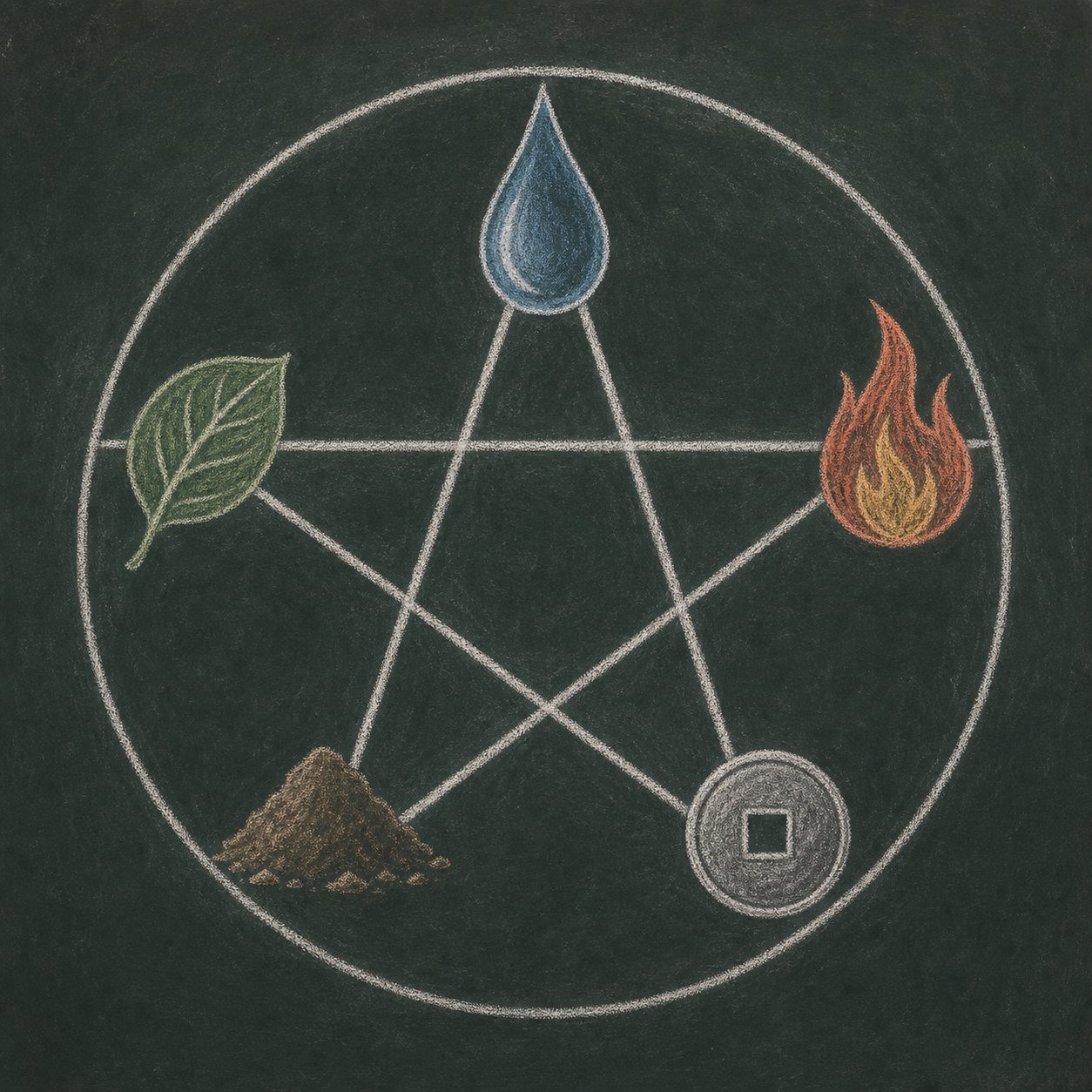
- Trace the star pattern. Draw a circle with five points (like the points of a pentagon) and place the elements in their standard generating-cycle positions: Fire at top, Earth at upper right, Metal at lower right, Water at lower left, Wood at upper left. Now connect every other point — you'll draw a five-pointed star. Each line of that star represents one overcoming relationship. The elemental wheel becomes a visual anchor you can mentally "walk" whenever you need to recall a specific pair.
- Chain each pair to its metaphor. Instead of memorizing abstract element names, picture the action: a bucket of water dousing a campfire, a forge melting an iron bar, an axe splitting a log, tree roots cracking a sidewalk, a sandbag wall holding back a flood. Run through those five images in sequence and you've reconstructed the entire cycle without rote memorization.
Visual and Verbal Memory Techniques for All Five Pairs
For quick reference, here's each pair linked to a single vivid image you can recall instantly:
- Water → Fire: Picture a firefighter's hose blasting a burning building. Water wins.
- Fire → Metal: Picture a blacksmith's forge turning a solid sword into glowing liquid. Fire wins.
- Metal → Wood: Picture a lumberjack's steel axe biting into a tree trunk. Metal wins.
- Wood → Earth: Picture massive oak roots buckling a concrete sidewalk. Wood wins.
- Earth → Water: Picture a dam wall holding back an entire reservoir. Earth wins.
String those five images into a mental movie — hose, forge, axe, roots, dam — and play it forward whenever you need the sequence. The narrative flow makes it far easier to retain than a disconnected list.
Remembering which discipline uses which name is simpler than it looks. Match the term's emotional tone to the field's purpose:
- "Control" / "Restrain" sounds clinical and measured → TCM (where the goal is balanced health)
- "Destructive" sounds urgent and problematic → Feng shui (where the goal is fixing spatial conflict)
- "Conquest" / "Domination" sounds combative → Martial arts (where the goal is strategic advantage)
- "Overcoming" sounds neutral and academic → Sinology (where the goal is accurate translation)
The connotation tells you the context. If the word makes you think of a doctor's office, it's TCM terminology. If it makes you think of a battlefield, it's martial arts. If it sounds like a textbook, it's academic. That one-to-one emotional mapping eliminates guesswork when you encounter an unfamiliar translation in the wild.
With these techniques in place, the entire system — all five overcoming pairs, their natural metaphors, their twelve English names, and the disciplines that favor each — becomes something you can reconstruct from memory rather than look up every time. That's the difference between studying the 5 elements chinese philosophy and actually internalizing it.
Frequently Asked Questions About Five Elements Overcoming Cycle Names
1. What is the overcoming cycle in the five elements system?
The overcoming cycle, known as 相克 (xiāng kè) in Chinese, is one of two primary relationships in the Wu Xing system. It describes how each of the five elements — Wood, Fire, Earth, Metal, and Water — naturally restrains one other element to prevent unchecked growth. Water restrains Fire, Fire restrains Metal, Metal restrains Wood, Wood restrains Earth, and Earth restrains Water. This creates a closed loop of mutual regulation that maintains systemic balance alongside the generating cycle.
2. Why does the overcoming cycle have so many different English names?
The Chinese character 克 (kè) carries multiple valid meanings including overcome, restrain, conquer, subdue, and check. Translators working in different fields chose the English word that best matched their discipline's priorities. TCM practitioners selected 'control' or 'restraining' to imply healthy regulation. Feng shui consultants preferred 'destructive' to communicate urgency. Martial artists chose 'conquest' to reflect strategic dominance. Academic sinologists used 'overcoming' for literal accuracy. This produced at least twelve documented English names for the same cycle.
3. What is the difference between the control cycle and the destructive cycle?
They refer to the same set of five elemental relationships but carry different connotations. The 'control cycle' is preferred in Traditional Chinese Medicine because it frames the ke relationship as healthy physiological regulation between organ systems. The 'destructive cycle' is common in feng shui because it signals energetic conflict within a space that requires corrective action. Neither term is wrong — the choice depends on whether the practitioner is describing normal balance or a problematic clash.
4. What are the five overcoming pairs in order?
The five pairs follow a fixed cyclical sequence: Water overcomes Fire (水克火), Fire overcomes Metal (火克金), Metal overcomes Wood (金克木), Wood overcomes Earth (木克土), and Earth overcomes Water (土克水). Each pair is based on observable natural phenomena — water extinguishes flames, fire melts metal, axes cut trees, roots break soil, and earthen dams contain floods. The sequence never varies regardless of which tradition or discipline you study.
5. What is the difference between overacting and the insulting cycle in TCM?
Overacting (相乘, xiāng chéng) occurs when a controlling element becomes excessively dominant, damaging the element it normally just regulates — like Wood overwhelming a weakened Spleen instead of gently checking it. The insulting cycle (相侮, xiāng wǔ) is a reversal where the normally controlled element rebels against its controller — like an overly strong Fire evaporating the Water that should cool it. Both are pathological states distinct from the healthy ke cycle, which maintains balance without causing harm.