Why Gao and Ko Cause So Much Surname Confusion
You share a family reunion table with relatives named Gao, Ko, Koh, and even Go. Same ancestral village, same genealogy book, completely different passport spellings. So are Gao and Ko the same surname or two separate lineages? The short answer surprises most people researching their roots.
Why One Chinese Character Has So Many Spellings
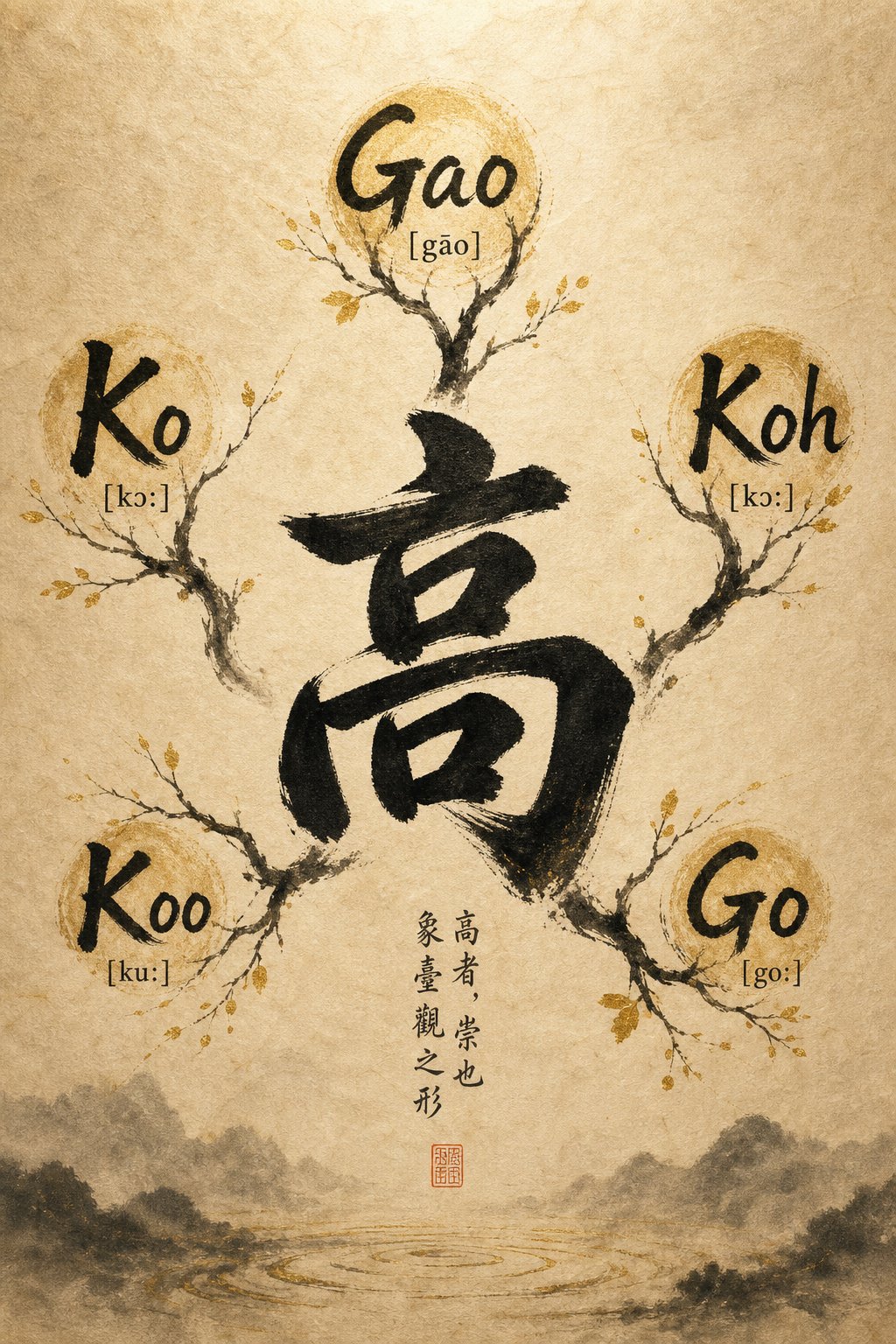
The character 高 sits at the center of this puzzle. Ranked #18 among the most common Chinese surnames, it carries the meaning "tall" or "high" and traces back to the ancient state of Qi during the Spring and Autumn period. Over a million bearers worldwide write this single character on their family altars, yet their English-language surnames look nothing alike.
The reason is dialect. When Chinese migrants registered their names with colonial administrators in Singapore, Hong Kong, or the Philippines, they spelled their surnames the way they pronounced them. A Mandarin speaker said "Gao." A Hokkien speaker said "Ko." A Cantonese speaker also said "Ko" but with a slightly different tonal quality. As CNA has noted, when Singapore's government later adopted Hanyu Pinyin for given names, many dialect-based surnames remained unchanged for the sake of continuity. The result is a single family tree with branches labeled in half a dozen different romanizations.
The Ko surname also appears in Korean last names, where 고 (Go/Ko) carries its own independent lineage tied to the Goguryeo kingdom. This overlap adds another layer of confusion for anyone trying to trace whether a Ko last name points to Chinese or Korean heritage.
Gao and Ko typically share the same ancestral character 高 but diverged through dialect pronunciation and migration patterns over centuries.
What This Comparison Covers
This article breaks down every major romanization of 高 side by side: Gao, Ko, Koh, Koo, Go, Gow, and Kao. For each variant, you'll find the dialect or language it comes from, where bearers concentrate geographically, and how it ended up fixed on official documents. We also address the critical question of when a Ko surname does not mean 高 at all, since several unrelated characters produce the same English spelling. Whether you're building a family tree, choosing a romanization for a newborn, or simply curious why your Korean surname matches your Chinese colleague's, the comparison ahead covers it all.
How We Evaluated Each Surname Variant
Comparing romanization variants of 高 requires more than just listing different spellings. Each variant carries its own linguistic fingerprint, geographic story, and bureaucratic history. To make this comparison useful for genealogy research, passport decisions, and family reconnection, we applied a consistent framework across every spelling.
Linguistic and Historical Criteria
Each variant in the sections ahead is evaluated on four dimensions:
- Linguistic origin - Which dialect or romanization system produces this spelling? Is it Mandarin Pinyin, Cantonese Jyutping, Hokkien POJ, or a Korean romanization of 고?
- Geographic concentration - Where do bearers primarily live today? This includes both ancestral homelands and diaspora communities.
- Historical context - When and why did this spelling become fixed? Colonial registration, government standardization, and immigration processing all played roles.
- Practical usage - How does this spelling perform in official documents, genealogy databases, and cross-border identity verification?
For each variant, you'll also find notable bearers, common points of confusion, and tips for connecting with relatives who use a different romanization of the same character.
How Dialect Determines Spelling
Imagine two cousins from the same village. One migrates north to Beijing, the other south to Hong Kong. Within a generation, their shared surname 高 splits into two completely different English spellings. The phonological mechanism behind this is straightforward once you see it.
In Mandarin, 高 is pronounced with a voiced velar initial g- and a diphthong -ao, giving us "Gao." Southern Chinese dialects shift this in two key ways. First, the initial consonant moves from g- toward an aspirated k-. As research on Cantonese phonology demonstrates, word-initial consonants in Cantonese correlate systematically with their Mandarin counterparts, reflecting changes from proto-Chinese distributions. Second, the diphthong -ao reduces to a simple -o vowel. The result: "Gao" becomes "Ko" through entirely predictable sound correspondences, not random variation.
This same pattern explains why a Korean family name like 고 also romanizes as Ko or Go. In Korean naming conventions, is surname first in Korean? Yes, the family name precedes the given name, which is the opposite of Western order. This matters because when Korean immigrants adapted their names for English-speaking countries, they sometimes reversed the order, creating additional confusion. If you've ever wondered "in korean is the last name first," the answer is yes, and that structural difference compounds the spelling puzzle when Ko appears on documents without context about whether it traces to Chinese 高 or Korean 고.
Understanding these sound shifts is the key to seeing all variants of 高 as branches of one tree rather than unrelated surnames. The sections ahead apply this framework to each spelling individually, starting with the most globally standardized form: Gao.
Gao - The Standard Mandarin Romanization of 高
Of all the spellings that represent 高, Gao is the one most people encounter first in databases, academic papers, and international news. It is the product of a deliberate government standardization effort, and its dominance reflects the global reach of Mandarin Chinese as a lingua franca.
Origins in Mandarin Pinyin
On February 11, 1958, the People's Republic of China officially introduced Hanyu Pinyin as its standard romanization system. The system replaced older methods like Wade-Giles, which rendered 高 as "Kao" (a spelling still common in Taiwan). Under Pinyin rules, the character 高 becomes "Gao" with a first-tone macron: Gāo. The spelling captures the Mandarin pronunciation precisely, with the voiced velar initial g- and the falling diphthong -ao.
Before Pinyin, the same character appeared as "Kao" in Wade-Giles documents, which explains the kao last name origin question many Taiwanese families encounter. Both Gao and Kao point to the identical Mandarin pronunciation; they simply reflect different transcription conventions from different political eras. In Japanese contexts, the same character reads as Kō (ko in kanji), showing yet another layer of cross-linguistic adaptation.
The character itself means "tall" or "high" and traces its ko last name origin to the ancient state of Qi during the Western Zhou dynasty (1122-771 BC). The Song dynasty encyclopedia Tongzhi records that an ancestor named Gao Xi was granted the surname in honor of his grandfather, Prince Gao, a son of Duke Wen of Qi. This makes 高 one of the oldest documented Chinese surnames with a clear territorial origin in modern-day Shandong province.
Geographic Distribution of Gao Bearers
The spelling "Gao" dominates wherever Mandarin is the primary dialect. In 2019, 高 ranked as the 19th most common surname in mainland China, with approximately 17 million living bearers worldwide. The vast majority of those who spell it "Gao" on official documents are either mainland Chinese residents or immigrants who left China after the 1980s, when Pinyin-based passports became standard.
You'll also find Gao bearers concentrated in northern Chinese provinces like Shandong, Henan, and Hebei, where the surname's historical roots run deepest. Among diaspora communities in North America, Europe, and Australia, post-reform immigrants overwhelmingly use the Gao spelling, distinguishing them from earlier waves of Cantonese or Hokkien migrants who carried Ko or Koh on their documents.
Strengths and Limitations of This Spelling
Choosing or inheriting the Gao spelling comes with clear practical trade-offs.
Pros
- Internationally recognized as the ISO standard romanization for Mandarin Chinese
- Consistent with PRC passports, making cross-border identity verification straightforward
- Easy database matching across genealogy platforms, academic records, and immigration systems
- Unambiguous: "Gao" almost always points to 高, reducing confusion with other characters
Cons
- Does not reflect Cantonese, Hokkien, or Teochew pronunciation, potentially disconnecting bearers from their dialect heritage
- Relatively recent standardization (1958) means older family records may use Kao, Ko, or other variants
- Unfamiliar to English speakers who may mispronounce it as "gay-oh" rather than the correct "gow" (rhyming with "cow")
- Creates a generational split within families where grandparents registered under Wade-Giles or dialect-based systems
The Gao spelling works best for families rooted in Mandarin-speaking regions who prioritize consistency with modern Chinese government systems. But for millions of 高 bearers whose ancestors left southern China before 1958, a different spelling already sits on their birth certificates, one shaped not by Beijing's standardization committee but by the sounds of Cantonese, Hokkien, or Korean.
Ko - The Cantonese and Korean Spelling Explained
Here is where the surname puzzle gets genuinely tricky. The spelling "Ko" sits at a crossroads between two entirely different linguistic traditions. One path leads back to Cantonese-speaking communities in southern China and Hong Kong. The other traces to the Korean peninsula and a lineage predating recorded Chinese contact. Same two letters, very different stories.
Ko as a Cantonese Romanization of 高
In Cantonese, the character 高 is pronounced "gou" in Jyutping (the modern academic standard) with an unaspirated velar initial /k/ and a simple vowel. Under the Hong Kong Government Cantonese Romanisation system, aspirated and unaspirated stops are not distinguished in spelling. Both map to "k" on paper. The diphthong "-ao" that Mandarin preserves reduces to a rounded "-o" in Cantonese, completing the shift from "Gao" to "Ko."
This is not a random spelling choice. It reflects a systematic phonological correspondence between Mandarin and Cantonese that applies across hundreds of characters. The Hong Kong Government romanisation system, based on conventions dating back to 1888, has been used on identity cards, street signs, and official records for over a century. If your family registered the last name Ko in Hong Kong before the 1990s, this system almost certainly produced that spelling.
The Ko name also appears among older Cantonese diaspora communities in Vancouver, San Francisco, Sydney, and London, where early immigrants carried their Hong Kong identity documents into new countries. Unlike Pinyin-based "Gao," the Cantonese "Ko" was never the product of a centralized government mandate. It emerged organically from colonial-era registration practices and stuck.
Ko as a Korean Surname With Independent Origins
The Ko family name carries a completely separate identity in Korean culture. Written as 고 in Hangul, it is one of the most common Korean last names, with approximately 470,000 bearers in South Korea alone. The ko korean connection runs deep: the surname traces its founding mythology to the Goguryeo kingdom (37 BC - 668 AD), one of the Three Kingdoms of Korea.
According to Korean genealogical records, the three primary clans bearing the 고 surname are the Jeju Ko clan, the Gaeseong Ko clan, and the Jangheung Ko clan. The Jeju Ko clan holds particular historical significance. Legend attributes its origin to three divine ancestors who emerged from the ground on Jeju Island, making it one of the royal korean surnames tied to founding mythology rather than Chinese migration. The Gaeseong Ko clan, meanwhile, descends from the Goguryeo royal house, reinforcing the surname's association with Korean sovereignty and aristocratic lineage.
While some scholars have speculated about ancient connections between Korean 고 and Chinese 高 through early cultural exchange along the Liaodong Peninsula, the two surname systems operate independently. Korean genealogical databases (jokbo) track 고 through Korean clan structures, not Chinese ancestral halls. The character used in Hanja (Korean use of Chinese characters) for the Korean surname is indeed 高, but the lineage narratives, clan seats, and genealogical records are entirely Korean in origin.
Among royal korean surnames, 고 stands out because it connects directly to pre-Chinese-influence Korean identity. Families bearing this name often emphasize their Goguryeo or Tamna (ancient Jeju) heritage rather than any continental Chinese origin.
How to Tell Them Apart
When you encounter someone with the last name Ko, how do you know whether it traces to Cantonese 高 or Korean 고? Context provides the strongest clues:
- Given name structure - Korean names typically have a two-syllable given name (e.g., Ko Joon-hee), while Cantonese names often use a single romanized given name or hyphenated pair (e.g., Ko Wing-man)
- Geographic background - Families from Hong Kong, Macau, or Guangdong province almost certainly carry the Cantonese version; families from Korea carry 고
- Clan or ancestral records - Chinese Ko families reference ancestral halls (citang) in Guangdong or Fujian; Korean Ko families reference clan seats (bon-gwan) like Jeju or Gaeseong
- Middle generation character - Korean families often share a generational character (dollimja) among siblings, a practice distinct from Chinese naming conventions
Pros
- Widely recognized across Hong Kong, Korea, and global diaspora communities
- Short, easy to spell, and phonetically intuitive for English speakers
- Reflects authentic Cantonese pronunciation of 高 for southern Chinese families
- Standard romanization for one of the most common Korean last names
Cons
- Ambiguous origin without additional context: could be Chinese 高, Korean 고, or even Chinese 柯 or 葛
- Database searches return mixed results combining unrelated Chinese and Korean lineages
- Immigration officials and genealogy platforms may conflate Cantonese Ko with Korean Ko
- No way to distinguish from other Chinese characters (柯, 古, 顧) that also romanize as Ko
The dual identity of the Ko spelling creates real challenges for genealogical research. A search for "Ko family name" in any major database returns a mix of Cantonese Chinese, Korean, and even Japanese results. For families who know their origin, this ambiguity is merely an inconvenience. For those trying to trace unknown roots, it becomes a genuine obstacle, one that requires looking beyond the romanization to the original character or clan records underneath.
This same ambiguity intensifies when you move further into Southeast Asia, where yet another spelling emerged from Hokkien-speaking communities: Koh, with its distinctive trailing "h" that tells its own colonial story.
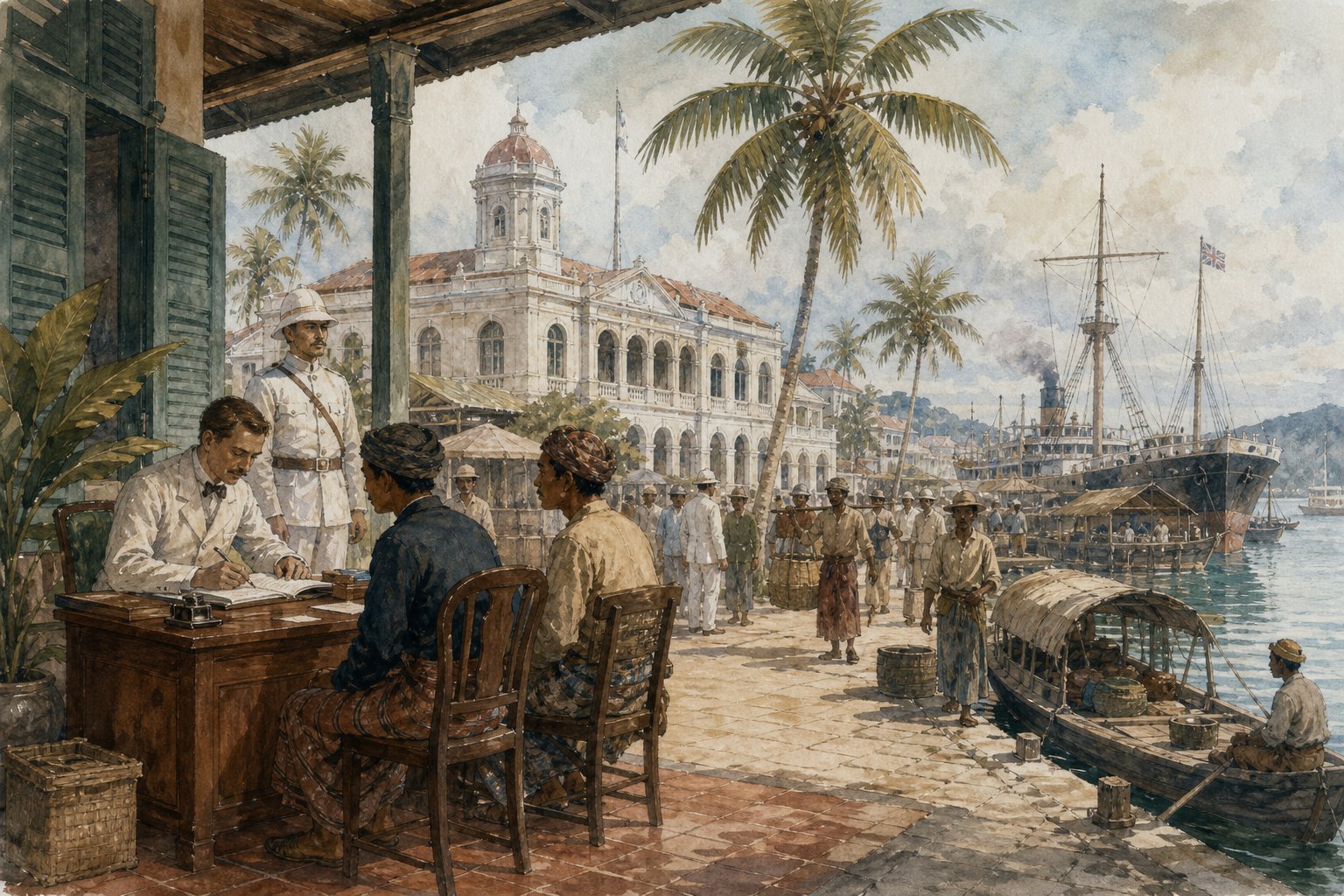
Koh - The Southeast Asian Hokkien Variant
That trailing "h" changes everything. If you carry the last name Koh on your identity card, your family's story almost certainly passes through Southeast Asia, specifically through the Hokkien and Teochew-speaking communities that settled in Singapore, Malaysia, and Indonesia generations ago. The koh surname is not a typo or a creative spelling. It is a deliberate artifact of colonial-era language recording, and it carries as much historical weight as any Pinyin standardization.
Hokkien Dialect Origins of Koh
In the Hokkien dialect (Southern Min), the character 高 is pronounced with a short, clipped vowel that sounds closer to "ko" with a slight glottal stop at the end. Unlike Mandarin's drawn-out diphthong "-ao" or Cantonese's rounded "-ou," Hokkien delivers the vowel quickly and cuts it short. Teochew, a closely related dialect spoken by many Chinese migrants to Thailand and Cambodia, produces a nearly identical sound.
This pronunciation difference is not subtle. When Hokkien speakers said their surname aloud to British colonial clerks in 19th-century Malaya and the Straits Settlements, the sound they produced was distinctly different from what Cantonese or Mandarin speakers offered. The clerks needed a way to capture that clipped quality on paper, and the solution they reached shaped the koh last name for generations to come.
Colonial Romanization and Why the H Was Added
So what is the name of Koh, and why does it end with that extra letter? The answer lies in British romanization conventions of the 1800s. Colonial administrators in Penang, Singapore, and Malacca used the trailing "-h" as a diacritical marker. It signaled one of two things: either a short, abrupt vowel (as opposed to a long, drawn-out one) or a glottal stop quality at the end of the syllable.
This convention was not unique to surnames. You'll find it across Southeast Asian place names and personal names recorded during the same period. The "-h" told English-speaking readers that the vowel should be pronounced short and sharp, not elongated. It distinguished "Koh" from a hypothetical "Ko" that might be read with a longer, more open vowel by English speakers unfamiliar with Chinese phonology.
Once these spellings appeared on official registration documents, they became permanent. The Straits Settlements civil registration system, established in the 1860s, recorded Chinese names in romanized form based on dialect pronunciation. Children inherited their father's registered spelling. By the time Singapore gained independence in 1965 and Malaysia in 1957, millions of identity documents already carried the Koh spelling. Changing it would have required legal name-change proceedings, so most families simply kept what the colonial system gave them.
Where Koh Is Most Common Today
The koh last name origin traces a clear geographic arc across maritime Southeast Asia. You'll encounter it most frequently in:
- Singapore - Where Hokkien speakers form the largest Chinese dialect group and the koh name appears on national identity cards, passports, and military records
- Malaysia - Particularly in Penang, Malacca, and Johor, where Hokkien and Teochew communities established deep roots during the tin mining and rubber plantation eras
- Indonesia - Among Peranakan and Hokkien-descended Chinese Indonesians, though Indonesian naming policies have sometimes obscured Chinese surnames
- Diaspora communities - Singaporean and Malaysian emigrants in Australia, the UK, and North America who carry their Southeast Asian documents abroad
Notable bearers of the name Koh span politics, business, and the arts across the region. The spelling signals a specific migration story: ancestors who left Fujian province (or eastern Guangdong, in the case of Teochew speakers) and landed in the Nanyang, the "Southern Seas" that Chinese migrants called Southeast Asia.
Pros
- Standard and immediately recognized in Singapore and Malaysia, where government systems expect it
- Reflects authentic Hokkien pronunciation of 高, preserving dialect heritage
- Well-established in Southeast Asian civil records spanning over 150 years
- Distinguishes Hokkien-origin families from Cantonese "Ko" bearers, adding genealogical specificity
Cons
- Unfamiliar outside Southeast Asia, often prompting questions about pronunciation or origin
- Sometimes confused with unrelated surnames or even place names (Koh Samui, for instance, uses a Thai word meaning "island")
- Not recognized by Pinyin-based systems, which may fail to connect Koh records with Gao records in genealogy databases
- The trailing "-h" leads some people to mispronounce it as "kaw" or add an aspirated breath that does not belong
For families carrying the last name Koh, the spelling is more than a bureaucratic accident. It encodes a specific dialect, a specific migration route, and a specific colonial encounter. It tells you that someone's ancestors spoke Hokkien, landed in British-administered Southeast Asia, and had their name written down by a clerk who used "-h" to mark a short vowel. That is a remarkable amount of history packed into three letters.
Yet Koh is not the only variant that emerged from these same migration waves. Some families from the same Hokkien-speaking villages ended up with "Koo" on their documents, while others in the Philippines received "Go." These lesser-known spellings carry their own stories of dialect, destination, and documentation.
Koo, Go, and Gow - Lesser-Known Variants of 高
Not every bearer of 高 ended up with Gao, Ko, or Koh on their documents. Depending on which port they arrived at, which clerk processed their papers, and which decade they immigrated, some families received spellings that look nothing like the standard forms. These variants are rarer, but they carry just as much genealogical significance. If you've been searching for the koo last name origin or wondering about the last name Go origin, the answers lie in specific dialect pronunciations meeting specific bureaucratic systems at specific moments in history.
Koo - The Older Cantonese Diaspora Spelling
The last name Koo appears most often among Cantonese families who settled abroad before the mid-20th century. It represents an older romanization convention where the Cantonese pronunciation of 高 was transcribed with a double-o to indicate the vowel quality. Where later systems produced "Ko," earlier English-speaking transcribers heard a rounder, more closed vowel and reached for "oo" to capture it.
You'll notice the koo last name concentrated in communities that established themselves during the gold rush era in North America and the early trading networks in Australia and New Zealand. These families registered their names decades before any standardized Cantonese romanization existed. The clerk's ear was the only system, and "Koo" was what that ear produced.
- Origin dialect: Cantonese, specifically older transcription conventions for the vowel in 高
- Primary geographic region: Older Cantonese diaspora communities in the United States, Canada, Australia, and New Zealand
- Current usage status: Declining among younger generations who may switch to Ko or Gao, but still present on legacy documents, family business names, and gravestones in historic Chinatowns
The koo last name is essentially a snapshot of how 19th-century English speakers heard Cantonese. It is neither wrong nor outdated. It simply reflects a different era's approach to writing down sounds that had no agreed-upon English spelling.
Go - Filipino-Chinese and Revised Korean Romanization
The go last name sits at another interesting crossroads. In the Philippines, Chinese immigrants (predominantly Hokkien speakers from Fujian province) had their surnames recorded under Spanish colonial conventions. Spanish phonology does not use the letter "K" as frequently as English does, and the unaspirated velar stop in Hokkien 高 mapped naturally to the Spanish "G." The vowel reduction from "-ao" to "-o" completed the transformation, producing "Go" as the standard Filipino-Chinese rendering.
This is why the last name Go origin traces directly to Hokkien pronunciation filtered through Spanish orthography. Families named Go in the Philippines almost always descend from Fujian province migrants who arrived during the Manila Galleon trade era (1565-1815) or the subsequent waves of Chinese commerce in the Spanish and American colonial periods.
The same spelling appears in Korean contexts for a different reason. South Korea's Revised Romanization system, adopted in 2000, renders 고 as "Go" rather than the older McCune-Reischauer "Ko." Younger Korean bearers and official government documents increasingly use "Go," while older passports and diaspora communities retain "Ko." This means the go last name can point to either Filipino-Chinese or Korean heritage depending on context.
- Origin dialect/language: Hokkien (via Spanish orthography) for Filipino-Chinese families; Korean 고 under Revised Romanization for Korean families
- Primary geographic region: Philippines (Filipino-Chinese community), South Korea (younger generation and post-2000 documents)
- Current usage status: Very common in the Philippines where Go ranks among the most frequent Chinese-Filipino surnames; growing in Korean usage as Revised Romanization replaces McCune-Reischauer on official documents
Gow and Other Historical Variants
Imagine arriving at a U.S. port in the 1890s, speaking only Cantonese, and having an immigration inspector transcribe your surname based on a brief verbal exchange conducted through an interpreter. The spelling that ended up on your entry papers became your legal identity in America, whether or not it matched any recognized system. This is how "Gow" entered the record.
The variant "Gow" appears in Chinese Exclusion Act case files held at the National Archives. The Chinese Exclusion Act of 1882 required all ethnic Chinese to apply for entry and re-entry into the United States, generating extensive documentation. Case files contained identification photographs, transcripts of interrogations, and personal information, all indexed under whatever romanization the processing officer chose. The surname 高, when spoken in certain Cantonese sub-dialects (particularly Toisanese, the dialect of most early Chinese immigrants to North America), could sound like "Gow" to an American ear unfamiliar with tonal languages.
These spellings became permanently fixed. The Act was enforced from 1882 until its repeal by the Magnuson Act of 1943, meaning over sixty years of Chinese-American immigration records contain non-standard romanizations that families still carry today. Children inherited their father's registered spelling. Subsequent departures and returns referenced the original case file, reinforcing whatever spelling appeared on the first document.
- Origin dialect: Toisanese and other Cantonese sub-dialects, as heard and transcribed by American immigration officials
- Primary geographic region: United States, particularly California, Oregon, and Washington state, where major ports processed Chinese arrivals
- Current usage status: Rare among younger generations but preserved in family records, historic documents, and some established family businesses; largely replaced by Ko or Gao in modern usage
Other uncommon variants include "Gaw" (another phonetic approximation from the Exclusion Act era), "Kao" (Wade-Giles romanization still used in Taiwan), and "Kou" (an occasional Mandarin variant reflecting regional accent). Each tells the same story: a moment in time when a living pronunciation met a foreign writing system, and the result became permanent.
These lesser-known spellings highlight a fundamental challenge for anyone researching 高 lineages. The romanization on a document tells you where and when a name was recorded, but it does not always tell you which Chinese character sits behind it. That ambiguity becomes a serious problem when you realize that Ko, Koh, Koo, and Go can each derive from entirely different characters with unrelated meanings and lineages.
When Ko Does Not Mean 高 - A Disambiguation Guide
Here is the uncomfortable truth that trips up most surname researchers: the name Ko, the surname Koh, and even the surname Koo do not always trace back to 高. These same romanizations can represent completely different Chinese characters with unrelated meanings, unrelated ancestral origins, and unrelated clan histories. If you have been building a family tree based solely on the English spelling of your surname, you may be connecting branches that belong to entirely different forests.
Other Characters That Romanize to Ko
The problem is structural. Southern Chinese dialects compress many distinct syllables into a narrow range of sounds, and colonial-era romanization systems lacked the precision to distinguish between them. The result is that a single English spelling can map to half a dozen different characters. Ancestry's Dictionary of American Family Names lists the surname Koh as a variant romanization for an extensive range of source characters, including 高, 柯, 葛, 古, 顧, 辜, 寇, 苟, 許, 邱, 丘, and 郭.
That is not a minor overlap. These characters represent completely different families with different ancestral homelands, different founding stories, and different genealogical records. Someone carrying the go surname in the Philippines might descend from 高 (tall/high), but they could equally descend from 吳 or 伍 depending on their specific family history. The name Ko on a Hong Kong identity card could point to 高, 柯, or 古, each with its own clan hall and ancestral village.
The following table covers the most common source characters that produce Ko, Koh, or Koo in English:
| Chinese Character | Meaning | Common Romanizations | Primary Dialect/Region | How to Distinguish |
|---|---|---|---|---|
| 高 | Tall, high | Gao, Ko, Koh, Koo, Go, Gow | All major dialects; Mandarin-speaking regions, Cantonese, Hokkien, Korean | Ancestral connection to Shandong province or the ancient state of Qi |
| 柯 | Axe handle, branch | Ke, Ko, Koh, Kua | Hokkien and Teochew; Fujian, Southeast Asia | Ancestral villages in Fujian (especially Quanzhou); clan halls reference 柯 explicitly |
| 葛 | Kudzu vine | Ge, Ko, Koh | Cantonese; Guangdong, Hong Kong | Ancestral connection to Anhui or Jiangsu province; less common than 高 |
| 古 | Ancient, old | Gu, Koo, Ko, Koh | Hokkien and Hakka; Fujian, Guangdong, Southeast Asia | Hakka-speaking family background; ancestral villages in Meizhou or eastern Guangdong |
| 顧 | To look back, to care for | Gu, Koo, Ko | Hokkien and Teochew; Fujian, Southeast Asia | Ancestral connection to Jiangsu (especially Wuxi); relatively rare surname |
| 辜 | Crime, guilt | Gu, Koo, Koh | Hokkien; Fujian, Southeast Asia | Strong association with Penang, Malaysia (the Koh/Koo families of Penang often trace to 辜) |
| 郭 | Outer city wall | Guo, Kwok, Koh, Kuek | Hokkien and Teochew; Fujian, Southeast Asia | Very common surname; ancestral connection to Shanxi or Henan province |
| 許 | To permit, to promise | Xu, Hsu, Koh, Ko | Teochew and Hokkien; eastern Guangdong, Fujian | Ancestral villages in Chaozhou or Zhangzhou; one of the most common Teochew surnames |
Notice how the surname Koh alone could represent 高, 柯, 葛, 古, 顧, 辜, 郭, or 許. Without the original Chinese character, the English spelling is genealogically meaningless.
How to Identify Your Family's Original Character
So how do you figure out which character your family actually carries? The romanization on your passport or birth certificate will not tell you. You need to look deeper. Here are the most reliable methods:
- Ask older relatives directly - Grandparents or great-aunts who grew up in Chinese-speaking environments often know the character, even if they cannot write it. Ask them to identify it from a list or write it by hand.
- Check ancestral tablets or altar inscriptions - Family altars, gravestone inscriptions, and ancestral hall records almost always use Chinese characters rather than romanizations.
- Locate your clan's genealogy book (zupu/jokbo) - These records, maintained by clan associations, list family members under the correct character. Many Southeast Asian clan associations maintain registries organized by source character.
- Examine old immigration documents - Some colonial-era records include the Chinese character alongside the romanization, particularly in Singapore and Malaysia where bilingual registration was common.
- Cross-reference with ancestral village location - If you know your family's village of origin in China, the dominant surname character in that village narrows the possibilities significantly.
- Consult dialect pronunciation - A Hokkien speaker pronouncing 柯 says "Kua" or "Ko" with a different tone than 高. If any family member still speaks the heritage dialect, the tonal difference can distinguish characters that look identical in English.
Why Disambiguation Matters for Genealogy
Imagine you are searching for relatives on a genealogy platform. You enter the surname Koo and find hundreds of matches. Without knowing whether your family's Koo derives from 高, 古, or 顧, you cannot determine which of those matches actually belong to your lineage. You might spend months corresponding with a family that shares your English spelling but descends from an entirely different ancestor in an entirely different province.
This is not a hypothetical problem. DNA testing services have revealed cases where families assumed they were related based on shared romanized surnames, only to discover through genetic evidence that their characters (and therefore their lineages) were completely different. The reverse also happens: families with different English spellings like Gao and Koh discover through DNA that they share recent common ancestors, because both spellings derive from the same 高 character split by dialect and migration.
For anyone serious about tracing their roots, the first step is always identifying the original character. The romanization is a clue to dialect and geography, but it is not an identity. It is a translation, and like all translations, it loses information in the process.
With the disambiguation challenge in focus, the next logical step is seeing all the confirmed variants of 高 side by side, stripped of ambiguity and organized for direct comparison.
Head-to-Head Comparison of Every Gao and Ko Variant
You have seen each variant individually. You know the dialect origins, the colonial histories, and the bureaucratic accidents that produced them. But when you are staring at a genealogy database trying to figure out which spellings to search, or when you are explaining to a confused relative why your surnames look different, you need everything in one place. This is that reference.
Complete Romanization Comparison Table
The following table consolidates every major romanization of the Chinese character 高 (and the Korean surname 고) into a single comparison. Each entry represents a confirmed variant that appears on official documents, genealogy records, or immigration files. If your family spells the surname Ko, Koh, Gao, or any other form listed here, this table tells you exactly where that spelling came from and where it concentrates today.
| Spelling | Source Dialect/Language | Romanization System | Primary Regions of Use | Approximate Bearers | Official Recognition Status |
|---|---|---|---|---|---|
| Gao | Mandarin Chinese | Hanyu Pinyin (1958) | Mainland China, post-1980s diaspora worldwide | ~17 million (as 高 in China) | ISO standard; used on all PRC passports and official documents |
| Ko | Cantonese | Hong Kong Government Romanisation | Hong Kong, Macau, older Cantonese diaspora (Vancouver, Sydney, London) | Subset of ~17 million; concentrated in Hong Kong and Guangdong diaspora | Standard on Hong Kong identity cards and passports |
| Ko/Go (Korean 고) | Korean | McCune-Reischauer (Ko) / Revised Romanization (Go) | South Korea, Korean diaspora in the US, Canada, Australia | ~470,000 in South Korea | Official under South Korean passport system; both Ko and Go accepted |
| Koh | Hokkien / Teochew | Colonial British romanization (Straits Settlements) | Singapore, Malaysia, Indonesia, Southeast Asian diaspora | Significant portion of Hokkien-descended Chinese in Southeast Asia | Standard on Singapore and Malaysian identity documents |
| Koo | Cantonese (older transcription) | Informal / pre-standardization English transcription | Older Cantonese diaspora in the US, Canada, Australia, New Zealand | Small; declining as younger generations adopt Ko or Gao | Legacy recognition only; no current government system produces this spelling |
| Go | Hokkien (via Spanish orthography) / Korean (Revised Romanization) | Spanish colonial transcription / South Korean Revised Romanization (2000) | Philippines (Filipino-Chinese community), South Korea | Common among Filipino-Chinese; growing in Korean usage | Standard in Philippine civil records; official in South Korean government documents |
| Gow | Toisanese / Cantonese sub-dialects | Ad hoc transcription by US immigration officials | United States (California, Oregon, Washington) | Rare; limited to families with Chinese Exclusion Act-era records | No official system; historical artifact preserved in US National Archives case files |
| Kao | Mandarin Chinese | Wade-Giles (1892) | Taiwan, older academic publications, pre-1980s diaspora | Subset of Mandarin speakers; concentrated in Taiwan | Standard on Taiwanese passports (alongside other Wade-Giles-based systems) |
A few things jump out immediately. The surname Ko alone maps to three separate origins: Cantonese Chinese, Korean, and (in older records) even Hokkien. The spelling "Go" similarly straddles two unrelated linguistic traditions. Only "Gao" and "Kao" point unambiguously to Mandarin Chinese pronunciation of 高, which is why these spellings cause the least confusion in genealogy databases.
Geographic Distribution Patterns
When you plot these variants on a map, clear regional clusters emerge. Each spelling tells you not just what dialect someone's ancestors spoke, but where their migration journey landed them.
- East Asia (origin regions) - Gao dominates mainland China. Kao persists in Taiwan. Ko/Go splits between Hong Kong (Cantonese) and South Korea (Korean 고). The korea last name system treats 고 as entirely independent from Chinese 高, with its own clan registries and genealogical infrastructure.
- Southeast Asia - Koh is the dominant spelling in Singapore and Malaysia, reflecting Hokkien migration patterns. Go prevails in the Philippines. The goh last name origin (a variant of Koh sometimes seen in Malaysian records) traces the same Hokkien path but with slightly different colonial transcription conventions.
- North America - All variants coexist, reflecting successive waves of immigration. Gow and Koo appear in 19th-century records. Ko shows up in mid-20th-century Cantonese immigrant communities. Gao dominates among post-1980s arrivals from mainland China. Korean Ko/Go concentrates in areas with large Korean-American populations like Los Angeles and New York.
- Australia and New Zealand - Koo appears in gold rush-era records. Ko is common among Hong Kong emigrants who arrived in the 1970s-1990s. Gao is standard among recent mainland Chinese arrivals. Koh appears among Singaporean and Malaysian emigrants.
- Europe - Gao is most common, reflecting the predominance of post-reform mainland Chinese immigration. Ko appears in the UK, where Hong Kong emigrants settled before and after the 1997 handover.
The pattern is consistent: earlier migration waves produced more variant spellings because no standardized system existed. Later waves converged on Gao (for mainland Chinese) or the official romanization of whatever country issued the passport. The surname of Korean bearers follows its own trajectory entirely, with Ko gradually giving way to Go on newer documents as South Korea's Revised Romanization gains ground.
What does this mean practically? If you are searching for relatives and you know your family left Fujian province for Singapore in the 1900s, search for Koh. If they went to the Philippines during the same period, search for Go. If they stayed in China and emigrated after 1980, search for Gao. The spelling is a timestamp and a GPS coordinate compressed into three or four letters.
Every variant of 高 listed in this table shares common ancestry tracing back to the ancient state of Qi in Shandong province. The spelling differences reflect where descendants ended up, not who they descended from.
Knowing which variant to search for is one thing. Deciding which variant to use on your own documents, especially when your family history spans multiple spellings, is a different challenge entirely, one that involves practical, legal, and deeply personal considerations.

Choosing the Right Romanization for Your Family
Knowing the history behind each spelling is one thing. Deciding what goes on your child's birth certificate, your passport renewal, or your immigration application is something else entirely. For diaspora families straddling multiple countries and dialect traditions, this choice carries weight that goes beyond paperwork. It touches identity, belonging, and how you want future generations to connect with their roots.
Matching Your Spelling to Your Dialect Background
Your surname spelling is a statement about which branch of the family tree you claim. A Hokkien-speaking family from Penang choosing to switch from Koh to Gao gains database compatibility but loses a visible link to their Southeast Asian heritage. A Korean family debating whether to use Ko or Go on a new passport is navigating a shift between two official systems, each carrying different generational associations. Understanding korean surnames and meanings helps contextualize why these choices feel so personal: in Korea, surnames encode clan identity, ancestral seat, and even social history in ways that a simple romanization cannot fully capture.
The following step-by-step process helps you think through the decision systematically:
- Identify your family's original character. Confirm whether your surname derives from 高, 고, 柯, or another character entirely. Everything else depends on this.
- Determine your dialect background. Which Chinese dialect (or Korean) did your grandparents speak? The spelling that matches their pronunciation preserves the most authentic connection.
- Check existing family documents. If your parents, siblings, and cousins all use Koh, switching to Gao creates inconsistency that complicates legal matters like inheritance, property transfers, and sponsorship applications.
- Consider your country of residence. Singapore expects Koh. Mainland China issues Gao. Taiwan produces Kao. South Korea now favors Go over Ko. Aligning with your country's system simplifies bureaucratic interactions.
- Weigh genealogical discoverability. If connecting with distant relatives matters to you, consider which spelling they are most likely searching under. DNA matching platforms are surname-agnostic, but traditional genealogy databases are not.
- Acknowledge the emotional dimension. A surname is not just a database entry. It is how you introduce yourself, how your children will identify, and how your family story gets told. Choose the spelling that feels like home.
Practical Tips for Official Documents and Passports
Legal systems are less forgiving than family reunions. A few practical realities to keep in mind:
- Most countries do not allow you to change your surname spelling on a passport without a formal legal name change. If your current documents say Koh, that is your legal identity regardless of what Pinyin would produce.
- When applying for citizenship or permanent residency in a new country, consistency across all documents (birth certificate, marriage certificate, academic transcripts) matters more than linguistic accuracy.
- If you are naturalizing and have the option to choose a romanization, pick one spelling and use it everywhere. Mixing Ko on your passport with Gao on your driver's license creates verification headaches.
- For Korean families navigating English-language systems, remember that in korea is the last name first. When filling out Western forms that ask for "last name," your surname (Ko, Go, or Gao) goes in that field, not your given name. This seems obvious, but the question "are korean last names first" comes up frequently because the reversed order on Korean documents causes real confusion at immigration counters.
Connecting With Relatives Across Spelling Variants
The most important thing to remember when searching for family across different romanizations is this: spelling variants are a feature of migration, not a sign of different ancestry. Your cousin in Singapore spells it Koh. Your uncle in Hong Kong writes Ko. Your nephew in Beijing uses Gao. They all descend from the same ancestor who bore the character 高 in the same ancestral village.
When searching genealogy databases, cast a wide net. Search for every variant listed in the comparison table: Gao, Ko, Koh, Koo, Go, Gow, and Kao. DNA testing platforms bypass the spelling problem entirely by matching genetic markers rather than surnames, making them particularly valuable for families fragmented across multiple romanization systems. Clan associations, especially those organized by the original Chinese character rather than any single romanization, remain one of the best resources for reconnecting branches that spelling differences have separated.
All variants of 高 share common ancestry regardless of spelling. The character on your family altar is the same whether your passport says Gao, Ko, Koh, or Go.
Korean last name meanings and Chinese surname origins operate through different genealogical systems, but the underlying principle is identical: the written character (高 or 고) is the true identifier, and the romanization is simply the clothing it wears in English. Choose the clothing that fits your family's story, keep your documents consistent, and never let a spelling difference convince you that a relative is a stranger.
Frequently Asked Questions About Gao vs Ko Surname
1. Are Gao and Ko the same surname?
Yes, in most cases Gao and Ko represent the same Chinese character 高. The difference is purely a matter of romanization. Gao comes from the Mandarin Pinyin system adopted by mainland China in 1958, while Ko reflects Cantonese pronunciation as recorded under Hong Kong Government Romanisation. Both trace back to the ancient state of Qi in Shandong province. However, Ko can also represent the Korean surname 고, which has independent origins tied to the Goguryeo kingdom, so context matters when determining lineage.
2. Why do some families spell the surname Koh instead of Ko or Gao?
The Koh spelling originated from British colonial romanization practices in Southeast Asia during the 1800s. When Hokkien-speaking Chinese immigrants in Singapore, Malaysia, and Indonesia pronounced 高, British clerks added a trailing '-h' to indicate the short, clipped vowel quality of the Hokkien dialect. Once recorded on official registration documents in the Straits Settlements, the spelling became permanent and was inherited by subsequent generations. Today, Koh remains standard on identity documents throughout Singapore and Malaysia.
3. How can I tell if my Ko surname is Chinese or Korean?
Several contextual clues help distinguish Chinese Ko (高) from Korean Ko (고). Korean names typically feature a two-syllable given name and follow surname-first order, while Cantonese names often use a single romanized given name or hyphenated pair. Geographic background is the strongest indicator: families from Hong Kong or Guangdong carry the Cantonese version, while families from Korea carry 고. Checking ancestral records is definitive since Chinese families reference ancestral halls in southern China, whereas Korean families reference clan seats like Jeju or Gaeseong.
4. Can the surname Ko come from a different Chinese character than 高?
Absolutely. The romanization Ko, Koh, or Koo can derive from multiple unrelated Chinese characters including 柯 (axe handle), 葛 (kudzu vine), 古 (ancient), 顧 (to care for), 辜 (guilt), and 郭 (outer wall). Each has its own ancestral origin, clan history, and geographic associations. Without knowing the original Chinese character, the English spelling alone cannot confirm lineage. Consulting older relatives, ancestral tablets, clan genealogy books, or old immigration documents that include Chinese characters is essential for accurate identification.
5. Should I change my surname spelling from Koh or Ko to Gao for consistency?
This depends on your priorities. Switching to Gao improves database compatibility with modern Chinese systems but creates inconsistency with existing family documents and may complicate legal matters like inheritance or immigration sponsorship. Most countries require a formal legal name change to alter passport spellings. If your parents and siblings all use Koh or Ko, maintaining that spelling preserves family continuity and your Southeast Asian or Cantonese heritage. The key principle is consistency across all your official documents, regardless of which variant you choose.