What the Guo Surname Means and Why It Matters
Imagine tracing your family name back over 3,000 years to the defensive walls of an ancient Chinese city. That is exactly the story behind the Guo surname (郭), one of the most historically layered family names in the Chinese-speaking world. Whether you spell it Guo, Kwok, Kuo, or Gwak, the roots lead to the same place: a character that once described the outer fortifications protecting entire communities.
The guo surname origin is not a single, tidy narrative. It branches across royal lineages, ancient feudal states, ethnic adoptions, and geographic associations. Understanding which branch your family belongs to can unlock centuries of migration history and ancestral connections that would otherwise remain hidden.
Is Guo a Chinese Last Name
Yes. The Guo last name is one of the most common Chinese surnames in existence. It currently ranks among the top 20 in mainland China, with an estimated 14.9 million people carrying it. That places it ahead of many surnames Westerners might recognize more readily. If you have encountered the spelling Kwok in Hong Kong or Kuo in Taiwan, you have already met this surname in its regional variations.
Chinese surnames carry a history stretching back more than 4,000 years, and finding your specific surname is often the first step to uncovering your family's deeper heritage. The Guo family name is no exception. Its bearers span every province of China and dozens of countries across the globe.
Why Understanding Guo Surname Origin Matters
Knowing where a surname comes from is more than trivia. In Chinese genealogical tradition, families and clans maintained their own documentation rather than relying on centralized records. Your surname reveals your clan's history, migration patterns, and present-day distribution.
In Chinese culture, a surname is not merely an identifier. It is a living thread connecting you to specific ancestors, ancestral lands, and a lineage that may stretch back to the founding of dynasties.
For the Guo surname specifically, at least four distinct origin branches exist, each tied to different time periods, geographic regions, and even ethnic groups. No single English-language resource has previously unified all of these branches with the depth found in Chinese-language scholarship. This article changes that, walking you through every documented lineage from the earliest records to modern diaspora communities.
The story begins, fittingly, with a wall. Specifically, with the Chinese character 郭 itself and what it originally meant before it ever became anyone's family name.
The Character 郭 and Its Ancient City Wall Etymology
Every Chinese character tells a story, and the guo meaning embedded in 郭 is remarkably concrete. Before it identified millions of families, this character described something you could touch, climb, and defend: the outer wall surrounding an ancient city. Understanding this original sense is the key to grasping how a piece of urban architecture became a hereditary surname carried across continents.
The Outer City Wall Meaning of 郭
In ancient Chinese urban planning, cities were protected by two concentric rings of fortification. The inner wall was called 城 (cheng), enclosing the administrative and royal core. The outer wall, wrapping around the broader residential and commercial districts, was called 郭 (guō). Think of it as the difference between a castle keep and the town wall that sheltered everyone else.
The character 郭 in Chinese is composed of two parts. On the right side sits the radical 阝, a compressed form of 邑, which signals a connection to cities, territories, or settlements. The left component, 享, serves primarily as a phonetic indicator, guiding pronunciation. Together, these elements form a char in Chinese writing that literally points to a place, specifically the defensive outer perimeter of a walled settlement.
Historical records from the Tang dynasty capital Chang'an illustrate this distinction clearly. The city comprised three layers: the palace city (宫城), the imperial city (皇城), and the outer city (郭城). That outermost ring, the 郭城, housed ordinary residents and bustling markets. Both the simplified form 郭 and the traditional form 郭 remain identical, making this one of the characters unchanged by China's script reforms.
The classical text Shuowen Jiezi defines 郭 as "the outer wall of a city" (城外之墙), distinguishing it from 城, which refers to the inner fortification protecting the ruler's domain.
How a Word for Walls Became a Family Name
So how does a word for masonry and rammed earth become someone's identity? The transition happened in stages during the Zhou dynasty period (1046-256 BC), following a pattern common to many Chinese surnames.
First came geographic association. Families living near or just outside the outer walls of a city were naturally described by their location. "The people of the guo" was a practical label, much like English surnames such as Wall or Gates originated from proximity to physical structures.
Next came occupational identity. Those tasked with guarding, maintaining, or patrolling the outer fortifications became further linked to the term. In an era when cities were fortified with outer defensive walls, the people responsible for those walls carried real social standing.
Finally, as hereditary surnames crystallized across Chinese society during the Western Zhou and Spring and Autumn periods, these geographic and occupational labels solidified into permanent family names passed from father to child. The architectural term became a lineage marker.
This geographic-to-surname pipeline also produced compound forms. Families identified by their position relative to the walls took names like Dongguo (East Wall), Nanguo (South Wall), Xiguo (West Wall), and Beiguo (North Wall). Over centuries, many of these compound surnames simplified down to a single character: 郭.
Yet the geographic explanation is only one thread. The most prominent and historically documented origin of the Guo surname traces not to anonymous wall-dwellers, but to specific royal states granted by Zhou dynasty kings to their own relatives, states whose very name would outlive their borders by millennia.
Ancient Guo States During the Western Zhou Dynasty
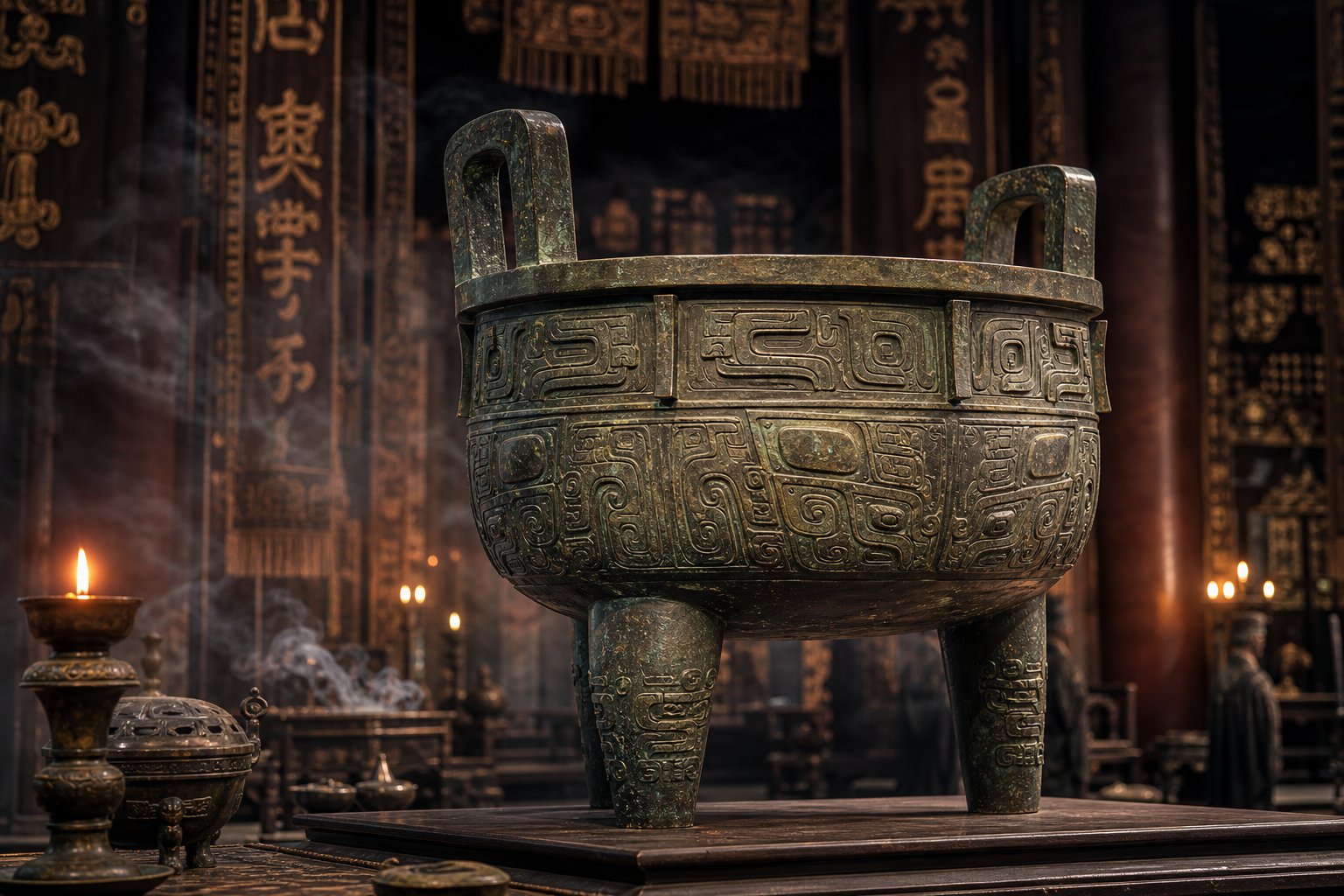
Royal states, not just city walls, gave the Guo last name origin its most prestigious lineage. When the Zhou dynasty consolidated power around 1046 BC, its kings rewarded loyal relatives with feudal territories. Two of those territories carried the name 虢 (Guo), and their eventual destruction would scatter a surname across China for the next three millennia.
Eastern Guo and Western Guo of the Zhou Dynasty
King Wen of Zhou had two sons, Guo Zhong (虢仲) and Guo Shu (虢叔), who were younger brothers of King Wu, the dynasty's founder. Each received a feudal state bearing the name Guo (虢) as a reward for their role in establishing Zhou rule.
Guo Shu was enfeoffed in Western Guo (西虢), situated in what is now Baoji, Shaanxi province, placing it squarely in the Zhou heartland near the dynasty's own capital. Guo Zhong received Eastern Guo (东虢), located near modern Xingyang in Henan province, positioned to guard the eastern approaches to Zhou territory.
These were not minor holdings. Both states served as strategic buffers protecting the Zhou royal domain. Their rulers held the title of gong (公), the highest noble rank, and participated directly in royal court affairs. Over time, Western Guo relocated eastward, splitting into what historians call Northern Guo (北虢) in modern Shanxi and Southern Guo (南虢) near Sanmenxia in Henan. The result was a cluster of related Guo states stretching across north-central China.
The Annexation That Created a Surname
Feudal states rarely last forever. As Zhou royal authority weakened during the Spring and Autumn period (770-476 BC), larger states swallowed smaller neighbors. Eastern Guo fell first, annexed by the rising state of Zheng around 767 BC. The remaining Guo territories survived longer but met the same fate. In 655 BC, the powerful state of Jin absorbed both Northern and Southern Guo in a campaign still referenced in Chinese idioms today.
When these states collapsed, their royal families and common residents alike lost their homeland. What they kept was the name. Displaced nobles and commoners adopted their former state's name as a hereditary surname, a practice common across the Zhou feudal system. Imagine losing your country but carrying its identity forward through every generation that follows.
Here is where the character shift matters. The ancient states were written as 虢, but the surname that emerged was written as 郭 (kuo in Wade-Giles romanization). Both characters share the same pronunciation (guó), and historical linguists consider 郭 a phonetic simplification that gradually replaced 虢 in everyday use. If you carry the surname 郭 today, the kuo last name origin traces back to these very states, regardless of which romanization your family uses.
| State Name | Location (Modern) | Founded | Annexed By | Annexation Date |
|---|---|---|---|---|
| Eastern Guo (东虢) | Xingyang, Henan | c. 1046 BC | State of Zheng | c. 767 BC |
| Western Guo (西虢) | Baoji, Shaanxi | c. 1046 BC | Relocated eastward | c. 769 BC (moved) |
| Northern Guo (北虢) | Pinglu, Shanxi | c. 769 BC | State of Jin | 655 BC |
| Southern Guo (南虢) | Sanmenxia, Henan | c. 769 BC | State of Jin | 655 BC |
Each of these states produced its own branch of Guo surname descendants. Families from Eastern Guo settled in the central plains of Henan, while those from the northern and southern branches dispersed across Shanxi and beyond. The geographic spread of these founding populations set the stage for the multiple distinct lineages that the Guo surname carries to this day, each traceable to a specific state and a specific moment of loss.
Every Origin Branch of the Guo Surname Explained
The ancient Guo states account for the most famous lineage, but they are not the only source. The surname Guo is what Chinese genealogists call a "multi-origin surname" (多源姓氏), meaning several unrelated groups independently arrived at the same family name through different historical paths. If you carry the guo family name, your specific ancestry could trace to royal Zhou blood, a far older Xia dynasty clan, or simply a geographic label that stuck. Here is every documented branch, unified in one place for the first time in English.
The Ji Surname Branch From Royal Zhou Lineage
This is the largest and most historically prominent origin. The Zhou royal house carried the ancestral surname Ji (姬), and when King Wu distributed territories to his uncles Guo Zhong and Guo Shu around 1046 BC, their descendants inherited both the feudal title and, eventually, the surname itself. After the Guo states fell during the Spring and Autumn period, these displaced Ji-lineage nobles adopted 郭 as their hereditary name.
A descendant of Guo Shu named Xu (序) was later enfeoffed at Yangqu with the rank of duke, earning the title "Duke Guo." His branch settled north of Taiyuan and, from the Qin and Han dynasties onward, grew into the dominant Guo clan of Taiyuan Commandery. Chinese genealogical tradition holds that seven or eight out of every ten distinguished Guo families trace their roots to this Taiyuan branch. The Ji-surname lineage has a documented history of approximately 3,000 years.
The Ren Surname and Other Lineage Branches
Older than the Zhou connection by nearly a millennium sits the Ren (任) surname branch. The ren meaning here refers to one of the twelve ancient clan surnames from the Yellow Emperor's era. According to historical records, a descendant of the Yellow Emperor named Yuguo (禺虢) led the Ren clan and was enfeoffed at Ren (near modern Renqiu, Hebei). His descendants established a Guo state during the Xia dynasty, located northwest of present-day Liaocheng, Shandong.
This Xia-era Guo state survived through the Shang dynasty before being annexed by the state of Qi in 670 BC. Its people then adopted the state name as their surname, forming what genealogists call the Zhongshan Guo Clan. Notable early figures from this branch include Guo Ai, who served as charioteer for the legendary Yu the Great, and Guo Zhi, a minister of the Xia court. The Ren-surname branch gives the surname Guo a history stretching back at least 4,000 years, predating the Zhou dynasty entirely.
A third branch emerged independently from place names. As described in the classical text Fengsu Tongyi (Comprehensive Meaning of Customs): people who lived outside the main city wall, in the area called the 郭, simply adopted that geographic marker as their family name. Compound surnames like Dongguo (East Wall) and Xiguo (West Wall) eventually simplified to the single character 郭. Because these adoptions happened organically across many cities during the pre-Qin period, it is impossible to trace them to a single ancestor or clan origin.
A Consolidated Timeline of Guo Surname Emergence
Seeing all branches laid out chronologically makes the full picture clear. Each origin emerged at a distinct point in Chinese history, and each produced its own clan traditions and geographic concentrations:
- Xia dynasty (c. 2070-1600 BC) — Ren surname branch. Descendants of the Yellow Emperor's Ren clan establish a Guo state in Shandong. This is the oldest documented origin, giving the surname Guo a 4,000-year history.
- Western Zhou dynasty (c. 1046 BC) — Ji surname branch. King Wu enfeoffs his uncles in Eastern and Western Guo states. After their annexation during the Spring and Autumn period (767-655 BC), displaced nobles adopt 郭 as their hereditary surname. This branch produces the dominant Taiyuan Guo clan.
- Zhou and pre-Qin period — Place-name branch. Residents of outer city wall districts across northern China adopt 郭 based on where they live. Compound directional surnames (Dongguo, Nanguo, etc.) later simplify to Guo.
- Various dynasties — Ethnic minority adoptions. Hui, Manchu, Mongol, and other non-Han groups adopt the surname Guo through sinicization, transliteration, or clan name simplification across later imperial periods.
For anyone researching their own guo family name, identifying which branch applies is the critical first step. A family from the Taiyuan Guo clan carries Ji-surname royal lineage. A family tracing to Zhongshan Commandery likely descends from the older Ren branch. And families with roots in Hui Muslim communities or Manchu banner clans followed an entirely different path into the same surname, a story that deserves its own telling.

How Non-Han Ethnic Groups Adopted the Guo Name
Not every family carrying the Guo Chinese surname traces back to Zhou dynasty royalty or ancient city walls. Across centuries of cultural exchange, conquest, and integration, multiple non-Han ethnic groups independently adopted 郭 as their family name. These adoptions represent a significant but often overlooked branch of the guo surname origin, one that connects Muslim traders, Manchu banner families, and Mongol clans to the same single character.
Hui Muslim Families and the Guo Surname
Among the most well-documented cases are the Hui (回族) Muslim families of Fujian province. The Guo lineage of Baiqi Township, Huian County, traces its ancestry to Guo Deguang (郭德广), a Muslim trader presumably of foreign origin who moved to Quanzhou from Hangzhou in the early fourteenth century. His grandson, Guo Zhongyuan (1348-1422), established the family's permanent home in Baiqi Village in 1376, shortly after the Ming dynasty takeover.
How did a Muslim family end up with a Han Chinese surname? The process was gradual. Foreign Muslim merchants settling in China's coastal trading cities during the Song and Yuan dynasties often adopted local surnames to facilitate commerce and social integration. Some transliterated Arabic or Persian names into phonetically similar Chinese equivalents. Others, like the Baiqi Guos, claimed descent from the famous Tang dynasty general Guo Ziyi, linking themselves to an established Han surname group as a form of cultural camouflage during periods of persecution.
By the seventeenth century, most Baiqi Guos had abandoned Islamic practice entirely. Their genealogy records that "after the Fifth generation, the proper conduct of Islam was lost." Yet they still maintain ancestral pork taboos during rituals and preserve ancient Qur'anic manuscripts as offerings, markers of a Muslim heritage embedded within a thoroughly Guo Chinese identity. Since 1979, the Chinese government has granted Hui minority status to several of these households based on evidence of their Muslim ancestry.
Manchu, Mongol, and Korean Minority Adoptions
A completely different mechanism brought Manchu families into the Guo surname. During the Qing dynasty (1644-1912), Manchu banner families carried multi-syllable clan names that bore no resemblance to Han Chinese surnames. After the dynasty's collapse, most Manchu clans adopted single-character Chinese surnames to blend into the majority population.
Several Manchu clans chose Guo (郭) through phonetic transliteration of their original names. The Guoluoluo (郭络罗) clan is the best-known example, simplifying their lengthy clan name down to its first syllable. Historical records also document the Aru (阿噜氏), Barhu (巴尔虎氏), and Bultu (布尔图氏) clans as adopting Guo among their Chinese surname options. In each case, the choice was driven by phonetic similarity between part of the Manchu clan name and the Chinese character 郭.
Mongol families followed a similar pattern. Banner families of Mongol descent who had served within the Qing military system adopted Han surnames after 1912, with some choosing Guo based on transliteration of their original clan names. Ethnic Korean families in northeastern China (朝鲜族) also adopted Guo in some cases, though the Korean reading of 郭 is Gwak (곽), which already functioned as a native Korean surname with its own lineage traditions.
What ties all these adoptions together is a shared process: families from distinct cultural backgrounds converging on the same written character for different reasons at different times. A Hui Muslim trader in fourteenth-century Quanzhou, a Manchu bannerman in early twentieth-century Beijing, and a Mongol herder registering a new surname after the Qing collapse all arrived at 郭 through separate paths. The result is that the modern Guo surname encompasses far more ethnic diversity than its ancient Zhou dynasty origins might suggest.
This diversity also explains why the same surname appears in so many different romanized forms across East Asia, each spelling reflecting a distinct linguistic tradition and regional history that carried 郭 far beyond China's borders.
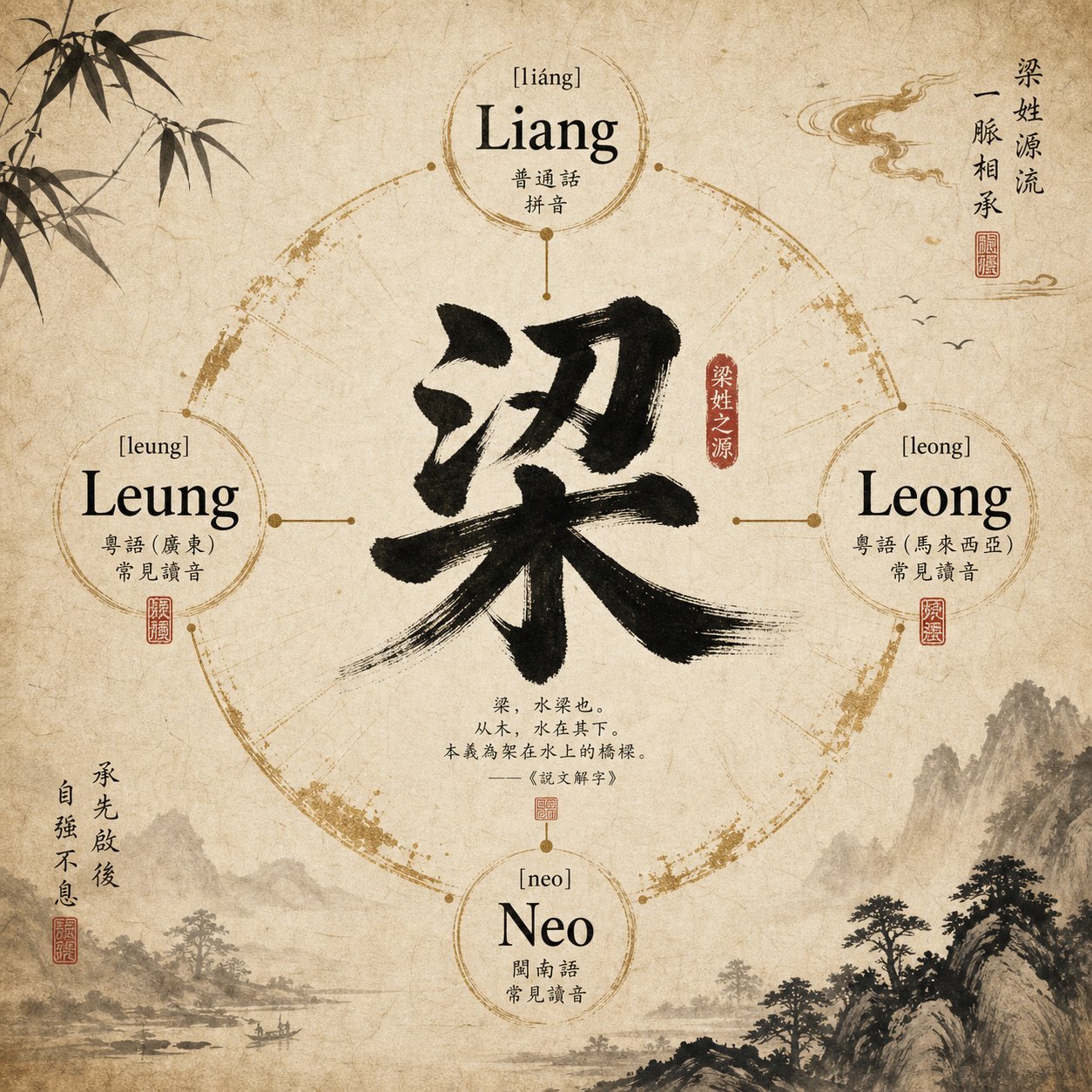
From Guo to Kwok and Gwak: Romanizations Worldwide
One surname, one character, and yet a dozen different spellings scattered across passports, business cards, and family records around the world. If you have ever wondered whether Kwok, Kuo, Kuok, and Guo are the same name, the answer is yes. They all represent 郭, filtered through different languages, dialects, and transliteration systems. For diaspora families researching the kwok last name origin or trying to connect a kuo surname on an old immigration document to living relatives, understanding these variants is essential.
Kwok, Kuo, Kuok, and Other Chinese Romanizations
Chinese is not one spoken language but many. The same written character 郭 sounds different depending on which dialect or regional language a family speaks, and each sound gets its own romanized spelling when written in the Latin alphabet.
Here is how the major variants break down:
- Guo — the Hanyu Pinyin standard used in mainland China since the 1950s. If your family emigrated after the People's Republic adopted Pinyin for passports, this is likely your spelling.
- Kuo — the Wade-Giles romanization, which was the international standard before Pinyin. Families from Taiwan still commonly use this form, and older academic texts reference the last name Kuo in historical contexts. You will also see it on immigration records from the early and mid-twentieth century.
- Kwok — the Cantonese pronunciation, romanized using the system common in Hong Kong. The Cantonese reading of 郭 is "gwok3," and Kwok became the standard spelling for Hong Kong identity documents. Families who emigrated from Guangdong province or Hong Kong before the 1997 handover typically carry this spelling.
- Kuok — a Hokkien or Teochew romanization found primarily among Chinese communities in Malaysia, Singapore, and the Philippines. The koo last name origin question often leads back to this same character, as some families further simplified the spelling to Koh, Kok, or Koo depending on local conventions.
- Quách — the Sino-Vietnamese reading, used by ethnic Chinese families in Vietnam who adopted Vietnamese phonetic conventions.
The spelling on your family documents is essentially a geographic timestamp. It tells you not just that your ancestors carried the character 郭, but which region they likely emigrated from and roughly when they left. A passport reading "Kwok" points toward Hong Kong or Guangdong. A document showing "Kuo" suggests Taiwan or pre-1950s mainland China. "Kuok" narrows the origin to Southeast Asian Chinese communities with Hokkien or Teochew roots.
Korean Gwak and Vietnamese Quách
The character 郭 did not stay within Chinese-speaking communities. As Chinese writing spread across East Asia, neighboring cultures absorbed the character into their own naming systems, each applying their native pronunciation.
In Korea, 郭 is read as Gwak (곽). The Gwak surname is well-established in Korean genealogical records, with its own documented lineage traditions tracing back to the Silla and Goryeo dynasties. Korean families bearing this surname share the same written character as their Chinese counterparts, though their specific ancestral narratives may differ. Approximately 187,000 people in South Korea carry the surname Gwak, making it a recognized if not extremely common Korean family name.
In Vietnam, the same character becomes Quách, following Sino-Vietnamese pronunciation rules. Vietnamese families with this surname are typically of Chinese descent, their ancestors having settled in Vietnam during various migration waves from southern China. The spelling reflects Vietnamese tonal orthography applied to the original Chinese sound.
What connects all of these variants is a single point of origin: the character 郭 and the ancient history behind it. Whether your family Bible says Kwok, your grandfather's naturalization papers read Kuo, or your Korean relatives spell it Gwak, the genealogical trail leads back to the same city walls, feudal states, and migration patterns described throughout this article.
| Romanization | Language / Region | Notable Bearers |
|---|---|---|
| Guo | Mandarin (Mainland China, Pinyin) | Guo Moruo (scholar, writer), Guo Jingjing (Olympic diver) |
| Kuo | Mandarin (Taiwan, Wade-Giles) | Kuo Hsing-chun (Olympic weightlifter) |
| Kwok | Cantonese (Hong Kong, Guangdong) | Raymond Kwok (business leader), Aaron Kwok (entertainer) |
| Kuok | Hokkien/Teochew (Malaysia, Singapore) | Robert Kuok (business magnate) |
| Gwak (곽) | Korean (South Korea) | Gwak Ji-yong (film director) |
| Quách | Vietnamese (Vietnam) | Quách Tĩnh (literary figure from Jin Yong novels) |
| Kaku | Japanese (on'yomi reading) | Used primarily for Chinese names in Japanese contexts |
For genealogical purposes, recognizing these variants can break open a research dead end. A family searching for "Kwok" ancestors in Hong Kong civil records and a family searching for "Kuo" relatives in Taiwanese household registries may discover they share a common ancestor who left Fujian province centuries earlier under yet another spelling entirely. The romanization is the surface layer. The character 郭 and its origin branches are the connective tissue underneath.
Knowing which spelling your family uses also hints at which migration wave carried your ancestors out of their original homeland, a pattern of movement that reshaped the geographic distribution of the Guo surname across dynasties of upheaval and resettlement.

Migration Patterns and Ancestral Commanderies
A surname spelling tells you where your ancestors ended up. Migration history tells you how they got there. The Guo surname began concentrated in a narrow band of northern China, centered on Henan, Shaanxi, Shanxi, and Shandong. Over the next two thousand years, war, rebellion, and dynastic collapse pushed Guo families steadily southward in waves so distinct that genealogists can often pinpoint which upheaval displaced a specific lineage. Much like the nguyen name history in Vietnam, where a single surname spread across an entire nation through political upheaval, the Guo surname's geographic reach was shaped less by peaceful expansion than by catastrophic displacement.
Southward Migrations During Dynastic Upheavals
Three major migration waves reshaped the distribution of the kuo last name across China. Each corresponds to a specific military disaster that made northern China uninhabitable for millions.
The Yongjia Rebellion (311 AD). When nomadic Xiongnu forces sacked the Western Jin capital of Luoyang, the entire northern aristocracy fled south. Guo families from Taiyuan, Hedong, and the Central Plains crossed the Yangtze for the first time in significant numbers. By the end of the Jin dynasty, the surname was distributed across both sides of the river. This wave established the earliest Guo communities in what are now Jiangsu, Zhejiang, and Jiangxi provinces.
The An Lushan Rebellion (755-763 AD). This mid-Tang catastrophe devastated northern China for eight years. Ironically, the general who ultimately suppressed the rebellion, Guo Ziyi, was himself a bearer of the surname. His military success brought the Guo clan to its peak of prestige and influence. During and after the rebellion, massive population movements carried Guo families deeper into southern China. In the early Tang period, military expeditions led by Chen Zheng and his son Chen Yuanguang brought 58 surname groups from Gushi, Henan into Fujian. Later, Wang Shenzhi's campaign into Fujian brought another wave of Henan-origin families, including more Guo clans. To this day, most Guo-surnamed people in southern China and overseas revere Guo Ziyi as their progenitor.
The Jingkang Incident (1127 AD). When Jurchen armies captured the Northern Song capital of Kaifeng and took two emperors prisoner, the resulting exodus was the largest southward migration in Chinese history. Guo families poured into Fujian and Guangdong in enormous numbers. This wave is particularly significant for diaspora research because Fujian and Guangdong later became the primary source regions for Chinese emigration to Southeast Asia, Taiwan, and the Americas. If your family carries the spelling Kwok, Kuok, or Quek, the Jingkang migration likely set the chain in motion.
The cumulative effect of these three waves transformed the Guo surname from a predominantly northern name into one spread across nearly every Chinese province. During the Song dynasty, the surname population was approximately 1.01 million, ranking twelfth nationally. By the Ming dynasty, continuous warfare in the north had actually reduced the Guo population to around 960,000, even as the national population grew. The surname's center of gravity shifted decisively southward and eastward during this period.
Ancestral Commanderies and Halls of the Guo Clan
Imagine two families both surnamed Guo meeting for the first time. How would they determine whether they share a common ancestor or descend from entirely separate lineages? In Chinese genealogical tradition, the answer lies in two identification markers: the ancestral commandery (郡望, junwang) and the ancestral hall name (堂号, tanghao).
A commandery designation identifies the geographic region where a particular Guo lineage first rose to prominence. It functions like a clan address, pointing to the specific branch of the surname tree. The major Guo commanderies include:
- Taiyuan Commandery (太原郡) — The most prestigious and widespread. Traces to Guo Xu, descendant of Guo Shu, who settled at Yangqu north of Taiyuan. Seven or eight out of ten distinguished Guo families historically claimed Taiyuan origin.
- Huayin Commandery (华阴郡) — A branch of the Taiyuan clan that settled in modern Huazhou, Shaanxi. This is the lineage of Guo Ziyi himself, the Tang dynasty general whose descendants spread across southern China.
- Fengyi Commandery (冯翊郡) — Another Taiyuan offshoot, founded by Guo Mengru, who served as Left Administrator of the Capital Region during the Western Han dynasty.
- Zhongshan Commandery (中山郡) — Descendants of the ancient Ren-surname Guo state from the Xia dynasty, centered at modern Dingzhou, Hebei.
- Yingchuan Commandery (颍川郡) — Based at Yangdi (modern Yuzhou, Henan), already a prominent Guo family by the early Eastern Han dynasty.
Hall names work differently. Rather than geography, they commemorate a specific ancestor's achievement or virtue. The most famous Guo hall name is Fenyang Hall (汾阳堂), honoring Guo Ziyi's title as Prince of Fenyang. Families displaying this hall name on their ancestral tablets or clan documents are declaring descent from Guo Ziyi's line. Other hall names include Taiyuan Hall (based on the commandery), Huayin Hall, and Respect for the Worthy Hall (尊贤堂), which commemorates the Warring States story of King Zhao of Yan honoring Guo Wei as his teacher to attract talented scholars.
If your family genealogy records a commandery or hall name, you hold a direct key to identifying your specific Guo lineage branch, the migration wave that carried your ancestors south, and the historical period when your clan first rose to prominence.
For practical research, these markers narrow the search dramatically. A family identifying with Huayin Commandery and Fenyang Hall almost certainly descends from Guo Ziyi's Tang dynasty lineage and likely migrated south during or after the An Lushan Rebellion. A family claiming Zhongshan Commandery connects to the far older Ren-surname branch from the Xia dynasty. The nguyen origin story in Vietnam shows a parallel pattern, where a single surname fractured into regional branches identifiable only through local clan records. The Guo system of commanderies and halls serves the same function: distinguishing related from unrelated families who happen to share a character.
These markers also explain why Guo clan ancestral halls across Fujian, Guangdong, and Taiwan almost universally display couplets referencing Fenyang and the Jin River. The families who built those halls traced their migration path back through the Tang dynasty to Taiyuan, and they wanted every descendant who walked through those doors to remember exactly where the journey began, and who made it possible.

Famous Historical Figures With the Guo Surname
Ancestral halls and commandery names preserve lineage on paper. The people who carried the Guo surname into history books gave it weight in the real world. From battlefield commanders who saved dynasties to scholars who reshaped modern Chinese literature, bearers of 郭 have left marks across nearly every century of recorded Chinese history. Whether your family spells it Guo, Kwok, or Kuo, these are the figures whose achievements elevated the name from a regional clan identity into one of China's most recognized surnames.
Guo Ziyi and Tang Dynasty Military Legacy
No discussion of the Guo surname is complete without Guo Ziyi (郭子仪, 697-781 AD). Born in Huaxian, Shaanxi province, he rose to become one of the most celebrated generals in all of Chinese history. His story is inseparable from the surname's prestige.
When the devastating An Lushan Rebellion erupted in 755, threatening to destroy the Tang dynasty entirely, Guo Ziyi led the military campaigns that ultimately suppressed it by 757. His service did not end there. From 760 to 765, he defended China's western provinces against Tangut and other nomadic incursions. In 763, he accomplished what seemed impossible: recapturing the Tang capital Chang'an from invading Turfan forces using only about 4,000 demoralized troops.
The emperor rewarded him with the highest honors, granting him the title Prince of Fenyang and giving an imperial princess in marriage to his youngest son. Guo Ziyi served three Tang emperors across a career spanning decades, and he managed something almost unheard of in Chinese political history: he retained imperial trust and died peacefully at age 84, never falling victim to the court intrigues that destroyed so many other powerful generals.
His legacy extended beyond the military. In Chinese popular religion, Guo Ziyi became deified, sometimes identified with Fuxing, the stellar god of happiness. Paintings and woodblock prints depicting him surrounded by descendants became symbols of prosperity and longevity. For the Guo clan specifically, his achievements established the Fenyang Hall name that millions of descendants still claim today. Most Guo families in southern China, Taiwan, and Southeast Asia trace their lineage through his branch.
Guo Surname Bearers Across the Centuries
Guo Ziyi may be the most famous, but the surname produced influential figures in every era. Here is a selection spanning from ancient philosophy to modern science:
- Guo Wei (郭隗, Warring States period) — A scholar who advised King Zhao of Yan on attracting talented people. His story became the idiom "start with Guo Wei" (先从隗始), meaning to begin reform by honoring those already present. The Respect for the Worthy Hall (尊贤堂) commemorates his legacy.
- Guo Xiang (郭象, c. 252-312 AD, Western Jin) — A philosopher who wrote the most influential commentary on the Daoist classic Zhuangzi, shaping how generations of Chinese intellectuals interpreted that text.
- Guo Xi (郭熙, c. 1020-1090 AD, Northern Song) — A landscape painter and art theorist whose treatise Linquan Gaozhi (The Lofty Message of Forest and Streams) became foundational to Chinese painting aesthetics. His monumental landscapes remain among the finest examples of Song dynasty art.
- Guo Shoujing (郭守敬, 1231-1316 AD, Yuan dynasty) — An astronomer, engineer, and mathematician who created the Shoushi Calendar, one of the most accurate calendars in pre-modern history. He also designed water management systems and astronomical instruments that demonstrated engineering sophistication centuries ahead of European equivalents.
- Guo Moruo (郭沫若, 1892-1978, modern era) — A towering figure in twentieth-century Chinese culture. His 1921 poetry anthology Nü shen (Goddess) laid the first cornerstone for modern Chinese verse. He co-founded the Creation Society, one of the most important literary groups of the May Fourth period. Beyond literature, Guo Moruo produced groundbreaking scholarship on oracle bone and bronze vessel inscriptions, served as president of the Chinese Academy of Sciences, and remained a central cultural figure in the People's Republic until his death.
- Aaron Kwok (郭富城, born 1965, contemporary) — One of Hong Kong's "Four Heavenly Kings" of Cantopop, demonstrating how the surname continues to appear in public life under its Cantonese romanization. Alongside business figures like Robert Kuok in Malaysia, modern Kwok-surnamed individuals illustrate the global reach of the diaspora.
What stands out across this list is range. The Guo surname did not concentrate its influence in a single domain. Military strategy, Daoist philosophy, landscape painting, astronomical science, revolutionary literature — each century seemed to produce a different kind of Guo who left a permanent mark. Surnames like Cheng (程) or Chung (钟) share similarly deep histories, but few can match the breadth of fields where Guo bearers achieved lasting prominence.
These individual stories also serve a practical genealogical purpose. If your family records reference a specific historical figure as a direct ancestor, that claim narrows your lineage to a particular branch, time period, and migration path. A family claiming descent from Guo Ziyi, for instance, connects to the Huayin Commandery and Fenyang Hall, placing their ancestors in Shaanxi before the southward migrations of the late Tang. Turning these historical connections into actionable research steps is where surname knowledge meets modern genealogy.
Population Data and Practical Genealogy Research
Historical figures and migration waves paint the big picture. But if you are trying to trace your own family line, you need something more concrete: numbers, geographic patterns, and a clear research method. The Guo surname's sheer size makes it both easier and harder to research. Easier because records are plentiful. Harder because 14.9 million people share the same character, and distinguishing your specific branch from millions of unrelated families requires strategy.
Population Rankings and Global Distribution
The Guo surname currently ranks among the top 20 most common surnames in mainland China, with approximately 14.9 million bearers based on national census data. That places it roughly sixteenth or seventeenth depending on the survey year, ahead of many surnames with far greater international name recognition. To put this in perspective, the entire population of a country like the Netherlands fits within the Guo surname community.
Geographic concentration within China still reflects those ancient migration patterns. The heaviest populations cluster in Henan, Hebei, Shanxi, and Shandong — the original northern heartland where the Zhou-era Guo states once stood. Secondary concentrations appear in Fujian and Guangdong, the southern provinces that absorbed wave after wave of northern refugees across a thousand years of upheaval.
Globally, the diaspora follows predictable emigration corridors. Most Guo families who settled overseas in the past 400 years emigrated from Guangdong and Fujian provinces. This means the majority of overseas Guos — whether spelled Kwok in Canada, Kuok in Malaysia, or Kuo in the United States — trace their more recent departure point to southern China, even if their deeper ancestry leads back to Taiyuan or Henan centuries earlier. Significant communities exist across Southeast Asia (Malaysia, Singapore, Indonesia, the Philippines), North America, Australia, and Western Europe.
For comparison, researchers studying the nguyen last name origin face a similar scale challenge. Nguyen accounts for roughly 40% of Vietnam's population, making it the world's most common surname proportionally. The origin of nguyen last name research requires the same branch-identification approach that Guo genealogy demands: you cannot treat millions of unrelated families as a single clan simply because they share a character. The nguyen name origin parallels the Guo story in another way too — both surnames spread through political upheaval rather than organic growth, and both require researchers to identify specific regional branches before making meaningful ancestral connections.
Using Surname Origin Knowledge for Genealogical Research
Everything covered in this article — origin branches, commanderies, hall names, migration waves, and romanization variants — becomes a practical filtering tool when you sit down to research your own family. Think of it as a funnel. Each piece of knowledge eliminates thousands of unrelated Guo families and narrows your search toward the specific lineage that matters.
Your romanization variant is the first filter. A family spelling it Kwok almost certainly emigrated from a Cantonese-speaking region, most likely Hong Kong or Guangdong province. A family using Kuo likely has Taiwanese or pre-1950s mainland roots. Kuok or Kok points toward Hokkien or Teochew communities in Southeast Asia. This single data point tells you which regional archives, dialect group associations, and overseas community records to prioritize.
Your ancestral commandery or hall name, if known, is the second filter. A family claiming Fenyang Hall descends from Guo Ziyi's Tang dynasty lineage and migrated south during or after the An Lushan Rebellion. A family identifying with Zhongshan Commandery connects to the far older Ren-surname branch. If your family maintains ancestral tablets, clan documents, or even oral traditions mentioning these terms, you hold a direct key to your specific branch.
Here are practical steps for beginning your own Guo surname genealogical research:
- Document the romanization variant your family uses. Check old passports, immigration papers, naturalization documents, and tombstones. The spelling narrows your ancestral region immediately.
- Identify your ancestral province and village. Ask older relatives for place names, even partial ones. Chinese genealogical records are organized by locality, so a village name is worth more than a century of dates.
- Search for commandery and hall name references. Look at ancestral tablets, family altars, clan association membership records, or zupu (族谱, family genealogy books). Terms like Taiyuan, Fenyang, or Huayin connect you to a specific branch.
- Check overseas Chinese community records. Clan associations in cities like San Francisco, Singapore, Sydney, and Vancouver maintained membership rolls organized by surname and ancestral village. Many of these records are now digitized.
- Consult zupu databases. Family genealogy books (族谱) are the gold standard of Chinese genealogical research. Platforms like My China Roots index thousands of these records and can match your family details against existing genealogies.
- Cross-reference dialect group with migration timing. If your family speaks Cantonese and settled in Southeast Asia, the Jingkang migration (1127 AD) likely started the chain. If they speak Hokkien and trace to Fujian, the Tang dynasty military campaigns into that province may be the connection point.
- Connect with surname-specific clan associations. Guo clan associations (郭氏宗亲会) exist in most major Chinese diaspora cities and increasingly maintain online databases and DNA matching programs.
The key insight is that surname research is not about finding every Guo who ever lived. It is about eliminating the branches that are not yours until you arrive at the specific lineage, commandery, migration wave, and village that connect directly to your family. Each layer of knowledge from this article — from the Zhou dynasty states to the Qing-era ethnic adoptions to the romanization on your grandfather's passport — serves as one more filter narrowing millions of possibilities down to your particular story.
A surname is the starting point of Chinese genealogical research, never the ending point. The real work begins when you identify which Guo you are.
Frequently Asked Questions About the Guo Surname Origin
1. What does the Chinese character 郭 (Guo) originally mean?
The character 郭 originally referred to the outer defensive wall of an ancient Chinese city, as opposed to 城 (cheng), which meant the inner wall protecting the ruler's domain. Over time, people living near or guarding these outer fortifications adopted the term as a geographic identifier, which eventually crystallized into a hereditary surname during the Zhou dynasty period (1046-256 BC). The character combines the 阝 radical (indicating a place or city) with 享 as a phonetic component.
2. Are Kwok, Kuo, Kuok, and Guo the same surname?
Yes, they all represent the same Chinese character 郭. The different spellings reflect regional dialects and romanization systems. Guo is the Mandarin Pinyin standard used in mainland China. Kuo follows the Wade-Giles system common in Taiwan. Kwok is the Cantonese romanization used in Hong Kong. Kuok comes from Hokkien or Teochew pronunciation in Malaysia and Singapore. The Korean reading is Gwak (곽) and the Vietnamese form is Quach. Each spelling serves as a geographic timestamp indicating where and when a family emigrated.
3. How many people have the Guo surname worldwide?
Approximately 14.9 million people carry the Guo surname in mainland China alone, making it one of the top 20 most common Chinese surnames. The heaviest concentrations are in Henan, Hebei, Shanxi, and Shandong provinces in the north, with significant secondary populations in Fujian and Guangdong. Globally, diaspora communities exist across Southeast Asia, North America, Australia, and Western Europe, primarily descended from emigrants who left Guangdong and Fujian provinces over the past four centuries.
4. What are the different origin branches of the Guo surname?
There are four main branches. The oldest is the Ren surname branch from the Xia dynasty (c. 2070-1600 BC), tracing to the Yellow Emperor's descendants. The most prominent is the Ji surname branch from the Western Zhou dynasty (c. 1046 BC), where royal relatives were enfeoffed in Guo states. A third branch comes from place-name adoption, where residents of outer city wall districts took 郭 as their surname. The fourth encompasses ethnic minority adoptions by Hui Muslim, Manchu, Mongol, and Korean families across later imperial periods.
5. How can I research my Guo family genealogy?
Start by documenting your family's romanization variant, which narrows your ancestral region. Next, identify your ancestral province and village through older relatives. Look for commandery (郡望) and hall name (堂号) references on ancestral tablets or clan documents — terms like Taiyuan, Fenyang, or Huayin connect you to specific lineage branches. Search overseas clan association records, consult zupu (族谱) databases like My China Roots, and cross-reference your dialect group with known migration timings to pinpoint which historical wave carried your ancestors south.