Why the Same Chinese Surname Has So Many Spellings
Imagine two people at a family reunion discovering they share the same ancestral surname, yet one spells it Guo and the other spells it Kwok. Same character. Same lineage. Completely different romanizations. How does that happen?
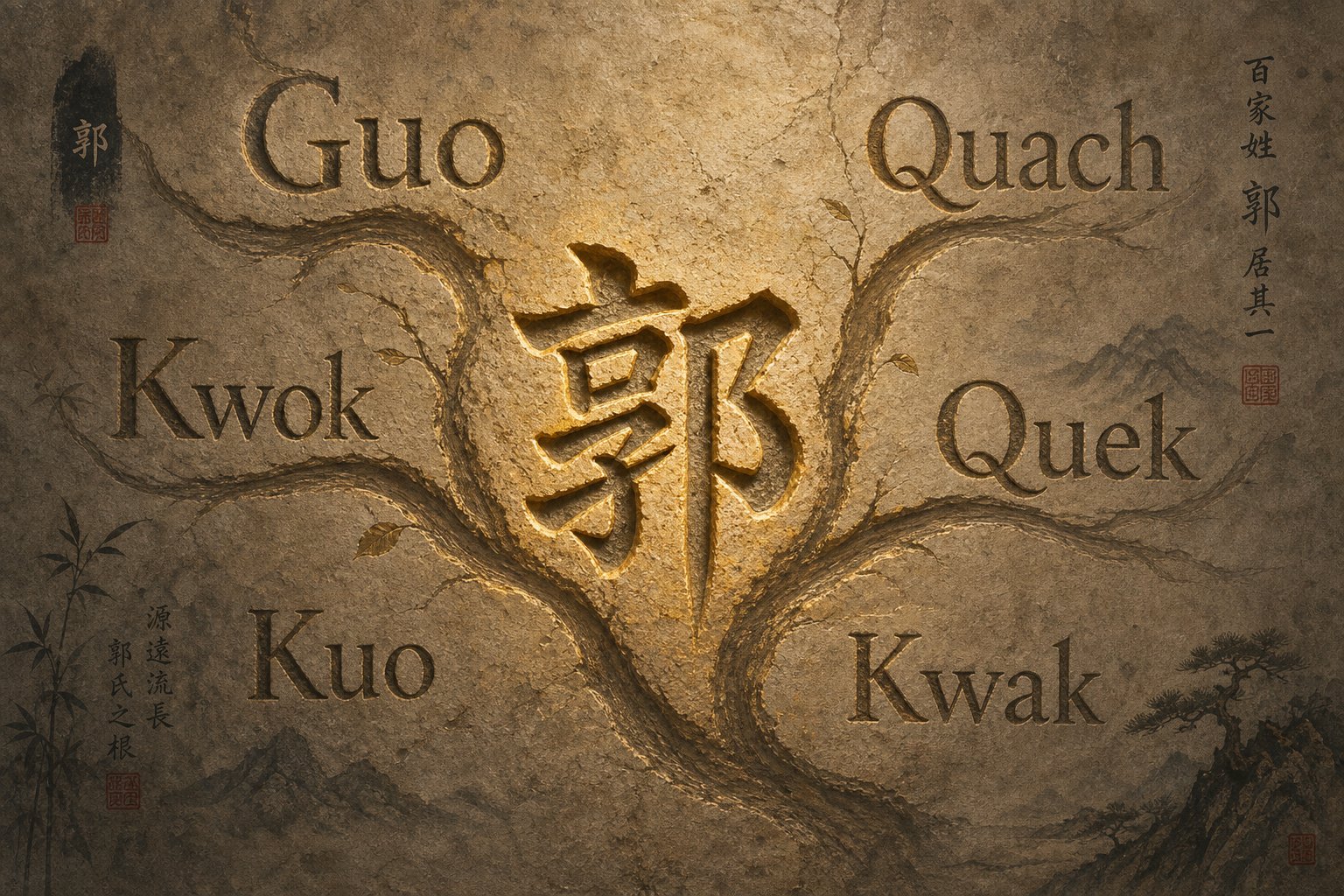
The answer lies in dialect, geography, and the messy history of transliterating Chinese into the Latin alphabet. The character 郭 is one of the most common surnames in the Chinese-speaking world, yet it appears on passports and immigration records as Guo, Kwok, Kuo, Quach, Quek, Kwak, and more. Each spelling reflects a different spoken dialect or a different romanization system, not a different family.
One Character, Many Spellings
When you see the guo surname on a mainland Chinese passport, it follows Mandarin Pinyin: Guō. When you see the kwok surname on a Hong Kong identity document, it reflects Cantonese pronunciation. A Taiwanese passport might read Kuo, while a Vietnamese family register shows Quach. All of these point back to the single character 郭.
Guo and Kwok are the same surname written differently based on dialect and romanization system. Every variant, from Quek to Kwak, traces back to the Chinese character 郭.
The Ancient Origins of 郭
The guo meaning is rooted in architecture and power. In Old Chinese, 郭 referred to the outer city wall or rampart that surrounded and protected a settlement. Families associated with these fortifications eventually adopted the character as their name.
The most prominent ancestral line descends from the State of Western Guo, established during the Zhou Dynasty around 1046 BCE. King Wu of Zhou granted this territory to his uncle, and when the state fell centuries later during the Spring and Autumn Period, its people took 郭 as their surname to honor their homeland. With over 4,000 years of documented history, this is one of China's oldest and most storied family names.
So how did one ancient character end up with so many modern spellings? The story starts with how different Chinese dialects pronounce that same syllable, and which romanization system captured it on paper.

How We Compared Each Surname Variant
Different dialects of Chinese are not just accents. They are, for all practical purposes, separate spoken languages that happen to share a writing system. When you try to pronounce guo in Mandarin and then hear the same character spoken in Cantonese, the sounds are so different that it makes perfect sense why the romanized spellings look nothing alike. Understanding this phonetic gap is the key to understanding why so many variants exist.
How Dialect Shapes Spelling
Mandarin and Cantonese diverge in ways that directly affect how surnames get written in English. Mandarin has four tones and syllables that always end in a vowel or a nasal sound like "n" or "ng." Cantonese, by contrast, preserves features from older forms of Chinese, including syllables that end in abrupt stop consonants like "k," "p," or "t." These checked tones give Cantonese words a clipped, punchy quality that Mandarin simply does not have.
Here is what that means for 郭. The guo pronunciation in Mandarin is "guō": a smooth, single-syllable glide starting with a hard "g," flowing through a "w" sound, and landing on an open "oh" vowel in the first (high flat) tone. Nothing stops the airflow at the end. In Cantonese, the same character is pronounced "gwok3": it starts similarly but ends with a sharp, unreleased "k" that cuts the syllable short. That final stop consonant is why Cantonese romanizations include a "k" at the end, producing spellings like Kwok and Gwok that look radically different from Guo.
This is not a minor accent difference. Mandarin speakers and Cantonese speakers cannot understand each other in conversation. So when colonial administrators, immigration officers, and passport clerks wrote down what they heard, they produced entirely different letter combinations for the same written character.
Romanization Systems Explained
The spelling gap widened further because different governments adopted different romanization systems at different times. In Mainland China, the Pinyin system was introduced in 1958 and became the international standard for Mandarin transliteration. Under Pinyin, 郭 is always "Guo." Taiwan retained the older Wade-Giles system, which renders the same Mandarin sound as "Kuo." Meanwhile, Hong Kong never adopted Pinyin at all. Cantonese surnames on HKSAR documents follow informal romanization conventions rooted in British colonial-era practices, giving us "Kwok."
Southeast Asian communities added more layers. Vietnamese phonology transformed 郭 into "Quach." Hokkien and Teochew speakers in Singapore and Malaysia produced "Quek" and "Kok." Korean readings of the same Chinese character yielded "Kwak" or "Gwak." Each spelling is a snapshot of a specific dialect filtered through a specific transliteration method at a specific moment in history.
It is worth noting that the character 郭 can also appear in compound words beyond surnames. In Mandarin, the second tone "guó" means "country" (国), while the fourth tone "guò" means "to pass" or "to cross" (过). These are entirely different characters with different meanings, but their Pinyin spellings sometimes cause confusion for people unfamiliar with how to pronounce guo in its various tonal contexts.
Our Comparison Criteria
To give you a clear, practical framework for understanding each variant, we evaluated every major spelling of 郭 against the same set of criteria:
- Dialect origin - Which spoken Chinese language or regional language does this spelling reflect?
- Romanization system - Which transliteration standard (Pinyin, Wade-Giles, Jyutping, informal colonial, etc.) produced this spelling?
- Primary region - Where in the world is this spelling most commonly found on official documents?
- Approximate global bearers - How widely used is this particular spelling today?
- Passport and document usage - Which governments and institutions recognize or issue documents with this spelling?
These criteria let us move beyond simple pronunciation guides and into the practical territory that matters most: genealogy research, immigration paperwork, and connecting family members who may not realize they share the same surname. The next step is examining each major variant on its own terms, starting with the most internationally standardized spelling of them all.
Guo as the Mandarin Pinyin Standard
If you search "is Guo a Chinese last name" online, you will find it listed among the most common surnames in China. That is because Guo is the official Pinyin romanization of 郭, and Pinyin is the system the People's Republic of China has used on all government documents, passports, and international communications since its formal adoption in 1958. For the roughly 17 million bearers of this surname in Mainland China, Guo is the only spelling that appears on their identity papers.
Where Guo Is the Standard Spelling
The surname Guo dominates wherever Mandarin Pinyin holds authority. That includes all PRC-issued passports, academic publications from mainland institutions, United Nations documents, and records maintained by the International Organization for Standardization. When foreign governments, universities, or media outlets reference a person with the Pinyin-romanized surname, they use Guo.
The guo family name is also the standard spelling among mainland Chinese diaspora communities that emigrated after the 1980s. Whether in Vancouver, Sydney, or London, newer immigrants from the PRC carry passports reading "Guo," and that spelling follows them into local records, bank accounts, and professional directories. This makes the guo last name the single most common romanization of 郭 in global databases today.
Pronunciation and Common Mispronunciations
English speakers often stumble over this three-letter combination. The most common mistake is pronouncing it like "goo-oh" with two distinct syllables. In reality, it is a single syllable. Think of it as the "gw" sound in "Gwen" blended smoothly into an "oh" vowel, all in one breath. The Mandarin first tone means the pitch stays high and flat throughout.
Another frequent error is pronouncing the "u" as in "gust." The vowel here is closer to the "uo" in the Italian word "buono." If you say "gwoh" quickly, with a high steady pitch, you are close enough for most native speakers to recognize the name immediately.
Pros and Cons of the Guo Spelling
Choosing or inheriting a particular romanization carries practical consequences. Here is how the Guo spelling stacks up:
Pros
- Internationally standardized and recognized by the UN, ISO, and virtually all academic institutions
- Consistent across all PRC government documents, making paperwork straightforward
- Easy to locate in digital databases because Pinyin spellings are uniform and predictable
- Increasingly familiar worldwide as China's global presence grows
Cons
- Frequently mispronounced by English speakers unfamiliar with Pinyin conventions
- Relatively recent adoption, so older immigration records, genealogy documents, and historical texts use Wade-Giles "Kuo" or other forms instead
- Can create confusion when connecting with family members in Hong Kong, Taiwan, or Southeast Asia who use different spellings for the same character
These trade-offs matter most when you are tracing family history across borders. A grandparent who left China before 1958 almost certainly had their name recorded as Kuo, Kwok, or something else entirely. The Pinyin standard is powerful for modern consistency, but it draws a line in the historical record that genealogy researchers need to cross carefully. And on the other side of that line sits the Cantonese world, where 郭 sounds nothing like "Guo" and the spelling reflects an entirely different phonetic reality.

Kwok as the Cantonese Romanization
In Cantonese, 郭 does not glide gently into an open vowel. It snaps shut. The syllable ends with an unreleased "k" that stops the airflow dead, producing a sound so different from Mandarin "Guo" that early British colonial clerks in Hong Kong wrote down something that looks like a completely unrelated name: Kwok.
Kwok in Hong Kong and the Cantonese Diaspora
The kwok last name origin traces directly to how British administrators romanized Cantonese sounds during colonial rule in Hong Kong. There was no official system like Pinyin. Instead, clerks listened to local pronunciation and wrote what they heard using English spelling conventions. The Cantonese reading of 郭 in Jyutping notation is "gwok3," where the "3" indicates a mid-level tone and the final "k" represents that characteristic stop consonant. Colonial romanization dropped the initial "g" cluster in favor of "Kw," producing the spelling Kwok that has appeared on Hong Kong identity documents for over a century.
This spelling carried forward into the HKSAR passport system after the 1997 handover. Hong Kong never adopted Mandarin Pinyin for personal names, so the surname Kwok remains the standard on all government-issued identification for Cantonese speakers bearing 郭. The same applies in Macau, where Portuguese colonial administration produced similar romanizations.
Beyond Hong Kong, the last name Kwok traveled wherever Cantonese emigrants settled. Families who left Guangdong province and Hong Kong during the 19th and 20th centuries brought this spelling to Chinatowns in San Francisco, London, Sydney, and Toronto. Many Kwoks in English-speaking countries today are second or third-generation descendants who have never used any other romanization.
Global Distribution of the Kwok Spelling
Data from Forebears shows approximately 152,344 people worldwide bear the surname Kwok, making it the 3,686th most common surname globally. The distribution tells a clear story of Cantonese migration patterns:
- Hong Kong - 113,063 bearers (1 in every 65 people), where it ranks as the 13th most common surname
- Singapore - 15,450 bearers, reflecting the city-state's large Cantonese community
- United States - 7,793 bearers, concentrated in cities with historic Cantonese populations
- Canada - 4,505 bearers, particularly in Vancouver and Toronto
- Macau - 3,218 bearers
- Australia - 1,499 bearers
- England - 1,102 bearers
You will notice that 77 percent of all Kwoks live in East Asia, with Hong Kong alone accounting for roughly three-quarters of the global total. The remaining quarter maps almost perfectly onto the routes of Cantonese emigration to English-speaking countries during the 19th and 20th centuries.
Pros and Cons of the Kwok Spelling
For anyone carrying or researching the surname Kwok, here is how this particular romanization performs in practical terms:
Pros
- Phonetically closer to the actual Cantonese pronunciation than any Mandarin-based spelling
- Well-established in English-speaking countries with over a century of documented usage
- Strong presence in business and media, with recognizable bearers like the Kwok brothers of Sun Hung Kai Properties in Hong Kong
- Immediately signals Cantonese heritage, which can be meaningful for community and identity
Cons
- Not recognized as standard Pinyin, which can cause confusion in mainland Chinese academic or bureaucratic contexts
- Database searches for "Guo" will not return "Kwok" results, creating gaps in genealogy and professional records
- Non-Chinese speakers sometimes mispronounce it as "kwawk" (rhyming with "talk") rather than the correct clipped "gwok"
The disconnect between Guo and Kwok is not just phonetic. It reflects two entirely different political and cultural histories of romanization. And there is a third path that predates both: the Wade-Giles system, which gave Taiwan and older overseas communities yet another spelling for the same character.
Kuo as the Wade-Giles and Taiwanese Variant
Before Pinyin existed, Western scholars needed a way to write Mandarin sounds in Latin letters. The system they created in the 1860s, Wade-Giles, became the dominant romanization for nearly a century. Under its conventions, 郭 was spelled Kuo, and that spelling became embedded in Taiwanese passports, English-language academic texts, and immigration records long before the PRC introduced Pinyin in 1958.
Kuo in Taiwan and Historical Records
The kuo last name remains the standard romanization of 郭 in Taiwan today. The Republic of China never adopted Pinyin for personal names on passports, so Taiwanese citizens bearing this surname carry documents reading "Kuo." This means the kuo surname appears across decades of Taiwanese diplomatic correspondence, university records, and business registrations.
The kuo last name origin is identical to Guo and Kwok. It is the same character, the same ancestral lineage from the State of Western Guo, simply filtered through a different transliteration method. Yet for genealogy researchers, this creates a real obstacle. Historical English-language texts about China published before the 1980s almost universally use Wade-Giles. If you are searching for family records in old newspapers, missionary archives, or immigration logs from the early 20th century, you will find "Kuo" far more often than "Guo."
Wade-Giles vs Pinyin for the Same Sound
The difference between Kuo and Guo is purely a matter of spelling convention, not pronunciation. Both represent the same Mandarin syllable "guō." Wade-Giles uses "K" for unaspirated velar stops where Pinyin uses "G," and it adds a "u" before the "o" in a way that looks like two syllables to English readers. This is why people often wonder how to pronounce Kuo. The answer: exactly like Guo. Say "gwoh" with a high flat tone, and you have it right regardless of which spelling you are reading.
The confusion runs deeper than pronunciation, though. Because Wade-Giles uses "K" where Pinyin uses "G," the last name Kuo can be mistaken for an entirely different surname by people unfamiliar with both systems. Someone searching a database for "Guo" will never find "Kuo" entries unless they know to search both.
Pros and Cons of the Kuo Spelling
Pros
- Standard on Taiwanese passports and official ROC documents, giving it institutional backing
- Appears in the majority of pre-1980s English-language texts about China, making it essential for historical research
- Familiar to older diaspora communities who emigrated before Pinyin became widespread
Cons
- Declining in international usage as Pinyin becomes the global default for Mandarin romanization
- Easily confused with unrelated surnames or misread as two syllables ("koo-oh") by English speakers
- Not compatible with Pinyin-based search systems, creating gaps in modern databases
Kuo occupies an interesting middle ground: it represents the same Mandarin pronunciation as Guo but belongs to an older institutional world. For families split between Taiwan and the mainland, the Kuo-Guo divide is a minor spelling difference with zero phonetic distinction. The real phonetic leaps happen when 郭 crosses into entirely different language families, as it did centuries ago when Chinese migrants carried the character into Vietnam and Southeast Asia.
Quach and Other Southeast Asian Adaptations
When Chinese families migrated south into Vietnam over centuries of trade, war, and resettlement, they brought the character 郭 with them. But Vietnamese is a tonal language with its own phonological rules, its own alphabet (based on Latin script since the 17th century), and no use for Chinese romanization systems whatsoever. The result? A spelling that looks nothing like Guo, Kwok, or Kuo: Quach.
Quach and the Vietnamese Connection
The quach last name origin traces back to Cantonese and Hokkien-speaking migrants from Guangdong and Fujian provinces who settled in Vietnam over the past 400 years. These southern Chinese communities, known as the Hoa people, integrated into Vietnamese society while preserving their clan identities. When their surnames were recorded in Vietnamese script (Quoc Ngu), local phonology reshaped the sounds completely.
Vietnamese does not have a "gw" or "kw" initial consonant cluster the way Cantonese does. Instead, the "qu" combination in Vietnamese represents a "kw" sound, and the vowel shifted to match Vietnamese tonal patterns. The final stop consonant, so prominent in Cantonese "gwok3," softened into the "ch" ending. The result is "Quach" (sometimes written Quách with a diacritical mark indicating tone), a spelling that feels entirely Vietnamese yet points directly back to 郭.
Research from My China Roots confirms that the surname Quach is commonly found in Vietnam among its Chinese community, with most Quach families tracing their origins to Guangdong and Fujian provinces. The database contains 151 Quach family tree books spanning records in China, Singapore, Malaysia, Thailand, Japan, Indonesia, and beyond. For anyone carrying the last name Quach and wondering about their deeper ancestry, these zupu (clan genealogy books) can bridge the gap between Vietnamese family records and Chinese ancestral villages.
Southeast Asian Adaptations of 郭
Vietnam is not the only place where 郭 took on a dramatically different appearance. Across Southeast Asia, colonial-era migration from southern China produced a patchwork of local spellings:
- Kuok - Found primarily in Malaysia and associated with Hokkien or Teochew-speaking communities. The billionaire Robert Kuok, often called the "Sugar King of Asia," carries this spelling.
- Kwik - An Indonesian adaptation reflecting how Dutch colonial phonetics captured the Hokkien pronunciation. The "w" replaces the vowel glide, and the "ik" ending mirrors the clipped stop consonant.
- Kok - A simplified Cantonese or Hakka variant found in parts of Malaysia and Singapore, stripping the initial consonant cluster down to its core.
Each of these spellings emerged from the same process: a southern Chinese dialect speaker said their surname aloud, and a local clerk, whether Dutch, British, or Vietnamese, wrote down what they heard using the conventions of their own language. No coordination. No standardization. Just practical transliteration in the moment.
For genealogy researchers, this means a single family line that originated in Fujian province might appear as Guo in modern mainland records, Kwok in Hong Kong documents, Quach in Vietnamese registers, and Kwik in Indonesian archives. The surname Quach in a Vietnamese family tree and the surname Kwik on an Indonesian birth certificate can represent the same bloodline separated by a few generations and a few hundred miles of ocean.
Pros and Cons of Regional Variants
If you carry the Quach surname or another Southeast Asian adaptation of 郭, here is how these regional spellings perform in practice:
Pros
- Reflects authentic local pronunciation and linguistic heritage
- Deeply rooted in community identity, connecting bearers to specific migration histories
- Immediately recognizable within local contexts (Quach signals Vietnamese-Chinese heritage; Kwik signals Indonesian-Chinese heritage)
Cons
- Harder to connect to Chinese-origin records without knowing the underlying character 郭
- Less recognizable internationally as a Chinese surname, which can complicate cross-border paperwork
- Database searches under one regional spelling will miss all other variants entirely
These regional adaptations highlight something important about the broader guo vs kwok surname question. The divergence is not limited to two spellings or even two dialects. It extends across an entire network of languages and colonial histories spanning East and Southeast Asia. And the story grows even wider when you look east to Korea and south to the Hokkien heartlands of Singapore and Malaysia, where still more variants emerged from the same single character.
Kwak and Hokkien Variants Across East Asia
The character 郭 did not just travel south into Vietnam and Indonesia. It also traveled east into Korea over a thousand years ago, where it became part of the Korean writing system and acquired a pronunciation entirely distinct from any Chinese dialect. Meanwhile, back in the Hokkien and Teochew heartlands of Fujian province, speakers who migrated to British Malaya and Singapore produced yet another cluster of spellings that remain common today.
Kwak and Gwak in Korean Contexts
Korea adopted Chinese characters (known as Hanja) centuries ago for use in names, classical texts, and official records. The character 郭 entered Korean as the surname 곽, pronounced "gwak" in modern Korean. When romanized, this becomes either Kwak or Gwak depending on which Korean romanization system is applied.
The older McCune-Reischauer system, widely used before 2000, renders it as "Kwak." The Revised Romanization of Korean, adopted by the South Korean government in 2000, spells it "Gwak." Both represent the same Korean pronunciation. The kwak surname is carried by a significant number of Korean families, with historical roots tracing back to Chinese immigrants who settled on the Korean peninsula during the Tang and Song dynasties. Over generations, these families became fully Korean in language and culture, but the Hanja character on their family registers remains 郭, the same character shared by every Guo, Kwok, and Kuo family in the Chinese-speaking world.
For anyone researching the koo last name origin or encountering the last name Koo in Korean contexts, it is worth noting that Koo (구/丘 or 具) is typically a different Korean surname entirely. The koo last name and the Kwak surname represent different characters and different lineages, though both are Korean. The surname Ku (also written Koo or Gu in Korean romanization) derives from characters like 具 or 丘, making the ku surname and the ku last name origin distinct from 郭. Confusing the surname Ku with Kwak is a common genealogy mistake that careful researchers should avoid.
Quek and Kok from Hokkien and Teochew Dialects
Back in the Chinese dialect world, Hokkien and Teochew speakers from Fujian and eastern Guangdong provinces pronounce 郭 quite differently from both Mandarin and Cantonese. In Hokkien, the character sounds like "kueh" or "keh" with a short, clipped quality. In Teochew, it lands closer to "koet" with that same abrupt stop consonant found in Cantonese.
When these dialect speakers migrated to British Malaya and Singapore during the 19th and early 20th centuries, colonial clerks wrote down what they heard. The results were spellings like Quek, Kuek, Kok, Koet, and Keh. Dialect variant records confirm that in the Singapore, Malaysia, and Indonesia diaspora context, the most common Hokkien romanization is Kuek, while Teochew speakers typically appear as Keh. Hainanese speakers in the same region often use Quek.
These spellings are not standardized. Two siblings from the same Hokkien family might end up as "Quek" and "Kuek" on different documents depending on which clerk processed their paperwork. The lack of a unified system means that Hokkien variants of 郭 are among the most fragmented of all the romanizations, scattered across immigration records, birth certificates, and school registers with little consistency.
Connecting All Variants Back to 郭
When you step back and look at the full picture, the sheer number of spellings can feel overwhelming. Yet every single one traces back to the same eleven-stroke character. Here is the complete list of documented romanizations for 郭:
- Guo - Mandarin Pinyin (Mainland China)
- Kwok - Cantonese informal romanization (Hong Kong, Macau)
- Gwok - Cantonese Jyutping (academic contexts)
- Kuo - Wade-Giles (Taiwan, historical texts)
- Kuok - Hokkien/Teochew (Malaysia)
- Quek - Hainanese/Hokkien (Singapore, Malaysia)
- Kuek - Hokkien (Singapore)
- Kok - Cantonese/Hakka simplified (Malaysia)
- Koet - Teochew (Malaysia)
- Keh - Teochew (Singapore)
- Quach - Vietnamese adaptation
- Kwik - Indonesian adaptation
- Kwak / Gwak - Korean romanization
Thirteen or more spellings, one character, one ancestral origin. The diversity is not a sign of confusion. It is a map of how one ancient Chinese surname radiated outward across dialects, borders, colonial administrations, and centuries of migration. With so many variants in play, a side-by-side comparison becomes essential for anyone trying to see the full picture at a glance.

All Variants of 郭 Compared Side by Side
Thirteen spellings across seven dialects and half a dozen romanization systems. That is a lot to hold in your head. Whether you are a genealogy researcher cross-referencing immigration records or simply trying to confirm that your colleague named Kwok shares the same guo last name origin as your friend named Quek, you need a single reference point that lays everything out clearly.
Complete Variant Comparison at a Glance
The table below maps every major romanization of 郭 to its dialect, transliteration system, geographic home, and document context. Think of it as a decoder ring for one of the most widely dispersed Chinese surnames in the world.
| Spelling | Dialect | Romanization System | Primary Region(s) | Passport/Document Usage |
|---|---|---|---|---|
| Guo | Mandarin | Hanyu Pinyin | Mainland China | PRC passports, UN documents, academic publications |
| Kwok | Cantonese | Hong Kong informal romanization | Hong Kong, Macau, Cantonese diaspora | HKSAR passports, colonial-era records |
| Kuo | Mandarin | Wade-Giles | Taiwan, older overseas communities | ROC (Taiwan) passports, pre-1980s English texts |
| Quach | Vietnamese (from Cantonese/Hokkien) | Quoc Ngu (Vietnamese Latin script) | Vietnam, Vietnamese diaspora | Vietnamese national ID, family registers |
| Quek | Hokkien / Hainanese | Informal colonial romanization | Singapore, Malaysia | Singapore IC, Malaysian MyKad |
| Kok | Cantonese / Hakka | Informal colonial romanization | Malaysia | Malaysian MyKad, birth certificates |
| Kwak / Gwak | Korean | McCune-Reischauer / Revised Romanization | South Korea, Korean diaspora | Korean passports, family registers (jokbo) |
| Kuok | Hokkien / Teochew | Informal colonial romanization | Malaysia, Singapore | Malaysian MyKad, business registrations |
| Kwik | Hokkien | Dutch colonial romanization | Indonesia | Historical Indonesian records (pre-name-change era) |
Notice how the guo chinese spelling and the 郭 Kuo variant represent the exact same Mandarin pronunciation, just captured by different systems decades apart. Meanwhile, Kwok, Quek, and Kok all reflect southern Chinese dialects where that final stop consonant creates an entirely different sound profile. The Guos you meet in Beijing and the Kwoks you meet in Hong Kong are reading the same character off the same ancestral tablets.
Every spelling in this table represents the identical surname 郭. Regardless of whether a document reads Guo, Kwok, Kuo, Quach, Quek, or Kwak, the ancestral origin is the same: the ancient State of Western Guo and the character meaning "outer city wall."
Which Spelling Appears on Which Documents
The practical question most people face is straightforward: if I see a particular spelling on a passport, birth certificate, or immigration record, what does it tell me?
- PRC passport - Always "Guo." No exceptions since Pinyin standardization.
- HKSAR passport - Almost always "Kwok" for 郭 bearers, though rare variants like "Gwok" or "Kok" appear occasionally.
- ROC (Taiwan) passport - Typically "Kuo," though Taiwan now allows applicants to choose Pinyin, so newer passports may show "Guo."
- Vietnamese documents - "Quach" (or Quách with diacritics).
- Singapore/Malaysia IC - Varies by dialect group. Hokkien families appear as Quek or Kuek; Cantonese families as Kwok or Kok; Teochew families as Keh or Koet.
- Korean passport - "Kwak" on older documents, "Gwak" on newer ones issued after the 2000 romanization reform.
- Indonesian records - "Kwik" in historical documents, though many Indonesian-Chinese families adopted non-Chinese names under government policy.
This mapping gives you a reliable way to work backward from any document. See "Kuo" on a 1960s immigration form? That is almost certainly a Mandarin speaker from Taiwan or a pre-Pinyin mainland record. See "Kwik" on a Dutch colonial-era certificate? That points to a Hokkien family in Indonesia. The spelling itself is a clue to dialect, era, and geography all at once.
Knowing which variant appears where is useful for identification. But the real challenge for most families is not classification. It is action: how do you actually trace relatives, search records, and bridge the gaps between these spellings when building a family tree?
Practical Guidance for Genealogy and Identity
A table of variants is helpful for understanding. But understanding alone does not reunite family lines or decode a great-grandmother's immigration record. The real work begins when you sit down at a database, type in a surname, and realize that the system only returns exact matches. If your family spells it Kwok and your distant cousin's branch spells it Guo, no search engine will connect you automatically. You have to bridge that gap yourself.
Tips for Tracing Family Across Spelling Variants
Whether you are coming from the Guo side and wondering about relatives named Kwok, or you carry the Kwok spelling and suspect a connection to someone named Kuo or Quek, the research process follows the same logic. Here are actionable steps that work regardless of which variant you start with:
- Identify your family's dialect origin. Ask older relatives which dialect they spoke at home. Cantonese? Hokkien? Mandarin? Teochew? The dialect tells you which romanization system likely captured your surname on early documents. If your grandparents spoke Cantonese, look for Kwok. If they spoke Hokkien, search for Quek, Kuek, or Kok. If they came from a Mandarin-speaking household before 1958, check for Kuo under Wade-Giles.
- Check historical immigration records under multiple spellings. When searching databases like FamilySearch, Ancestry, or national archives, run separate searches for every plausible variant. A single ancestor might appear as "Kuo" on a 1920s ship manifest, "Kwok" on a British colonial registration, and "Guo" on a modern naturalization certificate. Cast a wide net.
- Use the Chinese character 郭 as the universal connector. Romanized spellings fragment. The character unifies. If you can locate records written in Chinese, whether clan genealogies (族譜), gravestone inscriptions, or ancestral hall registers, the character 郭 will appear identically regardless of which dialect the family spoke. This single character is your anchor across every spelling variant.
- Connect with surname associations that track all romanizations. Many 郭 clan associations maintain membership rolls that include Guo, Kwok, Kuo, Quach, and Quek families together. These organizations often hold zupu (family genealogy books) that trace lineages back to specific villages in China, providing the bridge between a modern diaspora spelling and an ancestral hometown.
One additional tip that saves hours of frustration: when searching English-language databases, try wildcard searches if the platform supports them. Searching "K*o*" or "Guo OR Kwok OR Kuo" can surface records that a single-spelling search would miss entirely.
Which Variant Should You Use
People sometimes ask which spelling is "correct." The honest answer? All of them. If your passport says Kwok, that is your legal spelling. If your family has used Kuo for three generations in Taiwan, there is no reason to switch to Guo just because Pinyin is more internationally common. Your romanization reflects your family's specific history, dialect, and migration path. It is not wrong. It is a record.
That said, practical situations do arise where you need to explain the relationship between variants. When a non-Chinese speaker asks how do you pronounce Guo, you can say it sounds like "gwoh" in a single quick syllable, similar to saying the letters G-U-O run together smoothly rather than spelling out each letter as "g u o" separately. For how to pronounce Kuo, the answer is identical: same sound, different spelling system. And if someone asks how do you pronounce Kuo versus Kwok, you can explain that Kuo and Guo sound the same (Mandarin), while Kwok sounds different because it comes from Cantonese, ending in a sharp clipped "k" sound.
For formal contexts like academic papers, legal documents, or professional profiles, use whatever spelling appears on your government-issued ID. Consistency across your official records prevents confusion. But in personal and genealogical contexts, knowing that your Kwok matches someone else's Guo is what matters most. The spelling is a historical artifact. The family connection is real.
If you take away one thing from this entire comparison, let it be this: the character 郭 has never changed. It meant "outer city wall" three thousand years ago, and it still means that today. The walls that once protected an ancient Zhou Dynasty state now protect something else entirely: the identity of millions of people scattered across continents, speaking different languages, carrying different passports, yet sharing a single ancestral character that connects them all.
Frequently Asked Questions About Guo vs Kwok Surname
1. Are Guo and Kwok the same surname?
Yes, Guo and Kwok both represent the Chinese character 郭. The difference is purely linguistic: Guo follows Mandarin Pinyin used in Mainland China, while Kwok reflects Cantonese pronunciation used in Hong Kong and Macau. Both trace back to the ancient State of Western Guo during the Zhou Dynasty, sharing identical ancestral origins despite their dramatically different spellings.
2. How do you pronounce the surname Guo correctly?
Guo is pronounced as a single syllable, similar to saying 'gwoh' quickly with a high, flat tone. A common mistake is splitting it into two syllables like 'goo-oh.' Think of the 'gw' sound in the name 'Gwen' blended smoothly into an 'oh' vowel, all in one breath. The Mandarin first tone keeps the pitch steady and high throughout.
3. Why does the same Chinese surname have so many different spellings?
Chinese dialects like Mandarin, Cantonese, Hokkien, and Teochew pronounce the same written character very differently. When colonial administrators, immigration officers, and government clerks romanized these sounds into Latin letters, they used different systems at different times in different regions. This produced spellings like Guo (Pinyin), Kwok (Hong Kong colonial), Kuo (Wade-Giles), Quach (Vietnamese), and Quek (Hokkien) for the single character 郭.
4. How can I trace family connections across different spellings of 郭?
Start by identifying your family's dialect origin, then search historical records under all plausible romanizations. Use the Chinese character 郭 as your universal connector since it remains identical regardless of dialect. Clan associations often maintain records spanning multiple spellings, and genealogy databases like FamilySearch allow wildcard searches to capture variants like Guo, Kwok, Kuo, and Quach in a single query.
5. What is the difference between Kuo and Guo?
Kuo and Guo represent the exact same Mandarin pronunciation of 郭, just captured by different romanization systems. Kuo uses the older Wade-Giles system standard in Taiwan and pre-1980s English texts, while Guo uses Hanyu Pinyin adopted by Mainland China in 1958. They sound identical when spoken aloud. The distinction is purely a matter of which government or institution issued the document.