What Are Hong Kong English Names and Why Do They Exist
Imagine meeting someone named Cathy. She introduces herself confidently, shakes your hand, and you move on. What you might not realize is that Cathy also has an entirely different name, one her parents carefully crafted with a fortune teller before she was born. Her official Chinese name carries generational meaning, balanced elements, and family hopes. But in everyday life, from university lectures to office emails, she goes by Cathy. This is the reality of Hong Kong English names: a parallel naming system where nearly every local person operates with two distinct identities.
What Makes Hong Kong English Names Unique
So what do you call someone from Hong Kong? The answer is a Hongkonger. But ask a Hongkonger what they call themselves, and you will likely hear an English name first. Unlike in most Western cultures, where names are inherited and fixed at birth, Hong Kong names exist in a dual system. A person maintains their formal Chinese name for family, legal documents, and intimate relationships, while their English name handles everything else: school, work, social media, and casual friendships.
What makes this practice remarkable is its sheer scale. This is not a niche habit among internationally educated elites. It is a cultural habitus, so deeply embedded that not having an English name actually feels socially awkward. Students in Hong Kong report feeling uncomfortable when someone lacks an English name because they simply do not know how to address that person in informal settings.
Unlike Western names passed down through families, Hong Kong English names are often personally chosen, making them one of the few socially accepted forms of self-naming in the world.
The Dual-Name System at a Glance
Here is how it works in practice. A person from Hong Kong, sometimes called a Hongkonger, carries a Chinese name that follows traditional conventions: family name first, then a given name rich with meaning. The name might reference health, wisdom, or prosperity. Parents may consult fortune tellers to ensure the characters align with the child's birth date and elemental balance. This name appears on the HKID card and formal documents.
Then there is the English name. It might be chosen by parents at birth, assigned by a primary school teacher, or picked by the person themselves as a teenager. Some people change it multiple times throughout life, which is perfectly normal in Hong Kong but would raise eyebrows in London or New York. The English name functions as the default mode of address in educational, professional, and social contexts. You'll notice that Hongkongers introduce themselves with their English name in almost all situations, reserving the Chinese name for close friends and family.
This dual system is not merely about convenience for foreigners. It reflects something deeper: the negotiation of identity in a city shaped by both Chinese heritage and over a century of British colonial influence. English names carry symbolic capital. They signal belonging to a modern, internationally connected community. They flatten social hierarchies that Chinese naming conventions enforce through formal modes of address. And they offer something rare in any culture: the freedom to name yourself.
Understanding this practice requires looking at its full lifecycle, from how these names are acquired, to how they function in daily social settings, to what they reveal about status, generation, and cultural identity. That story begins with history.
The Historical Roots of English Naming in Hong Kong
Hong Kong's dual-name system did not appear overnight. It grew out of specific political conditions, educational policies, and social pressures that unfolded across more than 150 years of colonial rule and the decades that followed. Tracing that timeline reveals how a bureaucratic convenience became a deeply personal cultural practice.
Colonial Origins and Administrative Necessity
When Britain established Hong Kong as a colony in 1841, the administration operated almost entirely in English. Court documents, land registries, business licenses, and government correspondence all required romanized names. For the Chinese population, this created an immediate practical problem: British officials could not read or pronounce Chinese characters, and there was no standardized system for romanizing Cantonese.
The earliest adopters of English names were elites. Merchants, compradors, and professionals who dealt directly with British administrators needed a way to be identified in official records. Some simply romanized their Chinese surnames using whatever spelling a clerk deemed appropriate. Others went further, adopting full English given names to smooth interactions with colonial officials and trading partners. These were not casual choices. They were strategic moves to accumulate what researchers describe as symbolic capital, signaling access to English-language networks and the economic opportunities they unlocked.
During this early period, the English name functioned as a status marker. It told other Hong Kongese people that you had connections, education, or business dealings with the ruling class. The practice remained confined to a small segment of society well into the early twentieth century.
How English-Medium Education Spread the Practice
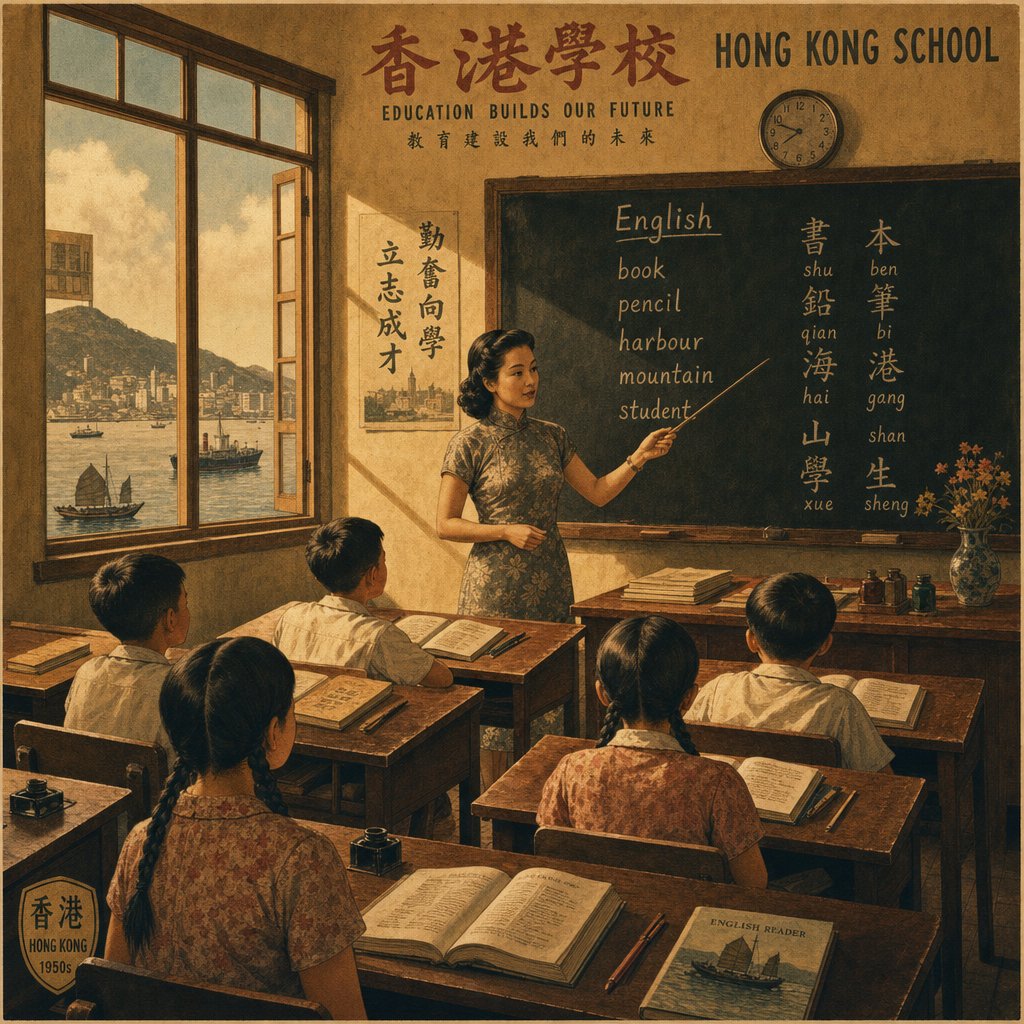
The real turning point came through schools. As English-medium education expanded from elite missionary institutions to a broader network of government and aided schools, millions of children encountered a new expectation: you need an English name for class. Teachers, whether local or expatriate, found it simpler to address students by English names during English-language lessons. Some assigned names from lists. Others let students pick their own. Either way, the classroom became the primary engine for spreading the practice across all social classes.
By the mid-twentieth century, attending an English-medium secondary school was the clearest path to university admission and white-collar employment. English was not just a subject but the medium of instruction for mathematics, science, and history. In this environment, HK English became linguistic capital. Students who could operate fluently in English, including carrying an English name, gained access to educational and economic advantages that Cantonese-only speakers could not easily reach.
The names chosen during the 1950s through 1970s reflected the cultural environment: formal, British, and conservative. Think Margaret, Edward, Albert, and Dorothy. These were names drawn from English textbooks, teachers' suggestions, or the limited pool of Western names that Hong Kong families encountered through church, government, or media. The choices signaled respectability and alignment with British norms rather than personal creativity.
Post-Handover Evolution
The 1997 handover to China might have ended the practice. It did not. Under the "one country, two systems" framework, Hong Kong maintained its bilingual policy, and English retained its co-official status. New education policies did shift many secondary schools from English to Cantonese as the medium of instruction, but universities continued operating largely in English, and the business world remained firmly bilingual.
What changed was the meaning behind the names. Before 1997, an English name signaled proximity to colonial power. After the handover, it became something different: an expression of distinct Hong Kongese identity. Students raised entirely after the handover describe English naming as "a very Hong Kongese practice" that distinguishes them from mainland Chinese culture. The colonial origin has been reappropriated. What was once imposed from above is now owned from within.
This shift also transformed the kinds of names people chose. The blending of Cantonese speech patterns with English vocabulary, sometimes called Hong Kong Chinglish, created a linguistic environment where creative name-making felt natural. Hong Kongese names no longer needed to sound like they came from a British registry office. People began drawing inspiration from Japanese culture, luxury brands, phonetic play on their Chinese names, and pure invention. Names like Hacken (from Lee Hak-kan), Rimsky, and York entered public life through celebrities and officials, normalizing unconventional choices.
The percentage of people using English names also kept climbing. A 2015 survey found that 25.8% of Hongkongers carry English given names as part of their legal identity, while another 38.3% use English names socially without registering them officially. That adds up to 64.1% of the population operating with an English name in daily life, a figure that has likely grown since.
From administrative tool to status symbol to identity marker, the English name in Hong Kong has traveled a long arc. Each generation has reshaped the practice to fit its own cultural moment. The question that follows naturally is not just why people adopt these names, but how exactly they get them, because the methods are far more varied than outsiders assume.
How Hong Kongers Choose Their English Names
The path to an English name in Hong Kong is rarely a single event. It is more like a series of opportunities, some imposed, some chosen, and some reinvented over time. While outsiders might assume parents simply pick a name at birth the way they would in English-speaking countries, the reality involves multiple channels, each with its own social logic.
Ranked roughly from most to least common, here are the primary methods through which names in Hong Kong are acquired:
- Parental choice at birth or early childhood - Parents select an English name alongside the Chinese one, sometimes before the child is even born.
- Teacher assignment in primary school - A teacher provides or facilitates the choice of an English name when formal English lessons begin.
- Self-selection as teenagers and adults - Individuals choose or change their own name during secondary school, university, or later in life.
- Workplace adoption for professional settings - Adults pick a new English name when entering a career that demands one, particularly in international business or client-facing roles.
Parental Choice at Birth or Early Childhood
In contrast to earlier generations, it has become common for Hong Kong parents to choose an English name for their child at birth. Research on post-handover students found that the majority already had an English name before entering primary school, given by their parents. The name might be used casually at home or in kindergarten, sitting quietly in the background until English-medium education activates it. Parents often apply the same phonetic and aesthetic criteria they use for Chinese names: the sound should be pleasant, the meaning positive, and ideally there is some connection to the Chinese name through shared syllables or tonal echoes.
Teacher Assignment in Primary School
For children who arrive at school without an English name, the classroom fills the gap. This is where the process gets interesting. Teachers handle it in several ways depending on the school:
- Offering a printed list of common English names for students to choose from
- Matching names phonetically to the student's Chinese name (a child named Sen might become Sam; Hai-yan might become Helen)
- Letting students flip through a baby name book and pick whatever appeals to them
- Simply assigning a name, particularly in earlier decades when teachers had more authority over the process
One participant in a qualitative study on Hong Kong naming described how teachers would suggest, or as she put it, "force" students to adopt an English name. The word "force" is telling. Even when the process feels mandatory, most students do not resent it. They describe wanting an English name because everyone else has one. Not having one would feel, as multiple students put it, "weird."
This method historically produced waves of very common names. When your English vocabulary is limited to what appears in a Primary 1 textbook, you end up with a lot of Marys, Peters, and Davids. The limited pool creates a downstream problem: too many people sharing the same name, compounded by the relatively small number of Chinese surnames in circulation.
Self-Selection as Teenagers and Adults
Here is where Hong Kong's naming culture diverges most sharply from Western norms. Changing your English name as a teenager or adult is not only acceptable but common. All participants in naming studies report knowing someone who has changed their English name at least once. Some people maintain different English names for different contexts: one for professional correspondence, another for friends in Hong Kong, perhaps a third for social media.
The triggers for a name change vary. A student entering university might want something that feels more mature. Someone preparing for an international career might realize that "Candy" or "Bobo" will not land well in a London boardroom. Others simply grow tired of sharing their name with five other people in every group chat. As one student explained, an English name is "like a phone case. Can easily change it." The Chinese name, by contrast, is the phone itself.
When choosing a new name, people weigh five key factors that closely mirror traditional Chinese naming criteria: sound, meaning, uniqueness, memorability, and simplicity. A good name for Hong Kong should be recognizable to English speakers but not so common that it disappears into the crowd. It should sound pleasant in both Cantonese and English phonetic systems. And increasingly, it should carry some personal significance beyond mere convenience.
Workplace Adoption for Professional Settings
Some adults reach their twenties without ever needing an English name in daily life, particularly if they attended Chinese-medium schools and work in locally oriented industries. But a career shift into finance, law, international trade, or tech often creates sudden demand. In these sectors, English names are used not only with foreign colleagues but among local Chinese-speaking coworkers as well. The English name flattens hierarchies that Chinese naming conventions enforce through formal titles and modes of address, creating what researchers describe as a "more equal relation among friends or business partners."
Workplace names tend to be more conservative than those chosen by teenagers. Professionals gravitate toward names that project competence and international fluency. The stakes feel higher when your name appears on business cards, email signatures, and LinkedIn profiles.
When Family Names Shape the English Name
One subtle pattern worth noting: some names for Hong Kong residents derive directly from their surname sounds. The Kong surname, for instance, might inspire names like Conrad or Connie through phonetic association. A person surnamed Ma might playfully choose Pony (ma means horse in Mandarin). Someone named Lam might gravitate toward names starting with L. This phonetic bridging between Chinese family names and English given names creates a sense of continuity between the two identities, even when the names appear completely unrelated to outsiders.
The same logic works in reverse. Hong Kong surnames like Chan, Wong, Cheung, and Lau are Cantonese romanizations that already function as fixed English-language identifiers. The English given name then becomes the variable, the element a person can control and reshape throughout life. This combination of a fixed Cantonese surname with a fluid, self-chosen English given name captures something essential about how identity works in Hong Kong: rooted in family and heritage on one side, personally crafted and adaptable on the other.
What a person chooses, and when they choose it, also reveals something about their generation. The names favored by someone born in 1965 look nothing like those picked by someone born in 2005, and the reasons behind those differences tell a broader story about cultural influence and shifting values.

Generational Shifts in Hong Kong English Name Trends
A person's English name in Hong Kong often reveals their approximate age before they say a single word about themselves. The naming landscape has shifted so dramatically across decades that generational patterns are almost as reliable as carbon dating. Each era carries its own cultural fingerprint, shaped by whatever media, politics, and social aspirations dominated at the time.
Classic British Names of the Post-War Generation
Hong Kongers born in the 1950s through early 1970s overwhelmingly chose names that sounded like they belonged in a British registry office. Margaret, Edward, Albert, Dorothy, Raymond, and Florence were standard picks. The logic was straightforward: English names served as professional tools, and the safest tool was one that sounded unmistakably proper. Teachers suggested them from textbooks. Parents heard them in church. The limited exposure to Western culture meant the available pool was small and conservative.
These names carried weight. They signaled respectability, education, and alignment with colonial institutions. Nobody was trying to stand out. The goal was to fit in, specifically into the English-speaking professional class that controlled access to opportunity. As one writer observed, Chinese names were "swept aside in favour of more fashionable Pauls, Jennifers and Christophers" as Hong Kong accelerated toward becoming Asia's world city in the 1970s and 80s.
Pop Culture Influence on Millennial Names
The 1980s and 1990s brought a flood of new reference points. Hollywood films, American television, Japanese anime, and Cantopop created a much wider vocabulary of possible names. Suddenly, a hong kong nickname did not need to come from a textbook. It could come from a favorite character, a pop star, or a brand that felt aspirational. Names like Jacky, Vivian, Leon, and Kelly surged in popularity, directly traceable to Cantopop icons who had themselves chosen English stage names.
Celebrity influence created a feedback loop. When singer Hacken Lee (born Lee Hak-kan) crafted his English name from Cantonese phonetics, it normalized creative derivation. When actors and public figures carried names like Chow Yun-fat or Maggie Cheung into international fame, those names became cultural touchpoints that younger generations referenced when making their own choices.
The Rise of Unconventional and Creative Names
Recent generations have pushed the boundaries far beyond what earlier cohorts would have considered acceptable. Names like Souffle, Arial, Focus, Hippo, and Kinky are real examples from contemporary Hong Kong. Others have chosen Rainbow, Water, and Sparrow. The motivation has flipped entirely: where older generations sought to blend in, younger Hongkongers compete to find the most original hong name possible.
This creative explosion also produces unintentionally amusing results. The phenomenon of funny first names and surnames combinations emerges when an unconventional English name collides with a common Cantonese surname. Think "Candy Ho," "Kinky Wong," or "iPhone Chan." These pairings are not jokes. They are real names carried by real people who may not have considered how the combination reads to English speakers, or who simply do not mind.
| Generation | Typical Names | Primary Cultural Influence | Naming Goal |
|---|---|---|---|
| 1950s-1970s | Margaret, Edward, Albert, Dorothy, Raymond | British colonial institutions, church, textbooks | Respectability and professional access |
| 1980s-1990s | Jacky, Vivian, Leon, Kelly, Sammi | Cantopop, Hollywood, Japanese media | Trendiness and cultural affiliation |
| 2000s-present | Souffle, Arial, Focus, Rainbow, Sparrow | Global internet culture, personal creativity, brand names | Uniqueness and self-expression |
The table above captures a clear trajectory: from conformity to creativity, from external validation to internal meaning. Each generation's choices reflect not just personal taste but the broader cultural forces shaping Hong Kong at that moment. What remains consistent across all eras is that these names carry social information, whether the bearer intends it or not. A name signals generation, education background, and even personality type. And those signals play out differently depending on whether the bearer is male or female, a distinction that shapes naming patterns in ways worth examining closely.
Popular Male and Female English Names in Hong Kong
Gender shapes naming choices in Hong Kong in ways that mirror broader cultural expectations, though not always in the directions you might predict. Names of women from Hong Kong tend to cluster around different aesthetic values than those chosen by men, and the professional world amplifies these patterns further. Understanding these tendencies helps decode the social signals a name carries before a single word of conversation happens.
Common Female English Names and Their Appeal
Names of female in Hong Kong lean toward softness, elegance, and positive association. Among older generations, you will encounter plenty of Amys, Graces, Vickys, and Wendys. These choices reflect a preference for names that sound approachable and carry pleasant connotations in English. The millennial cohort brought in Vivian, Sammi, Kelly, and Fiona, often inspired by Cantopop stars and television personalities.
Younger women increasingly gravitate toward names that feel distinctive without being jarring. Names like Hayley, Zoe, Chloe, and Iris have gained ground, borrowing from contemporary Western naming trends accessed through social media and international pop culture. There is also a notable subset of names drawn from nature or abstract qualities: Crystal, Jasmine, Sunny, Cherry. These carry meaning in English, which appeals to the Chinese naming tradition of embedding wishes or imagery into a name.
One pattern worth noting: names that sound playful or diminutive, like Candy, Bobo, or Yoyo, appear more frequently among women. Research participants expressed mixed feelings about these choices, with some finding them unsuitable for professional contexts. A name like Candy might feel perfectly natural in a Hong Kong social circle but raise eyebrows in an international boardroom, a tension many women navigate as their careers become more global.
Popular Male English Names Across Professions
Names of male in Hong Kong skew toward the conventional and sturdy. David, Kevin, Peter, Eric, and Jason dominate across generations. The post-war cohort favored Albert, Raymond, and Edward. Millennials brought in names like Calvin, Derek, and Marcus. The overall pattern is more conservative than the female naming landscape, with fewer men opting for creative or unconventional choices.
Professional sector matters here. In legal and financial services, you will find a concentration of traditional Anglo-Saxon names: Michael, Andrew, Richard, William. These industries reward perceived gravitas, and a conventional name signals alignment with institutional culture. In creative industries and tech, the range widens. Names like Rex, Hugo, and even single-syllable inventions appear more frequently, reflecting workplaces that value individuality over formality.
The limited pool of common male names, combined with Hong Kong's small set of frequently occurring surnames, creates a practical problem one study participant described vividly: "I have a lot of Peter, David, Calvin in my mind. And most of the time we use their last name to differentiate between the people. But there are a lot of Wong or Cheung in Chinese society, so there are a lot of Kevin Cheung and Amy Wong." This overlap drives some men toward less common alternatives simply to be memorable.
| Name | Gender | Popularity Tier | Typical Generation |
|---|---|---|---|
| David | Male | Very High | All generations |
| Kevin | Male | Very High | 1980s-2000s |
| Raymond | Male | High | 1960s-1980s |
| Jason | Male | High | 1980s-2000s |
| Marcus | Male | Moderate | 1990s-present |
| Amy | Female | Very High | All generations |
| Vivian | Female | Very High | 1980s-2000s |
| Grace | Female | High | 1960s-1990s |
| Chloe | Female | Moderate | 2000s-present |
| Cherry | Female | Moderate | 1990s-present |
Gender-Neutral Naming as an Emerging Trend
A smaller but growing segment of younger Hongkongers is choosing names that do not signal gender at all. Names like Sam, Alex, Chris, and Jordan have always existed in the pool, but their deliberate selection as gender-neutral markers is newer. This trend tracks with global shifts in how younger people think about identity categories, amplified by exposure to international media and online communities where gender-neutral presentation is normalized.
Class and education background also shape these choices. Students at elite English-medium schools and international schools tend to pick names that read naturally to native English speakers, whether conventional or creatively neutral. Those from Chinese-medium backgrounds who adopt English names later often choose from a narrower, more traditional set, partly because their exposure to the full range of English naming possibilities came later. The result is that a person's English name can inadvertently signal their educational pathway, a dimension of social information that Hongkongers read instinctively but rarely discuss openly.
These gendered and class-inflected patterns play out in everyday life. But they exist in a space that is, legally speaking, surprisingly informal. Most English names in Hong Kong have no official status at all, which raises a practical question: what happens when a name that shapes your entire social identity does not actually appear on your identity documents?
English Names on Official Hong Kong Documents
Most Hongkongers carry an English name that shapes their daily interactions, yet a surprising number of those names exist nowhere on paper. The gap between social identity and legal identity is one of the most misunderstood aspects of the naming system. Your colleague "Kevin" might officially be "CHAN Wai-keung" on every government document he owns. Understanding how names actually appear on official records, and what it takes to change them, reveals just how informal this deeply embedded practice really is.
How Names Appear on the HKID Card
The Hong Kong Identity Card (HKID) is the single most important personal document for any resident. Every person aged 11 or above is required to register for one. The name displayed on the card follows a specific format: the romanized Chinese surname appears first in capital letters, followed by the romanized given name separated by a comma. If the holder has a registered English name, it appears after the Chinese given name, also separated by a comma.
So a typical Hong Kong name on ID card might read: CHAN, Wai-keung Kevin. The Chinese characters for the name also appear on the card. This format means the English name is technically part of the registered identity, but only if the holder chose to include it during registration. Many people never bother. Their HKID simply shows the romanized Chinese name alone, like WONG, Mei-ling, with no English given name at all.
This creates a two-tier system. Some Hongkongers have their English name legally embedded in their identity documents. Others use an English name every single day of their lives without it appearing on any official record. Both situations are completely normal, and neither carries social stigma. The English name functions socially regardless of its legal status.
English Names on Passports and Legal Documents
The HKSAR passport mirrors the HKID card format. The name field displays the romanized Chinese name and, if registered, the English given name. Hong Kong in Chinese letters appears as the characters for the holder's name, printed alongside the romanized version. For international travel, the romanized name is what matters at border control, which means the English given name travels with you only if it was formally registered.
Other legal documents, including birth certificates, marriage certificates, and property deeds, follow the same principle. The name that appears is whatever was registered with the relevant authority at the time. A person married under "LEUNG, Siu-fai" cannot sign contracts as "Stanley Leung" unless Stanley is part of their registered name. In practice, banks and employers in Hong Kong are accustomed to this duality and often accept both versions with supporting documentation, but the legal distinction remains.
How Hong Kong Surnames Are Romanized
Hong Kong surnames follow a romanization system rooted in colonial-era conventions rather than any single standardized method. Unlike mainland China's universal pinyin system, Hong Kong uses Cantonese pronunciation as the basis for spelling. The result is a distinctive set of surname spellings that immediately identify someone as being from Hong Kong rather than the mainland: Chan instead of Chen, Wong instead of Wang, Cheung instead of Zhang, Lau instead of Liu.
These romanizations were historically recorded by government clerks who spelled Cantonese sounds using English phonetic intuition. No single system governs the process, which means the same Chinese character can appear as different English spellings across families. The surname written as Ng, Wu, or Woo might all represent the same character. Once a romanization is registered on the HKID, it becomes fixed for official purposes unless formally amended.
This lack of standardization means Hong Kong surnames carry geographic and generational information. A surname spelled "Tsang" signals Cantonese romanization and likely Hong Kong origin, while "Zeng" signals pinyin and mainland or Taiwanese background. For outsiders, recognizing these patterns helps decode where someone's family roots lie.
The Process of Officially Changing Your English Name
Want to add an English name to your HKID, or change the one already there? The Immigration Department handles all amendments to registered particulars. The process is straightforward but involves paperwork and a fee. Here is what it looks like:
- Complete application form ROP 73 (Application for Amendment of Registered Particulars of Hong Kong Identity Card)
- Submit the form by post, fax, drop-in box, online through the Immigration Department website, or in person at a Registration of Persons Office
- Provide supporting documents for the name change (such as a deed poll, statutory declaration, or other evidence)
- Attend an interview at the Registration of Persons Office to present original documents
- Make a statutory declaration before a registration officer if required
- Pay the replacement card fee of HK$460 upon approval
- Collect the new HKID card displaying the updated name
The entire process typically takes a few weeks. Applicants can submit their forms through multiple channels, including the Immigration Department's mobile application. For those living outside Hong Kong, postal submission is available.
One important nuance: changing your English name on the HKID does not automatically update other documents. You will need to separately notify banks, employers, the passport office, and any other institutions that hold your records. This administrative friction is one reason many Hongkongers simply never formalize their English name at all. If everyone already calls you Kevin and your email signature says Kevin, the practical motivation to spend HK$460 and visit a government office feels low.
The result is a city where legal identity and social identity routinely diverge. A person's registered name might bear little resemblance to the name their friends, colleagues, and even spouse use daily. This split is not a bureaucratic failure. It reflects the flexibility built into Hong Kong's naming culture, where the English name lives primarily in social space rather than legal space. That flexibility also means the name carries psychological weight beyond its administrative function, serving as a bridge between different versions of the self.

Code-Switching and Identity Between Two Names
That divergence between legal and social identity is not just an administrative quirk. It reflects something deeply psychological: the experience of living as two named selves, each activated by different people, places, and emotional registers. For a Hongkonger, switching between names is not a conscious performance. It is closer to breathing, automatic and constant, yet loaded with meaning that outsiders rarely perceive.
Family and Intimate Contexts Versus Professional Settings
The rules are unwritten but remarkably consistent. Your Chinese name belongs to the people who knew you first: parents, grandparents, siblings, and childhood friends who grew up hearing it at home. Your English name belongs to everyone else. At university, at work, on social media, and in any setting where you meet someone new, the English name is the default introduction.
Qualitative research on Hong Kong students confirms this pattern clearly. One participant explained: "You can't go wrong if you call people by their English name. It won't be too rude. And it's more appropriate if you meet for the first time." The English name functions as neutral ground, a mode of address that carries no assumptions about closeness or hierarchy.
The Chinese name, by contrast, implies intimacy. Using someone's Chinese given name when you are not close enough signals a boundary violation. As one student described it: "If someone I'm not really familiar with calls my Chinese name, I will have some uncomfortable feeling. Because in our society, Chinese name is for those who are very close to you and English name is for the normal unbonding relationship." Calling someone by their Chinese name without the relationship to justify it feels presumptuous, even slightly offensive.
This creates a layered system of social proximity. Imagine meeting someone at a networking event. They introduce themselves as "Rachel." Months later, after spending time together, you might learn her Chinese name is Siu-ying. Eventually, if the friendship deepens enough, you start calling her Siu-ying instead. That shift is not casual. It marks a threshold, an acknowledgment that the relationship has moved from surface-level to something real. And once it happens, participants report it rarely reverses: "I feel weird if we become very close and I use your English name. It won't go back, it's like an ongoing process."
The Psychology of Dual Identity
Living with two names is not the same as having a nickname. Each name activates a different facet of identity. The Chinese name connects to family, heritage, and the private self. The English name connects to the professional, social, and outward-facing self. Neither is fake. Both are real. But they operate in different emotional registers.
When asked which name feels more important, Hong Kong students consistently point to the Chinese one, even when they prefer the sound of their English name or use it far more frequently. The reasoning is revealing. One student put it this way: "I love my English name more, but the Chinese name has a deeper meaning for me." Another described the relationship between the two as: "Chinese name is my phone and English name is my phone case. Can easily change it."
This asymmetry matters. The English name is lighter, more flexible, more public. It can be swapped out without existential crisis. The Chinese name is fixed, weighty, and tied to destiny. Parents consult fortune tellers to get it right. Stopping to use it, as one participant noted, would be "just like you erase your whole Chinese identity."
Name choice in Hong Kong often signals how someone positions themselves between local and international identity, with the English name serving as a bridge outward and the Chinese name anchoring them inward.
This dual structure also solves a practical problem rooted in Chinese naming conventions. In Cantonese, the mode of address always implies a specific relationship. Calling someone by their given name suggests either intimacy or downward communication. Using the family name feels overly formal. Age-based honorifics (Brother, Uncle, Auntie) can offend if you guess wrong. The English name sidesteps all of this. It creates a more equal relation among colleagues and acquaintances, flattening hierarchies that Chinese address systems enforce.
When Names Signal Belonging and Otherness
What are the people of Hong Kong called? The term Hongkonger itself carries political and cultural weight. It is not merely a geographic label. It signals a distinct identity, separate from "mainland Chinese" or "Chinese" in the broader national sense. And the practice of English naming is one of the clearest markers of that distinction.
Students raised after the 1997 handover describe English naming as "a very Hong Kongese practice" and recognize it as a subtle way of expressing cultural identity. When someone introduces themselves without an English name, the immediate assumption among young Hongkongers is that the person might be from mainland China. One student was blunt about this reaction: "If we met for the first time, and all of us call English name, suddenly one person says her Chinese name, I will feel like 'oh my god, it's a bit weird' and I also think whether he or she comes from Mainland China."
This is not simple prejudice. It reflects how deeply the practice has become woven into what it means to be a Hong Konger. The English name is a membership card for a specific cultural community, one that values bilingualism, international orientation, and the particular blend of Eastern and Western identity that defines Hong Kong. Refusing or lacking an English name does not just create a practical addressing problem. It signals that you might not share the same cultural framework.
Changing your English name as an adult carries its own social dynamics. Friends and colleagues generally adapt without drama, though the transition period can feel awkward. Some people maintain parallel names: a formal one for new professional contacts and the old familiar one for existing friends who resist the switch. One university student described choosing a more official name upon entering university "because I wanted something new at that time," while keeping his childhood English name for close friends. The flexibility is the point. Identity in Hong Kong is not a fixed destination but an ongoing negotiation, and names are the most visible tool for managing it.
This negotiation does not happen in isolation. Hong Kong's naming culture exists within a broader East Asian context where English name adoption is spreading, but the depth and universality of the practice here remains distinctive. Comparing Hong Kong to its regional neighbors reveals just how much colonial history, educational policy, and cultural identity have shaped what might otherwise look like a simple naming convention.
How Hong Kong Compares to Other Asian Naming Cultures
English names in Asia are not exclusive to Hong Kong. Walk into a tech office in Shenzhen, a cram school in Taipei, or a multinational in Singapore, and you will hear people introducing themselves as Kevin, Cindy, or Jason. The practice has spread across the region, driven by globalization, English-language education, and international business. But the resemblance is surface-level. Dig into how, when, and why people in each place adopt English names, and the differences become stark. Hong Kong's version is older, deeper, and more socially embedded than anything found elsewhere in East Asia.
Mainland China and the Rise of English Names in Business
In mainland China, English name adoption is a relatively recent phenomenon tied primarily to commerce and English-language education. Most people acquire their English name in secondary school or university, typically when a teacher of English suggests or assigns one. Research on Chinese naming practices shows that the classroom is where the vast majority of mainland Chinese first encounter the concept, and for many, the name stays confined to that context until professional life demands it.
The key difference is universality. In mainland China, English names are common among urban professionals working in foreign-invested companies, tech, and international trade. But they are far from universal. A government employee in Chengdu, a factory worker in Dongguan, or a teacher in a rural school likely has no English name at all. The practice is class-stratified and industry-specific in a way it simply is not in Hong Kong, where everyone from taxi drivers to CEOs carries one.
Mainland names also tend toward more unusual choices. Studies document names like Dragon, Pony, Money, and Medusa appearing among Chinese students, partly because the acquisition happens with limited English proficiency and partly because Chinese naming culture prizes uniqueness over convention. Researchers note that many mainland Chinese say they would change their name if they went abroad, suggesting the name is treated as provisional rather than identity-defining. In Hong Kong, by contrast, an English name is a serious social identifier that people grow into and defend.
Hong Kong students themselves perceive this gap clearly. Participants in qualitative interviews described English naming as "a very Hong Kongese practice" and believed it to be far less common on the mainland. Several noted that the difference stems from English having higher everyday importance in Hong Kong, where it functions as a co-official language rather than merely a school subject.
Taiwan and South Korea as Contrasting Cases
Taiwan offers the closest parallel to Hong Kong. Survey data from Taiwanese young adults shows that nearly all respondents (98.1% of those under 30) have an English name, acquired through the education system in much the same way as in Hong Kong. Teachers assign names during English class, students change them as they mature, and the names eventually migrate into social and professional life.
The similarities are real, but so are the differences. In Taiwan, English names remain more tightly bound to English-language contexts. Many Taiwanese use their English name primarily with foreigners, in English classes, or at internationally oriented workplaces. Among close friends speaking Mandarin, the Chinese name or a Chinese nickname often takes precedence. Only about 25% of Taiwanese respondents reported using their English name with close friends, compared to Hong Kong where the English name dominates nearly all non-family interactions regardless of which language is being spoken.
Taiwan also lacks the colonial history that made English names a social necessity in Hong Kong. The practice there is driven more by education policy and aspirational bilingualism than by deeply rooted cultural habitus. Taiwan's government has pursued a "bilingual nation" goal, positioning English proficiency as a marker of global modernization and cultural distinction from mainland China, a motivation that echoes Hong Kong's identity politics but arrived decades later.
South Korea presents a different picture entirely. While Korean students studying English may adopt English names in language academies (hagwons), the practice has far less social penetration. Koreans working in international business sometimes use English names with foreign colleagues, but the names rarely cross into Korean-language social life. There is no expectation that every Korean person should have an English name, and using one among Korean friends would feel affected rather than natural. The Korean naming system, with its own set of conventions around generational characters and family registers, remains dominant across all social contexts.
Singapore's Multilingual Naming Landscape
Singapore shares Hong Kong's colonial heritage and bilingual education system, making it the most instructive comparison. Ethnic Chinese Singaporeans commonly carry English names, and the practice is deeply embedded in daily life. Research on Singaporean naming confirms that the phenomenon mirrors Hong Kong in many structural ways: names are acquired early, used across social contexts, and carry identity significance.
The difference lies in official status. Singapore's national registration system has long accommodated English names as primary legal identifiers. Many Singaporean Chinese register their English name as their official given name on identity documents, with the Chinese name appearing as a secondary or "dialect" name. This means the English name in Singapore often is the legal name, not a social overlay on top of a Chinese legal identity. In Hong Kong, the Chinese name retains primacy on official documents, and the English name exists in a more informal, socially negotiated space.
Singapore's multiracial policy also shapes the practice differently. With Malay, Indian, and Eurasian communities all operating within the same national framework, English serves as the neutral lingua franca rather than a marker of any single ethnic identity. For Kongers, the English name carries a more specific cultural charge: it signals belonging to a distinct Hong Kong identity that is neither fully Western nor fully mainland Chinese.
| Dimension | Hong Kong | Mainland China | Taiwan | South Korea | Singapore |
|---|---|---|---|---|---|
| Prevalence | Near-universal | Common in urban professional class | Very high among under-30s | Limited to English-learning contexts | Very high among ethnic Chinese |
| Typical Acquisition | Parents at birth or primary school | Secondary school or university English class | Elementary school English class | Language academy (hagwon) | Parents at birth; registered officially |
| Usage Beyond English Contexts | Yes, dominant in all non-family settings | Mostly limited to international workplaces | Growing but still context-dependent | Rare among Korean speakers | Yes, functions as primary name |
| Official Document Status | Optional addition to HKID | Not on official documents | Can be added to passport as "also known as" | Not on official documents | Often the registered legal name |
| Historical Driver | British colonial administration (150+ years) | Economic globalization (post-1990s) | English education policy (post-2000s) | English education and K-pop globalization | British colonial administration (140+ years) |
| Identity Significance | Marker of Hong Kong cultural identity | Professional tool and status symbol | Emerging identity marker; global aspiration | Functional convenience | Integrated into multiracial national identity |
The table reveals a clear pattern. Colonial history creates depth. Where English names were introduced through decades of administrative necessity and bilingual education, they become woven into the social fabric rather than sitting on top of it. Hong Kong and Singapore share this depth. Mainland China and South Korea, where the practice is commercially driven and more recent, treat English names as tools rather than identities. Taiwan sits in between, with education policy creating near-universal adoption but without the same level of social embeddedness that 150 years of colonial bilingualism produced.
What makes Hong Kong's chinese english name culture truly distinctive is the combination of universality, informality, and identity weight. Nearly everyone has one. It rarely appears on legal documents. And yet it carries enormous social meaning, functioning as the primary way people are known, addressed, and remembered in daily life. That combination does not exist anywhere else in quite the same form.
For outsiders arriving in Hong Kong, these regional differences matter less than the practical question: how do you actually navigate this system without stumbling? The etiquette around names is intuitive for locals but full of invisible tripwires for anyone who did not grow up inside it.

Naming Etiquette That Every Outsider Should Know
Those invisible tripwires are real, but they are also easy to avoid once you understand the logic behind them. Whether you are relocating to Hong Kong for work, visiting for business, or simply building relationships with Hongkongers abroad, the way you handle names sends immediate signals about your cultural awareness. Get it right, and you build rapport effortlessly. Get it wrong, and you create awkwardness that lingers longer than you might expect.
When to Use English Names Versus Chinese Names
The simplest rule: use whatever name someone introduces themselves with. In nearly all professional and social situations, a Hongkonger will offer their English name first. Accept it. Use it. Do not ask for their "real name" or attempt to dig out their Chinese name as a gesture of cultural respect. That instinct, while well-meaning, actually violates the social convention. The Chinese name is reserved for intimacy, and requesting it from someone you just met implies a closeness that does not yet exist.
If a relationship deepens over months or years, you may naturally learn their Chinese name. Even then, do not start using it unless they invite you to. The shift from English name to Chinese name is a meaningful threshold in Hong Kong relationships, one that the local person typically initiates. Jumping ahead of that progression feels presumptuous, like calling your boss's spouse by a pet name you overheard.
Common Mistakes Foreigners Make With Hong Kong Names
Sounds straightforward? You would be surprised how often outsiders stumble. Here are the most common errors and how to avoid them:
- Do use the English name a person introduces themselves with, exactly as they say it, even if it sounds unusual to you.
- Do ask "What would you like me to call you?" if you are unsure, rather than guessing or defaulting to a surname.
- Do accept unconventional names like Souffle, Rainbow, or Hacken without visible surprise. Reacting with amusement signals ignorance of local naming culture.
- Do remember that male hong kong names like Kevin, David, or Jason may belong to multiple people in the same office. Use surnames to differentiate when needed.
- Don't attempt someone's Chinese name unless explicitly invited to. Mispronouncing it is worse than not trying at all.
- Don't assume the English name is a "nickname" or less legitimate than the Chinese one. For most Hongkongers, it is their primary social identifier.
- Don't comment on whether a name "suits" someone or seems unusual. What reads as quirky to a native English speaker may carry personal meaning you cannot see.
- Don't be confused if someone changes their English name. It is socially normal here. Simply adapt and use the new one.
- Don't address someone by their Chinese given name alone in a professional setting. This implies either extreme familiarity or a downward power dynamic.
One particularly common misstep: assuming that because someone has an English name, they prefer to speak English. The name and the language are separate systems. Many Hongkongers use English names while conducting entire conversations in Cantonese. The name is a social tool, not a language preference indicator.
Building Rapport Through Name Awareness
For foreigners working long-term in Hong Kong, paying attention to naming patterns builds cultural fluency faster than almost any other single habit. Notice which colleagues use conventional hong kong names male professionals favor in your industry, like Andrew or Michael in finance, versus more creative choices in design or media. Observe how local teams address each other. If everyone uses English names even in Cantonese conversation, follow that pattern. If a team mixes English and Chinese names depending on context, ask a trusted colleague to explain the dynamics.
When someone shares their Chinese name with you, treat it as the gesture of trust it is. You do not need to use it immediately, but acknowledging it matters. A simple "thank you for sharing that" goes further than attempting a pronunciation you will likely butcher.
For Hongkongers choosing or changing their English name, the considerations run in the other direction. If your career involves international contexts, think about how the name reads to native English speakers. Hong kong style female english names like Candy, Cherry, or Bobo carry different connotations abroad than they do locally. A name that feels perfectly natural in Mong Kok might create unintended impressions in Melbourne or Manhattan. This does not mean you must choose a conventional Western name. It means being aware of the full range of associations a name carries across cultures.
Other practical considerations for name selection include: Can people spell it after hearing it once? Does it work in email signatures without requiring explanation? Does it feel like you, or like a costume you put on for professional settings? The best English names in Hong Kong satisfy all three. They are internationally legible, professionally appropriate, and personally meaningful. That balance is not always easy to strike, but it is worth pursuing because this name will likely introduce you to thousands of people over a lifetime.
Ultimately, Hong Kong English names are not a quirk or a leftover colonial habit. They are living expressions of identity in a city that has always existed at the intersection of Eastern and Western worlds. Each name represents a small act of self-creation, a bridge between family heritage and global aspiration, between the intimate Chinese self and the outward-facing international self. For outsiders, respecting that bridge means following the lead of the person in front of you. For Hongkongers, building that bridge means choosing a name that carries both who you are and who you are becoming. In a city defined by its ability to hold two worlds at once, nothing could be more natural.
Frequently Asked Questions About Hong Kong English Names
1. Why do people from Hong Kong have English names?
Hong Kongers adopt English names due to over 150 years of British colonial influence that embedded bilingualism into education, government, and business. What began as an administrative necessity for interacting with colonial officials evolved into a deeply rooted cultural practice. Today, roughly 64% of the population uses an English name in daily life. The practice persists because English names flatten social hierarchies enforced by Chinese address conventions, signal membership in Hong Kong's bilingual community, and offer a rare form of socially accepted self-naming.
2. What do you call someone from Hong Kong?
A person from Hong Kong is called a Hongkonger. This term carries cultural and political significance beyond simple geography, representing a distinct identity shaped by the city's unique blend of Chinese heritage and international orientation. Hongkongers typically introduce themselves using their English name in professional and social settings, reserving their Chinese name for family and close friends.
3. Can Hong Kongers change their English name legally?
Yes, Hong Kongers can officially add or change their English name on their HKID card through the Immigration Department. The process involves completing form ROP 73, providing supporting documents such as a deed poll or statutory declaration, attending an interview, and paying a HK$460 replacement card fee. However, many Hongkongers use English names socially without ever registering them on official documents, since the name functions effectively in daily life regardless of legal status.
4. How do Hong Kongers choose their English names?
Hong Kongers acquire English names through several channels: parents choosing one at birth, teachers assigning or facilitating selection in primary school, self-selection during teenage years or adulthood, and workplace adoption for professional settings. Unlike Western cultures, changing your English name multiple times throughout life is socially acceptable in Hong Kong. People weigh factors like sound, meaning, uniqueness, memorability, and how the name works across both Cantonese and English phonetic systems.
5. What are the most common English names in Hong Kong?
Popular male English names in Hong Kong include David, Kevin, Peter, Jason, and Raymond, while common female names include Amy, Vivian, Grace, Kelly, and Fiona. Name popularity varies by generation: older Hongkongers favor formal British names like Margaret and Edward, millennials lean toward pop-culture-influenced choices like Jacky and Sammi, and younger generations increasingly pick creative or unconventional names like Souffle, Rainbow, or Arial. Professional sector also influences choices, with finance and law favoring conservative names.