Before You Begin Your Chinese Surname Origin Search
Imagine holding a single word, one syllable passed down through dozens of generations, that connects you to an ancient clan, a specific village, and a story stretching back thousands of years. That word is your Chinese surname. Unlike many Western naming traditions that solidified only a few centuries ago, Chinese surnames rank among the oldest hereditary naming systems on the planet, with roots reaching into the third millennium BC. Throughout recorded history, over 12,000 Chinese family names have been documented, though only about 25 percent remain in active use today.
Learning how to find Chinese surname origin is more than an academic exercise. It is a doorway into your family's migration patterns, ancestral geography, and clan identity. Whether you are building a family tree, reconnecting with relatives in China, or simply curious about what your last name actually means, tracing your Chinese surname back to its source gives you a concrete starting point for deeper genealogical work.
Why Chinese Surname Origins Matter
In Chinese culture, families and clans historically kept all their own documentation rather than relying on centralized church or state records. Your chinese surname is often the single most important key to unlocking that documentation. It can reveal which province your ancestors called home, which historical figure founded your lineage, and how your clan migrated over centuries. For members of the Chinese diaspora scattered across Southeast Asia, the Americas, and beyond, this knowledge rebuilds a bridge to chinese ancestry that immigration, language shifts, and generational distance may have obscured.
Common chinese last names like Li, Wang, and Zhang each carry distinct origin narratives tied to specific dynasties, geographic regions, and even imperial decrees. Rarer chinese family names may trace back to ethnic minority adoption or ancient official titles. Regardless of how common or uncommon your name is, its origin story exists somewhere in the historical record, waiting to be found.
What You Will Need Before Starting
Your starting point depends on what you already know. Some readers can write their surname in Chinese characters. Others only have a romanized spelling from a passport or immigration document. A few may have old clan books, gravestones with inscriptions, or elderly relatives who remember details. All of these are valid entry points.
Before diving into research, gather whatever you can from the following list:
- The romanized spelling of your surname as it appears on official documents
- Any known Chinese characters for your family name, even if you are unsure they are correct
- Family documents such as old letters, immigration papers, photos of gravestones, or ancestral tablets
- Dialect information from relatives, specifically whether your family spoke Mandarin, Cantonese, Hakka, Hokkien, or Teochew
- Any oral history about an ancestral hometown, province, or village name in China
You do not need all of these to begin. Even a single romanized spelling gives you enough to start narrowing down possibilities. The challenge, however, is that one romanized spelling can correspond to multiple distinct Chinese characters, each with an entirely different origin story. That distinction is where the real detective work begins.
Step 1 Identify Your Surname's Chinese Character
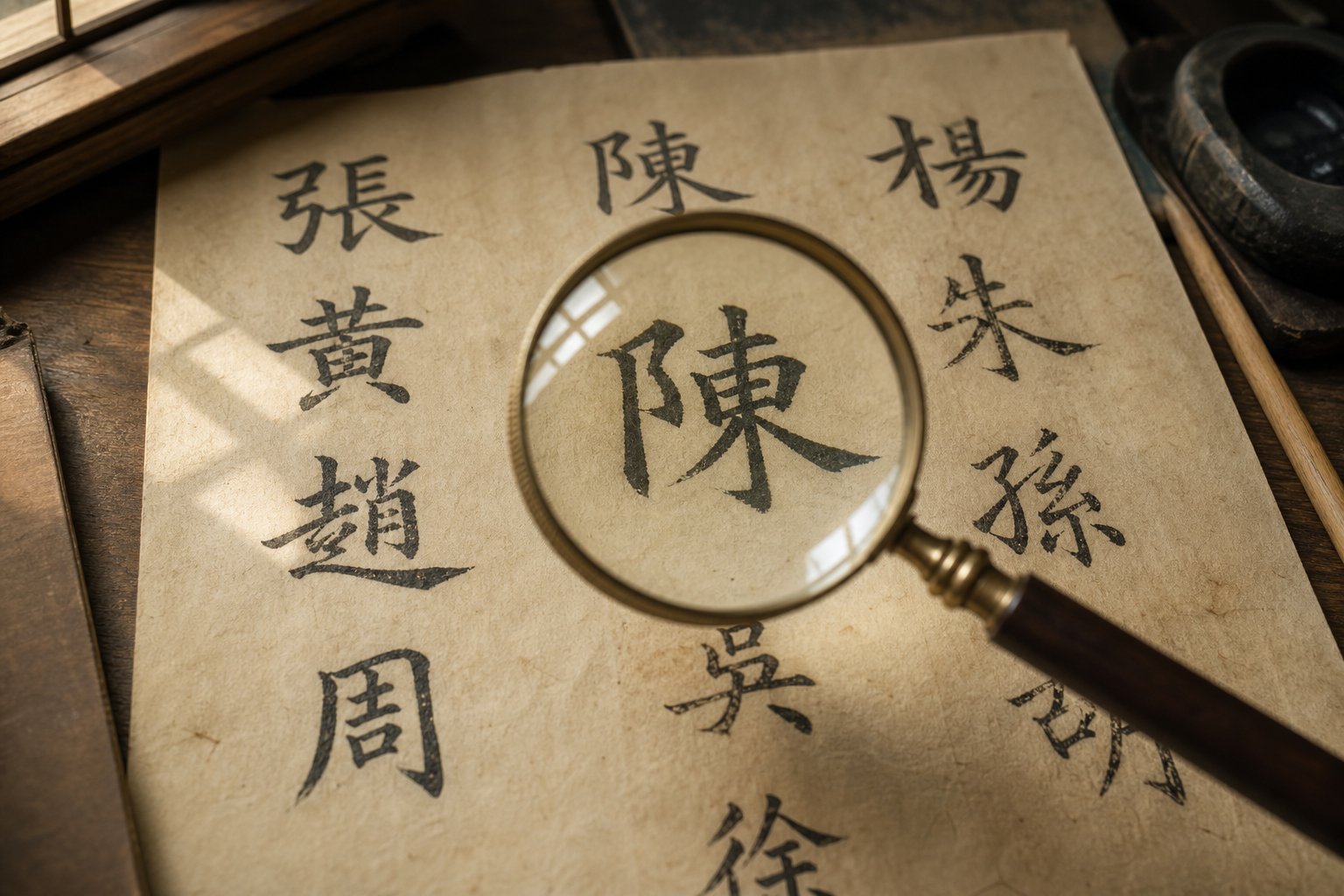
A romanized spelling on a passport or birth certificate might feel like a solid fact, but in the world of Chinese surnames, it is only an approximation. The same spelling can point to completely different characters, each carrying a separate origin story, clan history, and geographic root. Pinning down the correct character is the single most important step in your research, because everything that follows depends on it.
Matching Romanization to Chinese Characters
Consider the spelling "Zhang." In Mandarin Pinyin, this could represent 张 (meaning "to draw a bow," linked to the legendary inventor of the bow and arrow) or 章 (meaning "a seal or emblem," tied to an ancient fiefdom). These two characters share nothing beyond a sound. If you trace the wrong one, you end up researching someone else's clan entirely.
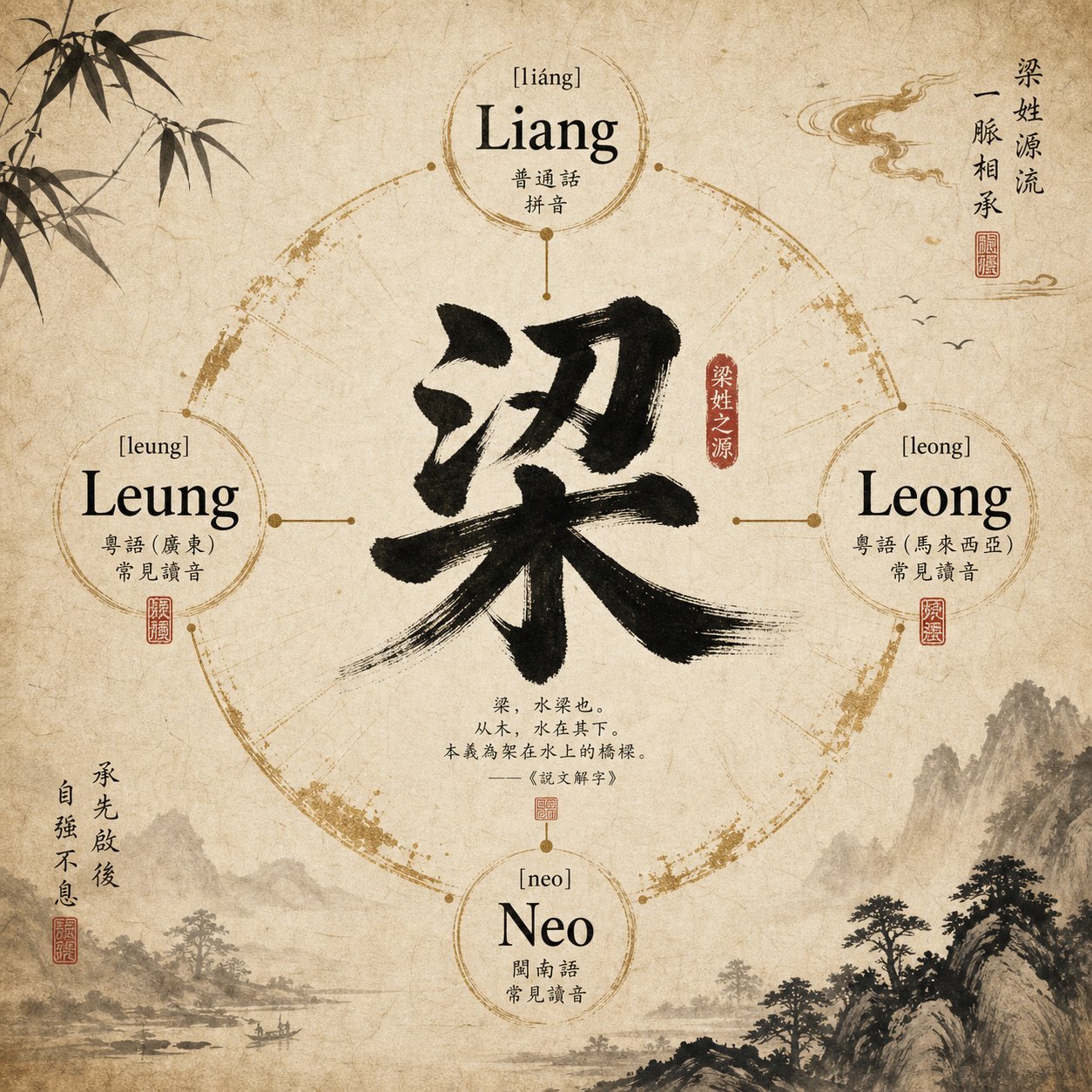
This ambiguity exists because romanization systems were designed to capture pronunciation, not meaning. Pinyin serves Mandarin speakers in mainland China. Wade-Giles, an older system, appears on many Taiwanese documents and pre-1980s academic texts. Jyutping handles Cantonese romanization in Hong Kong and Guangdong. Each system produces different spellings for the same character, and the same spelling within one system can still map to multiple characters.
So how do you identify the right one? Start with your family. My China Roots recommends checking old ID documents, gravestones, ancestral tablets, or letters that belonged to your migrating ancestor. A relative who reads Chinese, even distantly, can often confirm the character in seconds. If no family source exists, online surname search tools let you enter a romanized spelling and filter results by dialect and region to narrow down candidates for your family name in chinese characters.
Navigating Dialect Differences Across Mandarin and Cantonese
Dialect is the hidden variable that makes or breaks your identification. The Chinese language encompasses hundreds of regional varieties, and common dialects among overseas communities include Mandarin, Cantonese, Hakka, Hokkien, and Teochew. Each pronounces the same written character in its own way, which means a single chinese last name can appear under dozens of different romanized spellings worldwide.
The table below shows how five common surname characters sound across major dialect groups:
| Character | Mandarin (Pinyin) | Cantonese | Hokkien | Teochew | Hakka |
|---|---|---|---|---|---|
| 陈 | Chen | Chan | Tan | Tan | Chin |
| 王 | Wang | Wong | Ong | Heng | Wong |
| 黄 | Huang | Wong | Ng / Ooi | Ng | Vong |
| 林 | Lin | Lam | Lim | Lim | Lim |
| 刘 | Liu | Lau | Lau | Low | Liew |
Notice that 黄 alone has been romanized as Huang, Wong, Ng, Ong, Vong, and even Oei depending on dialect and country. Without knowing which dialect your ancestors spoke, you could easily confuse mandarin last names with cantonese last names that happen to share a spelling. For example, "Wong" might be 王 in Cantonese or 黄 in Cantonese, two entirely different surnames that sound identical in that dialect.
If you are unsure which dialect your family used, geography offers a strong clue. Families from Guangdong and Hong Kong typically spoke Cantonese. Those from Fujian and Taiwan often spoke Hokkien. Hakka communities spread across Guangdong, Jiangxi, and parts of Southeast Asia. Knowing even the province your ancestors left from helps you match the romanized spelling to the correct character, giving you a reliable foundation for tracing mandarin surnames or cantonese surnames back to their origins.
With the correct character confirmed, you hold the key that unlocks every historical text, clan record, and surname database relevant to your lineage. The next question becomes: what kind of origin story does that character actually carry?
Step 2 Understand the Categories of Surname Origins
Every Chinese surname carries a backstory, but not all backstories are the same kind. Some names point to a patch of land. Others echo an ancestor's job, a royal decree, or a deliberate reinvention to escape danger. Knowing which category your surname falls into shapes where you look next and how far back in time you need to reach.
The Han dynasty text Feng Su Tong Yi (Penetrating Popular Ways) organized surnames of that era into nine categories by origin, including ancestral names, feudal lands, official posts, and professions. Modern scholars have refined these groupings. Here are the primary categories you will encounter when researching chinese surnames and meanings:
- Place-based surnames - Derived from fiefdoms, ancient kingdoms, or geographic features. Examples include Zheng (鄭), from the state of Zheng, and Wu (吳), from the kingdom of Wu.
- Occupation-based surnames - Linked to ancestral trades or official roles. Soohoo (司徒), meaning "minister of education," is a classic example.
- Ancestral clan names - Inherited directly from a founding patriarch or matriarch. The surname Ji (姬), belonging to the imperial family of the Zhou dynasty, is one of the oldest.
- Emperor-granted surnames - Bestowed by a ruler as a reward for loyalty or achievement. After Li Shimin founded the Tang dynasty, he granted his own surname Li to distinguished ministers, which partly explains why Li is now the most widespread Chinese surname.
- Ethnic adoption surnames - Taken by non-Han peoples integrating into Chinese society. Hu (胡) was adopted by people of Persian, Sogdian, and Turkic origin, while Jin (金) and Man (满) are associated with Jurchen and Manchu communities.
- Political survival surnames - Changed to avoid persecution or clan feuds. Confucius' student Tzu Kung bore the compound surname Tuan Mu, but his descendants shortened it to Mu to escape targeting by a rival clan.
- Official title surnames - Derived from ancient bureaucratic positions, such as Sima (司马, "master of horses") and Shangguan (上官, "senior official").
Understanding which category your surname falls into directs your research toward the right historical period and geographic region. A place-based surname points you to a specific ancient state or territory. An emperor-granted surname narrows your timeline to a particular dynasty. An ethnic adoption surname shifts your focus toward border regions and minority histories.
Place-Based and Occupation-Based Surname Origins
The largest share of chinese last names and meanings trace back to geography. During the Zhou dynasty (1122-255 BC), feudal lords received territories, and their descendants adopted those place names as hereditary surnames. Zhou (周) itself comes from the Zhou kingdom. Zheng, Lu, Song, and Chen all follow this pattern, each tied to a specific state on the ancient map.
Occupation-based surnames work differently. They freeze a moment in time when an ancestor held a particular role. Tao (陶) connects to pottery-making. Wu (巫) points to shamanic practice. These names tell you less about geography and more about social position, which can still guide your research toward the right class of historical records.
Emperor-Granted and Ethnic Adoption Origins
Emperor-granted surnames carry a built-in timestamp. If your research reveals that your name was a royal gift, you can pinpoint the dynasty and often the specific emperor involved. The meaning of chinese last names in this category is inseparable from political history. Some grants honored military heroes. Others punished criminals by assigning degrading characters, though most of those names were later abandoned.
Ethnic adoption surnames reflect China's long history as a multiethnic society. When the Xiaowen Emperor of the Northern Wei dynasty enforced assimilation of the Xianbei people, entire communities adopted Chinese family names and meanings that replaced their polysyllabic originals. Similar patterns repeated during the Yuan, Ming, and Qing dynasties as Mongol, Manchu, and Hui Muslim populations integrated. The chinese last name meanings in these cases often encode the ethnic group itself: Ma (马) became strongly associated with Hui Muslims, while Aisin Gioro, the Manchu imperial clan name, was shortened to Jin or Zhao after the fall of the Qing.
Less common but worth noting are surnames that emerged from scribal errors, character simplification, or the deliberate shortening of compound surnames into single characters. The chinese surnames meaning you uncover may involve any combination of these forces layered over centuries.
With your surname's category identified, you have a compass pointing toward the right era and the right type of source material. The next move is to open the texts that catalog these origins systematically, starting with the most famous surname reference ever compiled.
Step 3 Consult the Baijiaxing and Historical Surname Texts
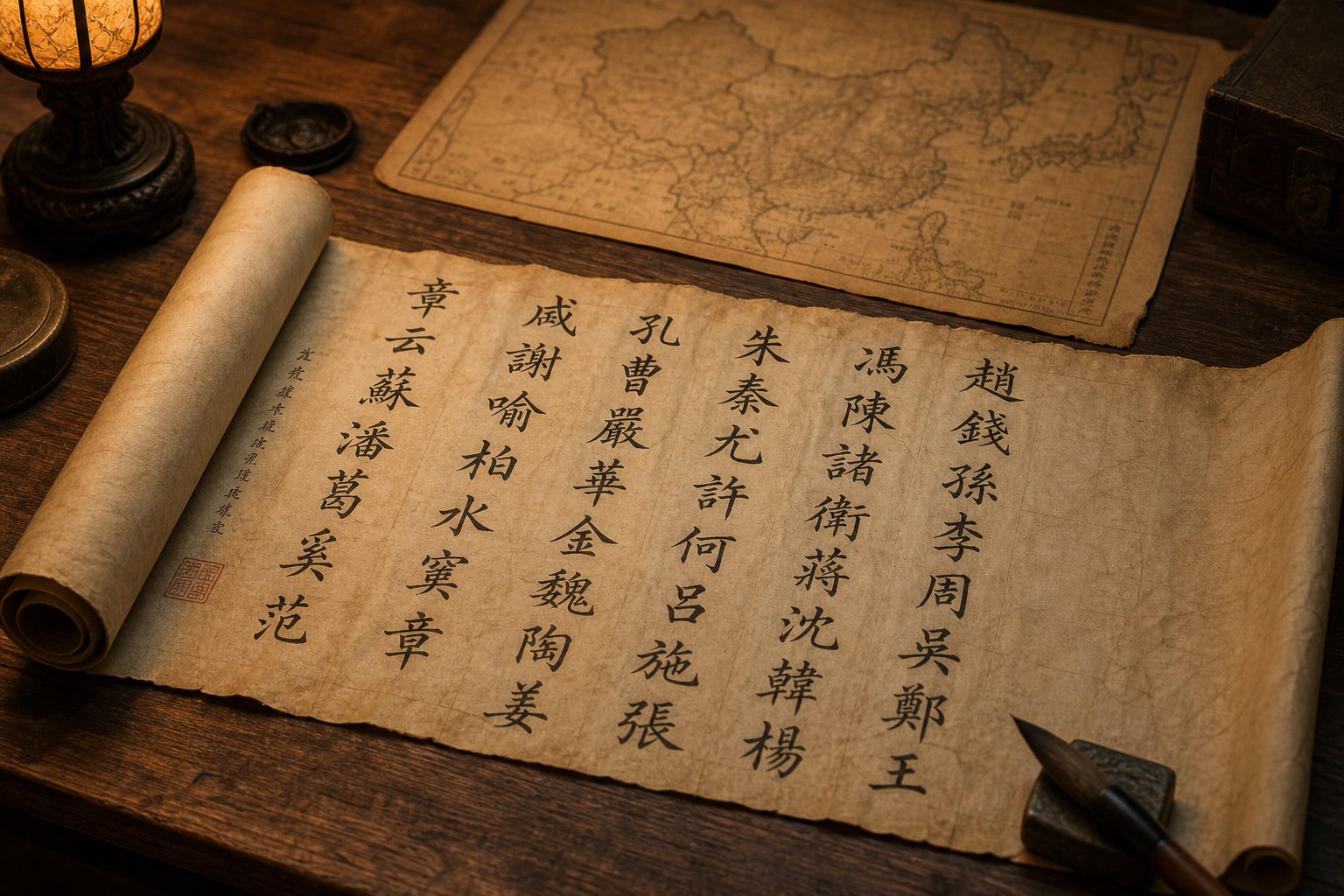
The most famous chinese surname list ever compiled is also one of the oldest structured references you can use. The Baijiaxing (百家姓, Hundred Family Surnames) has served as a starting point for surname research for over a thousand years, and it remains surprisingly useful today. But it is only the first layer. Deeper texts exist that trace lineage connections, etymological roots, and clan migrations in far greater detail.
Using the Baijiaxing as Your Starting Point
Compiled during the early Song Dynasty (960-1279), the Baijiaxing originally contained 411 surnames and was later expanded to 504, of which 444 are single-character surnames and 60 are double-character surnames. The text is structured as a rhyming poem in lines of eight characters, making it easy to memorize. About 800 additional names have been derived from the original entries over the centuries.
One detail worth noting: the list of chinese last names in the Baijiaxing is not arranged by frequency or popularity. The ordering reflects political power at the time of compilation. Zhao (赵) comes first because it was the imperial surname of the Song Dynasty. Qian (钱) follows as the family name of the kings of Wuyue. Sun (孙) represents the queen of Wuyue, and Li (李) honors the kings of Southern Tang. This political logic means you cannot assume your surname's position in the list says anything about its age or prevalence.
What the Baijiaxing does give you is confirmation that your surname existed in recognizable form by the Song Dynasty, plus a starting framework for cross-referencing against more detailed sources. If your surname appears in this chinese family name list, you know it has at least a thousand years of documented history. If it does not appear, you may be dealing with a rarer name that requires specialized texts.
Advanced Historical Texts for Deeper Research
The Baijiaxing tells you a surname exists. The texts below tell you where it came from, who carried it, and how it spread. Each serves a different research purpose:
- Yuanhe Xing Zuan (元和姓纂) - Tang Dynasty (finished 812 AD). Compiled by Lin Bao on imperial order, this register traces the family lineages of the empire's most powerful clans. It records genealogical connections, geographic origins, and branch migrations. The original was lost, but Qing-era scholars reconstructed it from fragments preserved in the Ming encyclopedia Yongle Dadian.
- Xing Shi Xun Yuan (姓氏寻源) - Qing Dynasty. This text provides etymological analysis of surname characters, tracing the linguistic and historical roots of each name. It is particularly useful for understanding how ancient chinese surnames evolved in meaning and form over time.
- Tongzhi Shi Zu Lue (通志·氏族略) - Song Dynasty (12th century). Compiled by scholar Zheng Qiao, this section of his universal history draws heavily on the Yuanhe Xing Zuan and organizes surnames by origin category, making it an excellent cross-reference for the classification work you completed in Step 2.
- Wan Xing Tong Pu (万姓统谱) - Ming Dynasty. A comprehensive list of chinese family names with biographical entries for notable bearers of each surname, useful for identifying famous ancestors and regional clusters.
Accessing these texts no longer requires a trip to Beijing. University East Asian libraries, particularly those with strong Chinese collections, hold physical copies and provide digital access. Princeton University's research guides list multiple databases where classical Chinese texts are fully searchable, including the Siku Quanshu (四库全书) digital edition, the Zhongguo Jiben Guji Ku (中国基本古籍库) with over 10,000 traditional titles, and the Academia Sinica Scripta Sinica database. Many of these platforms allow full-text keyword searching, so you can enter your surname character and retrieve every mention across thousands of historical works simultaneously.
For researchers without Chinese reading ability, translated excerpts of the Baijiaxing are widely available in English. The Yuanhe Xing Zuan is harder to find in translation, but genealogy societies and professional translators who specialize in classical Chinese can extract the relevant entries for your specific surname from the list of chinese surnames in these databases.
These texts give you the documented origin narrative. The next piece of the puzzle is geographic: connecting that narrative to a specific place on the map where your ancestors actually lived.
Step 4 Trace the Geographic Roots of Your Surname
A surname origin story tells you where a name came from in the abstract. But what most family researchers actually want is a place: a province, a county, a village they can point to on a map. This is where surname geography becomes your most practical tool. Surnames in china are not evenly scattered. They cluster, sometimes dramatically, in specific regions, and those clusters reflect centuries of migration, settlement, and clan growth.
Tracing Your Surname to a Province or Region
For a country of 1.3 billion people, the concentration of popular chinese last names is striking. An estimated 87% of the population shares one of just 100 surnames, and more than one in five Chinese citizens is surnamed Li, Wang, or Zhang, totaling over 275 million people. These most popular last names in china are not spread uniformly. Li, Wang, and Zhang concentrate heavily in the northeast, where the ethnic Han majority is most predominant. Chen dominates the southeastern provinces of Fujian and Guangdong. Ma clusters in the northwest due to its historic association with China's Muslim Hui minority.
The table below shows well-known surname-region associations that can help you narrow your search for chinese roots:
| Surname | Character | Primary Region of Concentration | Historical Context |
|---|---|---|---|
| Li | 李 | Northeast China (Hebei, Henan, Shandong) | Tang Dynasty imperial surname, widely granted |
| Wang | 王 | Northeast and North China | Derived from royal lineages across multiple states |
| Zhang | 张 | North and Central China | One of the oldest surnames, tied to the Yellow River basin |
| Chen | 陈 | Southeast China (Fujian, Guangdong) | State of Chen descendants migrated south |
| Ma | 马 | Northwest China (Ningxia, Gansu, Qinghai) | Strongly associated with Hui Muslim communities |
| Lin | 林 | Fujian and Guangdong | Roots surname traces to Bigan of the Shang Dynasty |
| Huang | 黄 | Southern China (Guangdong, Guangxi) | Ancient state of Huang in modern Henan, clan migrated south |
These patterns are not random. They reflect specific historical migrations documented in clan records and dynastic histories. If your surname is a common surname in china with a known regional base, you already have a strong geographic hypothesis to test against family oral history or immigration documents.
Understanding Patrilineal Inheritance and Migration Patterns
Chinese surnames follow strict patrilineal inheritance. Children receive their father's surname, and this pattern has held for over 4,000 years with remarkable consistency. Research from Beijing Normal University analyzing 1.28 billion citizen records confirms that Chinese surnames have been well preserved through generations due to the prevalence of Confucian culture, where people do not change their surnames unless forced to do so. This stability means that surname distribution maps function almost like genetic maps, revealing population movements across centuries.
The same study identified distinct geographic zones shaped by migration. The Yellow River basin in central-north China served as the origin point for most surnames china researchers encounter. After the Song Dynasty in the 11th century, massive southward migrations carried northern surnames into the Yangtze River basin, creating a zone of high surname diversity in central and southern China. Meanwhile, the northeast and northwest were populated much more recently through organized migrations like "Braving the Journey to the Northeast" in the 19th and 20th centuries.
What does this mean for your research? If your surname clusters in the south but your family's oral history points to a northern origin, you may be tracing a migration that happened during the Song or Ming dynasties. If your surname appears in the northeast with high frequency but low diversity of rare names, your ancestors likely arrived during the Qing-era land reclamation movements.
To use this data practically, surname frequency databases let you enter your character and see which provinces and prefectures have the highest concentration. Cross-reference that geographic data with the origin category you identified in Step 2 and the historical texts from Step 3. When multiple sources point to the same region, you have a strong candidate for your ancestral homeland. The next step is finding the clan-specific records that can confirm it and trace your particular branch within that region.
Step 5 Access Zupu and Clan Genealogical Records
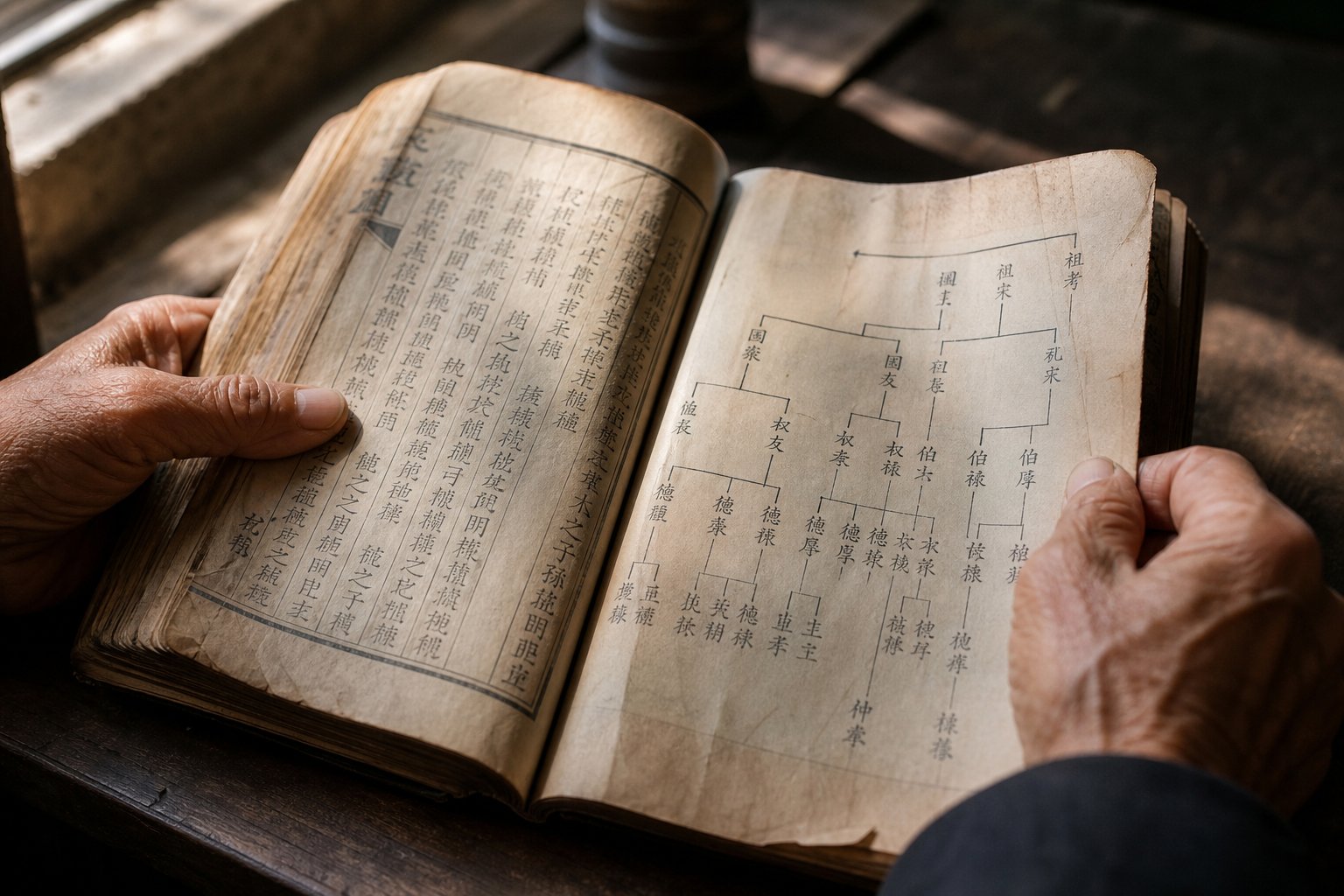
Geographic data and historical texts can point you toward a region, but the single richest source for your specific clan's surname origin narrative is a zupu (族谱). Think of it this way: the Baijiaxing tells you the broad origin of a surname across all its bearers. A zupu tells you the origin story of your branch, your particular ancestors, and the village they called home. It is the closest thing chinese genealogy has to a holy grail.
Unlike Western countries where church records and census data form the backbone of family research, China historically relied on clans themselves to document births, deaths, marriages, and migrations. The result is the zupu, also called a jiapu (家谱), a book compiled and maintained by a single clan in a specific locality. Some cover a few generations on loose pages. Others span dozens of volumes tracing a lineage back a thousand years or more.
What a Zupu Contains and Why It Matters
Imagine opening a book that begins with your founding ancestor and walks you, generation by generation, through every male descendant down to the present. That is the core of a zupu. But most contain far more than a simple china family tree. According to FamilySearch's jiapu research guide, a typical zupu includes the following sections:
- Surname origins - A narrative explaining how the clan acquired its name, often tracing back to a specific ancestor, place, or imperial grant
- Migration history - Records of when and why the clan moved from one region to another, sometimes spanning multiple relocations over centuries
- Pedigree charts - Generational lineage diagrams recording male descendants from the founding ancestor forward
- Generation poems (字辈) - A series of characters that dictate the first character of each generation's given name, allowing you to identify which generation any clan member belongs to simply by reading their name
- Biographies - Accounts of prominent ancestors, including dates, achievements, and family details
- Clan rules and teachings - Regulations governing membership, behavior, and responsibilities within the clan
- Ancestral portraits and cemetery maps - Visual records of important forebears and burial locations
- Ancestral hall information (堂号) - Details about the temple where chinese ancestors of the same clan are honored
The generation poem alone can be a powerful research tool. If you know the middle character of your grandfather's name, you can match it against the poem sequence in a zupu to confirm your family's place within the lineage. This is often how researchers verify they have found the correct clan record rather than a different branch sharing the same surname.
One important caveat: zupu were compiled by clans to honor and glorify their ancestors. Legacy Tree Genealogists notes that compilers were often selective about what they included. Individuals who disgraced the family were typically omitted. Wives appear only by surname, and daughters are rarely mentioned at all. The origin narratives in the earliest sections may blend historical fact with legend. Treat these records the way you would any compiled family history source: valuable but requiring cross-referencing.
Where to Find Zupu and Clan Records
The Cultural Revolution of the 1960s destroyed many zupu across mainland China, as the practice was branded a "feudalist, backward tradition." Yet a surprising number survived, hidden by families, preserved in libraries, or shipped abroad for safekeeping. Since the 1990s, many clans in southern China have been recompiling their records, and major institutions have invested heavily in digitizing surviving collections.
Here are the most practical access points for finding your family's zupu:
- Your ancestral village - The most direct path. If you know the village your emigrating ancestor came from, reach out to village leadership with photographs and your ancestor's Chinese name. They can confirm whether a zupu still exists locally and verify your ancestor's entry in it.
- FamilySearch's digitized collection - FamilySearch hosts a searchable jiapu database where you can input your surname, ancestral province, and other details to locate digitized clan records for free.
- Shanghai Library's jiapu collection - The Shanghai Library holds one of the largest zupu collections in the world, with an online search interface (in Chinese) that allows you to browse by surname and region.
- Provincial libraries in China - The Guangdong, Fujian, Beijing, and Guangzhou libraries all maintain significant genealogy chinese collections, many now partially digitized.
- Overseas clan associations - In Southeast Asian countries like Malaysia and Singapore, local clan associations (宗亲会) often collect and preserve zupu for their members. These organizations are especially valuable for Hokkien, Teochew, and Cantonese diaspora families.
- University East Asian libraries - Institutions like Columbia, Harvard-Yenching, and the University of British Columbia hold physical zupu collections accessible to researchers.
- Elderly relatives - Do not overlook the simplest source. Parents, grandparents, or distant cousins may have a zupu themselves or know someone who does. Even if the original was lost, copies often survive through relatives who emigrated before the 1960s.
When searching online, you will need your surname in Chinese characters (which you identified in Step 1) and ideally your ancestral village or county name. FamilySearch recommends gathering your ancestral hall name (堂号), generation poem, and any known honored ancestors before searching, as these details dramatically narrow results.
What if you find a zupu but cannot read classical Chinese? This is common, and it does not have to stop you. Zupu are written in literary Chinese that differs significantly from modern Mandarin. Even native Chinese speakers often struggle with the archaic phrasing. Your options include hiring a professional translator who specializes in genealogy in chinese historical documents, working with a local genealogy society that has experience with clan records, or using FamilySearch's Jiapu Guide, which walks you through common zupu styles and helps you identify names, villages, and generations even without full Chinese literacy.
The effort is worth it. A single zupu can contain the family tree in chinese names stretching back dozens of generations, confirm your surname's specific origin narrative, and identify the exact village your ancestors left. It transforms abstract historical knowledge into a personal, documented connection to your lineage. And if your initial search comes up empty, do not give up. Many families have been surprised to discover copies preserved by distant relatives in Malaysia, Singapore, or the United States, long after assuming the records were lost forever.
Of course, not every surname fits neatly into the standard single-character pattern that most zupu are organized around. Compound surnames and rare names require a different research strategy entirely.
Step 6 Handle Compound Surnames and Special Cases
Most Chinese surnames are a single character. But if your family name has two characters, like Sima, Ouyang, or Zhuge, you are dealing with a compound surname (复姓), and the research path looks different. These ancient chinese last names follow their own origin logic and require specialized sources that go beyond the standard Baijiaxing entries.
Researching Compound Surnames Like Sima and Ouyang
China once had over 1,000 compound surnames. Fewer than 100 remain in use today, carried by only a few million people total. Ouyang leads with approximately 1.1 million bearers according to the 2020 National Name Report by the Ministry of Public Security, followed by Shangguan (88,000), Huangfu, Linghu, Zhuge, Situ, and Sima.
Where do these names come from? Compound surnames typically derive from one of four sources:
- Official titles - Sima (司马) literally means "master of horses," an ancient military position. Situ (司徒) referred to a minister of education. The ancestor who held the post passed the title down as a hereditary name.
- Place names - Ouyang (欧阳) refers to the southern side of Mount Ou. Dongguo (东郭) means "east outer wall." These traditional chinese last names froze a geographic marker into a family identity.
- Clan differentiation - Some compounds were created to distinguish one branch from another within the same larger clan, preventing confusion in official records.
- Ethnic minority origins - Names like Helian (赫连) and Wanyan (完颜) entered the Chinese naming system through Xianbei, Jurchen, and other non-Han peoples who adopted Chinese-style surnames while preserving their polysyllabic structure.
Many compound surnames eventually shortened into single characters. People surnamed Ou (欧) or Yang (杨) today may descend from the Ouyang clan. If your single-character surname does not yield clear results in standard references, consider whether it might be a truncated compound name. Checking historical records for the full form can unlock an entirely different origin narrative.
Tracking Down Rare and Uncommon Surname Origins
Of the more than 23,000 Chinese surnames recorded throughout history, only about 25 percent remain in active use today, meaning thousands of ancient chinese family names have vanished from daily life.
If your surname does not appear in the Baijiaxing or common frequency lists, you are likely carrying one of these rare chinese last names. Uncommon chinese surnames often trace back to ethnic minority adoption, where a polysyllabic tribal name was compressed into one or two Chinese characters during assimilation campaigns. Others emerged from deliberate name changes to escape political persecution, or from scribal errors that became permanent over generations.
The FamilySearch Chinese Surnames wiki documents several examples: the surname Die (迭) developed from a four-character compound of Northern Wei ethnic minorities, while Zhi (植) traces its lineage to King Goujian of Yue. Some rare surnames survive in only a handful of villages. The compound surname Xushi (许世), for instance, reportedly has just one living inheritor, a descendant of a 15th-century Ceylon prince who settled in Quanzhou, Fujian.
For chinese noble last names and other uncommon names, your best resources are provincial gazetteers (地方志), ethnic minority history databases, and specialized surname dictionaries like the Zhonghua Xingshi Da Cidian (中华姓氏大辞典), which catalogs over 23,000 entries. Local archives in the province where your surname clusters will often hold records that national databases miss entirely.
Whether your surname is a well-documented compound or an obscure single character carried by a few hundred people, the research principles remain the same: identify the character, classify the origin type, and locate the geographic base. The difference is simply which sources you prioritize. With your origin findings in hand, the final step is pulling everything together into a coherent family narrative and connecting with others who share your lineage.
Step 7 Connect Your Findings and Build Your Family Story
You have identified your character, classified your surname's origin category, consulted historical texts, mapped a geographic base, and possibly located a zupu. Each piece of research sits in its own silo until you pull it together into a coherent narrative. This final step is about synthesis, verification, and action: turning scattered findings into a documented china name origin story you can share, build on, and pass forward.
Documenting and Verifying Your Findings
Not every surname origin story you encounter will be historical fact. Some are legendary, especially the founding narratives in zupu that attribute a clan's beginnings to mythological emperors or divine events. The key is cross-referencing. When three independent sources, say a historical text, a zupu, and a regional gazetteer, all point to the same founding ancestor, geographic origin, or migration event, you have a strong finding. When only one source makes a claim and others contradict it, treat that claim as tradition rather than established history.
Record your chinese name origin research in a structured format. Note each source you consulted, what it confirmed, and where gaps remain. Include the Chinese characters, romanizations across dialects, the origin category, the geographic region, and any generation poem or ancestral hall name you uncovered. This documentation becomes invaluable if you later search by surname in clan databases or connect with distant relatives who hold complementary records.
For diaspora researchers still working to find chinese name characters or verify spellings, your documented research trail also helps professional genealogists pick up where you left off. Even partial findings, a province, a generation poem fragment, a single ancestor's name, can be the missing piece someone else in your extended family needs.
Connecting with Clan Associations and Next Steps
Clan associations (宗亲会) exist in nearly every country with a significant Chinese population. These organizations, whether kinship-based groups like the Lung Kong Association uniting the Liu, Guan, Zhang, and Zhao clans, or single-surname societies like the Chen Clan Temple in Semarang, serve as living repositories of collective memory. They organize ancestral worship ceremonies, maintain member directories, and often hold zupu copies or know where to find them. The Singapore Federation of Chinese Clan Associations alone coordinates around 200 such organizations.
Reaching out to a clan association relevant to your surname can accelerate your research dramatically. Members may already know the chinese surname meanings and migration routes specific to your branch. They can connect you with elders who remember oral histories, or with researchers in China who have access to village-level records.
Here are recommended next steps after completing your surname origin research:
- Compile your findings into a single document that includes the surname character, origin narrative, geographic roots, and any zupu references, then share it with family members for additions or corrections.
- Search for a clan association matching your surname and ancestral region. Check directories from the My China Roots wiki, FamilySearch community forums, or local Chinese community centers.
- If you know your ancestral province but not the specific village, use your surname's generation poem or ancestral hall name to narrow the search further through clan association contacts.
- Plan a roots trip to your ancestral village if one has been identified. Village elders and local clan leaders can often confirm connections on the spot using their own records.
- Contribute your findings back to shared databases and clan records so future researchers benefit from your work.
For those who started this process wondering how to find my chinese name or its deeper meaning, the journey does not end with a single origin story. Each finding opens new questions: which branch migrated and when, who stayed behind, what connections still exist. The surname is your entry point, but the family story it unlocks stretches in every direction, backward through dynasties and forward through the relatives you have yet to meet.
Frequently Asked Questions About Finding Chinese Surname Origins
1. How do I find the Chinese character for my surname if I only have a romanized spelling?
Start by checking old family documents like immigration papers, gravestones, or ancestral tablets that may show the character. If none exist, determine which dialect your ancestors spoke (Mandarin, Cantonese, Hakka, Hokkien, or Teochew), since the same romanized spelling can represent entirely different characters depending on dialect. For example, 'Wong' could be either 王 or 黄 in Cantonese. Online surname search tools allow you to filter by dialect and region to narrow candidates. Consulting a relative who reads Chinese, even a distant one, can often confirm the correct character immediately.
2. What are the main categories of Chinese surname origins?
Chinese surnames generally fall into seven categories: place-based surnames derived from ancient fiefdoms or geographic features; occupation-based surnames tied to ancestral trades; ancestral clan names inherited from a founding patriarch; emperor-granted surnames bestowed as rewards for loyalty; ethnic adoption surnames taken by non-Han peoples integrating into Chinese society; political survival surnames changed to avoid persecution; and official title surnames derived from bureaucratic positions like Sima (master of horses). Identifying which category your surname belongs to helps direct research toward the correct historical period and geographic region.
3. What is a zupu and how can it help trace my Chinese surname origin?
A zupu (族谱) is a Chinese clan genealogical book compiled and maintained by a single family clan in a specific locality. Unlike Western genealogy that relies on church or state records, Chinese families documented their own histories. A zupu typically contains surname origin narratives, migration records, generational pedigree charts, generation poems that dictate naming patterns, biographies of prominent ancestors, and ancestral hall information. You can find zupu through FamilySearch's digitized collection, the Shanghai Library's jiapu database, overseas clan associations in Southeast Asia, university East Asian libraries, or by contacting your ancestral village directly.
4. Why does the same Chinese surname have different spellings in different countries?
Different spellings arise because Chinese dialects pronounce the same written character in distinct ways, and each dialect uses its own romanization system. For instance, the character 陈 is spelled Chen in Mandarin Pinyin, Chan in Cantonese, Tan in Hokkien, and Chin in Hakka. When Chinese families emigrated to different countries, their surnames were romanized based on whichever dialect they spoke and whichever romanization convention the destination country used. This means families sharing the exact same surname character can appear under completely different spellings depending on their dialect background and immigration history.
5. How can I trace my Chinese surname to a specific region or province in China?
Chinese surnames cluster in specific regions due to centuries of migration and settlement patterns. Use surname frequency databases to enter your character and see which provinces have the highest concentration. Cross-reference this with your surname's origin category and historical texts. For example, Chen concentrates in Fujian and Guangdong, while Ma clusters in the northwest due to Hui Muslim associations. Combine geographic data with family oral history, immigration documents, and generation poems from zupu records. When multiple independent sources point to the same region, you have a strong candidate for your ancestral homeland.