What Are Teochew Surname Romanizations
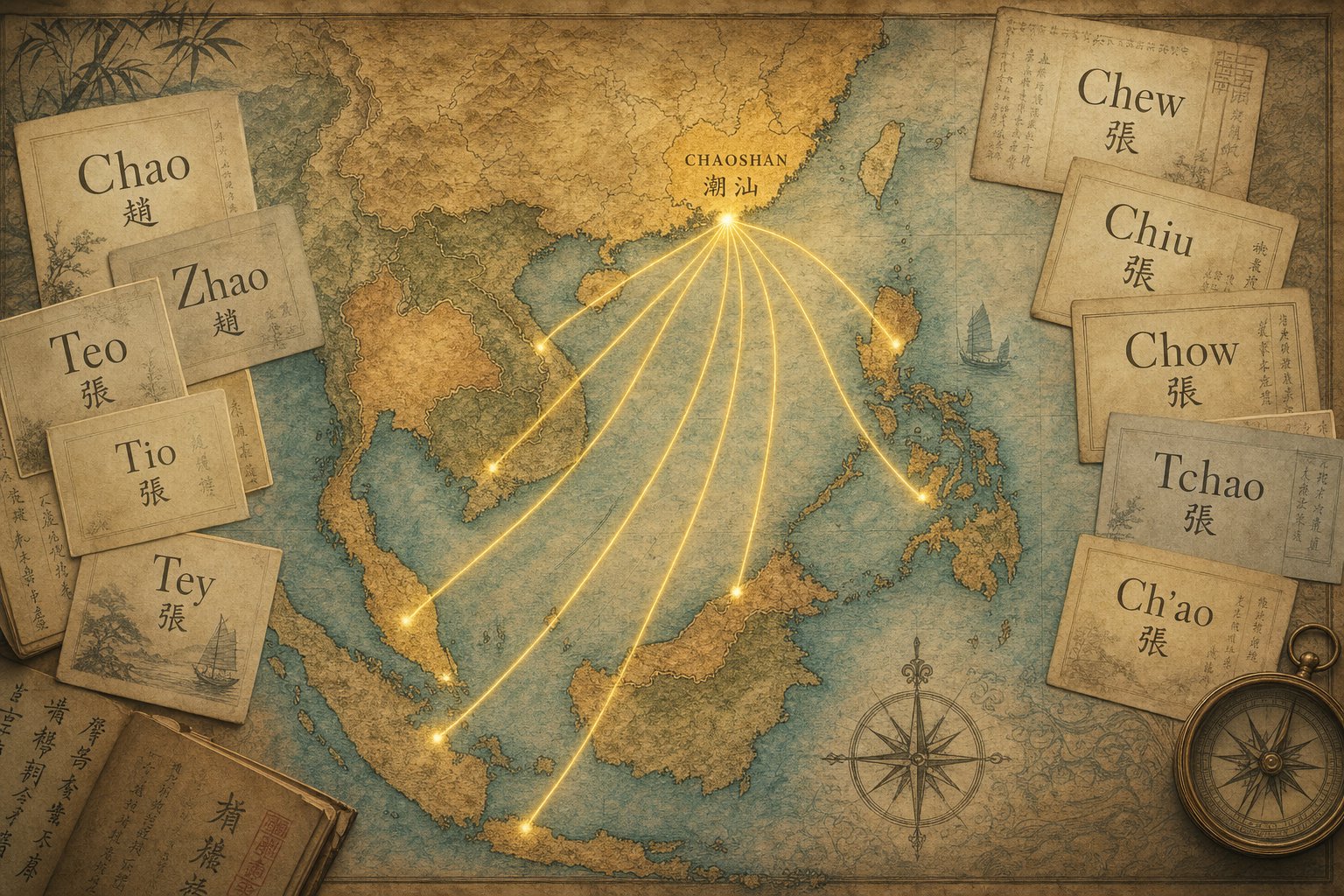
Imagine discovering a distant cousin in Singapore named Teo, another in Malaysia spelled Teoh, a relative in Indonesia going by Thio, and yet another in the Philippines using Tiu. All four trace their lineage to the same ancestor and the same Chinese character: 張 (Zhang in Mandarin). How did one family end up with four different last names?
This is the reality for millions of people in the global Teochew diaspora. Teochew surname romanizations refer to the various ways Chinese characters were transliterated into the Latin alphabet when Teochew-speaking migrants settled across Southeast Asia and beyond. Because no single standardized system existed, colonial administrators, missionaries, and local registrars each applied their own phonetic logic. The result: a single surname character fractured into multiple official spellings depending on where and when a family registered.
Why Teochew Surnames Have So Many Spellings
Why are Teochew names spelled differently from one country to the next? The short answer is that romanization was never consistent. A British clerk in Penang, a Dutch official in Batavia, and a Thai registrar in Bangkok each heard the same Teochew pronunciation and wrote it down using the spelling conventions of their own language. Once a spelling entered civil records, it became permanent, passed down through generations regardless of whether it accurately captured the original sound.
The surname 張, for instance, is pronounced something close to "tio" in Teochew. That single sound became Teo, Teoh, Tio, or Thio depending on the registrar's ear and the dominant colonial language. This pattern repeats across dozens of common surnames, creating a web of variant spellings that can make relatives invisible to each other in official records.
A single Teochew family may appear under three or four different romanized surnames across national records in Singapore, Malaysia, Thailand, and Indonesia, making it nearly impossible for descendants to connect the dots without understanding how these spelling variations arose.
Who This Guide Helps
This guide serves as a Rosetta Stone for anyone trying to decode Teochew surname spelling variations. You'll find it useful if you are:
- A descendant of Teochew migrants searching for ancestors across multiple countries
- A genealogist working with records from Southeast Asian civil registries
- Someone who has always wondered why cousins in different countries carry different last names
- A researcher exploring the Teochew diaspora communities spread across Brunei, Cambodia, France, Indonesia, Malaysia, Singapore, Thailand, Vietnam, and beyond
The challenge is real. As genealogy professionals note, one Chinese surname like 陳 can appear as Chen, Chin, Chan, Tan, Tjin, or Ting depending on dialect and location. For Teochew speakers specifically, the variations follow distinct patterns shaped by history, geography, and phonology. Understanding those patterns transforms a confusing tangle of spellings into a navigable map back to your ancestral character.
What created these patterns in the first place? The answer lies in a specific sequence of historical events, starting with 19th-century missionaries who first attempted to write Teochew sounds in Roman letters.
Historical Origins of Teochew Surname Spelling Variations
The history of Teochew surname romanization begins not with governments or linguists, but with Western missionaries trying to preach in a language that had no standard written form in Roman letters. Their improvised spelling systems became the foundation for how millions of Teochew surnames would eventually be recorded in official documents across Southeast Asia.
Missionary-Era Phonetic Systems
Protestant missionaries arriving in the Chaoshan region and among Teochew communities abroad during the mid-1800s faced an immediate problem: they needed to learn and transcribe a spoken language with no existing Latin-script orthography. Each mission developed its own approach. American Baptist missionary Josiah Goddard published a Tie-Chiu dialect vocabulary in Bangkok as early as 1847. British diplomat Herbert Allen Giles followed with his Handbook of the Swatow Dialect in 1877. By 1883, Adele Fielde had produced a full pronouncing dictionary, and the English Presbyterian Mission released its own vocabulary of spoken Swatow.
Each of these works used slightly different conventions to represent the same Teochew sounds. Goddard spelled the dialect name "Tie-Chiu." Others wrote "Tiê-chiû" or "Teo-chew." These inconsistencies carried directly into how surnames were captured. A missionary romanization of Teochew dialects in one region could produce "Teo" for 張, while another system in a neighboring community rendered it "Tio." There was no coordinating authority, no shared standard, just individual scholars making their best phonetic guesses using English, Dutch, or French spelling habits.
Colonial Registration and Its Lasting Impact
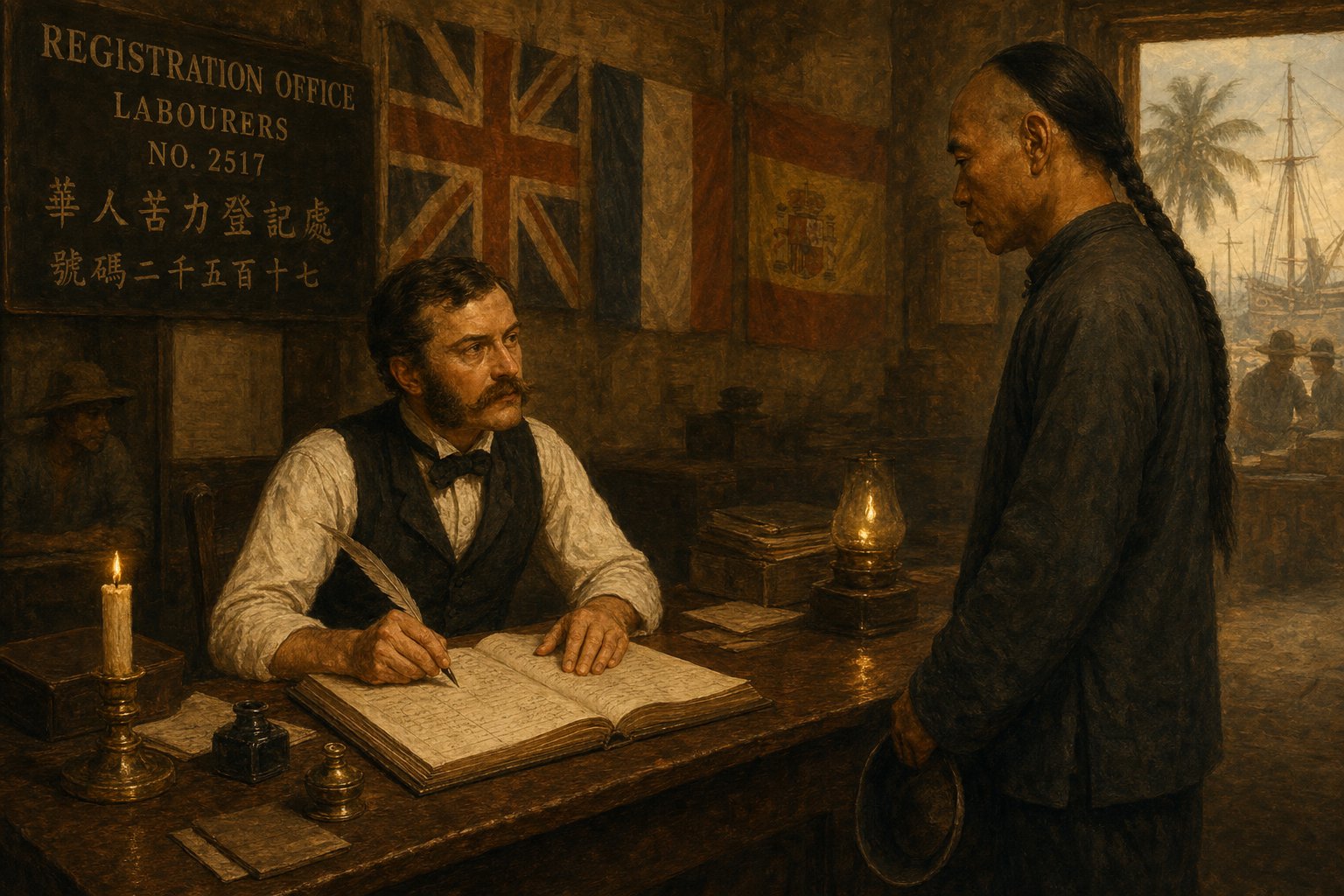
When Teochew migrants arrived in Southeast Asia by the hundreds of thousands during the late 19th and early 20th centuries, they entered colonial bureaucracies that required registered names in Latin script. The problem? Each colonial power applied its own language's phonetic rules to the task.
Here is how the timeline unfolded:
- 1840s-1880s: Missionary dictionaries and vocabularies establish the first written conventions for Teochew sounds, with no coordination between missions.
- 1824-1900s: The Anglo-Dutch Treaty of 1824 divides Southeast Asia into British and Dutch spheres. British Malaya and the Dutch East Indies develop separate registration systems for Chinese immigrants.
- 1900s-1940s: Colonial civil registration becomes widespread. British clerks in Penang and Singapore write Teochew names using English phonetics. Dutch officials in Batavia use Dutch spelling conventions. Thai registrars in Bangkok adapt names to Thai script and phonology. French administrators in Indochina apply French orthographic rules.
- 1940s-1960s: Independence movements across the region inherit and preserve these colonial-era spellings in new national identity systems. Surnames become legally fixed.
Consider what this meant in practice. A Teochew speaker with the surname 黃 might be registered as "Ng" in British Malaya (reflecting the clipped nasal sound a British ear perceived), "Oei" or "Oey" in the Dutch East Indies (using Dutch vowel conventions), and "Huang" in a Thai record influenced by Mandarin readings. The colonial era Chinese surname registration process was never designed to preserve linguistic accuracy. It was designed for administrative convenience.
The critical consequence: once a spelling entered an official birth certificate or immigration ledger, it became the family's permanent legal name. Children inherited it. Grandchildren carried it abroad. The original Teochew pronunciation lived on in speech, but the written form was frozen in whatever approximation a colonial clerk chose decades earlier. This is precisely why understanding how Teochew surnames were registered in Southeast Asia matters for anyone tracing family connections today.
These frozen spellings might seem arbitrary, but they actually follow predictable patterns rooted in the phonological features of Teochew itself, features that set it apart from Mandarin and even from its closest linguistic relative, Hokkien.
Teochew Phonology Behind Surname Spelling Differences
Why does the same Chinese character produce completely unrecognizable surnames in Teochew versus Mandarin? The answer is not random variation. It is the direct result of specific sound features that Teochew preserved from ancient Chinese while Mandarin evolved away from them. These phonological differences explain why Teochew and Mandarin surnames differ so dramatically, and why even Teochew and Hokkien, two closely related Southern Min languages, produce distinct romanizations for the same character.
Final Stops and Nasalized Vowels in Teochew
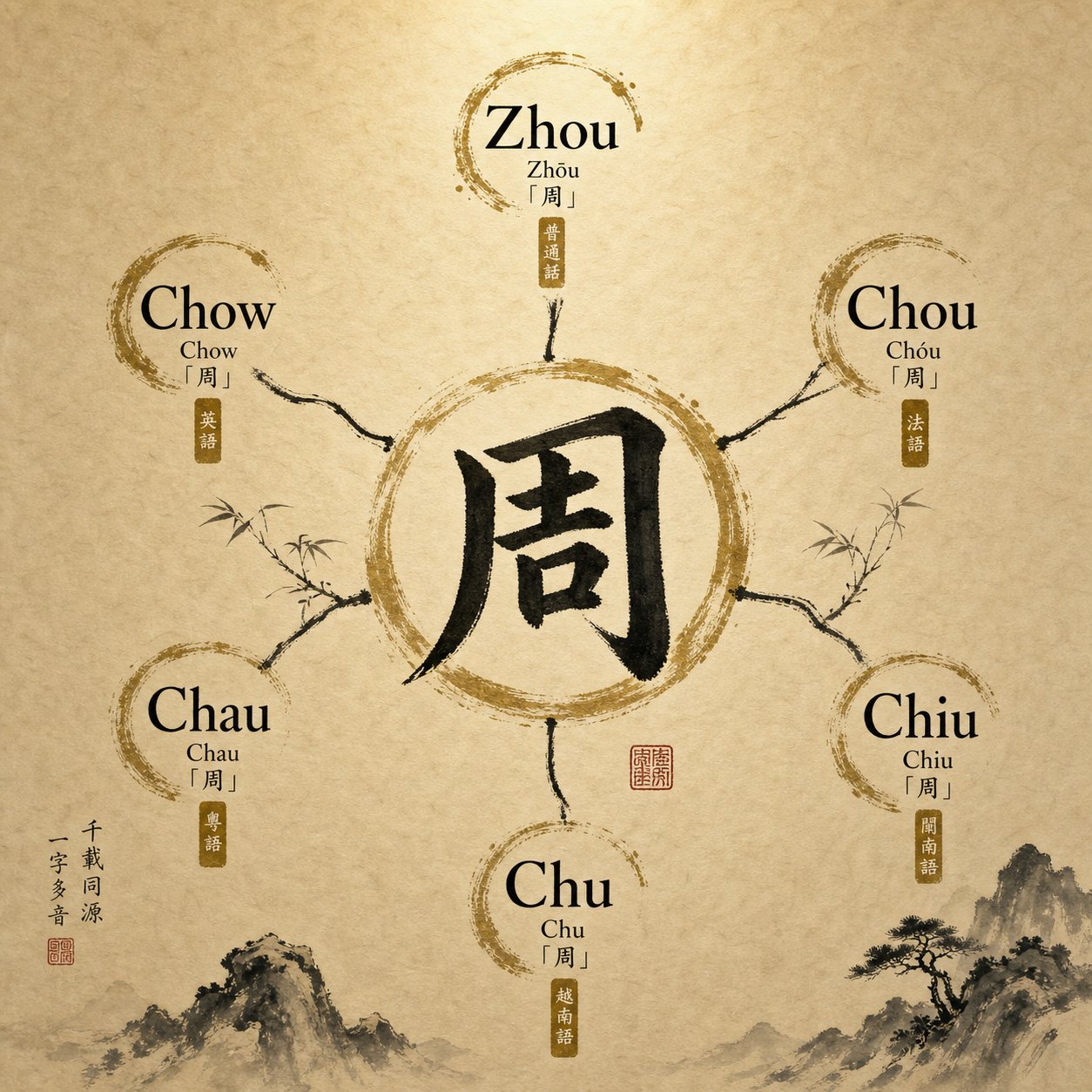
Imagine hearing a Mandarin speaker say "Zhang" and a Teochew speaker say "Tio" for the character 張. Sounds like two completely different words, right? The gap comes from centuries of divergent sound evolution. Teochew split from Mandarin roughly 2,000 years ago, and linguists consider it one of the most conservative Chinese dialects, preserving archaic features from Middle Chinese that Mandarin shed long ago.
The most significant of these preserved features is the retention of final stop consonants. In Mandarin, every syllable ends in either a vowel or a nasal sound (-n, -ng). Teochew syllables, by contrast, can end abruptly with a stop consonant: [-p], [-k], or a glottal stop [ʔ]. This single difference reshapes how surnames look when written in Roman letters.
Teochew also maintains a three-way distinction between unvoiced unaspirated, unvoiced aspirated, and voiced unaspirated plosives that Mandarin collapsed into a simpler two-way system. On top of that, oral and nasalized vowels form contrasting pairs in Teochew, meaning the presence or absence of nasalization can distinguish one word from another entirely.
Here are the key phonological distinctions that directly shape Teochew surname romanizations:
- Final stop consonants (-p, -k, -ʔ): Where Mandarin lost all final stops, Teochew kept them. The surname 郭 ends in a sharp [-k] sound, producing "Kuek" or "Kwek" in Teochew rather than the open-ended "Guo" in Mandarin. Similarly, 葉 retains its [-p] ending as "Iap" or "Yap" instead of Mandarin's "Ye."
- Merger of -t into -k (unlike Hokkien): Teochew merged the historical -t ending with -k, while Hokkien preserved both. This is why the surname 陸 appears as "Lak" in Teochew but "Liok" or "Liut" in some Hokkien varieties. It also explains why Teochew and Hokkien romanizations diverge despite both being Southern Min languages.
- Dental stops replacing affricates: Where Mandarin uses the affricate initials zh-, ch-, and sh-, Teochew often preserves older dental stop initials d- and t-. The surname 張 ("Zhang" in Mandarin) begins with a "t" sound in Teochew, yielding "Tio," "Teo," or "Teoh" depending on the registrar's conventions.
- Nasalized vowels: Teochew distinguishes between oral and nasal versions of the same vowel. The surname 孫 carries nasalization that can appear in romanization as "Sung" or "Sng," while its Mandarin equivalent "Sun" shows no trace of this feature.
- Aspirated consonant distinctions: The three-way plosive contrast means Teochew differentiates between, say, an unaspirated "t" and an aspirated "th." This is why some families spell their name "Teo" while others write "Thio" for the same character, reflecting whether the registrar perceived aspiration.
- Absence of certain Mandarin sounds: Teochew lacks the /f/ sound entirely, replacing it with /h/. The surname 方 becomes "Hng" or "Png" in Teochew rather than "Fang." This substitution is so characteristic that it marks a Teochew accent when speaking Mandarin.
How Eight Tones Affect Surname Spelling
Teochew operates with an eight-tone system, compared to Mandarin's four tones. While tones themselves rarely appear in romanized surnames on official documents, they influence spelling indirectly. Teochew's complex tone sandhi rules, where a syllable's tone shifts depending on what follows it, mean that the same character can sound slightly different in isolation versus in a compound name. A surname pronounced in citation form might carry a different vowel quality than when spoken in a full name, and a registrar hearing the compound form could write down a different romanization than one hearing the isolated surname.
The eight-tone system also preserves a distinction between "upper" and "lower" register tones that correlates with the presence of final stops. Surnames ending in -p, -k, or a glottal stop belong to the "entering tone" category (historically called rusheng), which Mandarin eliminated entirely. When these entering-tone surnames were romanized, the abrupt final consonant often got captured differently by different scribes: some wrote "Kuek," others "Kwek," and still others "Koek" for the same sound.
These phonological features are not academic curiosities. They are the engine that generated the entire landscape of variant spellings. Each feature interacts with the spelling habits of whichever language the registrar spoke, multiplying the possible romanizations for any single surname. The question then becomes: which romanization system, if any, captures these sounds most accurately?
Major Teochew Romanization Systems Compared
Several formal systems have attempted to capture Teochew sounds in Roman letters, each with its own logic and community of users. If you have ever searched for a Teochew word online and found three different spellings on three different websites, you have already encountered this fragmentation firsthand. Understanding how these systems differ helps explain why even linguistically informed sources disagree on how to spell a given surname.
Peng'im as the Modern Standard
The closest thing to an official Teochew romanization standard is Peng'im (潮州話拼音方案), published by the Guangdong Provincial Education Department in 1960. Based on the Swatow dialect, it uses the Latin alphabet plus numbers 1 through 8 to indicate tones. Its design was clearly inspired by Mandarin's Hanyu Pinyin, which explains some of its conventions.
The most distinctive feature of Peng'im is how it handles consonants. Unaspirated voiceless stops are written as b, d, g (representing [p], [t], [k]), while aspirated stops use p, t, k (representing [ph], [th], [kh]). Voiced consonants get bh and gh. For affricates, the system uses z, c, r. Final stop consonants, those preserved Middle Chinese features discussed earlier, are written as -b, -g, -h rather than the more intuitive -p, -k.
Tone numbers in Peng'im follow the character as a superscript: dang5 for 陳, lim5 for 林. The eight tones range from tone 1 (mid level, pitch value 33) through tone 8 (high stop, pitch value 4). Due to its official status, Peng'im appears widely in mainland Chinese publications and dictionaries, but it has seen limited adoption among overseas Teochew communities.
Comparing Gaginang and Missionary Systems
Before Peng'im existed, missionaries had already established a working orthography. Pe̍h-ue-ji (白話字), introduced by British Presbyterian missionaries John Campbell Gibson and William Duffus in 1875, adapted the Hokkien Pe̍h-oe-ji system for Teochew. It uses p/ph, t/th, k/kh for unaspirated/aspirated pairs and diacritics over vowels to mark tones. This system powered Teochew Bible translations and reached its peak usage in the 1910s.
Gaginang Peng'im, developed around 2002 by a US-based nonprofit of overseas Teochew enthusiasts, attempted to bridge the gap between Peng'im's structure and Western reading habits. It shares Peng'im's consonant model (b/p/bh) but uses ch, j, y for affricates and employs diacritics instead of numbers for tones. Its final stop codas use -p, -t, -k, which many find more intuitive than Peng'im's -b, -g convention.
Then there are the informal community spellings, the ones that actually appear on passports and birth certificates. These follow no formal system at all. They are the ad hoc romanizations created by colonial clerks and inherited by families, spellings like "Teo," "Tan," and "Ng" that millions of people carry as legal names.
The table below shows how five common Teochew surnames look across these systems:
| Chinese Character | Mandarin | Peng'im | Pe̍h-ue-ji (Missionary) | Gaginang | Common Diaspora Spellings |
|---|---|---|---|---|---|
| 陳 | Chen | dang5 | Tang | dāng | Tan, Tang |
| 林 | Lin | lim5 | Lim | līm | Lim, Lam |
| 黃 | Huang | ng5 | N̂g | n̄g | Ng, Ooi, Ung |
| 蔡 | Cai | cua3 | Tshua | chua | Chua, Tsua, Tjoa |
| 郭 | Guo | guêg4 | Kuek | guek | Kuek, Kwek, Quek |
You'll notice the pattern immediately. Peng'im and Gaginang share the same initial consonant logic (d- for 陳, g- for 郭), while the missionary system uses the letters most English speakers would expect (T- for 陳, K- for 郭). The diaspora spellings, meanwhile, tend to follow the missionary convention since British colonial clerks were the ones writing them down.
No single system has achieved universal adoption. Peng'im dominates in mainland China. The missionary system persists in academic and religious contexts. Gaginang appeals to Western-based learners but its parent organization has become inactive. And the informal spellings, inconsistent as they are, remain the ones that matter most for genealogy because they are what appear in actual civil records. The real challenge is not choosing the "correct" system but understanding how each one maps to specific countries and communities where your ancestors settled.
Country-by-Country Teochew Surname Conventions
Knowing which romanization system exists on paper is one thing. Knowing what actually ended up on your grandfather's birth certificate is another. The informal spellings that appear in civil records were shaped less by linguistic theory and more by the specific country where a Teochew migrant registered. Each nation's dominant language, colonial administration, and local phonetic habits produced a distinct set of conventions that persist to this day.
Southeast Asian Conventions by Country
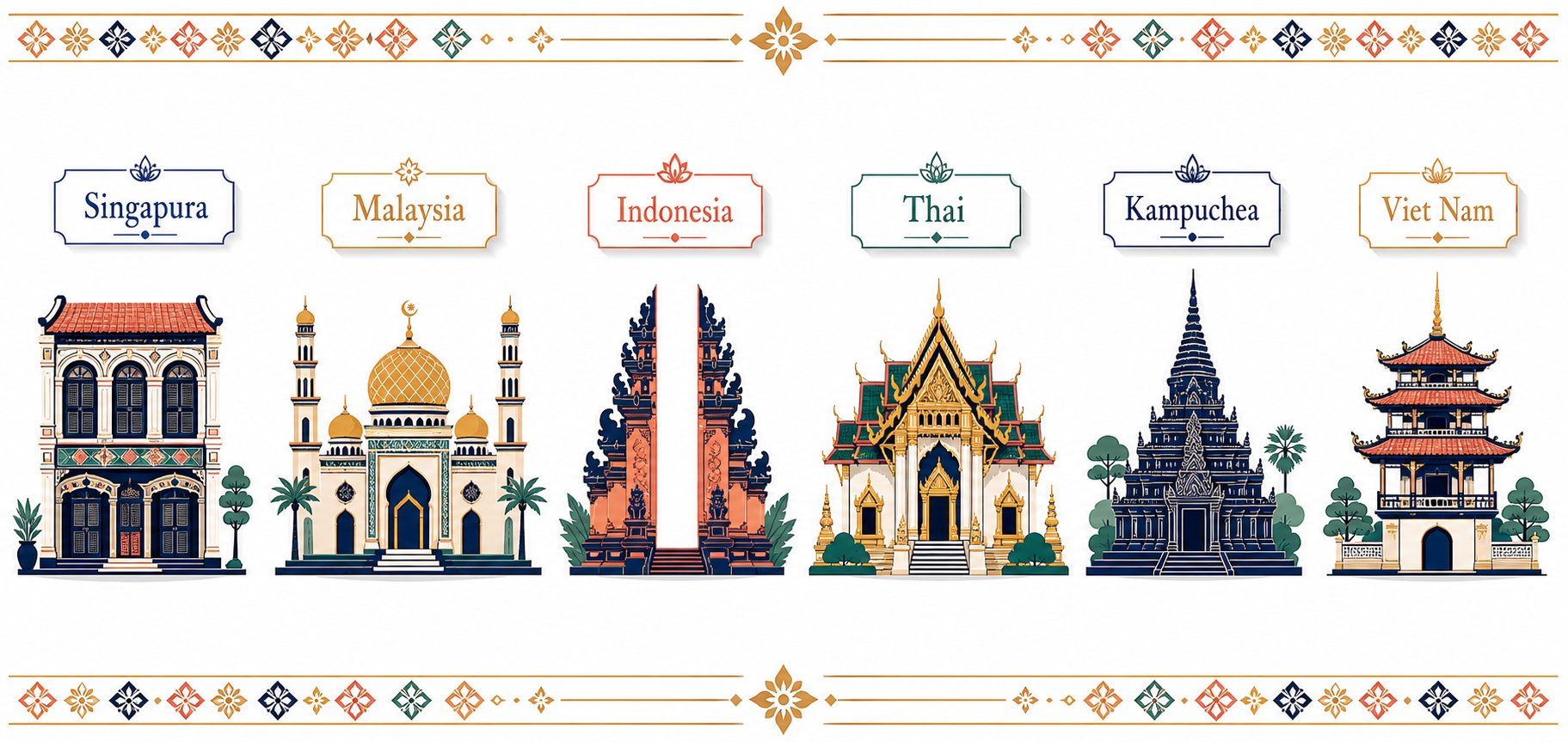
Teochew migrants fanned out across Southeast Asia from the 1800s onward, settling in communities from Bangkok to Saigon to Batavia. In each destination, the local bureaucracy heard the same Teochew pronunciations and filtered them through entirely different spelling systems. Here is how the major diaspora countries handled the task:
Singapore and Malaysia share a common origin in British colonial registration. English-speaking clerks wrote down Teochew sounds using intuitive English phonetics: "Tan" for 陳, "Teo" for 張, "Chua" for 蔡. The two countries diverge in small ways, though. Malaysian registrars more frequently added a trailing "h" to indicate vowel length or aspiration, which is why you'll often see "Teoh" in Malaysia where Singapore uses "Teo" for the same character 張. Similarly, 郭 appears as "Quek" in Singapore but often as "Koay" in Penang.
Indonesia inherited Dutch colonial spelling conventions, and the differences are immediately visible. Dutch uses "oe" for the /u/ sound, "tj" for /tʃ/, and "ie" for /i/. So 蔡 became "Tjoa" rather than "Chua," 林 became "Liem" instead of "Lim," and 張 appeared as "Thio" or "Tio." After Indonesia's 1972 spelling reform, "tj" officially became "c" and "oe" became "u," but many families retained the older Dutch-era spellings on their identity documents. This is why Indonesian Teochew surname spelling can look so different from Singaporean versions of the same character.
Thailand presents a unique case. Under the Cultural Mandates of the 1940s, many Thai-Chinese were pressured to adopt Thai surnames entirely. Those who retained Chinese surnames had them transliterated through Thai script, which lacks certain consonant clusters and final stops that Teochew preserves. Thai Teochew surname romanization therefore tends to simplify endings and adapt sounds to Thai phonological constraints. The surname 張 might appear as "Tio" or "Teo" in informal use, while 吳 becomes "Go" without the initial "Gh" sound that Teochew actually produces.
Cambodia hosts one of the largest Teochew communities outside China. French colonial influence shaped some spellings, but Cambodian-Teochew romanizations often stay closer to the raw Teochew pronunciation than other countries. A reader of The Teochew Store noted that 謝 is romanized as "Chea" in Cambodia, a spelling that reflects the Teochew pronunciation more directly than Singapore's "Chia" or "Seah."
Vietnam largely replaced Teochew pronunciations with Sino-Vietnamese readings, which derive from historical Chinese phonology filtered through Vietnamese orthography. So 陳 becomes "Tran" (Trần), 黃 becomes "Huynh" (Huỳnh), and 張 becomes "Truong" (Trương). One commenter on The Teochew Store shared that her family's Teochew surname 徐, originally romanized as "Chyr," was changed to "Tri" after her grandparents moved to Vietnam to appear more Vietnamese while preserving a similar pronunciation.
Hong Kong uses Cantonese-based romanization for official records, so Teochew families who settled there typically had their surnames recorded in Cantonese readings: 陳 as "Chan," 黃 as "Wong," 林 as "Lam." The Teochew pronunciation survived only within the family.
The table below provides a cross-regional reference for 10 common surnames, showing how teochew surname differences by country create a patchwork of spellings for the same characters:
| Character | Singapore | Malaysia | Indonesia | Thailand | Cambodia | Vietnam |
|---|---|---|---|---|---|---|
| 陳 | Tan | Tan | Tan, Tjan | Tan | Tan | Trần |
| 林 | Lim | Lim | Liem | Lim | Lim | Lâm |
| 黃 | Ng | Ng | Oei, Oey | Ng | Ng, Oung | Huỳnh |
| 張 | Teo | Teoh | Thio, Tio | Tio | Tio | Trương |
| 李 | Lee | Lee | Lie | Lee | Lee | Lý |
| 蔡 | Chua | Chua | Tjoa, Tjua | Chua | Chua | Thái |
| 吳 | Goh | Goh | Gouw, Go | Go | Go | Ngô |
| 王 | Heng | Heng | Ong | Heng | Heng | Vương |
| 謝 | Chia, Seah | Cheah, Seah | Sia | Sia | Chea | Tạ |
| 郭 | Quek, Kueh | Koay, Quek | Kwee, Kwik | Kuek | Kuek | Quách |
Why the Same Family Spells Their Name Differently Abroad
Look at the row for 張 in the table above. A single family that migrated from the Chaoshan region could have branches spelling their name as Teo in Singapore, Teoh in Malaysia, Thio in Indonesia, and Truong in Vietnam. None of these people changed their name voluntarily. The local registration system did it for them.
The pattern is consistent: Southeast Asian Chinese surname conventions reflect the colonial or national language of the host country far more than the actual dialect pronunciation. Dutch "oe" and "tj" in Indonesia, the trailing "-h" favored by Malaysian clerks, Vietnam's wholesale replacement with Sino-Vietnamese readings, each convention tells you where the family settled, not how they actually said their name at home.
This is why two cousins can sit across from each other at a family reunion, share the same great-grandfather, and carry completely different legal surnames. The divergence is not a mistake or a choice. It is a geographic fingerprint, a record of which border their particular ancestor happened to cross.
Recognizing these geographic patterns is the first step. The next challenge is working backward: when you encounter a romanized Teochew surname in isolation, how do you determine which Chinese character it originally represented, especially when one spelling can map to multiple characters across different dialect groups?
Teochew vs Hokkien Cantonese Hakka and Mandarin Spellings
One romanized spelling can point to entirely different Chinese characters depending on which dialect produced it. When you see the surname "Ng" on a document, does it represent 黃, 吳, or 伍? The answer depends on whether the person is Teochew, Hokkien, or Cantonese. This cross-dialect ambiguity is one of the biggest obstacles in genealogical research, and it demands a systematic way to compare how each dialect group renders the same characters.
Cross-Dialect Romanization Table
Teochew and Hokkien both belong to the Southern Min language family, which leads many people to assume their surname spellings are identical. In some cases they are. Both groups spell 陳 as "Tan" and 林 as "Lim," as LearnDialect.sg notes in its comparison of common Chinese surnames in Singapore. But the overlap ends quickly once you move beyond the most common characters.
Why do two closely related dialects diverge? The Chaoshan region, where Teochew developed, was geographically isolated from the Hokkien-speaking areas of southern Fujian by mountain ranges. Over centuries, this separation allowed distinct phonological shifts. Teochew merged the historical -t final stop into -k, while Hokkien preserved both. Teochew also developed different vowel shifts for certain rhyme classes, meaning the same Middle Chinese syllable evolved into audibly different modern pronunciations. The result is that surnames sharing identical initials in both dialects can carry different vowels or finals, producing distinct romanizations.
Cantonese and Hakka, meanwhile, belong to entirely separate branches of Chinese. Their surname readings diverge from Southern Min in predictable but dramatic ways. Cantonese preserves a full set of -p, -t, -k finals and uses initial consonants like "w-" and "ch-" where Teochew uses "h-" or "t-." Hakka shares some conservative features with Teochew but developed its own vowel system.
The table below compares how 12 common surname characters appear across all five major dialect groups:
| Character | Mandarin | Teochew | Hokkien | Cantonese | Hakka |
|---|---|---|---|---|---|
| 陳 | Chen | Tan | Tan | Chan | Chin |
| 林 | Lin | Lim | Lim | Lam | Lim |
| 黃 | Huang | Ng | Wee, Ooi, Ng | Wong | Wong |
| 王 | Wang | Heng | Ong | Wong | Vong |
| 張 | Zhang | Teo, Teoh | Teo, Tio | Cheung | Chong |
| 吳 | Wu | Goh | Goh, Go | Ng | Ng |
| 蔡 | Cai | Chua | Chua | Choi | Tsai |
| 鄭 | Zheng | Tay | Teh, Tay | Cheng | Chang |
| 郭 | Guo | Kuek, Quek | Koeh, Kueh | Kwok | Kok |
| 謝 | Xie | Chia, Sia | Chia, Cheah | Tse | Chia |
| 楊 | Yang | Yeo, Yeoh | Yeo, Yeoh | Yeung | Yong |
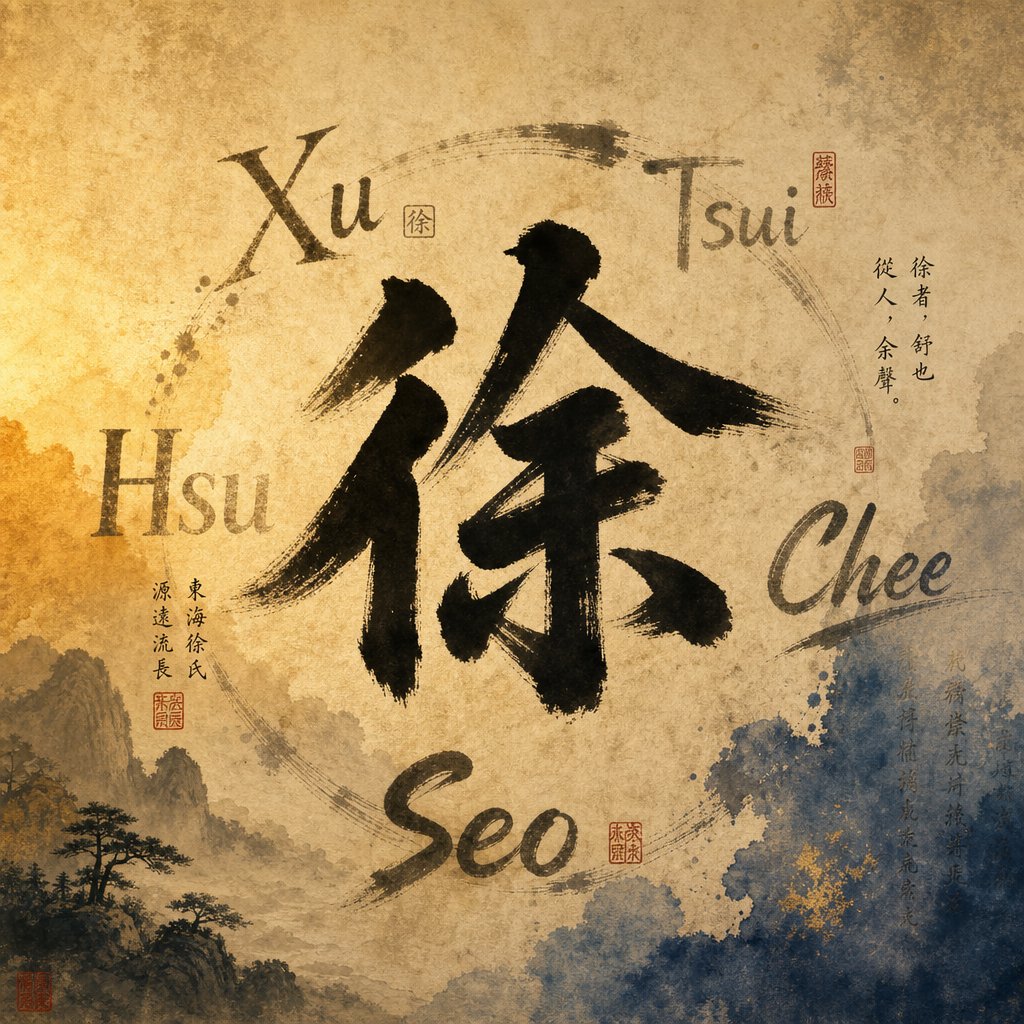
| 許 | Xu | Koh | Koh, Khoh | Hui | Hi |
A few patterns jump out immediately. Teochew and Hokkien share identical or near-identical spellings for 陳, 林, 蔡, and 吳, reflecting their common Southern Min ancestry. But look at 黃: Hokkien produces "Wee," "Ooi," or "Ng" depending on sub-dialect, while Teochew consistently uses "Ng." And 王 splits dramatically, with Teochew's "Heng" bearing no resemblance to Hokkien's "Ong" or Cantonese's "Wong." As LearnDialect.sg observes, 王 is one of the Chinese surnames that has a unique spelling across all three languages, making it a reliable dialect identifier.
Notice also how Cantonese spells both 黃 and 王 as "Wong." Two completely different characters, one romanized form. This kind of merger happens in every dialect, but the specific collisions differ, which is precisely what makes cross-dialect identification so tricky.
Disambiguating Commonly Confused Surnames
The real headache in genealogical research is not the surnames that look different across dialects. It is the ones that look the same but map to different characters. When you encounter a romanized surname without knowing the person's dialect group, multiple interpretations are possible.
Here are the most commonly confused romanizations and their possible character mappings:
- Tay - Could be 鄭 (Zheng) in Teochew/Hokkien, or 戴 (Dai) in Teochew. Context matters: 鄭 is far more common as a surname, but 戴 appears in certain Chaoshan lineages. If the family is from Jieyang, 戴 becomes more likely.
- Ng - Maps to 黃 (Huang) in Teochew, 黃 or 吳 (Wu) in Hokkien, and 吳 or 伍 (Wu) in Cantonese. A Cantonese "Ng" is almost never 黃 (they use "Wong" for that), but a Teochew "Ng" is almost always 黃.
- Wong - Could be 黃 (Huang) in Cantonese/Hakka, or 王 (Wang) in Cantonese/Hakka. Both characters produce identical romanizations in these dialects.
- Ong - Represents 王 (Wang) in Hokkien, but can also be 翁 (Weng) in Hokkien or 汪 (Wang) in some dialects.
- Goh - Usually 吳 (Wu) in Teochew/Hokkien, but occasionally 傲 or other rarer characters in specific lineages.
- Chua - Typically 蔡 (Cai) in Teochew/Hokkien, but can also represent 徐 (Xu) in certain Teochew sub-dialects where the initial consonant shifted.
- Koh - Maps to 許 (Xu) in Teochew, but 柯 (Ke) in Hokkien. Same spelling, completely different characters depending on dialect group.
- Lee/Li - Almost universally 李 across all dialect groups, making it one of the few unambiguous romanizations.
- Seah - Could be 謝 (Xie) in Teochew, or 佘 (She) in Teochew/Hokkien. The characters are unrelated but produce similar romanizations.
- Teo/Teoh - Usually 張 (Zhang) in Teochew, but occasionally 趙 (Zhao) in certain regional pronunciations.
The pattern is clear: southern Min surname romanization differences create a situation where dialect identification must come before character identification. You cannot look up a romanized surname in isolation and get a definitive answer. You need at least two additional pieces of information: which dialect group the person belongs to, and ideally which sub-region their family originated from.
This disambiguation challenge is not just academic. It directly affects anyone trying to trace their family tree backward from a romanized name on a passport or grave marker to the original Chinese character, and from there to ancestral records in China. The process requires a structured methodology, one that uses regional clues, phonological patterns, and historical context to narrow down the possibilities.
How to Identify Your Chinese Character From a Romanized Surname
You have a romanized surname on a document, maybe a birth certificate from Penang, a grave marker in Bangkok, or your own passport. You know the family is Teochew. But which Chinese character does that spelling actually represent? This is the core puzzle for anyone trying to find the Chinese character for a Teochew surname, and solving it requires more than a simple dictionary lookup.
The difficulty is real. As My China Roots explains, without a standardized romanization system, immigration officials were left to guess at spellings based on whatever sounds they could hear. The result is that one romanized form can map to multiple characters, and one character can appear under multiple romanized forms. A reverse lookup of a Teochew romanized surname therefore requires a structured process of elimination rather than a one-to-one translation.
Step-by-Step Surname Identification Method
Think of this as detective work. Each piece of evidence narrows the field until you arrive at the most likely character. Here is the methodology:
- Start with the romanized form exactly as written. Record the precise spelling from the original document. Do not "correct" it or modernize it. A spelling like "Tjoa" tells you something different from "Chua" even though both may represent the same character. The spelling itself is a clue to the country and era of registration.
- Identify the registration country and period. Was this name recorded in British Malaya, the Dutch East Indies, Thailand, or elsewhere? The country tells you which phonetic conventions were applied. "Tj" signals Dutch-era Indonesia. A trailing "-h" suggests Malaysia. A Sino-Vietnamese reading points to Vietnam.
- Determine the dialect group with certainty. Confirm that the person was actually Teochew, not Hokkien, Cantonese, or Hakka. Family oral history, ancestral village location in the Chaoshan region, or association membership records can verify this. As shown in the cross-dialect table above, "Koh" means 許 in Teochew but 柯 in Hokkien. Getting the dialect wrong sends you to the wrong character entirely.
- Map the romanization to possible phonological matches. Using the country-specific conventions identified in step 2, translate the spelling back into its likely Teochew pronunciation. Then compare that pronunciation against known Teochew surname readings. A tool like the My China Roots surname search lets you enter a romanized name and see possible character matches filtered by dialect and geography.
- Cross-reference against surname frequency data. If multiple characters are phonologically possible, check which ones actually function as surnames. Some characters that match the sound are never used as family names. Others are extremely rare. The Hundred Family Surnames tradition and modern census data both help here.
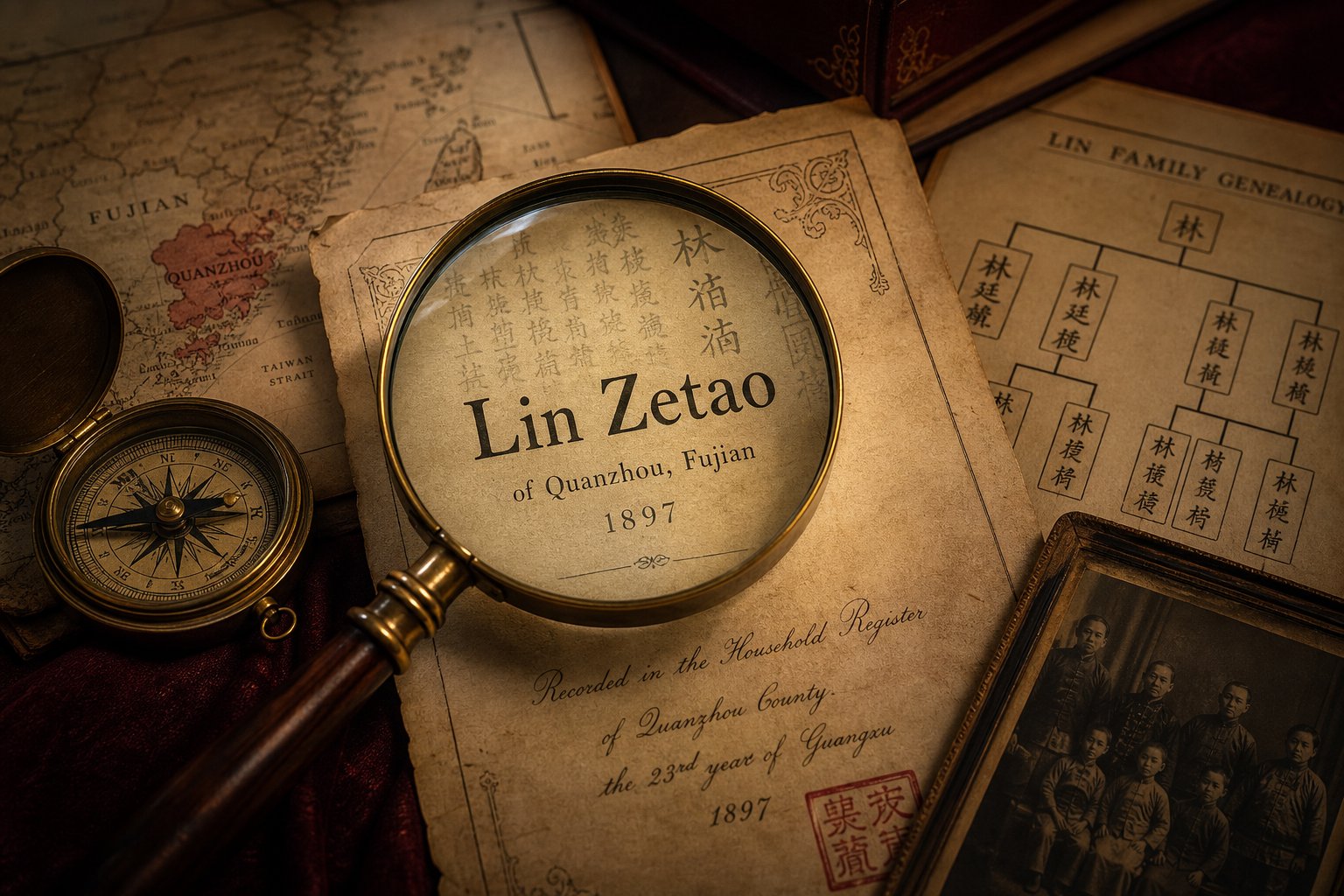
- Verify against historical records. Once you have a shortlist of one to three possible characters, look for corroborating evidence: clan association records, ancestral hall inscriptions, jiapu (genealogy books), or cemetery records that show the Chinese character alongside the romanized name. Older relatives who can write the character are invaluable at this stage.
- Confirm with regional sub-dialect patterns. Certain Teochew sub-dialects from specific counties (Chaoyang, Jieyang, Chenghai, Raoping) have distinctive pronunciation shifts. If you know which county your family originated from, this can resolve remaining ambiguity between two candidate characters.
Using Regional Clues to Narrow Your Search
The Chaoshan region is not linguistically uniform. Speakers from Chaozhou city, Shantou, Jieyang, Chaoyang, Chenghai, and Raoping each carry subtle pronunciation differences that affected how their surnames were romanized. A family from Jieyang might pronounce certain vowels differently from a Chaozhou family, producing a different romanized spelling for the same character.
This is exactly the problem highlighted by genealogy databases. When you search for "Tay," you might find it listed as a possible romanization for both 鄭 (Zheng) and 戴 (Dai). Both are legitimate Teochew surnames, both can produce the romanization "Tay," and without additional context, there is no way to distinguish them from the spelling alone. Regional origin resolves the ambiguity: 鄭 is one of the most common Teochew surnames across all sub-regions, while 戴 clusters in specific Jieyang-area lineages.
The table below serves as a teochew surname disambiguation guide for the 15 most ambiguous romanizations you are likely to encounter. Each entry shows the possible character mappings and the clues that help you identify the correct one:
| Romanized Form | Possible Characters | Distinguishing Clues |
|---|---|---|
| Tay | 鄭 (Zheng), 戴 (Dai) | 鄭 is far more common; 戴 clusters in Jieyang lineages |
| Ng | 黃 (Huang), 吳 (Wu) | In Teochew, almost always 黃; 吳 is typically romanized as "Goh" |
| Koh | 許 (Xu), 高 (Gao) | 許 is the dominant Teochew reading; 高 is rarer and sometimes spelled "Ko" |
| Seah | 謝 (Xie), 佘 (She) | 謝 is extremely common; 佘 is rare but present in Chaoyang area |
| Teo/Teoh | 張 (Zhang), 趙 (Zhao) | 張 is the standard mapping; 趙 only in specific sub-dialect pockets |
| Chua | 蔡 (Cai), 徐 (Xu) | 蔡 is the common reading; 徐 appears in sub-dialects with initial consonant shift |
| Ong | 王 (Wang), 翁 (Weng) | 王 is typically "Heng" in Teochew; "Ong" more likely 翁 or Hokkien 王 |
| Heng | 王 (Wang), 方 (Fang) | 王 is the standard; 方 sometimes romanized "Hng" or "Png" instead |
| Lau | 劉 (Liu), 廖 (Liao) | 劉 is typically "Lau" or "Low"; 廖 more often "Liow" or "Lio" |
| Sim | 沈 (Shen), 岑 (Cen) | 沈 is the common surname; 岑 is rare but phonologically possible |
| Phua | 潘 (Pan), 傅 (Fu) | 潘 is typically "Phua" or "Pua"; 傅 more often "Poh" or "Hu" |
| Goh | 吳 (Wu), 傲 (Ao) | 吳 accounts for nearly all cases; other mappings are extremely rare |
| Tan | 陳 (Chen), 曾 (Zeng) | 陳 is the dominant reading; 曾 is typically "Chan" or "Tsang" in Teochew |
| Low/Loh | 盧 (Lu), 羅 (Luo) | 盧 tends toward "Loh"; 羅 tends toward "Lo" without the trailing "h" |
| Sia | 謝 (Xie), 施 (Shi) | 謝 is common in Indonesian Teochew contexts; 施 is "Si" or "See" more often |
A few principles emerge from this table. First, frequency matters enormously. When in doubt, the more common surname is usually correct. Second, country of registration provides critical context: "Sia" for 謝 is an Indonesian convention, while Singaporean Teochew families spell the same character "Chia" or "Seah." Third, if you can identify the original Chinese surname from romanization using even one corroborating document that shows the character, you can confirm your match definitively.
The practical takeaway: never assume a one-to-one relationship between a romanized spelling and a Chinese character. Always gather at least three data points, the spelling itself, the country of registration, and the confirmed dialect group, before committing to an identification. When possible, seek a fourth: a document or family source that shows the actual character written alongside the romanized name.
Identifying the correct character is not the end of the journey. It is the starting point for deeper genealogical research, where understanding romanization patterns becomes a powerful tool for expanding your search across multiple record systems and reconnecting with relatives who carry different spellings of the same ancestral name.
Practical Applications for Genealogy and Family Research
Once you know which Chinese character your surname represents, the real power of understanding romanization patterns kicks in. Every variant spelling becomes a new search term, a new thread to pull. Instead of searching for one name and hoping for the best, you can systematically cast a wider net across databases, civil registries, and cemetery indexes by anticipating exactly which alternate forms might appear.
Expanding Genealogy Searches With Variant Spellings
The single biggest mistake in finding ancestors with different surname spellings is searching for only one romanization. If your family name is 張 and you only search "Teo," you are invisible to records filed under "Teoh," "Thio," "Tio," or "Truong." Each of those forms represents a real person in a real registry who might be your relative.
Here are practical teochew genealogy surname search tips that multiply your chances of finding relevant records:
- Generate a full variant list before searching. Use the country-by-country table from this guide to compile every known romanization of your character. Search each one individually, since most databases treat them as completely unrelated names.
- Use wildcards strategically. When searching civil records with variant Chinese surnames, a wildcard like "Te*" captures Teo, Teoh, and Teh simultaneously. Findmypast and similar platforms support wildcard searches that accommodate spelling variations with a single query.
- Search the Chinese character directly when possible. Databases like FamilySearch and Chinese clan association archives often index records by character. Bypassing romanization entirely eliminates the variant-spelling problem at its root.
- Check cemetery records with both romanized and character-based searches. Tombstone inscriptions frequently display both the Chinese character and a romanized name, making them ideal confirmation sources.
- Cross-reference clan association membership lists. These organizations often maintained records in Chinese characters even when members used romanized names in daily life, as Legacy Tree Genealogists notes in their guide to Chinese genealogy research.
Understanding romanization patterns does not just add a few extra search terms. It multiplies the effectiveness of every genealogical query by revealing the full set of names under which your family might appear in records across different countries and eras.
Connecting Across Romanization Boundaries
Teochew family research romanization strategies extend beyond databases. They also help you reconnect with living relatives. A cousin in Indonesia spelling their name "Thio" may have no idea that your Singaporean branch spells it "Teo," and a simple social media search under one spelling will never surface the other. Sharing your Chinese character in family group chats, posting it alongside your romanized name on genealogy forums, and registering with clan associations that index by character rather than romanization all increase the odds of rediscovery.
The spelling differences that once fragmented families can become the very tool that reunites them, once you understand the system behind the variation.
Frequently Asked Questions About Teochew Surname Romanizations
1. Why do Teochew families in different countries spell their surname differently?
When Teochew migrants registered in Southeast Asian countries, colonial clerks wrote down their surnames using the phonetic rules of the dominant local language. A British clerk in Penang used English spelling habits, a Dutch official in Batavia applied Dutch vowel conventions, and a Thai registrar adapted names to Thai phonology. Once a spelling entered official records, it became the family's permanent legal name passed down through generations. This is why the surname character for Zhang can appear as Teo in Singapore, Teoh in Malaysia, Thio in Indonesia, and Truong in Vietnam, all representing the same ancestral character and pronunciation.
2. How can I find the original Chinese character for my romanized Teochew surname?
Start by recording the exact spelling from your oldest family document, then identify the country and era of registration since these reveal which phonetic conventions were used. Confirm your family is Teochew rather than Hokkien or Cantonese, as the same romanization can map to different characters across dialect groups. Use surname search tools like My China Roots to match your romanization against known Teochew readings, cross-reference with surname frequency data, and verify against clan association records or cemetery inscriptions that display both the Chinese character and romanized name together.
3. What is the difference between Teochew and Hokkien surname spellings?
Although both are Southern Min languages, Teochew and Hokkien developed distinct pronunciations due to geographic isolation between the Chaoshan region and southern Fujian. Key differences include Teochew merging the historical -t final stop into -k while Hokkien preserved both, and different vowel shifts for certain syllable classes. For example, the character for Wang is romanized as Heng in Teochew but Ong in Hokkien. Some surnames like Tan for Chen and Lim for Lin remain identical across both dialects, but many others diverge significantly enough to cause confusion in genealogical research.
4. What romanization system is considered the modern standard for Teochew?
Peng'im, published by the Guangdong Provincial Education Department in 1960, is the closest thing to an official standard. It uses Latin letters plus tone numbers 1 through 8 and follows conventions inspired by Mandarin Pinyin. However, its adoption among overseas Teochew communities remains limited. The Gaginang system appeals to Western-based learners, while missionary-era Pe-ue-ji persists in academic contexts. For genealogy purposes, the informal community spellings found on actual civil documents matter most since they reflect what colonial registrars actually wrote down.
5. Can one Teochew romanized surname represent multiple Chinese characters?
Yes, this is one of the biggest challenges in Teochew genealogy. The romanization Tay can represent either Zheng or Dai. Ng in Teochew almost always means Huang, but in Cantonese it typically means Wu. Koh maps to Xu in Teochew but Ke in Hokkien. To resolve these ambiguities, you need at least three data points: the romanized spelling itself, the country where it was registered, and confirmed dialect group membership. Regional origin within the Chaoshan area can provide a fourth distinguishing clue when two characters remain equally plausible.