What the Jiang Surname Really Means
When you search for the Jiang surname meaning in Chinese, you might expect a single, straightforward answer. Instead, you'll find something far more interesting: Jiang is actually the romanization of three entirely different Chinese characters, each carrying its own history, its own ancestral lineage, and its own literal meaning. Those three characters are 姜, 蒋, and 江.
This distinction matters. A person surnamed 姜 traces their roots to one of the oldest documented clans in human civilization. Someone surnamed 蒋 connects to Zhou Dynasty land grants. And a bearer of 江 links back to an ancient river-based state. Same spelling in English, completely different stories.
What Does the Jiang Surname Mean
So what does Jiang mean as a last name? The answer depends on which character your family uses. The character 姜 literally refers to the ginger plant and belongs to the Eight Great Xing surnames of High Antiquity, the oldest traceable surname lineages in Chinese civilization. These eight ancestral surnames all contain the 女 (woman) radical, reflecting a time when family names passed through the maternal line. Among them, 姜 remains one of the few still commonly used today.
The character 蒋 ranks 13th in the classic Hundred Family Surnames poem and was the 39th most common surname in mainland China as of 2019. Meanwhile, 江 means river and points to geographic origins tied to waterways in ancient China.
Why Three Characters Share One Romanization
Mandarin Pinyin, the standard romanization system for Chinese, renders all three characters identically as "Jiang." This creates a unique challenge for anyone researching their Jiang Chinese surname origin, because a single English spelling conceals three separate clan histories.
Anyone searching for the Jiang surname meaning may belong to any of three entirely different clans with separate ancestral histories stretching back thousands of years.
This guide is designed as a single English-language resource that unifies all three Jiang characters explained side by side. You'll move from understanding what each variant means to identifying which one belongs to your family. The differences start at the most fundamental level: the characters themselves, their radicals, and the stories embedded in their brushstrokes.
Three Characters One Romanization
Those brushstrokes carry more than pronunciation. Each of the three Jiang characters encodes a different slice of ancient life: a plant, a grass, a river. Seeing them side by side reveals just how distinct these surname lineages really are.
姜 蒋 江 Side by Side Comparison
The table below consolidates the key differences between all three Jiang character variants in one place. Think of it as a quick-reference anchor you can return to as you explore each lineage in greater depth throughout this article.
| Character | Literal Meaning | Founding Ancestor | Dynasty of Origin | Approximate Population | Common Romanization Variants |
|---|---|---|---|---|---|
| 姜 | Ginger plant | Yan Emperor (Shennong) | High Antiquity (pre-Xia) | ~5 million | Jiang (Pinyin), Chiang (Wade-Giles), Keung/Geung (Cantonese) |
| 蒋 | Aquatic grass (Zizania) | Bo Ling (son of the Duke of Zhou) | Western Zhou (~1046 BC) | ~6.3 million | Jiang (Pinyin), Chiang (Wade-Giles), Cheung/Tseung (Cantonese) |
| 江 | River | Descendants of the ancient Jiang state near the Huai River | Shang/Western Zhou | ~4.5 million | Jiang (Pinyin), Chiang (Wade-Giles), Kong/Gong (Cantonese) |
You'll notice that all three share the same Pinyin spelling and even the same Wade-Giles romanization. Without the original Chinese character, there's simply no way to tell them apart in English text. That's exactly why this comparison matters for anyone asking "which Jiang surname is mine?"
How to Read the Differences at a Glance
The literal meanings offer the fastest clue. Imagine three ancient clans, each named after a defining feature of their homeland or livelihood:
- 姜 (ginger plant) - Connected to the Yan Emperor, who was born near the Jiang River in present-day Shaanxi. The ginger plant grew abundantly in that region, and the character became associated with the clan's agricultural identity.
- 蒋 (Zizania, an aquatic grass) - Linked to the State of Jiang (蒋国), a fief granted during the Zhou Dynasty. The territory was known for its wetlands where Zizania thrived, and the plant's character became the state's name and eventually the surname of its people.
- 江 (river) - Derived from the ancient Jiang state located near the Huai River basin. The character itself means a large river, directly reflecting the geographic feature that defined the clan's territory.
This pattern, surnames growing out of landscape and livelihood, was standard practice in ancient China. Before formal bureaucratic naming systems existed, clans identified themselves by what surrounded them. A river, a crop, a mountain: these weren't just features of the land but markers of belonging. Geography told you who someone's people were.
Agricultural naming worked the same way. The ginger plant and the Zizania grass weren't random choices. They signaled specific ecological zones, which in turn signaled specific clan territories. When you encountered someone bearing the character 蒋, you knew their ancestors came from wetland country. The character 姜 pointed to the highland valleys of the Wei River region where wild ginger flourished.
These literal meanings eventually fossilized into hereditary surnames as Chinese society formalized its naming conventions during the Zhou Dynasty. The living connection to ginger fields or riverbanks faded, but the characters persisted, carrying thousands of years of geographic memory in a single brushstroke.
Understanding these differences at a glance is the first step. The deeper question is what's hidden inside each character's structure, the radicals and components that reveal even more about how ancient Chinese people thought about identity, gender, and place.
Etymology and Character Composition Explained
Each Jiang character is built from smaller components called radicals, and these radicals act like visual clues baked into the writing system itself. Even if you can't read Chinese fluently, recognizing these building blocks can help you identify which Jiang character appears in your family's documents, ancestral tablets, or old immigration records. Think of radicals as a character's DNA: they reveal what category of meaning the word belongs to and often hint at its pronunciation.
Radical Breakdown of 姜
The character 姜 is composed of two stacked elements. The upper portion is 羊, and the lower portion is 女. Here's what each contributes:
- 羊 (yang) - Means sheep or goat. Positioned at the top of the character, it originally served as a phonetic indicator and also carried connotations of auspiciousness in ancient Chinese culture.
- 女 (nu) - Means woman. This is the semantic radical, the part that tells you the character's category of meaning.
Why does a surname contain the woman radical? This is one of the most telling details in the etymology of the Jiang surname in Chinese. The 女 radical appears in all of the Eight Great Xing surnames of High Antiquity, including 姬, 姚, 嬴, and 姜 itself. These characters preserve a record of matrilineal clan naming, a system where family identity passed through the mother's line. When 姜 was first used as a clan name thousands of years ago, lineage was traced through women. The character literally encodes that social structure in its composition.
If you spot a character with 女 at the bottom and 羊 at the top in your family records, you're looking at 姜, the oldest of the three Jiang lineages.
Radical Breakdown of 蒋 and 江
The other two Jiang characters follow completely different structural logic, making them visually distinct once you know what to look for.
蒋 breaks down as follows:
- 艹 (cao) - The grass radical, written as a horizontal stroke pattern across the top. It signals that the character relates to plants or vegetation. This connects directly to Zizania, the aquatic grass that gave the ancient Jiang state its name.
- 将 (jiang) - The lower component serves as the phonetic element, providing the pronunciation. It also contains sub-components (丬 and 寸), but for identification purposes, the grass radical on top is your primary visual marker.
When you see a character with the grass radical (those short horizontal strokes at the very top, resembling sprouting plants), you're likely looking at 蒋.
江 breaks down as follows:
- 氵 (shui) - The water radical, written as three short strokes on the left side of the character. It tells you the character relates to water, rivers, or liquids. In 江, this is the meaning component, pointing directly to the surname's river-based geographic origins.
- 工 (gong) - Means work. Positioned on the right side, it functions purely as a phonetic component. The sound "gong" approximates "jiang," especially in Cantonese where both 工 and 江 are pronounced "gong1."
This makes 江 the simplest of the three to identify visually: three water-drop strokes on the left, a simple square-shaped element on the right. Total stroke count is only six, compared to twelve for 蒋 and nine for 姜.
Here's a practical way to remember the Jiang character radical breakdown for quick identification:
- See a woman radical (女) at the bottom? That's 姜.
- See a grass radical (艹) at the top? That's 蒋.
- See a water radical (氵) on the left? That's 江.
These visual shortcuts work even on faded documents or partially legible handwriting. The radicals occupy distinct positions (bottom, top, left) and have distinct shapes, so you can often identify which Jiang character is yours from structure alone, without needing to read the full character. This becomes especially useful when examining old genealogy books, immigration papers, or ancestral hall inscriptions where the writing may be in traditional script or classical calligraphy styles unfamiliar to modern readers.
The radicals also reveal something deeper about how each clan was conceptualized: one defined by maternal lineage, one by the plants of its wetland territory, and one by the river that shaped its borders. These aren't arbitrary labels. They're compressed histories, and they point directly to the origin stories behind each surname.
The Ancient Origin of 姜 and the Yan Emperor
Of the three compressed histories, none reaches further back in time than 姜. This character doesn't just predate most Chinese surnames. It predates the concept of dynasties altogether. The 姜 surname origin traces to Shennong, the Yan Emperor, a figure so ancient that his story blurs the line between history and founding myth. Yet the naming logic behind 姜 is remarkably concrete: a man, a river, and the simple practice of calling yourself by where you were born.
Shennong and the Birth of the 姜 Clan
According to classical Chinese historical texts, the Yan Emperor was born near the Jiang River, a tributary of the Wei River in what is now Baoji, Shaanxi province. Following the ancient convention of adopting one's birthplace as a clan identifier, he took the river's name as his surname. The Xing Zuan, a Tang Dynasty genealogical text, records it plainly: "The Yan Emperor was born by the Jiang River, and thus took it as his surname."
This wasn't a unique practice. In High Antiquity, before hereditary surnames became formalized, clan names grew organically from geography. You were named for the land that sustained you. The Jiang River region, nestled in the highland valleys of the Wei River basin, provided the Yan Emperor's clan with its identity marker, one that would persist for over five thousand years.
Shennong himself occupies a foundational role in Chinese civilization. Tradition credits him with teaching agriculture to the early Chinese people, discovering the medicinal properties of plants, and establishing early market systems. His title, Shennong (literally "Divine Farmer"), reflects these contributions. The Jiang surname Yan Emperor connection is therefore not just a genealogical footnote. It ties bearers of 姜 to one of the two legendary ancestors of all Chinese people, the other being the Yellow Emperor (Huangdi).
The clan's lineage continued through notable descendants. Jiang Ziya (also known as Lyu Shang), a military strategist who helped King Wu of Zhou overthrow the Shang Dynasty around 1046 BC, was enfeoffed in the state of Qi. His descendants ruled Qi for centuries until the Tian clan usurped power during the mid-Warring States period. After that upheaval, some descendants adopted the state name Qi as their new surname, while others retained the original 姜. The history of 姜 as a surname spans over 5,000 years, though its continuous use as a clan name dates back at least 2,300 years to the fall of Qi.
Why 姜 Belongs to the Eight Great Xing of High Antiquity
The Eight Great Xing of Chinese Antiquity represent the oldest traceable surname lineages in Chinese civilization. These eight surnames, 姜, 姬, 姚, 嬴, 姒, 妘, 妊, and 媯, all share one visible trait: every single one contains the 女 (woman) radical. This isn't coincidence. It's a fossil record of matrilineal society, a time when identity passed through the mother's line and clan names reflected that structure.
What sets these eight surnames apart from the thousands that followed? Timing and mechanism. The Eight Great Xing predate the Zhou Dynasty's formalization of the surname system. They emerged during a period when China had no centralized state, no bureaucratic naming conventions, and no written genealogical records in the modern sense. These were organic clan identifiers, born from geography and kinship, not granted by kings or earned through service.
Most of the Eight Great Xing have nearly vanished from modern use. As of recent surveys, very few people still carry surnames like 嬴, 姒, or 妘. The surname 姜, however, remains a notable exception. With a contemporary population exceeding 4.6 million in China alone, it ranks among the top 50 most common surnames nationally. This makes 姜 a living link to the oldest layer of Chinese surname history, not a museum piece but an active, thriving lineage.
Why does this antiquity matter beyond genealogical curiosity? Because the 姜 clan didn't just persist. It branched. Over the millennia, the original 姜 lineage spawned dozens of derivative surnames as sub-clans adopted new identifiers based on their granted territories, official titles, or local geography. Understanding 姜 as a root surname unlocks the origin of over a hundred other Chinese family names, making it a keystone for anyone researching broader Chinese surname history.
The branching process accelerated during the Spring and Autumn period, when the descendants of the Yan Emperor's clan scattered across multiple states. Each new state, each new territory, became a potential source for a new surname. That proliferation is the next chapter in the 姜 story, and it reveals just how far one ancient river-born name could reach.
Origins of 蒋 and 江 with the Chiang Connection
The 姜 clan's branching produced dozens of new surnames, but the other two Jiang lineages, 蒋 and 江, arose through entirely separate mechanisms. Neither descends from the Yan Emperor. Neither belongs to the Eight Great Xing. Their stories begin later, rooted in the political machinery of the Zhou Dynasty and the geography of the Huai River basin. If 姜 represents the oldest layer of Chinese surname formation, 蒋 and 江 represent the next major wave: surnames born from feudal land grants and lost states.
How 蒋 Emerged from Zhou Dynasty Land Grants
The 蒋 surname traces its origin to a specific political act: the Duke of Zhou granting a fief called the State of Jiang (蒋国) to his third son, Bo Ling, during the early Western Zhou period around 1046 BC. This was part of the Fengjian system, the Zhou Dynasty's method of distributing territory to royal relatives and loyal supporters to consolidate control over newly conquered Shang lands.
Bo Ling's fief was located in what is now Qi County, Henan province. The territory took its name from the Zizania grass that grew abundantly in its wetlands, and the character 蒋 became the state's official designation. For generations, the ruling family and inhabitants of this small state identified themselves by their state name, as was standard practice during the Zhou period.
The State of Jiang (蒋国) eventually fell during the turbulent Spring and Autumn period, likely absorbed by the expanding State of Chu. When a state was conquered, its people didn't simply vanish. They scattered, carrying their state's name as a hereditary surname. This is the mechanism that transformed 蒋 from a place name into a family name: displaced citizens preserving their identity through the character that once marked their homeland on maps.
The 蒋 surname Zhou Dynasty origin follows a pattern repeated across dozens of Chinese surnames. States like Lu, Chen, Cai, and Wei all produced surnames the same way. What makes 蒋 distinctive is its later prominence. For centuries it remained a relatively modest surname until the modern era elevated it to national recognition through one particular bearer, a connection we'll address shortly.
The River Origin of 江 and the Jiang vs Chiang Question
The surname 江 has its own state-based origin, but one that reaches even further back in time. The ancient State of Jiang (江国) was a vassal state located in southeastern Henan, near the northern banks of the Huai River in present-day Zhengyang County. According to historical records, Yu the Great created this fief around 1101 BCE for Genchu, the son of Boyi, a legendary tribal leader rewarded for his role in controlling the Great Flood.
The state was ruled by the Ying (嬴) family and persisted for nearly five centuries. It was relatively prosperous during the Western Zhou period, but its position between the powerful states of Chu, Song, and Qi left it vulnerable. The state allied with Duke Huan of Qi in 658 BC to resist Chu expansion, but this protection proved temporary. In 623 BCE, King Mu of Chu launched a final invasion and annexed the state entirely.
After the fall of their homeland, the people of the Jiang state adopted the state name 江 as their surname, preserving the memory of a nation that had existed for almost 500 years. The character 江, meaning river, reflected the geographic reality of their territory: a state defined by its position on the Huai River's banks. Archaeological excavations at the former capital site in Zhengyang County have uncovered bronze tools and the remains of a rectangular city covering 75,000 square meters, confirming the state's historical existence.
This brings us to one of the most common points of confusion for anyone researching the Jiang surname: the relationship between "Jiang" and "Chiang." You've likely encountered both spellings and wondered whether they represent the same name or different ones.
Jiang and Chiang are the same surname written in two different romanization systems. Chiang Kai-shek's surname is 蒋, rendered as Jiang in Pinyin and Chiang in Wade-Giles. They are not different surnames. If your family spells the name "Chiang" and traces roots to Taiwan or pre-1979 documents, you almost certainly carry the character 蒋.
Here's why this confusion exists. Before 1979, most English-language materials about China used the Wade-Giles romanization system, which renders 蒋 as "Chiang." When the People's Republic of China adopted Pinyin as its official romanization standard, the same character became "Jiang." Taiwan, however, never adopted Pinyin for personal names in official documents. This means families from Taiwan or those who emigrated before 1979 typically spell the surname as Chiang, while families from mainland China use Jiang.
The practical result? Chiang Kai-shek and someone named Jiang in a modern mainland Chinese passport could share the exact same surname character, 蒋. The spelling difference is purely a product of which romanization system was in use when the name was first transliterated into English. It carries no genealogical significance whatsoever.
This distinction also applies to the other two characters. A person surnamed 姜 might appear as "Chiang" in older documents or Taiwanese records, just as someone surnamed 江 might. Without seeing the original Chinese character, the English spelling alone cannot tell you which of the three Jiang lineages a person belongs to, and it cannot even tell you which romanization system produced the spelling.
The romanization puzzle extends beyond just Pinyin and Wade-Giles. Cantonese, Hokkien, and other dialect groups produce entirely different spellings for the same characters, a layer of complexity that affects millions of overseas Chinese families trying to trace their roots back to a specific ancestral character.
Derivative Surnames and Migration Patterns
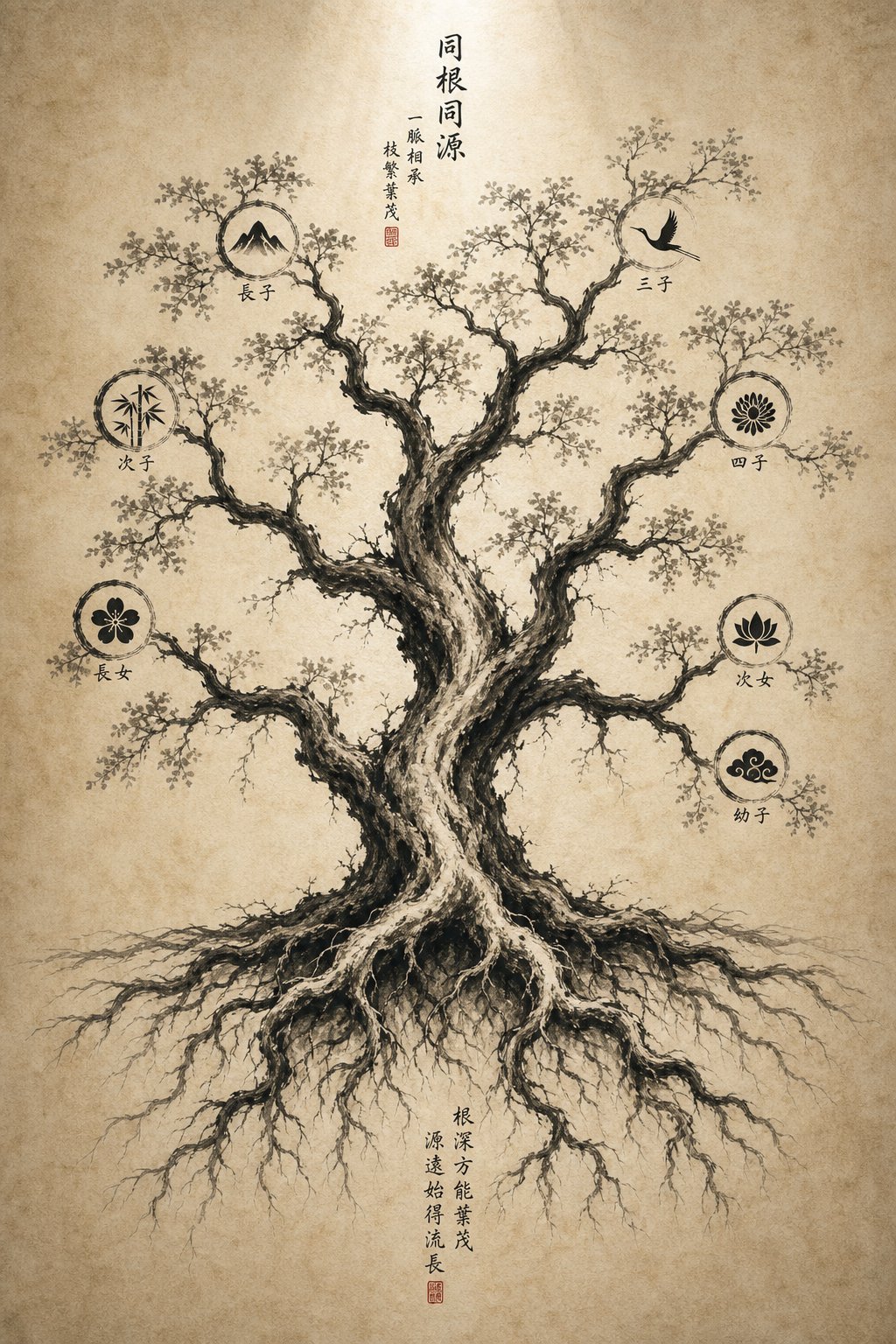
Dialect-based spelling variations are just one way the 姜 lineage dispersed across the map. A far deeper form of scattering happened at the surname level itself. Over thousands of years, the original 姜 clan didn't simply spread geographically. It fractured into entirely new surnames, each one born when a sub-clan adopted the name of its granted territory, its official title, or its new homeland. The result is a family tree so vast that many people carrying common Chinese surnames today have no idea their roots trace back to the ancient 姜 clan.
Surnames That Branched from the 姜 Clan
The branching mechanism was straightforward. During the Spring and Autumn period (770-403 BC), descendants of the Yan Emperor's 姜 clan governed or inhabited various vassal states. When those states fell to conquest or political upheaval, their people adopted the state name as a new hereditary surname. The same pattern repeated with fiefs, official titles, and geographic features within clan territories.
Research into Jiang Ziya's descendants identifies a total of 102 lineage names that branched from the 姜 surname throughout history. These include 64 monosyllabic surnames and 38 disyllabic (compound) surnames. If you count from the Yan Emperor rather than from Jiang Ziya alone, the number of Chinese surnames branched from the 姜 clan reaches 247.
Here are some of the most common single-character surnames derived from the Jiang clan:
- Lyu (吕) - From the fief granted to a lord who helped Yu the Great control the Great Flood. Jiang Ziya himself belonged to the Lyu branch before being enfeoffed in Qi.
- Qi (齐) - From the State of Qi, the powerful kingdom Jiang Ziya founded after helping establish the Zhou Dynasty.
- Xu (许) - From the State of Xu, a vassal state ruled by 姜 descendants in present-day Henan.
- Shen (申) - From the State of Shen, another Jiang-surnamed vassal state active during the Western Zhou period.
- Xie (谢) - From a fief granted to descendants of the Yan Emperor's clan.
- Gao (高) - Derived from a noble title within the Qi state's ruling family.
- Cui (崔) - From a fief within the State of Qi granted to a prince's descendants.
- Qiu (丘/邱) - Traced back to the Qi state's nobility.
- Zhang (章) - From the State of Zhang, a Jiang-surnamed vassal state.
- Lu (卢) - The Lu clan of Fanyang stems from the 姜 surname before adopting the Lu (卢) character.
Compound surnames derived from the same root include Chunyu, Dongguo, Gaotang, Ziya, Yongmen, Shentu, and Gongniu. Many of these are rare today, but they still appear in genealogical records and historical texts.
The sheer scale of this branching explains something important: the 姜 surname population ranking in China (currently around 50th, with over 4.6 million bearers) dramatically understates the clan's actual demographic footprint. Millions more carry surnames that originated from the same ancestral root but no longer bear the 姜 character.
Migration Patterns and Modern Population Data
The Jiang family migration history follows a clear arc from north to south and west to east, punctuated by periods of rapid expansion in unexpected directions.
During the pre-Qin period, the 姜 surname was concentrated in two regions: Gansu (near the original Jiang River birthplace of the Yan Emperor) and Shandong (where the State of Qi flourished). After the Qin and Han dynasties unified China, prominent Jiang clans from east of the Hangu Pass were relocated westward to populate the Guanzhong region as part of imperial population management policies. This forced migration established the famous Tianshui Commandery lineage, which became the most prestigious branch of the 姜 clan for centuries.
By the Three Kingdoms and Southern-Northern Dynasties periods, the surname had spread across the Qinchuan-Long corridor and into the Lu, Wan, Su, and Zhe regions (modern Shandong, Anhui, Jiangsu, and Zhejiang). The population center, however, remained anchored in Shaanxi and Shandong.
The Tang and Song dynasties brought the 姜 surname into the Min and Yue regions (Fujian and Guangdong), while the Qing Dynasty saw rapid growth in Northeast China driven by migration from Shandong and the sinicization of Manchu Eight Banners families. The entire Jianjia clan of the Manchu Eight Banners collectively adopted the surname Jiang during this period.
Today, the Jiang surname population in China exceeds 4.6 million, making it the 50th most common surname nationally and accounting for roughly 0.37% of the population. Shandong remains the province with the largest concentration, hosting about 11% of all Jiang bearers. Two major population clusters have formed: one spanning eastern Shandong and Henan, and another across the three northeastern provinces (Liaoning, Jilin, Heilongjiang).
Beyond China's borders, the surname appears in Korean communities (where 姜 is romanized as Kang and traces to Jinju), as well as among Chinese diaspora populations in the Philippines, Thailand, Indonesia, and North America. The global spread mirrors broader patterns of Chinese emigration, with each wave of migration carrying different regional pronunciations and romanization conventions, further multiplying the ways this single ancestral name appears in official records worldwide.
Pronunciation and Romanization Across Dialects
Regional pronunciations and romanization conventions don't just multiply the spelling variations. They actively obscure the connection between family members who share the same surname character but live in different Chinese-speaking communities. A grandfather in Hong Kong, a cousin in Taipei, and a nephew in Beijing might all carry the character 蒋, yet their passports read Tseung, Chiang, and Jiang respectively. Same character, three different spellings, zero obvious connection to an outsider.
Understanding how to pronounce the Jiang surname and why it appears differently across documents requires a quick look at how romanization systems and dialect groups interact.
Pinyin Wade-Giles and Other Romanization Systems
Romanization is simply the representation of Chinese pronunciation using the Latin alphabet. The two dominant systems for Mandarin are Pinyin and Wade-Giles. Pinyin became the international standard after China adopted it officially in 1958 and the United States normalized diplomatic relations in 1979. Wade-Giles, developed in the 19th century, dominated English-language scholarship and government documents for over a hundred years before that.
The key difference? Pinyin uses "j" to represent the sound that Wade-Giles writes as "ch." So the exact same Mandarin pronunciation becomes "Jiang" in one system and "Chiang" in the other. Neither is wrong. They're just different transcription conventions applied to identical sounds.
Taiwan never adopted Pinyin for personal names in official documents. This means Taiwanese citizens still carry Wade-Giles spellings on their passports and identification cards. If your family emigrated from Taiwan or produced documents before 1979, you'll almost certainly see "Chiang" rather than "Jiang" regardless of which character (姜, 蒋, or 江) your family uses.
Regional Dialect Pronunciations Across Chinese Communities
Romanization systems only account for part of the variation. The bigger factor is dialect. Chinese "dialects" (more accurately called topolects or regional languages) pronounce the same written character in fundamentally different ways. Cantonese, Hokkien, Hakka, and Teochew each have their own sound systems, and each produces a distinct romanized spelling when a surname gets transliterated into English.
Here's how the three Jiang characters sound across major dialect groups and romanization systems:
| System / Dialect | 姜 | 蒋 | 江 |
|---|---|---|---|
| Mandarin (Pinyin) | Jiang | Jiang | Jiang |
| Mandarin (Wade-Giles) | Chiang | Chiang | Chiang |
| Cantonese (Jyutping) | Goeng1 | Zoeng2 | Gong1 |
| Cantonese (common English) | Keung / Geung | Tseung / Cheung | Kong / Gong |
| Hokkien (POJ) | Khiang / Kiuⁿ | Chiunⁿ / Chiong | Kang |
| Teochew (Peng'im) | Giang | Zien / Zion | Gang |
| Hakka (PFS) | Kiong | Chiong | Kong |
You'll notice something immediately: while all three characters collapse into the same spelling in Mandarin (both Pinyin and Wade-Giles), they diverge sharply in southern dialects. In Cantonese, 姜 is Keung, 蒋 is Tseung, and 江 is Kong. These aren't even close to each other. A Cantonese speaker would never confuse the three.
This is why Jiang, Chiang, Keung are the same surname in some cases but not others. If someone's surname is romanized as "Keung" or "Geung," they almost certainly carry the character 姜. If it's "Kong" or "Gong," it's likely 江. The Cantonese romanization actually preserves distinctions that Mandarin-based systems erase.
The same logic applies to Hokkien communities in Southeast Asia. A surname spelled "Kang" in Malaysian or Singaporean documents typically points to 江, while "Chiong" or "Chiunn" suggests 蒋. These Jiang surname spelling variations by dialect aren't random. They follow consistent phonological rules within each dialect system.
For families trying to trace their roots, this dialect layer offers a valuable clue. The English spelling on an old immigration document or birth certificate often reveals which dialect community your ancestors belonged to, and by extension, which character they carried. A "Keung" in a Hong Kong document and a "Jiang" in a Beijing document might share the same character 姜, but you'd never guess it from the spelling alone without understanding the Jiang surname Cantonese pronunciation differs from its Mandarin equivalent.
The practical takeaway? Don't assume two family members with different surname spellings carry different characters, and don't assume two people with identical spellings share the same one. The only reliable identifier is the Chinese character itself. Romanization is a lossy compression: it captures sound but discards meaning, and which sound it captures depends entirely on which dialect and which system produced it.
Knowing your family's regional dialect and the romanization conventions of their emigration era narrows the possibilities considerably. But for a definitive answer, you'll need to trace back to the original character, a process that involves family documents, ancestral records, and sometimes a bit of detective work.
How to Identify Which Jiang Character Is Yours
That detective work doesn't have to be overwhelming. Most families have more clues available than they realize, scattered across old documents, living relatives, and even the way the surname sounds in their ancestral dialect. The challenge isn't a lack of evidence. It's knowing where to look and what counts as a meaningful signal.
If you've been reading this guide and wondering "how do I find which Jiang character is my surname?" the following steps move from the most direct sources of evidence to the more inferential ones. Start at the top and work your way down until you get a definitive answer.
Clues from Family Documents and Ancestral Records
The fastest path to identifying your Jiang character is finding it written in Chinese somewhere in your family's history. Here's a step-by-step approach, ordered by reliability:
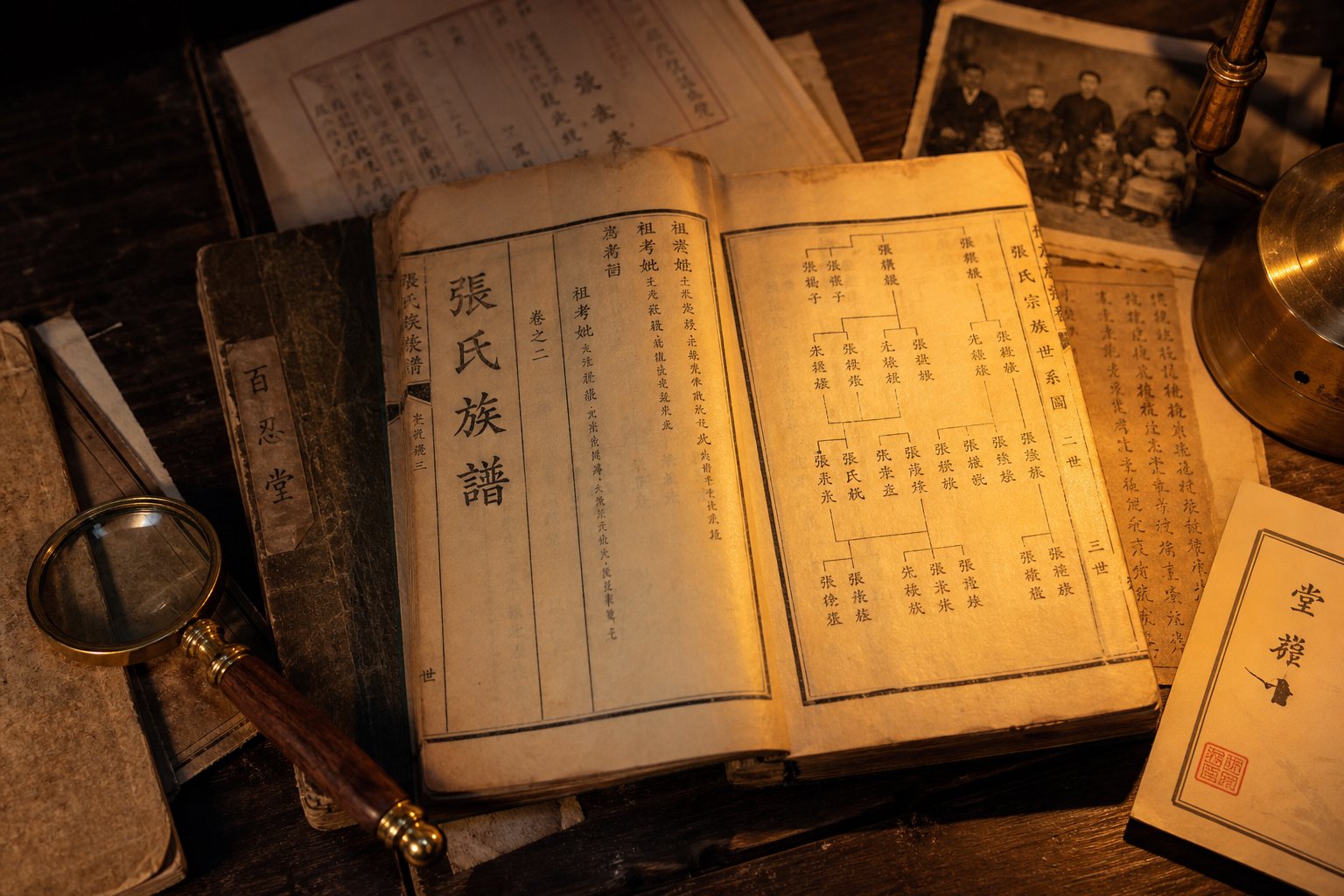
- Check family genealogy books (族谱). Many Chinese families maintain a zupu, a clan genealogy book that records lineage in Chinese characters. These books are the gold standard for surname identification. If your family has one, even a photocopy or a photograph of a page, the character will be written clearly. Ask older relatives whether such a book exists, even if it's stored with distant family members in China.
- Examine immigration and travel documents. Passports, ship manifests, immigration cards, and naturalization papers from the 19th and early 20th centuries often include the original Chinese characters alongside romanized names. FamilySearch notes that even if you don't read Chinese, old letters, identification papers, travel documents, and tombstone inscriptions frequently preserve the original character. Look for any handwritten Chinese on these materials.
- Consult older family members directly. Grandparents, great-aunts, or elderly relatives who grew up in a Chinese-speaking environment often know the character by sight, even if they can't write it from memory. Show them the three options (姜, 蒋, 江) and ask which one looks familiar. Visual recognition is often stronger than recall.
- Locate ancestral graves or memorial tablets. Tombstones and ancestral hall inscriptions almost always include the full name in Chinese characters. If your family's ancestral village or burial site is known, the character can be confirmed from these sources. Even photographs of grave markers found through relatives still in China can resolve the question instantly.
- Research your ancestral village location. If you know the province, county, or village your family originated from, cross-reference it with historical surname distribution data. Families from Shandong and Shaanxi are statistically more likely to carry 姜. Families from Henan (particularly Qi County) or those with strong connections to Nationalist-era political history often carry 蒋. Families from southeastern Henan near Zhengyang County may carry 江.
- Use your family's dialect pronunciation as a clue. As the romanization table in the previous section shows, southern dialects pronounce the three characters very differently. If your family says "Keung" or "Geung," you're almost certainly looking at 姜. If they say "Kong" or "Gong," it's likely 江. If "Tseung" or "Cheung," that points to 蒋. The dialect your family speaks is itself a piece of evidence.
Using Regional and Historical Context to Narrow Down Your Jiang
When direct documentary evidence isn't available, regional and historical patterns can narrow the possibilities. Think of these as probabilistic clues rather than certainties:
- Northeast China (Liaoning, Jilin, Heilongjiang): High concentration of 姜, partly due to Shandong migration during the Qing Dynasty and Manchu families who adopted the surname.
- Shandong province: The single largest concentration of 姜 bearers in China. If your family traces to Shandong, 姜 is the most likely character.
- Zhejiang, Jiangsu, and Anhui: These provinces have significant populations of all three variants, but 蒋 is particularly well-represented due to historical connections to the Zhou-era Jiang state in Henan and later southward migration.
- Guangdong and Fujian: Cantonese and Hokkien communities here often carry 江, though all three variants are present. The dialect pronunciation is your strongest differentiator in these regions.
- Taiwan: Families with the Wade-Giles spelling "Chiang" could carry any of the three characters, but 蒋 and 江 are more common on the island than 姜.
Historical period matters too. If your family emigrated during the mid-20th century and has any connection to military or government service under the Republic of China, the character 蒋 is worth investigating first, simply because the surname's prominence during that era makes it statistically more common among emigrant families from that period.
For families who've exhausted personal records, several resources can help push the research further. The U.S. National Archives holds Chinese Exclusion Act case files that sometimes include original Chinese characters. Clan associations and native-place organizations in cities with historic Chinatowns often maintain archived membership lists in Chinese. Online genealogical platforms like FamilySearch provide access to digitized immigration records, and Chinese-language genealogy databases such as those hosted on Baidu Baike offer surname-specific historical data.
Connecting with surname-specific research communities can also accelerate the process. Many Jiang clan associations maintain active online forums where members share genealogical findings, village-level records, and zupu excerpts. Even posting a question with your known family details, ancestral province, dialect group, and emigration period, can sometimes yield answers from other researchers who've already mapped that branch of the family tree.
The key insight for any Jiang family tree research is this: you're not looking for a needle in a haystack. You're choosing between exactly three options. Every piece of evidence, a dialect pronunciation, a geographic origin, a faded character on an old envelope, eliminates possibilities until only one remains. Most families can resolve the question with just two or three of the steps above.
The Enduring Legacy of the Jiang Name
Three options. Three characters. Three entirely separate histories stretching back thousands of years. Yet the importance of knowing your Chinese surname character goes far beyond settling a trivia question. It determines which ancestral story you carry, which migration path your family followed, and which branch of Chinese civilization shaped your lineage.
The Jiang Legacy in Chinese Surname Culture
Chinese surnames are not just identifiers. They are compressed archives. With a history dating back more than 4,000 years, each surname encodes information about clan origins, geographic roots, and social structures that predate written records in most other civilizations. The Jiang surname sits at the heart of this tradition in a unique way: it spans the full timeline of Chinese surname formation, from the matrilineal clans of High Antiquity (姜) through the feudal land grants of the Zhou Dynasty (蒋) to the state-based naming conventions of the Spring and Autumn period (江).
That range is what makes the Jiang surname cultural significance exceptional. Bearers of 姜 connect to one of the Eight Great Xing, the oldest traceable surname lineages in Chinese civilization, and through it to the Yan Emperor himself. Bearers of 蒋 link to the political architecture of the Zhou Dynasty and, in the modern era, to one of the most recognizable figures in 20th-century Chinese history. Bearers of 江 preserve the memory of a lost state that existed for nearly five centuries along the Huai River.
Each of these connections is a doorway. Follow the 姜 lineage and you encounter the birth of Chinese agriculture, the founding of the State of Qi, and the branching of over 100 derivative surnames still in use today. Follow 蒋 and you trace the mechanics of feudal governance, the fall of small states, and the modern diaspora shaped by 20th-century political upheaval. Follow 江 and you uncover the archaeology of a Bronze Age kingdom, the dynamics of interstate warfare, and the survival strategies of displaced peoples who carried a river's name into exile.
Carrying the Name Forward
The practical tools are already in your hands. The comparison table in the second section gives you a side-by-side reference for distinguishing the three variants at a glance. The radical identification guide (woman radical at the bottom, grass radical at the top, water radical on the left) lets you recognize which character appears in family documents even without reading Chinese. The dialect pronunciation table reveals which English spellings correspond to which characters across Cantonese, Hokkien, and Hakka communities. And the step-by-step identification process in the previous section provides a clear path from uncertainty to confirmation.
What matters most is starting the search. Every Jiang family heritage story begins with a single question: which character is mine? Once you answer that, you're no longer looking at a generic romanized spelling. You're looking at a specific lineage with a specific origin, a specific founding ancestor, and a specific place in the broader architecture of Chinese history.
Surname research is not just genealogy. It is a gateway to understanding where your family fits within one of the longest continuous civilizations on earth, and how a single character can connect you to events that shaped millions of lives across millennia.
Whether your Jiang traces to a ginger-scented river valley in Shaanxi, a wetland fief in Henan, or a lost kingdom on the banks of the Huai, the name you carry is more than a label. It's a thread running back through five thousand years of recorded history, waiting for you to follow it home.
Frequently Asked Questions About the Jiang Surname
1. What does the Jiang surname mean in Chinese?
The Jiang surname corresponds to three different Chinese characters, each with a unique literal meaning. 姜 means ginger plant and traces to the Yan Emperor in High Antiquity. 蒋 refers to Zizania, an aquatic grass, and originates from a Zhou Dynasty land grant. 江 means river and connects to an ancient state near the Huai River. The meaning depends entirely on which character your family carries.
2. Is Chiang the same as Jiang?
Yes, Chiang and Jiang represent the same surnames spelled in two different romanization systems. Chiang uses the older Wade-Giles system common in Taiwan and pre-1979 documents, while Jiang uses Pinyin, the modern standard in mainland China. Chiang Kai-shek's surname character is 蒋, which is written as Jiang in Pinyin. The spelling difference carries no genealogical significance and applies to all three Jiang characters.
3. How do I find out which Jiang character is my family's surname?
Start by checking family genealogy books (族谱), old immigration documents, or ancestral grave inscriptions for the original Chinese character. If those aren't available, ask elderly relatives to identify the character visually from the three options. Your family's dialect pronunciation also helps: Cantonese speakers saying Keung likely carry 姜, those saying Kong likely carry 江, and Tseung points to 蒋. Regional origin provides additional clues, as Shandong families most commonly carry 姜.
4. How old is the Jiang surname?
The oldest variant, 姜, dates back over 5,000 years to the era of the Yan Emperor (Shennong), making it one of the Eight Great Xing surnames of High Antiquity. These are the oldest traceable surname lineages in Chinese civilization, predating formal dynasties. The other two variants are younger but still ancient: 蒋 emerged around 1046 BC during the Western Zhou Dynasty, and 江 traces to a state founded around 1101 BC during the Shang-Zhou transition period.
5. What surnames are derived from the Jiang (姜) clan?
The ancient 姜 clan produced an extraordinary number of derivative surnames as sub-clans adopted names from their granted territories during the Spring and Autumn period. Research identifies 247 surnames branching from the Yan Emperor's lineage, including common ones like Lyu (吕), Qi (齐), Xu (许), Shen (申), Xie (谢), Gao (高), and Cui (崔). This means millions of people carrying these surnames share a common ancestral root with modern 姜 bearers.