Why Ouyang Has Two Characters When Most Chinese Surnames Have One
When you see a Chinese name like Wang Wei or Li Na, the pattern feels familiar: one character for the surname, one or two for the given name. So what happens when someone introduces themselves as Ouyang? That extra character catches your attention. It signals something older, rarer, and structurally different from the vast majority of Chinese family names.
The Ouyang compound surname belongs to a small category of multi-character surnames that have survived more than two millennia of dynastic upheaval, migration, and cultural pressure to simplify. China once had over 1,000 compound surnames. Fewer than 100 remain in use, and among those, Ouyang stands alone as the most common, carried by over 1.1 million people according to China's 2020 National Name Report.
What Makes Ouyang a Compound Surname
A compound surname (复姓, fuxi ng) is a Chinese family name composed of two or more characters that function as a single, indivisible unit, distinct from double-barrelled surnames created by combining two separate family names.
Think of it this way: you cannot split Ouyang into "Ou" and "Yang" as two independent surnames joined together. The two characters form one meaning rooted in a specific geographic origin. This is what separates a true compound surname from modern double-barrelled names, where parents blend both family names for a child. Many Chinese compound surnames derive from Zhou dynasty noble titles, official positions, place names, or tribal identities.
Why Two-Character Surnames Are Rare in China
Single-character surnames dominate Chinese naming. The top 100 surnames alone cover the vast majority of China's population, and every one of them uses just one character. Compound surnames occupy a sliver of that landscape. The second most popular, Shangguan, is carried by only about 88,000 people, a fraction of Ouyang's reach.
So what is a compound surname doing surviving in a system that overwhelmingly favors brevity? Many clans eventually shortened their names to a single character for convenience or assimilation. People today with the standalone surname Ou or Yang may well be descendants of the original Ouyang lineage. The fact that Ouyang persisted intact, while hundreds of others vanished, points to something deeper: a combination of cultural prestige, geographic concentration, and deliberate genealogical preservation that kept this two-character name alive across centuries.
That story begins with a mountain, a kingdom, and a king whose descendants turned geography into identity.
The Ancient Origins of Ouyang Traced to a Mountain and a Kingdom
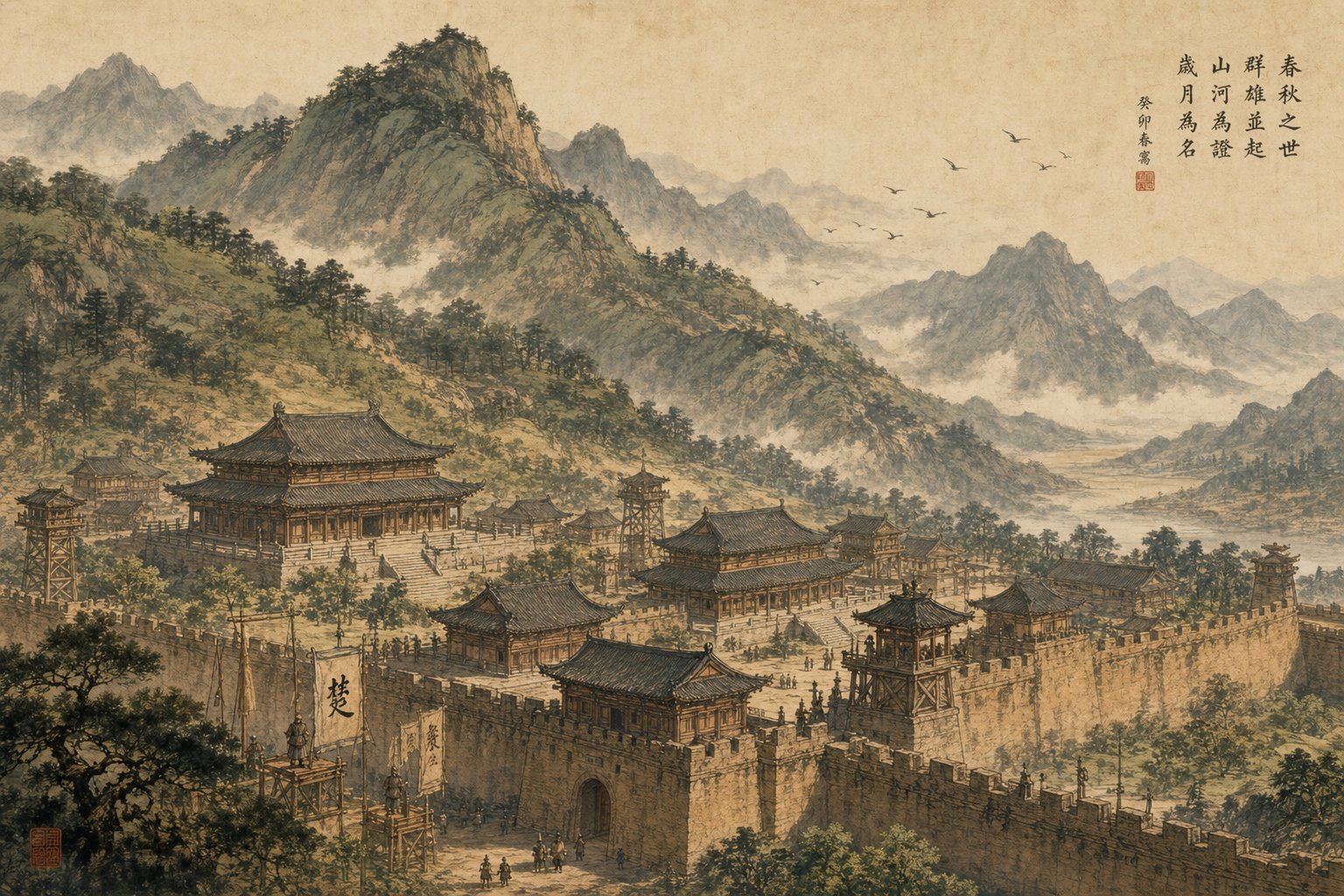
The State of Yue occupied what is now Zhejiang province in southeastern China during the Spring and Autumn period (roughly 771-476 BC). Its most celebrated ruler, King Goujian, famously endured years of humiliation as a prisoner of the rival Wu state before rebuilding his kingdom and conquering his captors. That royal bloodline continued for generations after Goujian's triumph, and it is from this lineage that the Ouyang surname eventually emerged.
King Goujian and the State of Yue Connection
Goujian's descendants ruled Yue for over a century after his death. The kingdom expanded, contracted, and navigated the volatile politics of the Warring States era. The last king in this line was Wujiang (reigned 355-333 BC), who overextended his military campaigns and lost his kingdom to the powerful state of Chu. When Yue fell, Wujiang's sons scattered. His second son, a prince named Ti, settled with his family near a hill called Mount Ouyu (欧余山) in Wucheng, located in present-day Huzhou, Zhejiang province. That geographic choice would define a family name for the next 2,300 years.
How Ouyu Mountain Gave Birth to a Surname
Ti and his descendants made their home on the southern slope of Mount Ouyu. In Classical Chinese, the south side of a mountain is called yang (阳), because it faces the sun. Combine the mountain's name with the word for its sunny side, and you get Ouyang, literally meaning "south of Mount Ouyu." Ti himself was granted the title Marquis of Ouyang Village (欧阳亭侯), formalizing the connection between place and identity.
The mountain still exists, though it is now called Mount Sheng (升山) in Huzhou. The name changed, but the surname it generated did not. Traditionally, Ti's ancestry traces even further back through the Yue royal house to the semi-legendary Yu the Great, the mythic flood-tamer credited with founding the Xia dynasty. Whether or not that deep lineage is historically verifiable, it gave the Ouyang clan an origin story of extraordinary prestige.
Place-Based Origins vs Other Compound Surname Patterns
Among Chinese compound surnames, origin stories fall into distinct categories. Some derive from official titles: Sima means "master of horses," a military rank. Others come from directional markers: Dongfang simply means "east." Ouyang belongs to the geographic category, where a clan's physical relationship to a landscape feature became its permanent identifier.
This place-based pattern matters because it anchors the surname to a specific, traceable location. Occupation-based compound surnames could arise independently in multiple regions wherever that role existed. A geographic surname like Ouyang points to one origin, one mountain, one family. That specificity made it easier for later generations to maintain a coherent genealogical record, connecting scattered descendants back to a single ancestral source.
Those descendants did not stay near Mount Ouyu forever. Over centuries, the Ouyang clan migrated southward into Jiangxi, Hunan, and Guangdong, carrying their two-character name alongside other compound Chinese surnames that were slowly disappearing from the registry. How Ouyang held its ground while others faded becomes clearer when you see where it stands among its peers.
How Ouyang Compares to Other Chinese Compound Surnames
Ouyang did not survive in isolation. It shares the compound surname category with dozens of other two-character names, each carrying its own origin story rooted in ancient officialdom, geography, or tribal identity. Yet when you look at a list of Chinese compound surnames side by side, the differences in how they formed and how many people still carry them reveal why Ouyang occupies a unique position among its peers.
Sima, Zhuge, and Other Famous Compound Surnames
Imagine ancient China's bureaucratic machinery. Official titles were specific, descriptive, and often hereditary. Several of the most recognizable compound surnames grew directly out of those roles:
- Sima (司马) - Literally "master of horses," this was a high-ranking military title responsible for cavalry and warfare logistics. The historian Sima Qian and the Jin dynasty founder Sima Yan both carried this name.
- Situ (司徒) - Meaning "master of land and people," this title oversaw civil administration and population management during the Zhou dynasty.
- Shangguan (上官) - Translates to "superior official," derived from a noble rank in the state of Chu during the Warring States period.
- Huangfu (皇甫) - Combines "imperial" and "father," tracing back to a noble lineage in the ancient Song state.
Other compound surnames took entirely different paths. Zhuge (诸葛) originated when a clan surnamed Ge relocated to a place called Zhuyi, merging their location with their original name. Dongfang (东方) simply means "east" or "eastern direction," reportedly adopted by the legendary sage Fu Xi's descendants because he was associated with the eastern sunrise.
Each of these names tells you something specific about its founders: what they did, where they lived, or what symbolic role they played. Ouyang fits squarely in the geographic camp, its meaning permanently tied to a mountain's sunny slope rather than a court appointment or a cardinal direction.
How Ouyang Compares in Prevalence and Origin Pattern
Here is where the numbers tell a striking story. The 2020 National Name Report from China's Ministry of Public Security shows Ouyang with over 1.1 million bearers. The second-place Shangguan has roughly 88,000. That gap is enormous. Ouyang is not just the most common compound surname; it dwarfs every other one by an order of magnitude.
| Compound Surname | Characters | Origin Type | Meaning of Characters | Approximate Prevalence Rank |
|---|---|---|---|---|
| Ouyang | 欧阳 | Geographic (mountain position) | South of Mount Ouyu | 1st (over 1.1 million) |
| Shangguan | 上官 | Official title (noble rank) | Superior official | 2nd (~88,000) |
| Huangfu | 皇甫 | Ancestral lineage (noble house) | Imperial father | 3rd |
| Linghu | 令狐 | Geographic (place name) | Named after Linghu town | 4th |
| Zhuge | 诸葛 | Combined (place + original surname) | Ge clan at Zhuyi | 5th |
| Sima | 司马 | Official title (military) | Master of horses | 6th |
Why such a dramatic difference? Several factors converge. Ouyang's geographic concentration in populous southern provinces like Hunan, Guangdong, and Jiangxi gave it a large population base. Its association with towering cultural figures across multiple dynasties reinforced clan pride and discouraged name-shortening. And its genealogical infrastructure, maintained through detailed clan records, kept scattered branches connected under one two-character banner.
The title-based surnames like Sima and Situ faced a different pressure. Once the official position disappeared or changed hands, the connection between name and identity weakened. Geographic surnames had the advantage of permanence. Mountains do not get reassigned.
Still, numbers alone do not explain cultural survival. The Ouyang name endured partly because the people who carried it produced figures whose achievements became inseparable from the surname itself, embedding it into China's literary and artistic canon.
Famous Ouyang Figures Who Shaped Chinese Culture
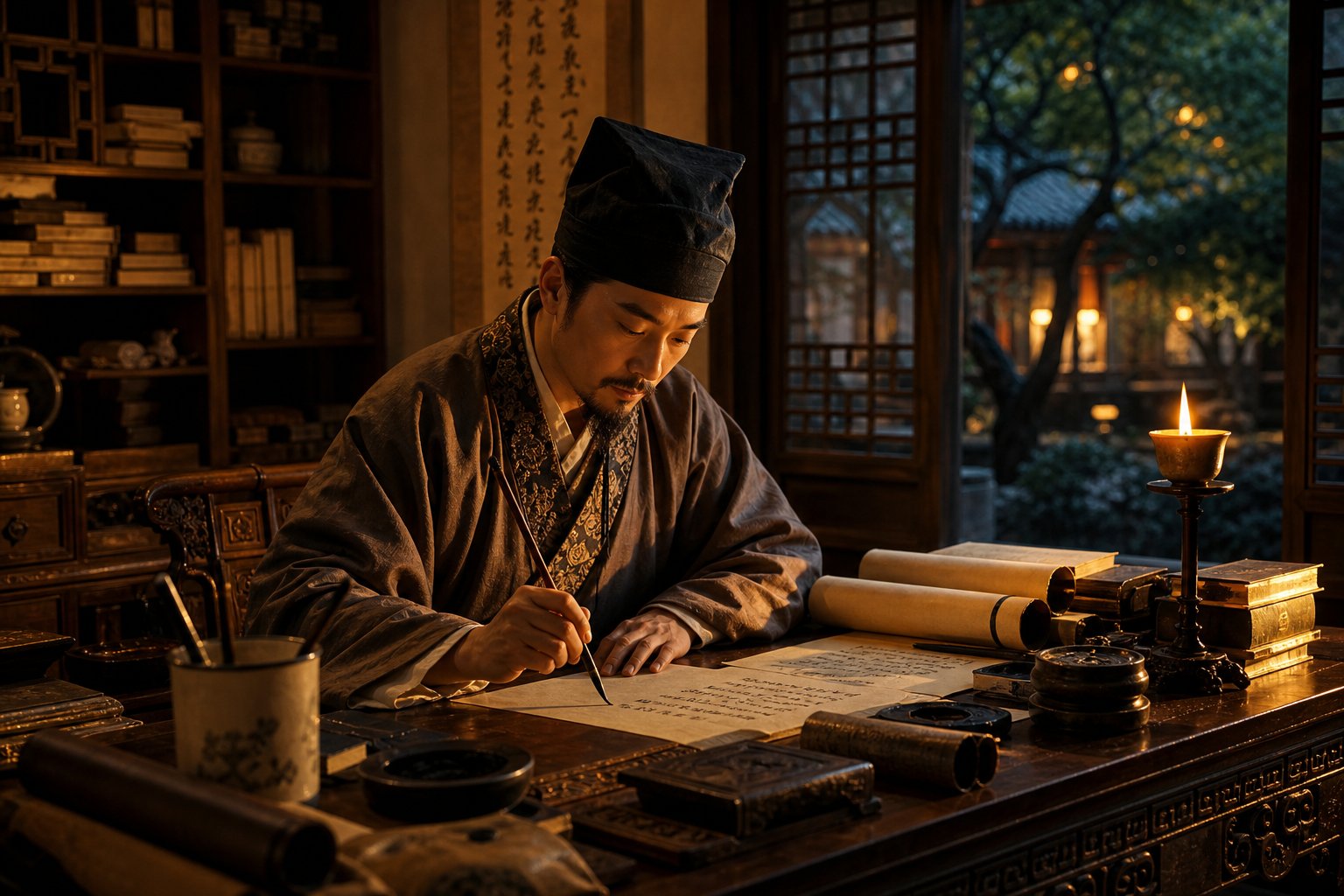
A surname gains population through birth rates and migration. It gains permanence through prestige. Two individuals, separated by four centuries, did more to cement the Ouyang name into Chinese cultural memory than any demographic trend could. One transformed how Chinese characters are written. The other transformed how Chinese prose is composed. Together, they gave this compound word surname a weight that made shortening or abandoning it unthinkable for their descendants.
Ouyang Xun and the Art of Tang Dynasty Calligraphy
Ouyang Xun (557-641) lived through one of China's most turbulent transitions, from the Sui dynasty's collapse into the Tang dynasty's golden age. Born in Hunan province, he served as a court official under Emperor Gaozu and later Emperor Taizong. But his lasting contribution was not political. It was visual.
His masterpiece, the "Jiucheng Palace Liquan Ming" (九成宫醴泉铭), is a stone inscription of roughly 1,200 characters commissioned by Emperor Taizong in 632 AD. The piece commemorates the discovery of a sweet spring at the emperor's summer palace in Linyou County, Shaanxi Province. Wei Zheng, the famous imperial censor, wrote the text. Ouyang Xun carved the calligraphy. The result became what scholars consider the single most representative example of regular script (楷书) in Chinese history.
What made his style so influential? You'll notice three qualities when studying his brushwork:
- Structural precision - Every character sits within a tightly controlled framework. Strokes are placed with mathematical consistency, making his work ideal for students learning proper character proportions.
- Balance of strength and flexibility - His lines carry a vigorous, powerful energy without becoming rigid. The horizontal strokes are even, the spacing between them consistent, creating visual harmony across entire passages.
- Standardization and repeatability - Unlike more expressive calligraphic styles, Ouyang Xun's regular script can be studied systematically. Each character follows clear structural rules that learners can internalize and reproduce.
These qualities made his work a foundational model for calligraphy education that persists to this day. Calligraphy students across China still begin their training by copying his inscriptions. The original stele remains standing in Linyou County, though centuries of rubbing have damaged its surface. Song dynasty rubbings preserved the work for continued study.
Ouyang Xun's style, known as "Ou ti" (欧体), became one of the four great regular script styles of the Tang dynasty. For a compound surname that might otherwise have faded into obscurity, having its name permanently attached to a pillar of Chinese visual culture was transformative.
Ouyang Xiu as Song Dynasty Poet and Statesman
Four hundred years later, another bearer of the name achieved something equally monumental in a completely different domain. Ouyang Xiu (1007-1072) was a poet, historian, and statesman whose influence reshaped Chinese literature for every dynasty that followed.
Born in Mianyang, Sichuan province, he lost his father at age three and grew up in modest circumstances. Despite this, he placed first in the doctoral examinations in 1030 and entered government service. His career was marked by cycles of promotion and exile, driven by his refusal to stay silent when he saw injustice. He defended colleagues who were banished for speaking truth to power, and he paid the price repeatedly with demotions to rural posts.
Those periods of exile, however, produced some of his finest work. His key achievements span literature, historiography, and governance:
- Leader of the Classical Prose Movement - Ouyang Xiu championed the "ancient style" (古文, guwen) of writing, a simpler, more direct prose modeled on Tang dynasty master Han Yu. He rejected the ornate, heavily rhythmic style popular in his era and used his position as chief examiner in 1057 to favor candidates who wrote clearly. This single act redirected the course of Chinese literary style.
- One of the Eight Great Masters of Tang and Song - His essays, poetry, and fu (prose poems) earned him a permanent place among China's most celebrated writers. His "Zuiwengting ji" (Old Drunkard Pavilion) remains one of the most widely read essays in the Chinese literary canon.
- Historian of two dynasties - He authored the "Xin Wudai shi" (New History of the Five Dynasties) and co-authored the "Xintangshu" (New History of the Tang Dynasty), both official dynastic histories that broke new ground in moral judgment and narrative structure.
- Statesman and reformer - He rose to the highest councils of state, serving as a grand councilor equivalent. He promoted talented younger writers including Su Dongpo and Zeng Gong, shaping the next generation of Chinese intellectual life.
- Scholar and collector - His personal library held 10,000 books. He compiled the "Jigulu" (Collection of Antiques), covering classical documents from the Zhou through Tang dynasties, contributing to early archaeological study in China.
Ouyang Xiu called himself "Liuyi Jushi" (六一居士), the "Retired Scholar of Six Ones," referring to his collection of 10,000 books, 1,000 stone rubbings, one zither, one chess set, one pot of wine, and one old man (himself). That self-designation later became the basis for one of the Ouyang clan's most important hall names, a genealogical marker that connected scattered family branches across provinces.
The compound surnames meaning embedded in "Ouyang" gained cultural gravity through these two figures. A calligrapher whose style defined how characters should look. A writer whose prose defined how ideas should sound. Their achievements made the name itself a symbol of literary and artistic excellence, giving every subsequent generation a reason to preserve it intact rather than simplify it into a single character.
That pride did not sustain itself through reputation alone. It was maintained through deliberate institutional structures: clan registries, ancestral halls, and genealogical traditions that formalized the connection between living bearers and their illustrious forebears.
Clan Traditions Behind the Ouyang Lineage
Reputation fades without infrastructure. What kept the Ouyang compound surname intact across 2,300 years was not just famous calligraphers and poets but a deliberate system of genealogical record-keeping that Chinese clans developed to an extraordinary degree of precision. Three interlocking traditions anchored the Ouyang identity: commandery origins, hall names, and ancestral couplets. If you are unfamiliar with Chinese clan culture, think of these as a combination of heraldry, motto, and parish registry rolled into one coherent system.
Commandery Origins and Hall Names Explained
Every major Chinese surname traces its prestige back to a commandery origin (郡望, junwang), essentially the geographic region where the clan first achieved prominence. For the Ouyang family, two commandery origins carry weight: Bohai (渤海) in present-day Hebei and Shandong, and Changle (长乐) in what is now Fujian province. These designations told other families where your branch came from and, by extension, which historical figures you could claim as ancestors.
Sounds abstract? Imagine introducing yourself at a gathering and your surname alone communicating your ancestral province, your clan's peak era of influence, and your family's social standing. That is what a commandery origin accomplished in traditional Chinese society.
Hall names (堂号, tanghao) worked at a more intimate level. Each branch of a clan adopted a hall name that referenced a defining achievement or value. The most celebrated Ouyang hall name is Liuyi Hall (六一堂), directly drawn from Ouyang Xiu's self-designation as the "Retired Scholar of Six Ones." Other branches used names like Huawen Hall (画文堂), emphasizing literary and artistic accomplishment. These hall names appeared on ancestral temples, clan documents, and even correspondence, functioning as a shorthand identity marker that connected scattered families without abbreviating the compound surname itself. For bearers wondering how to abbreviate compound surnames in formal contexts, the answer within Chinese tradition was clear: you did not. The hall name provided the shorthand; the full surname remained untouched.
Ancestral Couplets and Genealogical Records
Ancestral couplets (堂联, tanglian) hung at the entrance of clan halls, encoding family values and historical claims in paired poetic lines. They served as both decoration and declaration, reminding every visitor of the clan's heritage.
"Stone inscriptions carry the legacy of calligraphy mastery; prose writings illuminate the brilliance of the Six Ones Scholar" (石刻传承书法祖; 文章光耀六一公).
This couplet references both Ouyang Xun's calligraphic inscriptions and Ouyang Xiu's literary legacy in a single paired statement. Every Ouyang ancestral hall displaying these lines reinforced the message: this is a name worth preserving in full, a compound surname without hyphen or abbreviation, carrying the weight of two cultural giants.
The most critical preservation tool, however, was the genealogical record (族谱, zupu). These clan registries documented births, marriages, deaths, migrations, and notable achievements across generations. The Ouyang clan maintained particularly detailed records, with some surviving genealogies tracing lineages back through dozens of generations to the original settlement near Mount Ouyu. During dynastic collapses, wars, and mass migrations, these documents traveled with clan elders. When families resettled in new provinces, the zupu provided proof of identity and continuity.
This system explains something that puzzles many researchers studying compound surnames: why did Ouyang resist simplification when so many others did not? The answer lies partly in these institutional structures. A clan with detailed genealogies, named halls, and poetic couplets celebrating its two-character identity had built an entire cultural apparatus around preserving the name intact. Dropping a character would mean severing the connection to that apparatus.
These traditions traveled with the Ouyang clan as it spread across southern China and eventually overseas, but the name itself did not always look the same once it crossed linguistic boundaries. Different dialect groups rendered it differently, and modern bureaucratic systems introduced challenges that no ancestral couplet could have anticipated.
Romanization Variants and the Ouyang Diaspora Experience
A family that has carried the same two-character name for over two millennia can find itself fragmented by something as mundane as a spelling convention. When Ouyang bearers emigrated from different regions of China, they carried not just their genealogical records but also the phonetic imprint of their local dialect. The result is a single surname that appears in official documents around the world under dozens of different romanizations, often unrecognizable to members of the same clan.
Romanization Variants Across Dialect Groups
In Mandarin Pinyin, the standard spelling is straightforward: Ouyang. But China's linguistic diversity means the same two characters sound quite different depending on where a family originated. Cantonese speakers from Guangdong and Hong Kong typically romanize it as Au-Yeung, Au Yeung, or Au-Yeong. Hokkien speakers may write it as Eu-yang or Au Yong. In Macau, where Portuguese romanization conventions apply, you'll encounter Ao Ieong. Indonesian Chinese communities adopted Auwjong or Ojong, while Malaysian variants include Ow Yeong and Ean Yong.
The Wikipedia entry for Ouyang lists over two dozen romanization variants across Sinitic languages alone. Consider the range visible in public figures: comedian Jimmy O. Yang was born Au-yeung Man-sing, hip-hop artist MC Jin's legal name is Jin Au Yeung, Hong Kong racing driver Darryl O'Young uses an apostrophe, and Indonesian newspaper co-founder Petrus Kanisius Ojong was born Auwjong Peng Koen. These are all the same surname.
| Dialect/Region | Common Romanizations | Example Usage |
|---|---|---|
| Mandarin (Mainland China, Taiwan) | Ouyang, Oyang, Ou Yang | Ouyang Nana (musician) |
| Cantonese (Hong Kong) | Au-Yeung, Au Yeung, Auyeung | Bobby Au-yeung (actor) |
| Cantonese (Macau) | Ao Ieong, Au Ieong | Elsie Ao Ieong (government official) |
| Hokkien/Teochew (Southeast Asia) | Au Yong, Auyong, Eu-yang | Au-yeong Pak Kuan (athlete) |
| Hakka | Eu-yang, Ow Yeong, Ow Young | Regional community records |
| Indonesian Chinese | Auwjong, Ojong, Owyong | Petrus Kanisius Ojong (journalist) |
| Malaysian Chinese | Ean Yong, Ow Yeong, Au Yeong | Ean Yong Hian Wah (politician) |
| Vietnamese | Au Duong, Au-duong | Au Duong Quan (footballer) |
Within China itself, the surname concentrates in southern provinces. A 2013 population study ranked Ouyang as the 169th most common surname nationally, shared by approximately 910,000 people (0.068% of the population), with Hunan holding the largest concentration. Significant populations also cluster in southern Jiangxi, central Hubei, eastern Henan, Guangdong, Sichuan, and Guangxi. The most historically prominent branch traces to Yongfeng County in Jiangxi, which produced generations of scholars who reached high positions in the imperial bureaucracy.
Practical Challenges of a Compound Surname in Modern Systems
For diaspora communities, the variety of spellings creates a practical problem: people who share identical ancestry cannot find each other in databases. A genealogical search for "Ouyang" will miss every Au-Yeung, Auwjong, and O'Young entry. Family reunification research hits dead ends when the same name appears as three unrelated strings in different countries' civil registries.
Modern administrative systems compound the difficulty. Many government databases, airline booking platforms, and banking systems assume surnames are a single unbroken string. When someone enters "Ou Yang" with a space, the system may interpret "Ou" as a middle name and "Yang" as the surname, or vice versa. The U.S. Social Security Administration's guidelines on name discrepancies explicitly address compound surnames as a recognized category, noting that variations like "Sanchez Diaz" versus "Diaz" versus "Sanchez" are considered immaterial discrepancies. The same logic applies to Ouyang bearers whose documents may show the name split, merged, or partially omitted depending on which bureaucrat processed the paperwork.
What is the proper format for compound English surnames in official documents? There is no universal answer. Some countries hyphenate (Au-Yeung), some merge (Auyeung), and some separate with a space (Au Yeung). Each choice creates downstream consequences for passport matching, credit checks, and immigration records. Bearers pursuing a compound surname right back through European citizenship applications or other nationality claims face additional hurdles when historical documents use one romanization and current passports use another.
In Vietnam, the complexity takes yet another form. The Ouyang surname was often shortened to just Au (欧) or Duong (阳), splitting the compound into its component characters and effectively erasing the two-character identity that Chinese branches fought to preserve. This pattern mirrors what happened to many compound surnames English-speaking systems encountered: administrative convenience won out over genealogical accuracy.
These challenges are not unique to the Ouyang clan. They reflect a broader tension between compound naming traditions and modern systems built for simpler name structures, a tension that plays out across cultures worldwide.
Compound Surnames Beyond China and Across Cultures
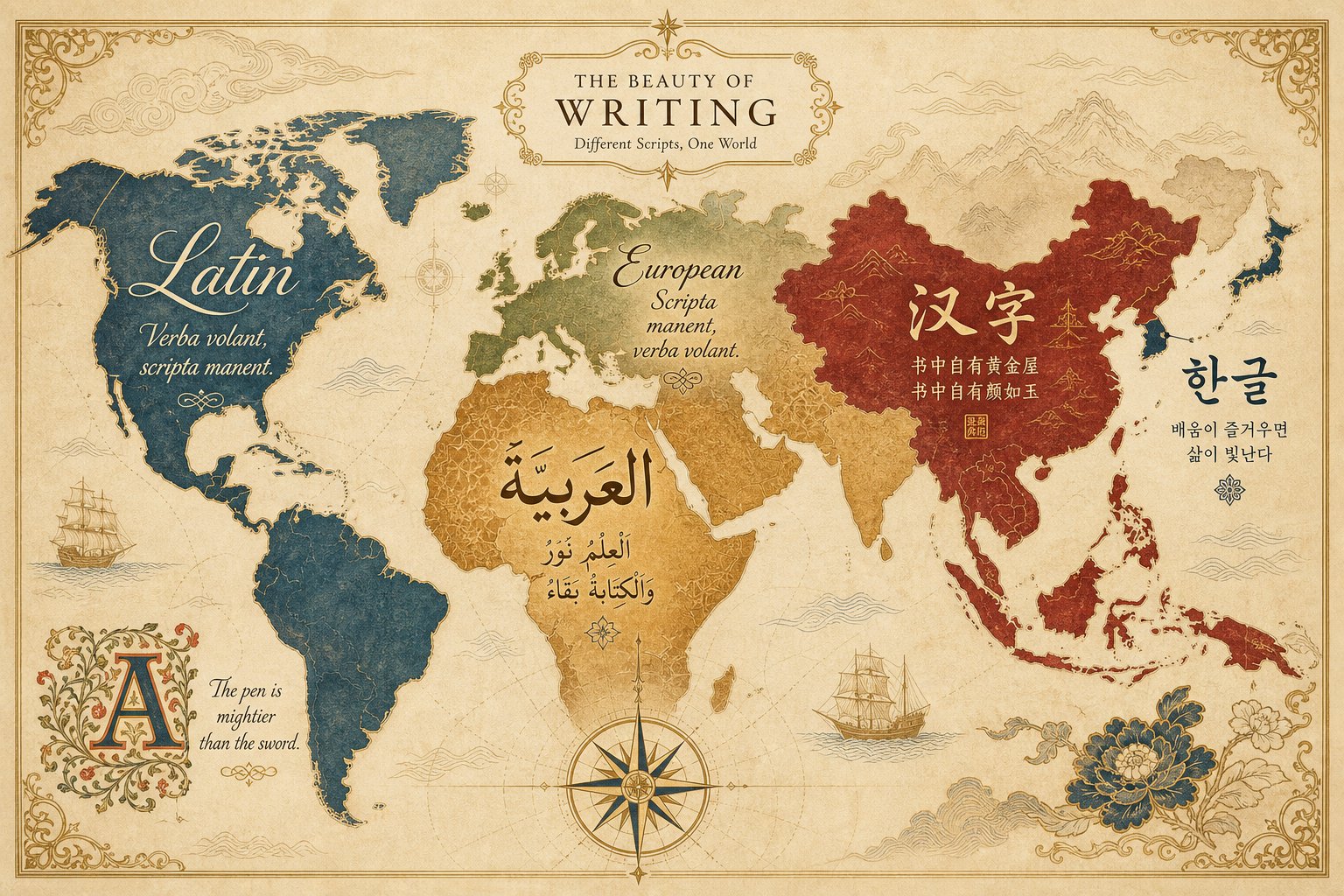
Every naming system eventually faces the same question: what happens when one word is not enough to capture a family's identity? The Ouyang compound surname answers that question through ancient geography and royal lineage. Other cultures arrived at multi-part surnames through entirely different paths, yet the underlying impulse is remarkably similar. Looking at how compound surnames function globally helps clarify what makes the Chinese tradition structurally distinct and why Ouyang's survival is more exceptional than it might first appear.
Korean and East Asian Compound Surname Parallels
Korea offers the closest parallel to China's compound surname tradition. Korean compound surnames use two syllables written with two Chinese characters (hanja), and they trace back to ancient Chinese origins rather than modern name-blending. The most well-known Korean compound surname is Namgung (南宮), meaning "southern palace." The Hamyeol Namgung clan claims descent from Nangong Kuo, a key adviser in King Wen of Zhou's court, with a branch reportedly arriving in Korea alongside the legendary figure Kija. South Korean census data from 2000 recorded only 18,703 Namgung bearers, making it far rarer than Ouyang's million-plus population in China.
Other Korean compound surnames include Sagong (司空, meaning "minister of works"), Dokgo (独孤, from a Xianbei tribal name), Hwangbo (皇甫, the same characters as Chinese Huangfu), and Seomun (西门, meaning "west gate"). Like their Chinese counterparts, these names are indivisible units with ancient roots. They cannot be split into two independent surnames any more than Ouyang can. Korea has fewer than ten compound surnames still in active use, and all of them are extremely rare compared to dominant single-syllable names like Kim, Lee, and Park.
The structural similarity is no coincidence. Korea adopted Chinese writing and naming conventions centuries ago, and its compound surnames are direct transplants or adaptations of Chinese originals. What differs is scale: China's compound surname tradition was once vastly larger, with over a thousand entries, while Korea's remained a small, stable set from the beginning.
Compound Surnames as a Global Naming Phenomenon
Step outside East Asia, and compound surnames take on fundamentally different forms. The mechanism changes from inherited ancient units to modern combinations of two existing family names:
- British compound surnames - Double-barrelled names like Spencer-Churchill or Rhys-Jones originated in Victorian-era aristocratic families seeking to preserve a maternal line when no male heir existed. The hyphen signals two distinct lineages joined by marriage or inheritance. Unlike Ouyang, these names are divisible: each half retains independent meaning and history.
- German compound surnames - Names like Rothschild ("red shield") or Schwarzenegger ("black plowman") look compound but actually function as single descriptive units, closer in spirit to Chinese compound surnames than to British double-barrelled names. True German compound surnames formed through marriage, such as Müller-Lüdenscheidt, follow the British hyphenation model and are a relatively modern phenomenon regulated by civil law.
- Spanish compound surnames - The Spanish system gives every person two surnames by default: the father's first surname followed by the mother's first surname. Garcia Lopez is not a compound surname in the Chinese sense but a structural feature of the entire naming system. Everyone has two; no one considers it unusual.
- Portuguese and Brazilian compound surnames - Similar to Spanish conventions but reversed in order, with the maternal surname appearing first. Brazilian names can stack three or four surnames, creating lengthy combinations like Silva Santos Oliveira that reflect multiple family lines.
- French compound surnames - Aristocratic names like Giscard d'Estaing or de Saint-Exupery incorporate particles and place names, functioning as compound units that signal noble origin. The "de" or "d'" is not a separate surname but an integral part of the whole.
The critical distinction is this: most Western compound surnames are created through combination. Two pre-existing names merge at a specific, documentable moment, usually a marriage or a legal decree. Chinese and Korean compound surnames are not combinations at all. They emerged as single units from the start, their two characters forming one meaning that never existed as separate parts. Ouyang was never "Ou" plus "Yang" joined together. It was always one name describing one relationship to one mountain.
This structural difference explains why the Ouyang compound surname has persisted for millennia while many Western double-barrelled names last only a generation or two before one half gets dropped for convenience. A name that was never two things cannot easily be reduced to one. Its integrity is built into its origin.
Understanding this distinction reframes how we think about naming across cultures. Compound surnames are not a single phenomenon with local variations. They are multiple, independent solutions to the same human desire: encoding more information, more history, and more identity into the few syllables that follow a person through life. For Ouyang bearers navigating a globalized world, that encoded history is both a source of pride and an ongoing negotiation with systems that were never designed to hold it.
The Living Legacy of the Ouyang Compound Surname
A name that encodes a mountain's sunny slope, a fallen kingdom's royal bloodline, and two millennia of literary achievement is not a relic. It is a living document. Unlike compound English surnames formed by hyphenating two family lines at a wedding, or compound French surnames that signal aristocratic land grants, the Ouyang compound surname carries its entire origin story within two inseparable characters. That story did not end with Ouyang Xiu's poetry or Ouyang Xun's calligraphy. It continues in every person who navigates airport check-in systems, corrects a database entry, or explains to a colleague why their last name has two parts.
Cultural Identity and the Modern Ouyang Bearer
For people carrying this name today, identity operates on two levels simultaneously. There is the private dimension: family genealogies passed down through generations, hall names inscribed above ancestral temple doors, and the quiet knowledge that your surname connects you to a specific hillside in Zhejiang province. Then there is the public dimension: filling out forms that split your name incorrectly, watching systems auto-correct "Ouyang" into "O. Yang," and fielding questions about whether Ou is your middle name.
That friction has not diminished pride. If anything, the challenges of carrying a compound surname in systems designed for simpler structures have sharpened awareness of what the name represents. Online communities of Ouyang descendants now share genealogical findings across continents, connecting Au-Yeung families in Toronto with Ouyang branches in Changsha who maintain the same zupu records. Social media groups dedicated to specific clan branches have made it possible for diaspora members to locate their ancestral villages without traveling to China first.
The renewed interest in genealogical research among younger generations reflects a broader cultural shift. Brazilian compound surnames might stack three or four family lines to honor multiple ancestors, but the Ouyang tradition achieves something different: it compresses an entire geographic and dynastic narrative into two syllables. For bearers raised outside China, rediscovering that narrative often becomes a turning point in how they relate to their heritage.
Tracing Your Ouyang Heritage
If you carry the Ouyang surname or one of its romanization variants, several resources can help you trace your lineage back through the centuries:
- Clan genealogy books (zupu) - Many Ouyang genealogies have been digitized or indexed. Provincial libraries in Hunan, Jiangxi, and Guangdong hold physical copies, and some have been uploaded to searchable databases. The FamilySearch Chinese genealogy portal offers guides on understanding jiapu (clan genealogy books), reading Chinese gravestones, and locating ancestral villages, all designed for English-speaking researchers.
- Ancestral village identification - Knowing which province and county your branch originated from narrows the search dramatically. Older relatives, immigration documents, and gravestone inscriptions often contain village-level detail that connects you to a specific branch of the clan.
- Romanization cross-referencing - If your family spells the name Au-Yeung, Auwjong, or any other variant, searching under multiple romanizations simultaneously increases your chances of finding matching records. Platforms like My China Roots specialize in bridging dialect-based spelling differences and can match records across naming conventions.
- Hall name identification - Determining whether your branch belongs to Liuyi Hall, Huawen Hall, or another tang hao helps pinpoint which sub-lineage you descend from and which genealogical records are most relevant to your family.
- DNA and community networks - Genetic genealogy cannot tell you your surname, but it can confirm connections between branches that lost touch centuries ago. Combined with documentary research, it fills gaps where paper records were destroyed during wars or political upheavals.
The tools available now would have been unimaginable even a generation ago. Digitized records, online family tree builders, and diaspora community networks have collapsed the distance between a second-generation immigrant in Melbourne and a clan registry kept in a Jiangxi village hall. The infrastructure that once required physical travel and fluent Classical Chinese literacy is increasingly accessible to anyone willing to start the search.
Compound surnames are not fossils preserved in amber. They are living historical records, rewritten with every generation that chooses to carry them forward intact.
The Ouyang compound surname survived when hundreds of others vanished because it was never just a name. It was a system: geographic origin, royal lineage, cultural achievement, genealogical infrastructure, and collective identity all compressed into two characters. Every Au-Yeung in Hong Kong, every Ouyang in Hunan, every Auwjong in Jakarta is a data point in that system, proof that a mountain's sunny slope can still cast its light across two and a half millennia.
Frequently Asked Questions About the Ouyang Compound Surname
1. What does the Ouyang surname mean?
Ouyang literally translates to 'south of Mount Ouyu.' The name combines the mountain's name (Ouyu, 欧余) with the Classical Chinese word for a mountain's sunny, south-facing slope (yang, 阳). It originated when descendants of King Goujian of the State of Yue settled on the southern side of Mount Ouyu in present-day Huzhou, Zhejiang province, around 333 BC. The geographic relationship between the family's settlement and the mountain became their permanent identifier, making Ouyang a place-based compound surname rather than one derived from an official title or occupation.
2. How many people have the Ouyang surname today?
According to China's 2020 National Name Report issued by the Ministry of Public Security, over 1.1 million people carry the Ouyang surname in mainland China alone. This makes it the most common Chinese compound surname by a wide margin, with the second-place Shangguan having only about 88,000 bearers. Globally, the number is higher when accounting for diaspora communities across Southeast Asia, North America, Europe, and Oceania who use variant romanizations like Au-Yeung, Auwjong, and Au Yong.
3. Why is Ouyang spelled differently in different countries?
The spelling variations stem from China's linguistic diversity. Different dialect groups pronounce the same two characters differently, and each community romanized the name according to their local pronunciation when emigrating. Cantonese speakers write Au-Yeung or Au Yeung, Hokkien speakers use Eu-yang or Au Yong, Macau residents write Ao Ieong following Portuguese conventions, and Indonesian Chinese adopted Auwjong or Ojong. All these variants represent the same two Chinese characters (欧阳) filtered through different phonetic systems and colonial-era romanization standards.
4. Is Ouyang one surname or two separate surnames combined?
Ouyang is one indivisible surname, not two surnames joined together. Unlike modern double-barrelled names where parents combine both family names (such as Smith-Jones), Ouyang emerged as a single unit from the start. The two characters form one meaning tied to a specific geographic origin. You cannot split it into 'Ou' and 'Yang' as independent surnames that were later merged. This structural characteristic is what defines a true Chinese compound surname (fuxi ng) and distinguishes it from Western hyphenated surnames created through marriage or legal combination.
5. Who are the most famous people with the Ouyang surname in Chinese history?
Two historical figures stand out above all others. Ouyang Xun (557-641) was a Tang dynasty calligrapher whose regular script style, known as 'Ou ti,' remains a foundational model in Chinese calligraphy education today. His 'Jiucheng Palace Liquan Ming' inscription is considered the most representative example of regular script in Chinese history. Ouyang Xiu (1007-1072) was a Song dynasty poet, historian, and statesman who led the Classical Prose Movement, authored official dynastic histories, and is counted among the Eight Great Masters of Tang and Song prose. Together, they cemented the surname's association with literary and artistic excellence.