What Same Pinyin Different Characters Actually Means
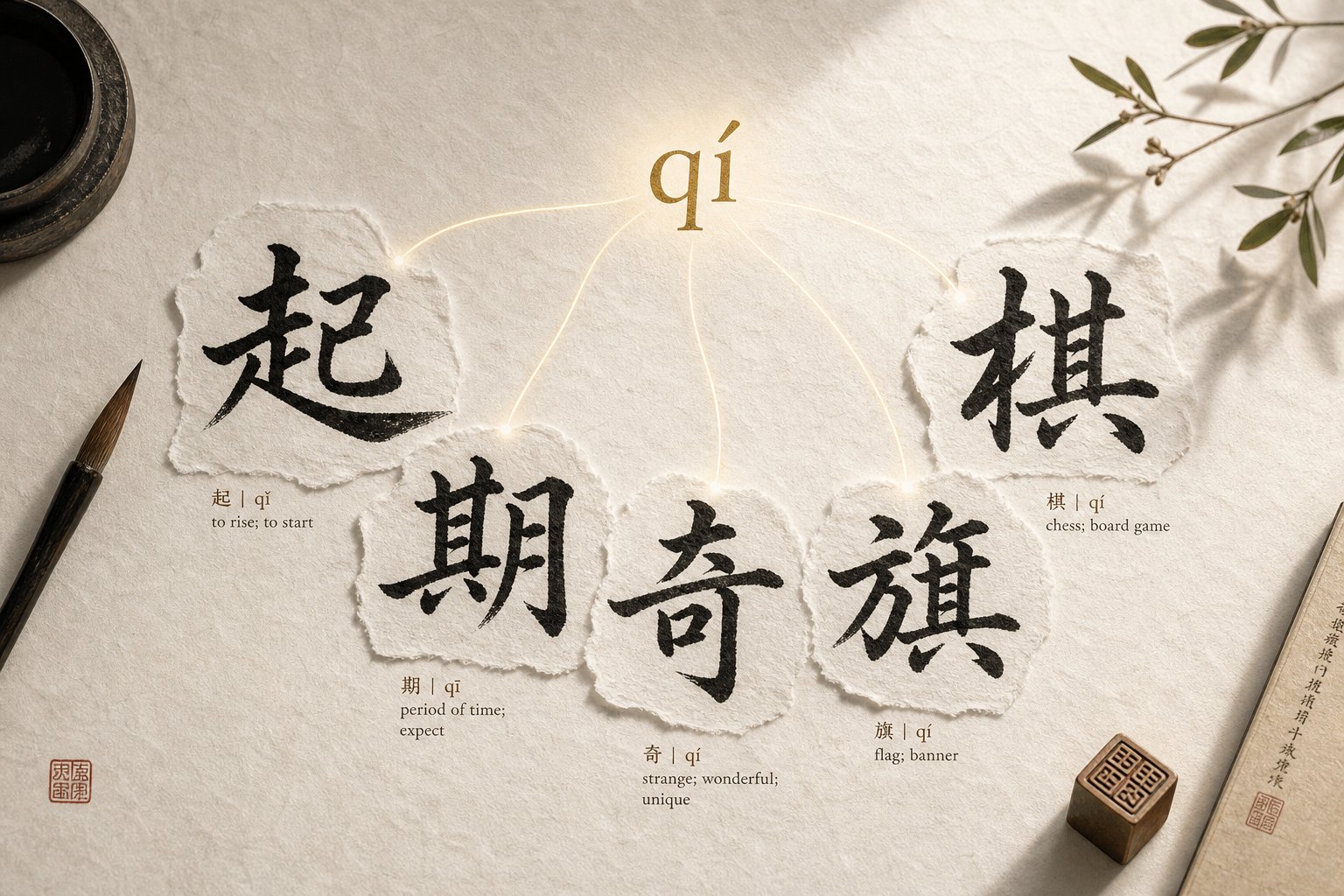
When you type "shi" into a pinyin input method, a long list of characters appears: 是, 市, 事, 室, 试, 式... all sharing the exact same romanized spelling and tone. Each one looks completely different on the page and carries a distinct meaning. This phenomenon — same pinyin different Chinese characters — is one of the first real hurdles learners face, and it raises an obvious question: how does anyone keep them straight?
What Are Chinese Homophones
The technical term for this is 同音字 (tongyinzi). In simple terms, Chinese homophones are characters that sound identical when spoken aloud but represent entirely different words in writing.
Chinese homophones are characters that share identical pinyin romanization — and often the same tone — but carry completely different meanings and written forms.
Consider the syllable "shi" in the fourth tone (shi). The character 是 means "to be," while 市 means "city" or "market." Same sound, same tone, zero overlap in meaning. A native speaker distinguishes them instantly through context, but for learners relying on pinyin as a pronunciation guide, the overlap can feel overwhelming. Does Chinese have homophones? It has them in abundance — far more than most languages — and understanding why is the first step toward handling them confidently.
Take another quick example from the 同音字 concept: the syllable "di" in the fourth tone gives you 地 (ground), 弟 (younger brother), and 递 (to deliver). Three characters, one sound, three unrelated meanings. The written form is the only reliable anchor.
Homophones vs Multi-Pronunciation Characters
Here is where many learners get confused. A homophone in Chinese is the opposite direction from another common phenomenon called 多音字 (duoyinzi) — polyphonic characters. The distinction is straightforward:
- Homophones (同音字): multiple characters share one pronunciation. Example: 是, 市, 事 all read as "shi."
- Polyphonic characters (多音字): one character has multiple pronunciations depending on context. Example: 行 reads as "xing" (to walk) or "hang" (profession, row).
Think of it this way — homophones are a many-to-one mapping from characters to sound, while polyphonic characters are a one-to-many mapping from a single character to multiple sounds. Mixing these two concepts up is common, but recognizing the difference early saves a lot of confusion down the road.
For learners, homophones present a reading and writing challenge: you hear a sound and need to pick the right character. Polyphonic characters present a pronunciation challenge: you see a character and need to pick the right sound. Both require context, but the strategies for handling each are different.
The real question, then, is why Mandarin has so many characters crowded onto the same handful of syllables — and the answer lies in the language's surprisingly small sound inventory.
Why Chinese Has So Many Homophones
Mandarin Chinese uses roughly 400 unique base syllables. Compare that to English, which has well over 8,000 possible syllable combinations. Even when you factor in the four tones (plus the neutral tone), the total number of distinct spoken syllables in Mandarin only reaches about 1,300. Meanwhile, the language uses tens of thousands of characters in everyday literacy. The math alone guarantees massive overlap — and it explains how many homophones there are in the Chinese language.
Limited Syllable Inventory Creates Overlap
Imagine trying to assign a unique sound to each of roughly 50,000 characters using only 1,300 available slots. The result is inevitable: dozens of characters pile onto the same pronunciation. The pinyin syllable "yi" in the fourth tone (yi) maps to over 100 distinct characters — 义, 意, 忆, 艺, 议, 译, and many more. It almost feels like every character is a homophone in Chinese, and at a statistical level, that intuition is not far off. Common chinese homophones cluster around high-frequency syllables like shi, ji, and cheng precisely because these sounds anchor so many everyday words.
This tight syllable budget is a structural feature of the language, not a flaw. Chinese compensates through context, compound words, and — most critically — the written character system, where each homophone gets its own unique visual form.
Historical Sound Mergers and Simplification
The syllable inventory was not always this compressed. Old Chinese (roughly 1250 BC to 200 AD) had a richer set of consonant clusters and syllable-final consonants that kept more characters phonetically distinct. Over centuries, sounds merged. Consonant clusters simplified, final stop consonants like -p, -t, and -k disappeared in Mandarin, and entire tonal categories collapsed into one another.
Scholars studying historical Chinese phonology have traced these mergers across three broad stages — Old Chinese, Middle Chinese (581-1279 AD), and Early Mandarin — each stage reducing the number of phonetically distinct syllables while the character inventory kept growing. Characters that once sounded completely different gradually converged onto the same pronunciation.
Character simplification in the 20th century added another layer. When complex traditional characters were reduced to fewer strokes, some previously distinct written forms became more visually similar, though the phonological mergers had already done the heavier lifting centuries earlier.
The takeaway for learners is practical: pinyin alone cannot carry meaning. It is a pronunciation guide, not a writing system. Because so many characters share the same sound, memorizing the written form — and understanding how context disambiguates — is not optional. It is the core skill. And the first disambiguation tool built right into the language? Tones.
How Tones Interact With Homophones
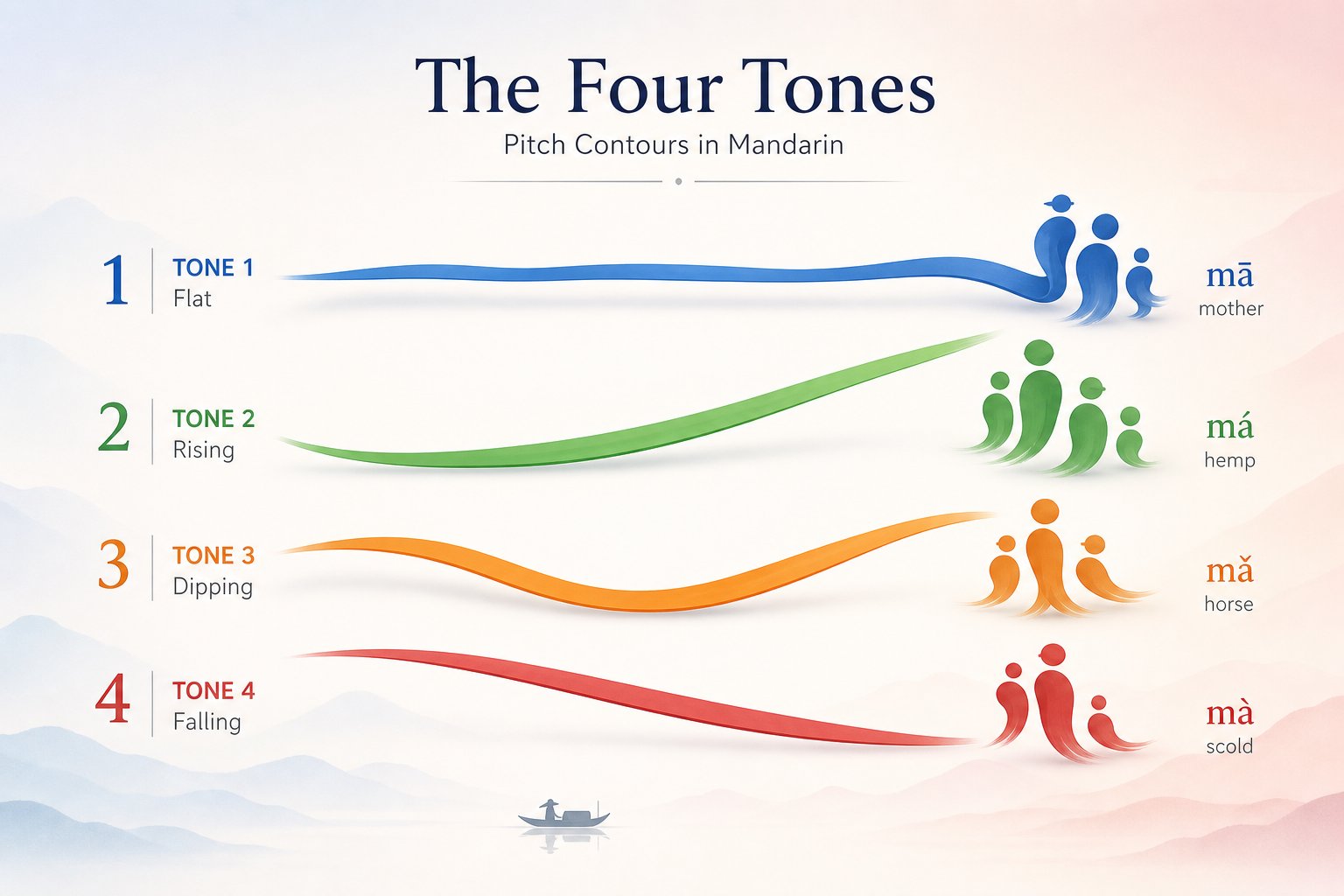
Tones are pitch patterns that change word meanings completely. In a language with only about 400 base syllables carrying tens of thousands of characters, those four tonal distinctions act as the first filter — splitting one crowded syllable into four separate lanes. But not all chinese pinyin homophones behave the same way. Some characters share both the syllable and the tone, making them true homophones. Others share only the base syllable while sitting in different tonal slots, making them near-homophones. The distinction matters for how you study and how you listen.
True Homophones Share Pinyin and Tone
True homophones are characters with identical pronunciation in every respect — same consonant, same vowel, same tone. You cannot tell them apart by sound alone. Consider these chinese homophones examples: 是 (to be) and 市 (city) are both pronounced shi in the fourth tone. 做 (to do) and 坐 (to sit) are both zuo in the fourth tone. 在 (to be at) and 再 (again) are both zai in the fourth tone.
In spoken conversation, only context resolves these. If someone says "wo zai chi fan", you know it means "I'm eating" because 再 (again) would not fit that sentence structure. The characters look nothing alike on paper, but through your ears, they arrive as the same signal. This is why reading builds listening comprehension — you internalize which character belongs in which context.
Near-Homophones Differ Only by Tone
Near-homophones share the same base syllable but land on different tones. Think of 如 ru (second tone, meaning "like" or "as") versus 入 ru (fourth tone, meaning "to enter"). Or the classic pair that trips up beginners: 买 mai (third tone, to buy) and 卖 mai (fourth tone, to sell). Same consonant, same vowel — opposite meanings separated by nothing more than a pitch movement.
The syllable chang is another good illustration of how chinese homophones chang across tonal slots. 长 chang (second tone) means "long," while 唱 chang (fourth tone) means "to sing," and 场 chang (third tone) means "field" or "venue." A single tone slip sends you to an entirely different word.
Here is a quick reference showing how tones split common syllables into distinct characters:
| Base Syllable | Tone 1 | Tone 2 | Tone 3 | Tone 4 |
|---|---|---|---|---|
| shi | 诗 (poem) | 十 (ten) | 使 (to cause) | 是 (to be) |
| yi | 一 (one) | 移 (to move) | 已 (already) | 意 (meaning) |
| ji | 机 (machine) | 极 (extreme) | 几 (how many) | 记 (to remember) |
| chang | 昌 (prosperous) | 长 (long) | 场 (field) | 唱 (to sing) |
Each row represents one base syllable. Each column is a different tone. Every cell holds a completely unrelated meaning. Tones alone give you four chances to land on the right word before context even enters the picture.
Why Tone Mastery Reduces Confusion
When you nail the correct tone, you immediately eliminate three-quarters of the possible characters for any given syllable. That is a massive reduction in ambiguity. Get the tone wrong, and you are not just mispronouncing — you are saying a different word entirely. Saying mai with a third tone when you mean the fourth tone turns "sell" into "buy." Saying tang with a first tone instead of a second tone turns "soup" (汤 tang) into "sugar" (糖 tang).
For learners, this means tone practice is not a polish-it-later skill. It is the foundational layer of disambiguation in a language where hundreds of characters compete for the same handful of sounds. Accurate tones will not solve every homophone puzzle — true homophones still require context — but they cut the problem down to a manageable size.
Tones handle the broad sorting. The finer distinctions between true homophones living in the same tonal slot? Those get resolved by the characters themselves — specifically, by the radicals embedded inside them.
Common Homophone Groups Every Learner Should Know
Radicals offer visual clues on the page, but you will not always have characters in front of you. In conversation, during listening practice, or while typing pinyin on your phone, you need to know which characters cluster together on the same sound — and how surrounding words reveal the right one. A solid chinese homophones list organized by difficulty gives you a mental map of where confusion is most likely to strike.
The groups below focus on high-frequency syllables you will encounter constantly. Each entry includes a context-rich sentence showing exactly how meaning becomes clear from the words around it.
Beginner-Level Homophone Groups
These are characters you meet in your first months of study. They appear in basic vocabulary, everyday conversation, and early reading materials — which means you will run into their overlapping pronunciations almost immediately.
| Pinyin | Character A | Meaning A | Character B | Meaning B | Example Sentence |
|---|---|---|---|---|---|
| shi (4th tone) | 是 | to be | 市 | city, market | 这是一个很大的市。(This is a very large city.) |
| shi (4th tone) | 事 | matter, affair | 室 | room | 办公室里有很多事要做。(There are many matters to handle in the office room.) |
| ji (1st tone) | 机 | machine | 鸡 | chicken | 他用手机拍了一只鸡。(He used his phone [machine] to photograph a chicken.) |
| ta (1st tone) | 他 | he | 她 | she | 他是老师,她是学生。(He is the teacher; she is the student.) |
| mai (3rd/4th) | 买 | to buy | 卖 | to sell | 我想买,他想卖。(I want to buy; he wants to sell.) |
Notice how the sentence structure does the heavy lifting. When you hear "shi" in "banggongshi," the compound word 办公室 locks in the meaning "room" without any ambiguity. The character 事 would never appear in that compound. This is why learning vocabulary as compounds — not isolated characters — is one of the fastest ways to handle homophones naturally.
Intermediate Homophones That Cause the Most Confusion
Once you move past survival vocabulary, the homophone landscape gets denser. These groups trip up learners because the characters appear in similar contexts — business, education, daily life — making the overlap feel more threatening.
| Pinyin | Character A | Meaning A | Character B | Meaning B | Example Sentence |
|---|---|---|---|---|---|
| cheng (2nd tone) | 成 | to become | 城 | city wall, city | 他长大后成了建筑师,设计了整座城。(He became an architect and designed the entire city.) |
| cheng (2nd tone) | 程 | journey, process | 承 | to bear, inherit | 这段旅程很长,你要承受很多压力。(This journey is long; you must bear a lot of pressure.) |
| ji (1st tone) | 基 | base, foundation | 击 | to strike, hit | 基础不牢,容易被困难打击。(A weak foundation makes you vulnerable to strikes from difficulty.) |
| mu di (4th tone) | 目的 | goal, purpose | 墓地 | tomb, graveyard | 他的目的是参观那片古老的墓地。(His goal is to visit that ancient graveyard.) |
| you yu (2nd tone) | 由于 | because of | 鱿鱼 | squid | 由于天气太热,鱿鱼很快就坏了。(Because of the hot weather, the squid spoiled quickly.) |
The cheng group is a perfect example of why these chinese homophone examples matter in practice. All four characters — 成, 城, 程, 承 — share the same pinyin and tone, yet they belong to completely different semantic fields. The compound word each one appears in acts as a fingerprint: 成功 (success), 城市 (city), 过程 (process), 承认 (to admit). You rarely encounter these characters floating alone in a sentence.
The pair 目的 and 墓地 is a classic that catches intermediate learners off guard — you would not want to confuse your goals with a graveyard. But in real usage, the surrounding vocabulary makes the intended meaning obvious. Words like 实现 (to achieve) signal 目的, while words like 参观 (to visit) or 古老 (ancient) point toward 墓地.
What these examples of chinese homophones reveal is a consistent pattern: individual characters may sound identical, but they almost never appear in identical environments. The compound words, grammatical positions, and topic of the sentence all converge to eliminate ambiguity. Recognizing this pattern shifts your approach from memorizing isolated characters to absorbing vocabulary in context — which is exactly how native speakers internalized these distinctions as children.
Context resolves most homophone confusion in real time. But there is another tool built directly into the characters themselves — one that works even when you encounter a word for the first time. The radical sitting inside each character quietly signals which meaning category it belongs to, giving you a visual shortcut before context even kicks in.
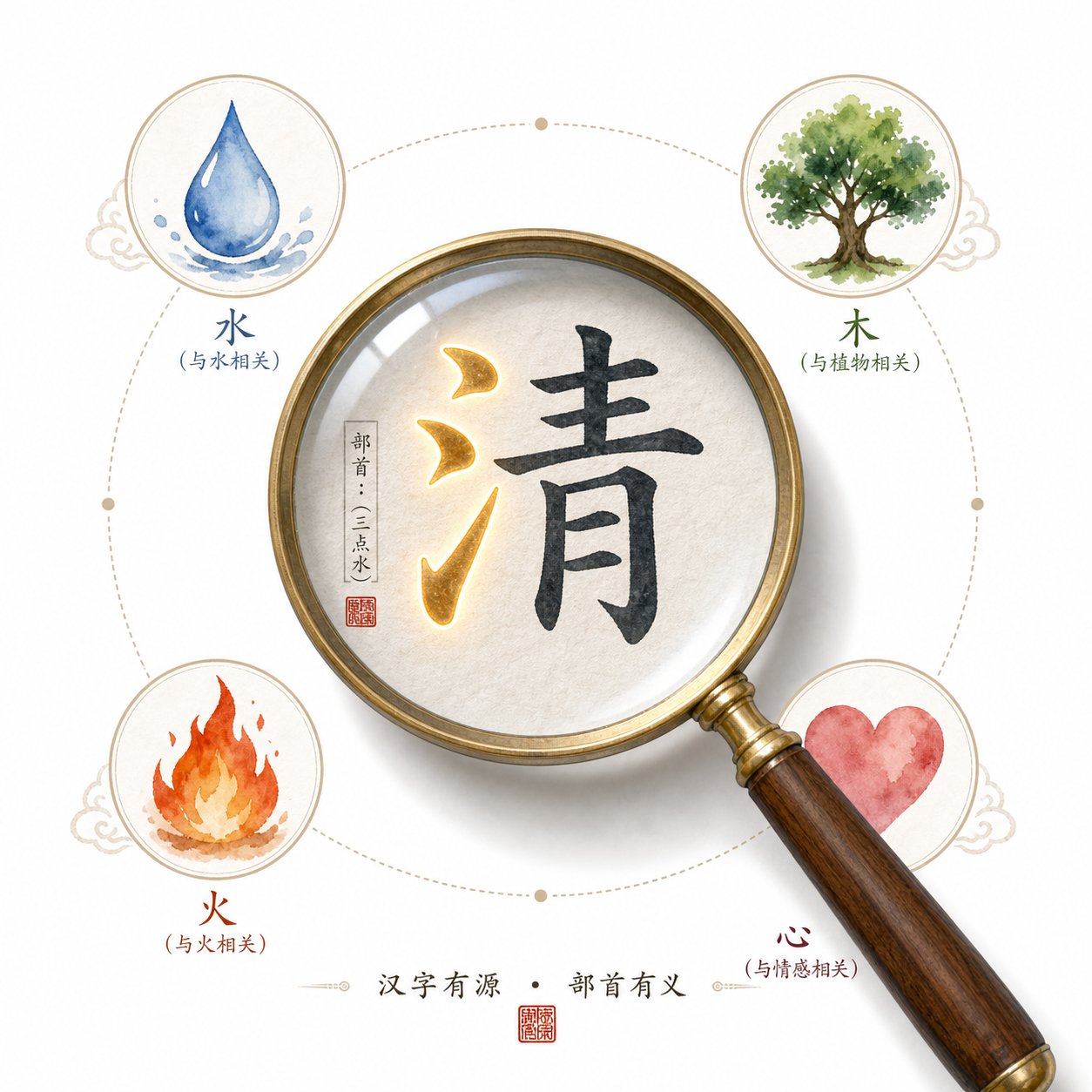
Using Radicals to Tell Homophones Apart
Radicals are the small structural components embedded inside Chinese characters that hint at meaning category. When you encounter unfamiliar chinese character homophones — two characters that sound identical but look different — the radical is often the fastest clue to which meaning you are dealing with. Think of radicals as built-in labels that sort characters into semantic families, even when their pronunciation gives you nothing to work with.
Radicals as Meaning Category Signals
Imagine you see two characters you have never studied, and someone tells you both are pronounced he in the second tone. One contains the 氵 component on its left side. The other contains 禾. Without knowing anything else, you can make an educated guess: the first character likely relates to water or liquid, and the second probably connects to grain or plants. That is the power of radical recognition — it narrows the meaning before you even check a dictionary.
Here are common radicals that reliably signal meaning categories, each paired with homophones they help distinguish:
- 氵(water) — Signals liquid, rivers, or moisture. Distinguishes 河 he (river) from 和 he (and, harmony). Spot the three water strokes, and you know the character lives in the water family.
- 木 (wood/tree) — Signals plants, timber, or wooden objects. Separates 材 cai (timber) from 才 cai (talent). The tree radical anchors the character to something physical and organic.
- 口 (mouth) — Signals speech, eating, or sounds. Tells you 吃 chi (to eat) belongs to oral activity, while 池 chi (pond) carries the water radical instead.
- 钅(metal) — Signals metals, tools, or money. Clarifies that 钱 qian (money) relates to metal coins, distinct from 前 qian (front, before) which has no metal component.
- 心/忄(heart) — Signals emotions, thoughts, or mental states. Reveals that 情 qing (feeling) is about inner experience, while 清 qing (clear) carries the water radical and relates to purity or clarity.
- 火/灬 (fire) — Signals heat, cooking, or burning. Separates 烤 kao (to roast) from 考 kao (to test), where the fire radical immediately tells you one involves heat.
Reading Strategy Using Radical Recognition
You do not need to memorize all 214 traditional radicals at once. Start with the ten most frequent ones — 氵, 木, 口, 钅, 心, 火, 土, 人, 女, and 讠 — and you will cover a large percentage of everyday characters. When you encounter a homophone pair, scan for the radical first. It often sits on the left side or at the bottom of the character.
This strategy is especially useful with chinese homophones simplified in the modern writing system. Simplification reduced stroke counts but generally preserved radicals, keeping those meaning signals intact. In some cases, however, simplified chinese characters that are homophone but different in traditional forms lost visual distinctions that traditional characters maintained — making radical awareness even more important for learners using simplified script.
Radicals give you a visual anchor. Context gives you confirmation. Together, they cover most situations where sound alone leaves you guessing. But what happens in spoken conversation, where you cannot see any characters at all? Native speakers have their own set of tricks for handling homophones on the fly.
How Native Speakers Handle Homophones Daily
Native Mandarin speakers rarely pause to think about homophones. They resolve ambiguity so quickly and automatically that the process is invisible — even to themselves. Yet the strategies they use are systematic, and once you recognize them, you can adopt the same habits. Disambiguation happens across three dimensions: spoken conversation, written text, and digital communication. Each one reinforces the others.
Spoken Disambiguation Through Compound Words
In everyday speech, native speakers almost never use a single-character word when a homophone collision could cause confusion. Instead, they expand into two-character compounds that lock in meaning. The syllable cheng (second tone) could point to 成, 城, 程, or 承 — but nobody says the bare syllable and hopes for the best. They say 成功 (success), 城市 (city), 过程 (process), or 承认 (to admit). The second character eliminates all ambiguity instantly.
This preference for compound words is deeply embedded in modern Mandarin. As linguistic research on Chinese word formation shows, the language has a strong structural preference for two-syllable words — and homophone density is one of the driving forces behind that preference. A single syllable carries too many possible meanings. Two syllables narrow the field to one.
When compound words are not enough, speakers add classifiers, rephrase, or simply provide more context. Imagine someone says "ta de mu di" and the listener looks confused. The speaker might clarify: "目标的目的" — referencing a related word (目标, goal) to anchor the correct character. You will hear this kind of verbal spelling in phone calls, at bank counters, and anywhere names or addresses need precision.
Written Context and Character Recognition
On the page, homophones are a non-issue for fluent readers. Each character has a unique visual form, and literate speakers recognize them the way you recognize faces — holistically and instantly. The radical signals meaning category, the overall shape triggers recall, and the surrounding sentence confirms the interpretation.
What makes this interesting for learners is the feedback loop: the more you read, the faster your brain maps each character to its meaning without routing through pronunciation at all. Experienced readers process characters visually, not phonetically. They do not "hear" the pinyin in their head and then pick a character — they see the character and access meaning directly. This is why extensive reading is the single most effective long-term strategy for handling same pinyin different Chinese characters. You are training the same visual recognition system native speakers rely on.
Digital Typing and Homophone Selection
Here is where things get practical for learners. Every time a native speaker types on a phone or computer using a pinyin input method, they face a chinese homophone search in miniature. They type a syllable — say, shi — and the system presents a candidate list: 是, 时, 事, 市, 式, 试... The speaker selects the correct character from the list, often guided by word prediction that uses context and usage statistics to rank candidates.
Modern pinyin input systems hold up to an entire clause before requiring conversion, using word phrases, grammatical structure, and context to guess the appropriate characters. For common phrases, the system gets it right automatically. For less common combinations, the user manually picks from the homophone candidate list.
This daily ritual — typing pinyin and choosing characters — is essentially a chinese homophones online drill that native speakers perform thousands of times per week without thinking of it as study. For learners, adopting pinyin input as your primary typing method turns every text message, search query, and social media post into active character recognition practice. You see the homophones side by side, you make a conscious choice, and over time that choice becomes automatic.
If you have ever browsed a chinese homophone wiki or dictionary tool and felt overwhelmed by the sheer number of characters sharing one syllable, consider this: native speakers navigate that same list every time they type. The difference is repetition. They have selected 是 over 市 so many times that the correct choice is reflexive. You can build that same reflex by making pinyin input your default — on your phone, your laptop, everywhere you write.
These three dimensions — spoken compounds, visual recognition, and digital selection — form an interlocking system. Speaking in compounds trains you to think in word-level units. Reading builds instant character recognition. Typing reinforces the connection between sound and written form. Together, they explain why native speakers handle homophones effortlessly and why learners who engage all three channels progress faster than those who rely on flashcards alone.
The practical payoff extends beyond avoiding confusion. Homophones are not just a source of errors — they are also a source of creativity. The same sound-sharing that frustrates learners has fueled centuries of wordplay, cultural symbolism, and humor across Chinese-speaking societies.

Cultural Wordplay and Puns From Chinese Homophones
Chinese homophone puns — called 谐音 (xieyin) — are not a quirky footnote in the language. They shape holidays, architecture, gift-giving etiquette, internet culture, and even classical literature. When the same sound can point to dozens of characters, creative minds exploit that overlap to layer hidden meanings into everyday life. Some of these chinese homophone puns are centuries old. Others were invented last week on social media.
Homophones in Chinese New Year Traditions
Spring Festival is where homophonic chinese new year traditions are most visible. Nearly every food, decoration, and greeting carries a second meaning encoded through sound. You will notice these puns everywhere once you know what to listen for:
- Fish (鱼 yu) = surplus (余 yu) — The phrase 年年有余 ("abundance every year") is homophonous with 年年有鱼 ("fish every year"). This is why fish appears on every New Year dinner table and in paper decorations on walls and windows.
- Bat (蝠 fu) = fortune (福 fu) — Bats are a common motif in traditional Chinese painting and decoration because their name sounds identical to the word for good fortune. Five bats together represent the "Five Blessings" (五福).
- Upside-down 福 = fortune has arrived — The character 福 is hung upside down on doors because "upside down" (倒 dao) sounds like "arrived" (到 dao). So 福倒了 ("fortune is upside down") becomes 福到了 ("fortune has arrived").
- Niangao (年糕) = rising higher each year — This sticky rice cake is homophonous with 年高, from the phrase 年年高升 meaning "to ascend higher every year," symbolizing growing prosperity.
- Lettuce (生菜 shengcai) = making money (生财 shengcai) — Served at the first meal of the New Year and offered to lions during traditional lion dances.
- Tangyuan (汤圆 tangyuan) = reunion (团圆 tuanyuan) — These sweet round dumplings are eaten during the Lantern Festival, the final day of New Year celebrations. The roundness of the dumplings and their name together emphasize family unity. Tangyuan is a chinese sweet that's a homophone for reunion, making it one of the most symbolically loaded foods in the entire festival calendar.
These chinese new year homophones are not just decorative — they actively guide behavior. Families choose specific dishes, hang specific decorations, and avoid specific words during the holiday because the sounds carry weight. Saying the wrong homophone during New Year is considered genuinely unlucky.
Number Homophones and Lucky Culture
Chinese number homophones influence everything from real estate pricing to phone number auctions to wedding dates. The logic is simple: if a number sounds like a lucky word, it attracts good fortune. If it sounds like an unlucky word, people avoid it.
The most powerful examples:
- 8 (八 ba) = prosperity (发 fa) — The number 8 sounds like the verb in 发财 (to get rich). Phone numbers, license plates, and apartment floors containing 8 command premium prices. The Beijing Olympics opening ceremony began at 8:08 PM on 08/08/2008 — not a coincidence.
- 4 (四 si) = death (死 si) — This near-homophone makes 4 so unlucky that many buildings in China skip the fourth floor entirely, jumping from 3 to 5. Apartment numbers, phone numbers, and license plates containing 4 are avoided or discounted.
- 9 (九 jiu) = longevity (久 jiu) — Represents eternality and long-lasting relationships. Couples get married on the 9th, give 99 roses, or choose dates with multiple 9s.
- 6 (六 liu) = smooth (溜 liu) — Represents things going smoothly. The internet slang "666" means "awesome" or "impressive."
These associations extend into digital communication. The chinese 5 20 homophone is a perfect example: 520 (wu er ling) sounds like 我爱你 (wo ai ni, "I love you"), turning May 20th into an unofficial Valentine's Day in China. Similarly, 1314 (yi san yi si) sounds like 一生一世 ("forever"), and 88 (baba) mimics 拜拜 ("bye-bye"). Numbers become a shorthand language built entirely on homophonic overlap.
Puns in Poetry and Internet Slang
Classical Chinese literature exploited homophones with deliberate artistry. In Dream of the Red Chamber, Cao Xueqin named his main family 贾 (Jia) — a homophone of 假 ("false") — while the contrasting family carries the surname 甄 (Zhen), sounding like 真 ("true"). The entire novel's thematic tension between illusion and reality is encoded in the characters' names through chinese homophonic puns that reward attentive readers.
Modern internet culture takes the same principle in a very different direction. Some of the most funny chinese homophones emerge from netizens replacing censored words with innocent-sounding alternatives that share the same pronunciation. The term 河蟹 (hexie, "river crab") became code for censorship because it sounds like 和谐 (hexie, "harmony") — the official policy used to justify content removal. The phrase 草泥马 (cao ni ma, "grass mud horse") became a viral meme precisely because its pronunciation overlaps with a common profanity. And when the #MeToo movement was censored, Chinese users adopted #米兔 (mitu, "rice bunny") as a phonetic stand-in.
Whether carved into Song dynasty paintings or typed into a group chat, the underlying mechanism is identical: same pinyin, different characters, new meaning layered on top. Understanding these chinese homophone puns does more than entertain — it reveals how deeply sound-meaning relationships are woven into Chinese thought. The language does not just tolerate homophones. It celebrates them.
Appreciating the cultural dimension is rewarding, but it also raises a practical question: when you encounter an unfamiliar homophone in the wild — no cultural context, no familiar compound word — what do you actually do? A systematic framework turns that moment of confusion into a solvable problem.

A Step-by-Step Framework for Identifying the Right Character
You are reading a text, listening to a podcast, or translating a sentence, and you hit a syllable that could map to five or six different characters. Guessing feels unreliable. Checking every possibility in a chinese homophone dictionary feels slow. What you need is a repeatable process — a mental checklist that narrows the options quickly and lands on the correct character with confidence.
The framework below works whether you are reading, listening, or figuring out how to handle homophones when translating into Chinese. Each step eliminates a layer of ambiguity, and by the fourth step, you will almost always have your answer.
The Four-Step Disambiguation Method
- Check the tone. Identify the exact tone of the syllable. This single step eliminates roughly 75% of candidate characters. If you hear qing in the first tone, you are dealing with 清 (clear) or 青 (green/blue) — not 情 (feeling, second tone) or 请 (please, third tone). Tone is your coarsest filter, but it removes the most noise.
- Examine the radical for meaning category. If you can see the character (in a text, on a sign, or in a typing candidate list), look at the radical component. A water radical (氵) points toward liquid or flow. A heart radical (忄) points toward emotion. A speech radical (讠) points toward language or communication. The radical tells you which semantic family the character belongs to, even if you have never seen it before.
- Look at the compound word it appears in. Chinese characters rarely float alone in modern text. Identify the two-character or multi-character word the target character belongs to. The companion character acts like a fingerprint — it locks in one specific meaning from the homophone group. Seeing 程 next to 过 (过程, process) tells you something completely different from seeing 城 next to 市 (城市, city), even though both are pronounced cheng.
- Use sentence context to confirm. Read the full sentence or listen to the complete thought. What is the topic? What grammatical role does the word play? A character functioning as a verb cannot be the same homophone that only works as a noun. The sentence-level meaning serves as your final confirmation that you have landed on the right character.
Each step builds on the previous one. Tone narrows the field. The radical narrows it further. The compound word usually gives you the answer. Sentence context confirms it. You will not always need all four steps — sometimes step one or step three alone is enough — but having the full sequence means you are never stuck.
Mastering this framework turns homophone confusion into a structured problem-solving exercise. You stop guessing and start eliminating.
Worked Example Applying the Framework
Imagine you encounter this sentence in a reading passage: 这个工__很复杂。The audio gives you the syllable cheng in the second tone. You know the homophone group includes 成, 城, 程, and 承. Which one fits?
Step 1 — Check the tone. Second tone confirmed. All four candidates (成, 城, 程, 承) share the second tone, so this step does not eliminate any of them here. That is fine — move to the next filter.
Step 2 — Examine the radical. If you can see the character options, notice that 程 contains the radical 禾 (grain/harvest), historically associated with measurement and processes. 城 contains 土 (earth), pointing to land or structures. 承 contains no strong semantic radical. 成 is a standalone form. The radical gives you a directional hint but is not conclusive alone in this case.
Step 3 — Look at the compound word. The character sits next to 工, forming 工___. You recognize 工程 (gongcheng, engineering/project). That compound only works with 程. It cannot be 工成, 工城, or 工承 — none of those are valid words. The compound locks in your answer: 程.
Step 4 — Use sentence context to confirm. The full sentence reads 这个工程很复杂 — "This project is very complex." The meaning fits perfectly. A project (工程) can be complex. A city (城) or the verb "to become" (成) would not make grammatical or semantic sense in this slot.
Total time once you internalize the process: a few seconds. The compound word (step 3) did most of the work here, which is typical. In practice, you will find that steps 1 and 3 resolve the vast majority of homophone encounters. Steps 2 and 4 serve as backup for unfamiliar vocabulary or ambiguous situations — exactly the moments when a homophone chinese dictionary lookup might otherwise be your only option.
The more you apply this framework consciously, the faster it becomes automatic. Eventually, you stop running through the steps deliberately and start recognizing the right character the way native speakers do — instantly, through pattern recognition built on thousands of prior encounters. That transition from deliberate process to intuitive recognition is what long-term homophone mastery actually looks like.
Building Long-Term Homophone Mastery
That shift from deliberate reasoning to instant recognition does not happen through a single study session. It builds gradually through consistent, varied exposure to characters in real contexts. The good news? You already have every tool you need. Understanding why homophones in Chinese exist (limited syllable inventory, historical mergers), how tones and radicals provide built-in disambiguation, and how native speakers resolve ambiguity through compounds and context — that knowledge forms a complete toolkit. What remains is putting it to work.
Key Takeaways for Learners
- Tones are your first filter — accurate tone production and perception eliminate roughly 75% of homophone candidates immediately.
- Radicals signal meaning categories visually, giving you a shortcut even with unfamiliar characters.
- Compound words are how modern Chinese resolves ambiguity in speech — learn vocabulary as two-character units, not isolated characters.
- Sentence context confirms everything — the topic, grammar, and surrounding words always point to the correct chinese homophone.
- Pinyin input is free daily practice — every text message you type forces active character selection from homophone lists.
Practice Strategies by Proficiency Level
Beginners benefit most from learning characters in compound-word pairs rather than alone. When you study 城, study it as 城市. When you study 成, study it as 成功. This builds the compound-word reflex that native speakers rely on.
Intermediate learners should prioritize extensive reading — consuming large volumes of text slightly below their maximum difficulty level. Reading builds the contextual intuition that makes homophones chinese learners struggle with feel effortless over time. Aim for material where you understand at least 95% of the vocabulary so your brain can absorb patterns naturally.
Advanced learners gain the most from studying characters by radical families. Group all the characters sharing the water radical, then all those sharing the heart radical. This approach reveals the internal logic of the writing system and makes new homophones instantly categorizable.
Homophone mastery is not a milestone you reach and check off. It is a natural byproduct of reading widely, typing in pinyin daily, and paying attention to how characters cluster into meaning. Every page you read, every message you type, and every compound word you absorb quietly strengthens the same recognition system that makes native speakers forget homophones are even a problem. Keep reading. The confusion fades faster than you expect.
Frequently Asked Questions About Same Pinyin Different Chinese Characters
1. Why does Chinese have so many characters with the same pinyin?
Mandarin has only about 400 base syllables, expanding to roughly 1,300 with tones. Yet the language uses tens of thousands of characters. This limited sound inventory forces dozens of characters to share the same pronunciation. Historical sound mergers across dynasties further compressed the syllable system, causing characters that once sounded distinct to converge onto identical pinyin spellings over centuries.
2. How do native Chinese speakers tell homophones apart in conversation?
Native speakers rely primarily on two-character compound words to eliminate ambiguity. Instead of saying a bare syllable like 'cheng,' they use compounds such as 城市 (city) or 成功 (success) where the second character locks in the meaning. They also use classifiers, rephrase when needed, and rely on conversational context. In writing and digital typing, character recognition and pinyin input candidate selection handle disambiguation automatically.
3. What is the difference between Chinese homophones and polyphonic characters?
Chinese homophones (同音字) are multiple characters that share one identical pronunciation, like 是, 市, and 事 all reading as 'shi' in the fourth tone. Polyphonic characters (多音字) work in the opposite direction: one single character has multiple pronunciations depending on context, such as 行 reading as 'xing' (to walk) or 'hang' (profession). Homophones challenge your writing; polyphonic characters challenge your reading aloud.
4. How can I use radicals to distinguish Chinese characters with the same pinyin?
Radicals are structural components inside characters that signal meaning categories. When two characters share identical pinyin, their radicals often reveal which semantic family each belongs to. For example, the water radical (氵) in 河 tells you it relates to rivers, distinguishing it from 和 (harmony) which lacks that component. Learning the ten most common radicals covers a large percentage of everyday characters and gives you a visual shortcut before context even kicks in.
5. What are some examples of Chinese homophone puns in culture?
Chinese culture is rich with homophone-based symbolism. Fish (鱼 yu) appears at New Year dinners because it sounds like surplus (余 yu). The number 8 (八 ba) is considered lucky because it resembles 发 (fa, to prosper). Bats (蝠 fu) symbolize fortune (福 fu) in traditional art. In digital culture, 520 sounds like 'I love you' (我爱你), and 666 means 'awesome' because 六 (liu) sounds like 溜 (smooth). These puns actively shape holidays, architecture, and daily communication.