Why Sun and Suen Confuse So Many Families
Imagine you are building a family tree and discover a branch of relatives with the last name Sun, while your own passport reads Suen. Different families? Different origins? Not necessarily. In most cases, the sun surname and the Suen spelling point back to the exact same Chinese character: 孫. The difference is not about ancestry. It is about which dialect your family spoke and which romanization system was used when their name was first written in English letters.
The Core Question Behind Sun vs Suen
Both spellings derive from the character 孫, which is ranked the 12th most common surname in mainland China, shared by over 18 million people. When Mandarin speakers romanize this character using Pinyin, it becomes "Sun." When Cantonese speakers in Hong Kong romanize the same character, it becomes "Suen." The underlying identity is identical. The surface-level spelling simply reflects geography and dialect. This single fact resolves the confusion for the vast majority of families searching for answers about the sun last name and its variants.
The split happened because Chinese is not one language with one pronunciation. It is a family of dialects, each producing a distinct sound for the same written character. Colonial administrators, immigration officers, and government clerks then transcribed those sounds into English using whatever system was available at the time. The result: one family, multiple spellings scattered across generations and continents.
Sun and Suen are not different surnames — they are different romanizations of the same character 孫, split by dialect and geography.
Who This Comparison Helps
This breakdown is for anyone who has encountered the surname Sun or Suen and wondered whether they share a connection. You might be a genealogy researcher tracing a sun family name across borders. You might be reconnecting with relatives whose documents spell the name differently from yours. Or you might simply be confused by variant spellings on old immigration papers, birth certificates, or ancestral tablets.
Whatever brought you here, the sections ahead rank and compare every major romanization system that produces these spelling differences. You will learn exactly which system created which spelling, where each variant is concentrated geographically, and how to determine whether two differently spelled names actually share the same lineage. The distinction matters because, as My China Roots notes, a single Chinese surname can have over 30 different English spellings depending on dialect and transcription method.
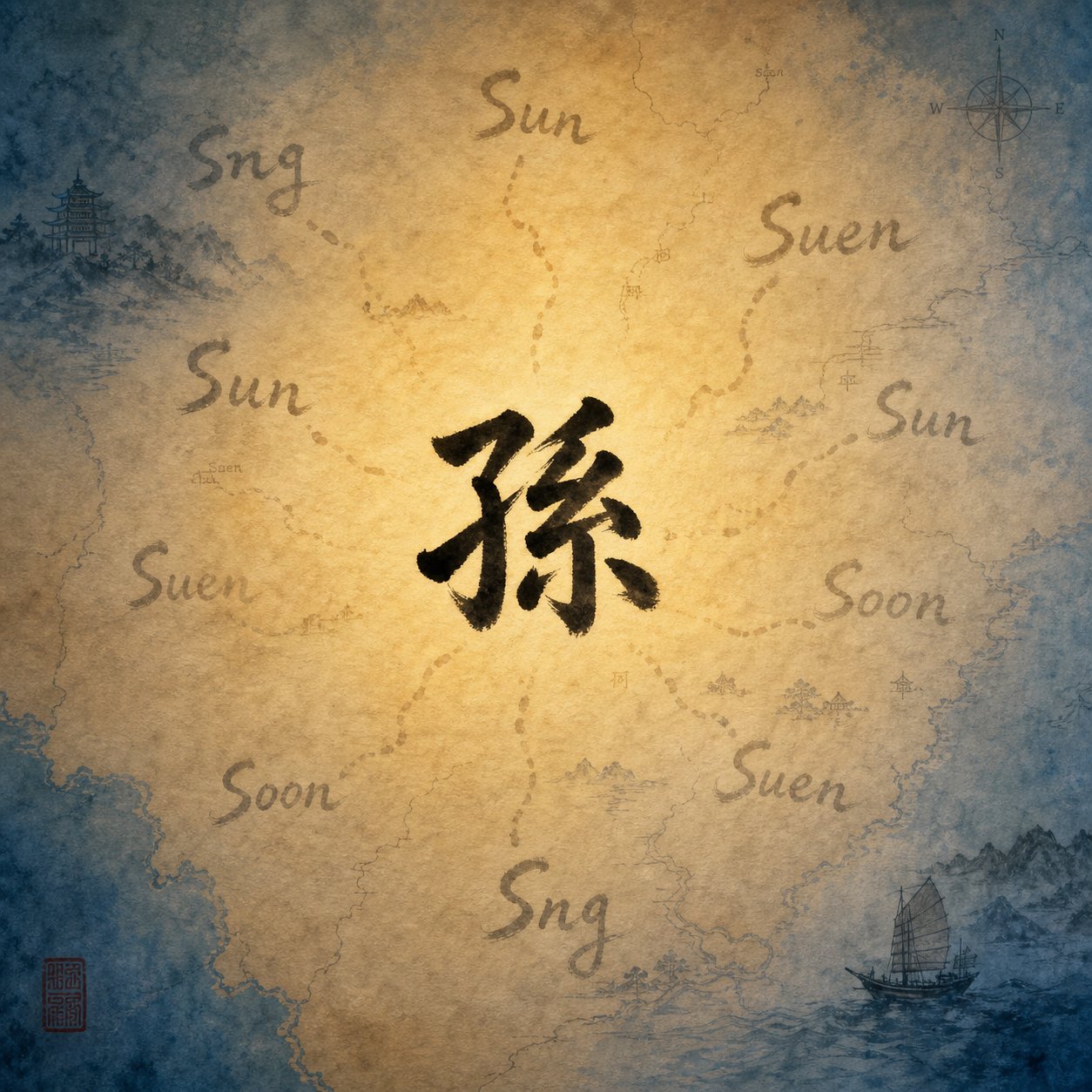
The confusion runs deeper than just Sun and Suen, though. Depending on when and where a family emigrated, the same character 孫 has also appeared as Sng, Soon, Son, and even Swen on official documents. Each spelling tells a story about a specific dialect, a specific era, and a specific romanization convention — and understanding those conventions is the key to untangling the puzzle.
How We Ranked These Romanization Differences
Multiple romanization systems have been applied to Chinese characters over the past 150 years, and each one produces a different English spelling for the same surname. To make sense of the sun surname origin and its variants, you need a framework for understanding which systems matter most in practical terms. Not every romanization carries equal weight when you are searching immigration records or trying to match family documents across borders.
Selection Criteria for Romanization Systems
Each system discussed in this article is evaluated against five factors, ranked here from most to least important for surname research:
- Official government adoption — Was this system mandated by a national government for passports, ID cards, or civil records? Government-backed systems appear on the documents you are most likely to encounter.
- Diaspora population size — How many people emigrated while this system was in active use? Larger diaspora communities mean more records carrying that particular spelling.
- Document prevalence — How often does this spelling show up on birth certificates, immigration forms, and legal paperwork today?
- Historical usage period — How long was this system the dominant standard? A system used for a century leaves a deeper paper trail than one used for a decade.
- Genealogical utility — Does this system help you trace the sun name origin back to a specific region, dialect group, or emigration wave?
Why Romanization Matters for Surname Research
Here is something easy to overlook: most families never chose their English spelling. Immigration officials at ports of entry, colonial administrators issuing identity documents, and government clerks processing paperwork all made that decision for them. A Cantonese-speaking family arriving in Vancouver in 1965 did not sit down and select "Suen" from a menu of options. A clerk heard the pronunciation, matched it to whatever convention was standard at that office, and wrote it down. That spelling then became permanent on every subsequent legal document.
This means the spelling on a passport often reflects the bureaucratic system of a particular time and place rather than a family's own preference. Understanding the sun last name origin through the lens of romanization history lets you reverse-engineer that process. You can look at a spelling, identify which system produced it, and narrow down when and where the family likely emigrated. That context turns a confusing jumble of variant spellings into a readable map of migration patterns.
Pinyin System and the Mandarin Standard Behind Sun
The spelling "Sun" dominates global records today for one reason: it is the product of Hanyu Pinyin, the official romanization system of the People's Republic of China. If your family emigrated from mainland China after the early 1980s, or if your relatives' documents were issued by PRC authorities, the spelling on those papers almost certainly follows Pinyin rules. Understanding how this system works reveals why "Sun" became the most widely recognized version of the chinese sun surname worldwide.
How Pinyin Produces the Spelling Sun
In Mandarin Chinese, the character 孫 is pronounced with a high, flat tone. Pinyin transcribes this as "Sūn" — the macron above the "u" indicating the first tone. In everyday use, especially on passports and legal documents, the tone mark is dropped, leaving the plain spelling "Sun."
The phonetic logic is straightforward. Pinyin maps each Mandarin syllable to a fixed combination of Latin letters. The initial consonant "s" pairs with the final "un" to produce a single syllable. There is no ambiguity, no variation. Every speaker of standard Mandarin pronounces 孫 the same way, and Pinyin renders it identically every time. This consistency is by design.
The system was formally approved on February 11, 1958, by the Fifth Session of the First National People's Congress. Its development stretched back to 1955, when the Committee for the Reform of the Chinese Written Language began drafting a Latin-alphabet-based phonetic scheme. After years of public consultation and expert revision, the final version utilized all 26 letters of the Latin alphabet, arranged to represent Mandarin sounds as closely as possible using internationally familiar letter values. The character 孫, rendered as "sun" in this system, maps cleanly because the Mandarin pronunciation already aligns with common Latin letter sounds.
Where You Will Encounter the Sun Spelling
Pinyin is not just a classroom tool. It is the legally mandated standard for romanizing Chinese personal names on mainland Chinese passports, identity cards, and all official international correspondence. The International Organization for Standardization adopted it as ISO 7098 in 1982, and the United Nations had already recognized it as the international standard for Chinese geographical names in 1977. By 1986, the UN formally adopted Pinyin for all its documents.
What does this mean in practice? If you encounter the sun in chinese language contexts — academic papers, news articles, diplomatic records, or any publication following international standards — the spelling will be "Sun." Major news organizations worldwide switched from older romanizations to Pinyin during the 1980s. Peking became Beijing. Canton became Guangzhou. And the surname 孫 became uniformly "Sun" in every internationally facing document produced by the PRC.
Notable bearers of this spelling include Sun Tzu (though his name predates Pinyin and uses an older romanization convention), and the millions of families who emigrated from mainland China during the post-reform era. Sun Yat-sen is a more complex case — his romanized name blends Cantonese pronunciation with historical convention rather than following Pinyin. Still, in modern references to the sun in mandarin chinese, the Pinyin spelling is what you will find in databases, academic indexes, and government records.
The PRC's standardization on Pinyin after 1979 created a clear dividing line. Families who left mainland China before this period may carry older spellings from Wade-Giles or other systems. Families who left afterward almost universally carry the Pinyin spelling "Sun" on their documents. This timeline is a useful genealogical marker when you are trying to date an emigration wave.
Pros and Cons of the Pinyin Spelling
Pros
- Internationally recognized — backed by ISO, the United Nations, and virtually every global institution that handles Chinese names
- Government-mandated consistency — no variation between documents; every PRC passport spells it the same way
- Largest user base — over a billion Mandarin speakers use this system, making it the default in most databases and search engines
- Clear genealogical signal — the spelling "Sun" on a document strongly suggests mainland Chinese origin or post-1980s emigration
Cons
- Tonal information lost in casual use — without the macron, "Sūn" becomes "Sun," which is indistinguishable from the English word for the star at the center of our solar system
- Confusion with the English word — search engines, databases, and even casual readers may not immediately recognize "Sun" as a Chinese surname
- Erases dialect identity — a Cantonese-speaking family forced to use Pinyin on PRC documents loses the phonetic connection to their actual spoken pronunciation
- Does not distinguish between different characters — the surname 荀 (Xún) can also appear as "Sun" through transcription errors, creating false matches in genealogical searches
Pinyin's dominance means that "Sun" is the spelling most people will encounter first when researching the chinese sun surname in any modern context. But dominance does not mean universality. Millions of families — particularly those rooted in Cantonese-speaking regions — carry a different spelling that reflects a completely different phonetic reality. That Cantonese pronunciation, and the informal system that captured it on paper, is what produced "Suen."

Cantonese Romanization and Where Suen Comes From
Cantonese does not simplify the vowel the way Mandarin does. When a Cantonese speaker in Hong Kong, Guangdong province, or Macau says the character 孫, the sound that comes out is noticeably different from the Mandarin "sun." It carries an additional vowel glide — a rounded "yu" quality that Mandarin flattens into a plain "u." That phonetic difference is exactly what produces the spelling "Suen" on passports, identity cards, and immigration records across the Hong Kong diaspora.
How Cantonese Pronunciation Creates Suen
In Mandarin, 孫 is a single clean syllable: the consonant "s" followed by the vowel "un." Cantonese preserves a more complex vowel combination. The tongue rounds forward, producing a sound closer to "syun" — a medial glide between the initial consonant and the final nasal. This is not a subtle difference. If you heard both pronunciations side by side, you would immediately recognize them as distinct sounds.
In Jyutping, the standardized academic romanization for Cantonese developed by the Linguistic Society of Hong Kong, the sun chinese character 孫 is written as "syun1" — the "1" indicating the first (high-level) tone. The "sy" captures that rounded medial glide, and the "un" captures the nasal ending. This is the most phonetically precise representation of how Cantonese speakers actually pronounce the surname.
So where does "Suen" come from? The Hong Kong government romanization system drops the "y" and replaces it with an "ue" vowel combination. The result is "Suen" — a spelling that approximates the Cantonese sound using English letter conventions that feel intuitive to English readers. The extra "e" in Suen is not decorative. It represents a real phonetic element that Mandarin-based Pinyin simply does not capture. When you see the sun in chinese character form (孫) paired with the spelling "Suen," you are looking at a Cantonese pronunciation preserved in writing.
Hong Kong Government Romanization and Its Legacy
Here is what makes Hong Kong's system unusual: it was never formally published as an official standard. The Hong Kong Government Cantonese Romanisation is an unpublished system based on an 1888 standard described by Roy T. Cowles in 1914. Government departments — particularly the Registration of Persons Office — use it by default when issuing identity documents, though individuals are technically free to choose their own spelling.
The system omits all tone markings and does not distinguish between aspirated and unaspirated stops. It was originally developed for place names, with the Survey and Mapping Office of the Lands Department consulting the Chinese Language Department of the Civil Service Bureau before gazetting new names. For personal names, the same conventions were applied to identity cards and passports, creating a de facto standard that millions of Hong Kong residents carry on their documents.
This semi-standardized approach has been broadly consistent since before 1888, as evidenced by maps from that period and the government's 1960 publication A Gazetteer of Place Names in Hong Kong, Kowloon and the New Territories. The romanization approach for the chinese character for sun (孫) settled into "Suen" under this convention and remained stable across decades of document issuance.
The practical impact is enormous. Families who emigrated from Hong Kong between the 1950s and the 1997 handover overwhelmingly carry the "Suen" spelling on their legal documents. This covers the massive waves of Hong Kong emigration to the United Kingdom, Canada, Australia, and the United States during the latter half of the 20th century. If your family left Hong Kong during this period, "Suen" is almost certainly what appears on the original immigration paperwork — regardless of whether anyone in the family consciously chose that spelling.
The Cantonese majority in Hong Kong generally employ this romanization system for their surnames, though non-Cantonese immigrants sometimes retain their hometown spelling. This means "Suen" functions as a geographic and linguistic marker: it signals Hong Kong origin and Cantonese-speaking heritage with high reliability.
Pros and Cons of the Suen Spelling
Pros
- Preserves Cantonese phonetics — the "ue" vowel combination reflects how the surname actually sounds in spoken Cantonese, maintaining a connection to the family's linguistic heritage
- Strong diaspora recognition — within Hong Kong emigrant communities in Canada, the UK, and Australia, "Suen" is immediately recognized as a Cantonese surname
- Distinguishes from the English word — unlike "Sun," the spelling "Suen" is unlikely to be confused with the celestial body, making database searches and document identification cleaner
- Clear genealogical signal — the spelling reliably points to Hong Kong origin and a specific emigration period (1950s-1997), narrowing research scope
Cons
- Less internationally recognized — outside Cantonese-speaking communities, people unfamiliar with the spelling may mispronounce it or fail to connect it to the character 孫
- Inconsistent across documents — because the system was never formally published, slight variations ("Shuen," "Syun," "Soon") sometimes appear even within the same family's records
- No official codification — unlike Pinyin, which has ISO backing, the Hong Kong government system lacks a publicly available reference document, making disputes harder to resolve
- Potential confusion with similar spellings — "Suen" can be mistaken for "Shuen" or "Soon" in handwritten records, and some immigration officers have recorded it as "Suan" or "Swen" through mishearing
The lack of a single codified standard in Hong Kong created a situation where the same character could appear slightly differently depending on which clerk processed the paperwork. Still, "Suen" remains the dominant and most recognizable Cantonese romanization of 孫 — a spelling carried by hundreds of thousands of families across the global Hong Kong diaspora. Beyond this informal government convention, though, academic romanization systems developed their own approaches to the same Cantonese sound, producing yet more variant spellings that show up in textbooks, church records, and community association documents from the mid-20th century.
Yale and Sidney Lau as Academic Alternatives
Not every romanization of 孫 was designed for passports and ID cards. Two academic systems — Yale and Sidney Lau — were built specifically for teaching Cantonese to non-native speakers. They rarely appear on government-issued documents, yet they show up in places that matter deeply for genealogical research: church registries, community association membership rolls, language school records, and mid-century diaspora directories. If you are tracing the chinese word for sun (孫) through older institutional records, you will likely encounter one of these systems.
Yale Romanization of Cantonese
The Yale romanization system was developed at Yale University by Parker Huang and Gerald Kok, designed specifically for American students learning Cantonese. Its pronunciation guides are based on American English sound values, making it intuitive for English speakers to approximate Cantonese tones and vowels without prior linguistic training.
Under this system, 孫 is rendered as "syūn" — the "sy" capturing the rounded initial glide, the "ū" marked with a macron to indicate the high-level tone, and the "n" closing the syllable. You will notice this looks quite different from both the Pinyin "Sun" and the Hong Kong government "Suen." The Yale spelling prioritizes phonetic precision for learners over document-friendly simplicity.
In practice, the Yale system dominated Western academic Cantonese instruction from the 1960s through the early 2000s. Textbooks, university course materials, and English-Cantonese dictionaries overwhelmingly used Yale conventions during this period. The system remains one of the most commonly seen romanizations in Western contexts, though universities like the University of Hong Kong have since transitioned to Jyutping for their Cantonese courses.
Sidney Lau System
Sidney Lau was the principal of the Hong Kong Government Language School who developed his romanization system for the radio series "Cantonese-by-Radio," broadcast during the 1960s. His system was built on the Hong Kong Government's earlier Standard Romanisation — itself the product of work by James D. Ball and Ernst J. Eitel roughly a century prior — but added superscript tone numbers to eliminate the need for diacritics.
In the Sidney Lau system, 孫 is romanized as "suen" — identical in spelling to the Hong Kong government convention. The finals table in Lau's system maps the vowel /yːn/ to "uen," and with the initial "s" attached, the result is "suen1" (the "1" marking the high-flat tone). This overlap with the government spelling is not coincidental. Lau's system grew directly from the same romanization tradition that Hong Kong clerks used on identity documents.
The system proved popular with Western learners and was initially adopted by the University of Hong Kong for its Cantonese courses. Its simplicity — plain letters plus a number for tone — made it accessible to government expatriates and casual learners alike. Lau's textbooks circulated widely through the 1970s, 1980s, and into the 1990s, meaning the chinese for sun (孫) appeared as "suen" in an entire generation of Cantonese learning materials published in Hong Kong.
When These Spellings Appear in Family Records
You are unlikely to find "syūn" on a passport. But imagine a different scenario: your great-uncle joined a Chinese Christian church in San Francisco in 1972, and the membership registry recorded his name using the Yale system because the church secretary had studied Cantonese at an American university. Or your grandmother enrolled in a community language class in the 1980s and her name was written in Sidney Lau romanization on the class roster.
These academic spellings surface in:
- Church and mission records — Western missionaries and clergy often used Yale romanization when recording Chinese names in parish registers
- Community association documents — clan associations and benevolent societies sometimes adopted whichever system their English-speaking secretary knew
- Language school enrollment records — students' names transcribed using the textbook system in use at that institution
- Academic publications and directories — university alumni lists, conference proceedings, and research papers from the 1960s-1990s
Recognizing these variants matters because they can look unfamiliar even to family members who know the sun in chinese writing as either "Sun" or "Suen." A spelling like "syūn" in an old document does not indicate a different surname or a clerical error — it indicates a specific academic romanization system applied at a specific moment in time. The character underneath remains 孫, and the lineage remains the same.
These academic systems, however, represent only one layer of historical complexity. Older romanization conventions — some predating both Yale and Sidney Lau by a full century — produced their own set of variant spellings that still appear on documents in Taiwan, Southeast Asia, and pre-1950s emigration records.
Wade-Giles and Other Historical Spelling Variants
Before Pinyin existed, English-language texts about China relied on a completely different system. Wade-Giles — developed by Thomas Francis Wade in 1859 and refined by Herbert Giles in 1892 — was the dominant romanization standard in Western academia, diplomacy, and journalism for over a century. Every English-language book about China published between the 1890s and the 1980s used it. And for the surname 孫, Wade-Giles produces a familiar result: "Sun."
Wade-Giles and Pre-Pinyin Spellings
This is one of those coincidences that simplifies things and complicates them at the same time. Wade-Giles renders 孫 as "Sun" — identical to the Pinyin spelling. The Mandarin pronunciation maps the same way in both systems because the syllable is phonetically straightforward. No aspirated consonant, no unusual vowel combination, no ambiguity.
The practical consequence: if you find the spelling "Sun" on a document, you cannot immediately tell whether it was produced by Pinyin or Wade-Giles. The distinction matters for dating. A document from 1960 using "Sun" is almost certainly Wade-Giles. A document from 2005 using "Sun" is almost certainly Pinyin. The dividing line falls roughly in the 1980s, when international media and institutions switched to Pinyin en masse.
Taiwan adds another layer. Most Taiwanese citizens romanize their names using a simplified version of Wade-Giles — stripped of diacritics, tone marks, and apostrophes. Taiwan officially adopted Hanyu Pinyin for signage in 2009, but personal names remain largely in Wade-Giles by convention. A Taiwanese passport issued today may still read "Sun" based on Wade-Giles rather than Pinyin, even though the spelling looks identical. This means the son surname origin question gets muddied further: the same spelling can trace back to mainland China via Pinyin or to Taiwan via Wade-Giles, depending on the document's issuing authority.
Hokkien and Teochew Variants
Move south from Mandarin and Cantonese into the Southern Min dialect group, and the character 孫 sounds dramatically different. Hokkien speakers — concentrated in Fujian province, Taiwan, Singapore, and Malaysia — pronounce it closer to "Sng." Teochew speakers, found primarily in eastern Guangdong and throughout Southeast Asia, produce something closer to "Soon" or "Song."
These are not misspellings or clerical errors. They represent the same character filtered through dialect systems that diverged from Mandarin over a thousand years ago. The Hokkien romanization "Sng" uses the Pe̍h-oe-ji system (POJ), a Latin-alphabet orthography developed by Presbyterian missionaries in the 19th century. If your family emigrated from Singapore or Malaysia and carries the song last name spelling, there is a strong chance it derives from this Hokkien or Teochew pronunciation of 孫.
The Teochew variant "Soon" appears frequently in Thai-Chinese and Malaysian-Chinese communities. Some families also carry "Son" — a spelling that raises its own questions about son last name origin, since the Korean surname Son (孫) shares the exact same Chinese character. A family named "Son" in Southeast Asia may be Teochew Chinese, while a family named "Son" in Korea traces the same character through an entirely different linguistic and cultural path. The sung last name origin question follows a similar pattern: "Sung" occasionally appears as a romanization of 孫 in older records, though it more commonly represents the character 宋.
Researchers investigating sohn last name origin encounter a parallel situation. "Sohn" is the most common romanization of 孫 in Korean contexts, where the character was adopted centuries ago as a Korean surname. A family named Sohn may share the same ancestral character as a family named Sun, Suen, or Sng — the divergence is linguistic and geographic, not genealogical.
How Historical Spellings Complicate Genealogy
Imagine a single extended family that left Guangdong province across three generations. The grandfather emigrated to Singapore in 1935 and his documents read "Sng" (Hokkien romanization). His brother went to Hong Kong and later Canada — his passport says "Suen." Their grandchildren, born in mainland China after 1980, carry passports reading "Sun." A cousin who settled in Thailand has documents showing "Soon." All four spellings represent the same character, the same lineage, and the same family — split across romanization systems by nothing more than geography and timing.
This is not a hypothetical edge case. It is the reality for thousands of diaspora families trying to piece together their connections. Here is a complete list of known romanization variants for the character 孫 across all major systems:
- Sun — Pinyin (mainland China) and Wade-Giles (Taiwan, older English texts)
- Suen — Hong Kong Government Romanisation and Sidney Lau system (Hong Kong)
- Syun — Jyutping (academic Cantonese romanization)
- Syūn — Yale Romanization of Cantonese (academic)
- Sng — Pe̍h-oe-ji / Hokkien (Singapore, Malaysia, Taiwan)
- Soon — Teochew romanization (Thailand, Malaysia, Southeast Asia)
- Song — Teochew variant (Southeast Asia)
- Son — Teochew simplified or Korean romanization
- Sohn — Korean romanization of the same character 孫
- Suen — occasionally appears in older Cantonese records as "Shuen" or "Swen" through clerical variation
Every one of these spellings can represent the character 孫. Every one can point to the same ancestral lineage. The spelling alone tells you where and when someone emigrated — but it cannot tell you whether two families are related. That determination requires going deeper, back to the original Chinese character itself. And that is where things get genuinely tricky, because "Sun" does not always mean 孫 at all.
Edge Cases When Sun and Suen Are Actually Different Surnames
Everything discussed so far assumes that both "Sun" and "Suen" trace back to the character 孫. In most cases, that assumption holds. But genealogy demands precision, and here is the uncomfortable truth: the spelling "Sun" on a document does not always represent 孫. It can derive from entirely different Chinese characters with completely separate ancestral lineages. Treating all "Sun" families as one clan without verifying the underlying character is a genealogical mistake that can send your research down the wrong branch entirely.
When Sun Comes from a Different Character Entirely
The surname 荀 (Xún in Pinyin) is the most common source of confusion. In older romanization systems and through immigration officer error, 荀 has been recorded as "Sun" on English-language documents. The phonetic similarity is close enough that a clerk unfamiliar with Chinese tones could easily write "Sun" when hearing "Xún" — especially in noisy port offices or rushed processing environments. The Wikipedia entry for the Sun surname documents a historical connection between these characters: during the reign of Emperor Xuan of Han (91-49 BC), people with the surname 荀 changed it to 孫 because 荀 shared the same pronunciation as the emperor's given name in Old Chinese. After the emperor's death, some families changed back while others kept 孫 permanently. This means a family named 荀 and a family named 孫 may share ancient roots in some cases — but not all.
The surname 辛 (Xīn in Pinyin) creates another overlap. In Hong Kong and regions with Cantonese-speaking populations, 辛 is also transliterated as "Sun" under the local romanization convention. A family carrying the spelling "Sun" in Hong Kong could be 孫 or 辛 — two completely unrelated lineages that happen to share the same English spelling due to Cantonese phonetics.
Similarly, 宣 (Xuān in Pinyin) has occasionally been recorded as "Suen" on immigration documents. The Cantonese pronunciation of 宣 produces a sound close enough to 孫 that clerks sometimes conflated them. A sen surname or sen family name on older records could also derive from 森 (Sēn) or represent a shortened form of other characters entirely. Researchers investigating sen last name origin need to be especially careful here, because "Sen" appears in Amoy dialect contexts as a variant of 孫, but it also exists as an independent surname in South Asian traditions with no Chinese connection whatsoever.
The su last name origin question introduces yet another character: 蘇 (Sū), which is a completely different surname sometimes confused with 孫 in abbreviated or poorly transcribed records. These are not edge cases you can afford to ignore. They represent real families whose genealogical research could be derailed by a false assumption about which character sits behind their English spelling.
How to Verify Your Character
So how do you confirm whether your family's "Sun" or "Suen" actually represents 孫? The process requires going back to the source — the original Chinese character — rather than relying on the English spelling alone.
- Check family documents for the original Chinese character — look at birth certificates, marriage records, or any bilingual documents that include both Chinese characters and English romanization. Older Hong Kong identity cards, for example, typically display both.
- Consult older relatives — grandparents and great-aunts often know which character the family uses, even if they cannot write it themselves. Genealogy researchers recommend interviewing elderly family members as a first step, since ordinary people in China seldom left behind written records and oral memory may be the sole source of certain facts.
- Examine ancestral tablets and tombstones — Chinese tombstones typically include the deceased's name in Chinese characters. If you can locate family graves, the character will be clearly inscribed. Tombstones of Chinese natives, both in and outside China, contain much more detail than typical Western markers, including the name in Chinese and place of birth.
- Contact clan association records — 孫 clan associations exist in most major diaspora cities. These organizations maintain membership rolls that record the Chinese character alongside the English spelling. If your family was ever affiliated with such a group, their records can confirm your character.
- Check zupu (family tree books) — if your family maintains a zupu (族谱), this is the definitive source. These private records kept by families in their ancestral village contain generational relationships and the clan's history, with every name recorded in Chinese characters.
If the character is 孫, then your family shares the same surname as every other 孫 family regardless of whether the English spelling reads Sun, Suen, Sng, or Soon. If the character is 荀, 辛, 宣, or something else entirely, you are looking at a different lineage with a different history.
The Chinese character determines the lineage, not the English spelling.
The Duke Wu of Wey Origin Story
Once you have confirmed that your character is 孫, a shared origin story connects your family to millions of others worldwide. The surname traces back to the Western Zhou dynasty, specifically to Duke Wu of Wey (衛武公, reigned approximately 812-758 BC). According to historical records documented in The Oxford Dictionary of Family Names in Britain and Ireland, Duke Wu's son bore the style name Hui Sun (惠孫). His grandson later inherited 孫 — which literally means "grandson" — as a permanent surname.
This is not the only origin branch. A second line traces to Sun Shu (孫叔), the style name of Sunshu Ao, an official in the state of Chu during the Spring and Autumn period. His descendants adopted part of the style name as their surname. A third line connects to Sun Shu (孫書), an official in the state of Qi who received the name from Duke Jing of Qi as a reward for military contributions. Notable descendants through this Qi line include Sun Tzu, the author of The Art of War.
These multiple origin branches mean that not every 孫 family descends from the same ancestor — but they all share the same character and the same surname identity. The character 孫 is listed third in the Hundred Family Surnames (百家姓), a classic Song dynasty text that has served as a reference for Chinese surname classification for over a thousand years.
What matters for your research is this: if two families both write 孫, they belong to the same surname group regardless of whether one spells it "Sun" and the other spells it "Suen" in English. The romanization difference is a product of the 20th century. The surname itself is nearly three thousand years old. Understanding which origin branch your specific family descends from requires deeper genealogical work — clan books, ancestral village records, and generational poems — but the shared surname identity is established the moment you confirm the character.
With the character verified and the historical origins understood, the next practical step is seeing all these romanization systems side by side — mapped to their regions, their official status, and their likelihood of appearing on the documents you are actually searching through.
Side-by-Side Comparison of All Spelling Systems
Eight romanization systems. One character. At least ten distinct English spellings scattered across passports, birth certificates, and immigration records worldwide. If you have been reading through each system individually, you might be wondering how they all stack up against each other in one view. This is that view — a consolidated reference designed to answer the question at a glance: which spelling comes from which system, where is it used, and how likely are you to encounter it on actual documents?
For anyone researching surnames meaning sun or trying to match family records across borders, this table eliminates the need to cross-reference multiple sections. Think of it as the decoder ring for the character 孫.
Complete Romanization Comparison Table
The table below consolidates every major romanization system that produces a spelling for the character 孫. Each row represents a distinct system, its output spelling, where it is used geographically, whether it carries official government backing, and how likely you are to find it on legal documents like passports and identity cards.
| Romanization System | Spelling Produced | Region of Use | Official Status | Likelihood on Documents |
|---|---|---|---|---|
| Hanyu Pinyin | Sun | Mainland China, international | PRC national standard; ISO 7098; UN standard | Very high — all PRC passports and official records |
| Wade-Giles | Sun | Taiwan, older English-language texts | De facto standard for Taiwanese personal names | High — Taiwanese passports and pre-1980s Western publications |
| Hong Kong Government Romanisation | Suen | Hong Kong | Unpublished de facto standard used by Registration of Persons Office | High — Hong Kong ID cards and passports (1950s-present) |
| Sidney Lau | Suen | Hong Kong, Western learners | No official government status; used in textbooks | Low — appears in educational and community records, not passports |
| Jyutping | Syun | Academic (Linguistic Society of Hong Kong) | Academic standard for Cantonese linguistics | Very low — academic papers and modern language courses only |
| Yale Romanization | Syūn | American universities, Western academia | No official government status; academic use | Very low — textbooks, church records, and institutional documents |
| Hokkien Pe̥h-oe-ji (POJ) | Sng | Singapore, Malaysia, Taiwan (Hokkien communities) | No official government status; missionary-developed | Medium — common on older Singapore/Malaysia identity documents |
| Teochew Romanization | Soon / Song | Thailand, Malaysia, Southeast Asia | No official standard; informal convention | Medium — appears on Southeast Asian immigration records |
A few things jump out immediately. First, "Sun" appears twice — produced independently by both Pinyin and Wade-Giles. This means you cannot determine the system from the spelling alone without knowing the document's date and issuing country. Second, "Suen" also appears twice, from both the Hong Kong Government system and Sidney Lau. In this case the overlap is not coincidental — Sidney Lau built his system directly on the government convention.
Third, notice the gap between official status and document likelihood. Jyutping is the most phonetically precise system for Cantonese, yet it almost never appears on legal documents. The Hong Kong Government system has no published specification, yet it dominates millions of identity cards. Official status and practical prevalence do not always align.
For genealogical researchers, the "Likelihood on Documents" column is the most actionable. If you are searching immigration databases or vital records, focus your variant searches on Sun, Suen, and Sng — these three cover the vast majority of legal documents worldwide. The academic spellings (Syun, Syūn) are worth checking only when you are digging through institutional records like church registries or university enrollment lists.
Geographic Distribution of Each Spelling
Where you live — or where your ancestors settled — largely determines which spelling you will encounter most often. The last name meaning sun (孫) maps to specific geographies with surprising consistency. Here is where each major variant concentrates:
Sun (Pinyin/Wade-Giles):
- Mainland China — universal on all PRC-issued documents
- Taiwan — dominant on passports and official records
- United States — most common spelling among post-1980s immigrants from mainland China
- Global academic and media contexts — default in all publications following international standards
Suen (Hong Kong Government):
- Hong Kong — standard on local identity documents
- United Kingdom — large Hong Kong diaspora community, especially post-1960s
- Canada — concentrated in Vancouver and Toronto, reflecting major Hong Kong emigration waves
- Australia — significant presence in Sydney and Melbourne
Sng (Hokkien POJ):
- Singapore — common among Hokkien-speaking families
- Malaysia — particularly in Penang and other Hokkien-majority areas
- Indonesia — appears in older Chinese-Indonesian community records
Soon / Song (Teochew):
- Thailand — large Teochew-Chinese community, especially in Bangkok
- Malaysia — Teochew-speaking communities in Johor and other southern states
- Cambodia and Vietnam — smaller Teochew diaspora populations
You will notice a pattern: each spelling variant clusters tightly around a specific dialect group and its emigration routes. "Sun" follows Mandarin speakers outward from mainland China and Taiwan. "Suen" tracks Cantonese speakers from Hong Kong to the Anglophone world. "Sng" maps the Hokkien trade networks of Southeast Asia. "Soon" traces Teochew migration into Thailand and the Malay Peninsula.
This geographic clustering is what makes the last name meaning sun so useful as a research tool. When you encounter a specific spelling on a document, you are not just seeing a name — you are seeing a migration path. The spelling tells you which port the family likely departed from, which dialect they spoke at home, and which era they most likely emigrated in. A "Suen" in Toronto almost certainly traces back to Hong Kong between the 1960s and 1990s. An "Sng" in Singapore points to Fujian province or Hokkien-speaking Taiwan. A "Sun" on a post-2000 American document suggests mainland Chinese origin.
Among all surnames that mean sun in English translation, 孫 is unique in this regard. The character itself literally means "grandson" rather than the celestial sun — yet its romanized spellings have become one of the most reliable dialect-and-geography markers in Chinese diaspora research. The spelling is not just a name. It is a compressed record of your family's linguistic identity and migration history, frozen in whatever romanization system happened to be in use at the moment they crossed a border.
Knowing which system produced which spelling, and where each variant concentrates geographically, gives you the framework. The final step is turning that framework into action — confirming whether your specific family's spelling connects to the same lineage as another family's, and tracing the thread back to its source.
How to Trace Whether Your Sun or Suen Shares the Same Lineage
You now have the framework — every romanization system, every geographic cluster, every historical variant mapped out. The question that remains is personal: does your family's spelling connect to the same lineage as that other branch you have been trying to reach? Answering this requires moving from linguistic theory into practical genealogical action. The steps below combine everything covered in this article into a repeatable process you can follow regardless of which spelling your family carries.
Steps to Confirm Shared Ancestry
Tracing the sun name meaning back to a confirmed lineage is not guesswork. It follows a logical sequence, starting with the most accessible evidence and working outward toward institutional records. Here is the process:
- Identify the original Chinese character from family records — check bilingual documents (old passports, Hong Kong ID cards, birth certificates, immigration papers) for the character printed alongside the English spelling. If the character is 孫, you have your answer for the surname identity. If no bilingual document exists, move to step two.
- Determine which dialect your ancestors spoke — ask older relatives whether the family spoke Cantonese, Mandarin, Hokkien, or Teochew at home. The dialect tells you which romanization system likely produced your spelling and narrows the geographic origin.
- Match the dialect to the expected romanization — use the comparison table from the previous section. If your family spoke Cantonese and your documents read "Suen," the match is clean. If the spelling does not align with the expected dialect, investigate whether a clerical error or system change occurred during immigration processing.
- Cross-reference with clan association records — 孫 clan associations operate in most major diaspora cities. Contact the relevant association and ask whether your family appears in their membership rolls. These records typically include the Chinese character, eliminating any ambiguity about which surname you carry.
- Use genealogical databases to find matching lineages — platforms like FamilySearch's Chinese genealogy collection and My China Roots allow you to search by Chinese character, ancestral village, and generational name. Cross-referencing your family's details against these databases can reveal connections to branches carrying different English spellings.
Resources for Tracing Your Sun or Suen Family
The sun original name — the character 孫 as it was written before any romanization system touched it — lives in specific places. Knowing where to look saves months of circular searching.
Clan associations remain one of the most underused resources. After settling overseas, many Chinese immigrants joined clan or district associations that provided welfare services and cultural activities. Some of these associations keep records of their members, their hometowns, and their contributions. If your family was ever affiliated with a 孫 association, their archives may contain the exact character, ancestral village name, and generational connections you need.
Zupu (族谱) or jiapu (家谱) — family tree books — are the gold standard. These private records, kept by families in their ancestral village, document generational relationships going back centuries. They record every name in Chinese characters, making romanization confusion irrelevant. Not every family has access to their zupu, but the number of digitized records is growing. FamilySearch's China Collection of Genealogies contains over 13 million images of these documents.
Older family members are often the fastest path to clarity. As genealogy researchers consistently emphasize, elderly relatives may be the sole source of certain facts and stories, since ordinary people in China seldom left behind written records. A grandparent who remembers the sun original name as it appeared on an ancestral tablet or a village gate can resolve in one conversation what months of database searching cannot.
Chinese tombstones deserve special attention. Tombstones of Chinese natives, both in and outside China, typically include the name in Chinese characters, spouse names, children's names, and place of birth. If you can locate family graves in any country, the character 孫 will be clearly inscribed — no romanization ambiguity, no system-dependent spelling variation.
Immigration records from destination countries often contain bilingual information. Countries that maintained Chinese-Canadian immigration records or similar archives sometimes recorded both the English spelling and the Chinese character, giving you a direct link between the two.
The Bottom Line on Sun vs Suen
The meaning of the name Sun — and Suen, and Sng, and Soon — is "grandson." The character 孫 carries that literal meaning across every dialect and every romanization system. If both families write 孫, they share the same surname regardless of how different the English spellings look on paper. The difference is purely a product of dialect and romanization convention, not ancestry.
Your spelling tells you something valuable: it reveals which dialect community your family belonged to, which port they likely departed from, and roughly when they emigrated. A "Suen" signals Hong Kong and Cantonese. A "Sun" points to mainland China or Taiwan and Mandarin. An "Sng" traces Hokkien networks through Southeast Asia. Each spelling is a compressed migration record — a single word that encodes geography, language, and historical timing.
But it does not encode blood. It does not determine lineage. Two families named "Sun" might descend from completely different characters (孫 vs. 荀 vs. 辛). Two families with different spellings — one "Sun," one "Suen" — might be siblings separated by nothing more than which immigration counter they stood at decades ago.
The character is what matters. Find it, confirm it, and the romanization differences dissolve into what they always were: artifacts of a specific moment in history when someone had to write a Chinese sound using English letters.
Your spelling tells the story of where your family emigrated from — not who your ancestors were.
Frequently Asked Questions About Sun vs Suen Surname
1. Are Sun and Suen the same surname?
In most cases, yes. Both Sun and Suen are romanizations of the Chinese character 孫, which is the 12th most common surname in mainland China. The spelling difference results from dialect and romanization system rather than ancestry. Sun comes from Mandarin Pinyin, while Suen comes from Cantonese as used in Hong Kong government documents. However, you should verify the original Chinese character, since Sun can occasionally represent different characters like 荀 or 辛, which are unrelated lineages.
2. Why is the same Chinese surname spelled differently in English?
Chinese is a family of dialects, each producing a distinct pronunciation for the same written character. When families emigrated, immigration officials and government clerks transcribed the sound they heard using whatever romanization system was standard at that time and place. A Mandarin speaker's 孫 became Sun through Pinyin, while a Cantonese speaker's 孫 became Suen through Hong Kong's informal romanization convention. Families rarely chose their own English spelling — it was assigned by bureaucratic systems.
3. What does the Chinese surname Sun (孫) mean?
The character 孫 literally means 'grandson' in Chinese. It originated during the Western Zhou dynasty, tracing back to Duke Wu of Wey (approximately 812-758 BC). His son bore the style name Hui Sun (惠孫), and the grandson later inherited 孫 as a permanent surname. The character is ranked third in the Hundred Family Surnames, a classic Song dynasty reference text, and is shared by over 18 million people in mainland China alone.
4. How can I tell if my family's Sun or Suen connects to the same lineage as another family?
The key is identifying the original Chinese character behind the English spelling. Check bilingual documents like old passports or Hong Kong ID cards for the printed character. Consult elderly relatives who may remember the character from ancestral tablets. Contact clan associations that maintain membership rolls with Chinese characters. If both families write 孫, they share the same surname regardless of English spelling differences. If the characters differ (孫 vs. 荀 vs. 辛), the lineages are unrelated.
5. What are all the different English spellings of the Chinese surname 孫?
The character 孫 has at least ten documented English spellings across different romanization systems: Sun (Pinyin and Wade-Giles), Suen (Hong Kong Government and Sidney Lau), Syun (Jyutping), Syun with macron (Yale), Sng (Hokkien), Soon and Song (Teochew), Son (Teochew simplified or Korean), and Sohn (Korean). Each spelling maps to a specific dialect group and geographic region, making it a useful marker for tracing migration patterns and emigration timing.