Zhou and Chow Are the Same Surname Spelled Differently
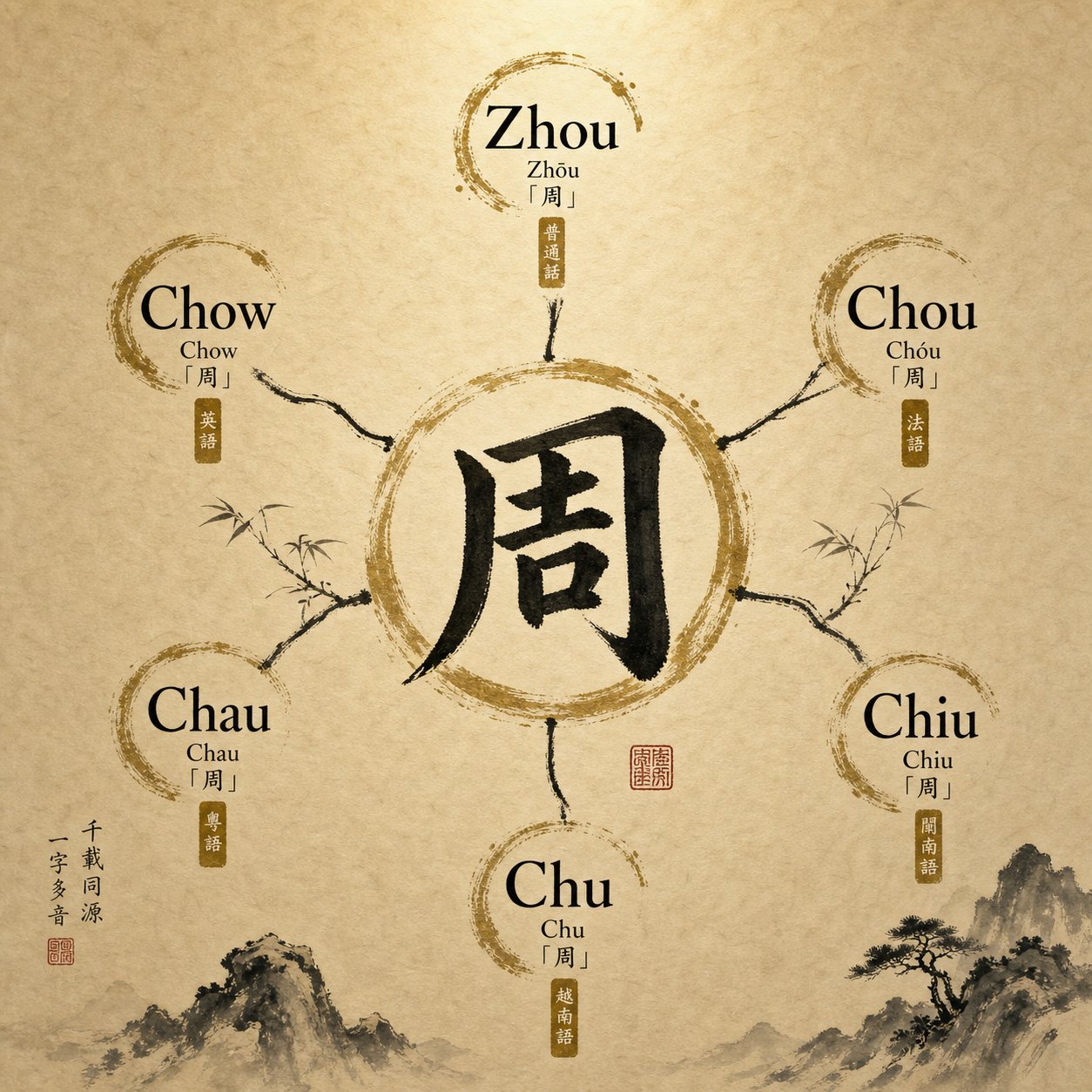
If you have ever wondered whether the Zhou surname and the Chow surname belong to the same family, the short answer is yes. Both spellings are romanizations of the same Chinese character: 周. The difference comes down to dialect pronunciation and the romanization system used when the name was first written in English letters.
Are Zhou and Chow Actually the Same Name
Zhou is the modern Mandarin Pinyin spelling. Chow is the traditional Cantonese romanization common in Hong Kong and among Cantonese-speaking diaspora communities. Same character, same ancestral origin, different sound systems. Think of it like the difference between "John" in English and "Juan" in Spanish — one name, two linguistic traditions.
Many people assume these are entirely separate families. They are not. A person named Zhou in mainland China and a person named Chow in Hong Kong may well share the same lineage tracing back to the royal house of the Zhou dynasty (1046-256 BCE).
Why So Many Spellings Exist for One Character
Here is where it gets interesting. Zhou and Chow are only two of the variants. The character 周 appears across passports, immigration records, and family documents as Chou, Chau, Chew, Chiu, Chu, and more — each reflecting a specific dialect or historical romanization convention.
Seven or more different English spellings can all trace back to a single Chinese character: 周. Different spelling does not mean different family.
What determines your spelling? Four key factors: whether your ancestors spoke Mandarin, Cantonese, Hokkien, or another dialect; which romanization system was in use at the time of immigration; colonial-era naming practices; and the country where your family settled. The Zhou last name ranks as the 10th most common surname in mainland China, shared by over 25 million people — and millions more carry the same character under a completely different English spelling.
Below, you will find a ranked breakdown of every major romanization variant of 周, where each one comes from geographically and linguistically, and how to determine which Chinese character your surname actually represents.
How We Evaluated and Ranked Each Spelling Variant
With seven or more romanizations floating around for a single character, you might wonder: is there a "correct" one? Not exactly. Each spelling is legitimate within its own linguistic and historical context. What we can do is rank them by practical usefulness — how likely you are to encounter each variant, how easily it connects you to genealogical records, and how widely it is recognized in official systems worldwide.
How We Ranked Each Romanization Variant
This is not a "best spelling" contest. A Chow family in Hong Kong has no reason to switch to Zhou, and a Chou family in Taiwan carries a perfectly valid romanization rooted in decades of academic convention. Instead, think of this ranking as a practical guide to understanding which variant of zhou in chinese documentation you are most likely to encounter and why it exists.
We evaluated each spelling against four criteria:
- Global prevalence — How many people worldwide currently use this spelling? Which variant appears most frequently in international databases, academic publications, and public records?
- Official recognition — Is this spelling produced by a government-endorsed romanization system? Is it used on passports, national ID cards, or in diplomatic contexts?
- Geographic reach — Does this variant appear across multiple countries and regions, or is it confined to a single community?
- Genealogical traceability — How easily can someone with this spelling connect to ancestral records, clan documents, and historical databases? Does the spelling unambiguously point to the character 周, or could it represent multiple characters?
That last criterion matters more than you might expect. Some romanizations map cleanly to a single Chinese character, making ancestry research straightforward. Others — like Chu or Chiu — can represent two or three completely different surnames, which complicates tracing your zhou chinese heritage considerably.
The Four Factors Behind Surname Spelling Differences
So what actually created this patchwork of spellings? Four forces shaped how 周 ended up written so many different ways in English.
Dialect pronunciation is the biggest driver. Mandarin, Cantonese, Hokkien, Teochew, and Hakka each pronounce 周 differently. The zhou meaning stays the same — the character still refers to the ancient Zhou royal lineage — but the sound changes dramatically depending on which dialect your ancestors spoke. Cantonese speakers say something close to "jau," Hokkien speakers produce something closer to "chiu" or "chu," and Mandarin speakers say "zhou."
Colonial-era naming conventions played an equally powerful role. British administrators in Hong Kong, Portuguese officials in Macau, and Dutch colonial officers in Indonesia each applied their own phonetic logic when transcribing Chinese names. A FamilySearch study on Chinese surnames notes that immigration officials unfamiliar with Chinese sounds would often guess how best to spell a migrant's name, producing inconsistent results even within the same family.
Immigration processing added another layer of variation. When families arrived at ports in San Francisco, Sydney, or London, the clerk recording their name might hear the same syllable differently than a clerk in another city. Some families ended up with anglicized spellings that drifted even further from any standard system — a cho last name origin story that many diaspora families share.
Pinyin standardization eventually brought order to the chaos, at least for Mandarin speakers. The Chinese Pinyin system was officially approved by China's National People's Congress in 1958 and became the international standard (ISO 7098) in 1982. After that point, mainland Chinese citizens overwhelmingly adopted Zhou as their official romanized spelling. But millions of families who emigrated before 1982 — or who speak dialects other than Mandarin — retained their earlier spellings.
Each variant in the sections ahead is examined through these four lenses. The goal is simple: help you understand where your specific spelling came from and how it connects to the broader 周 family tree.
Zhou in Pinyin – The Modern Global Standard
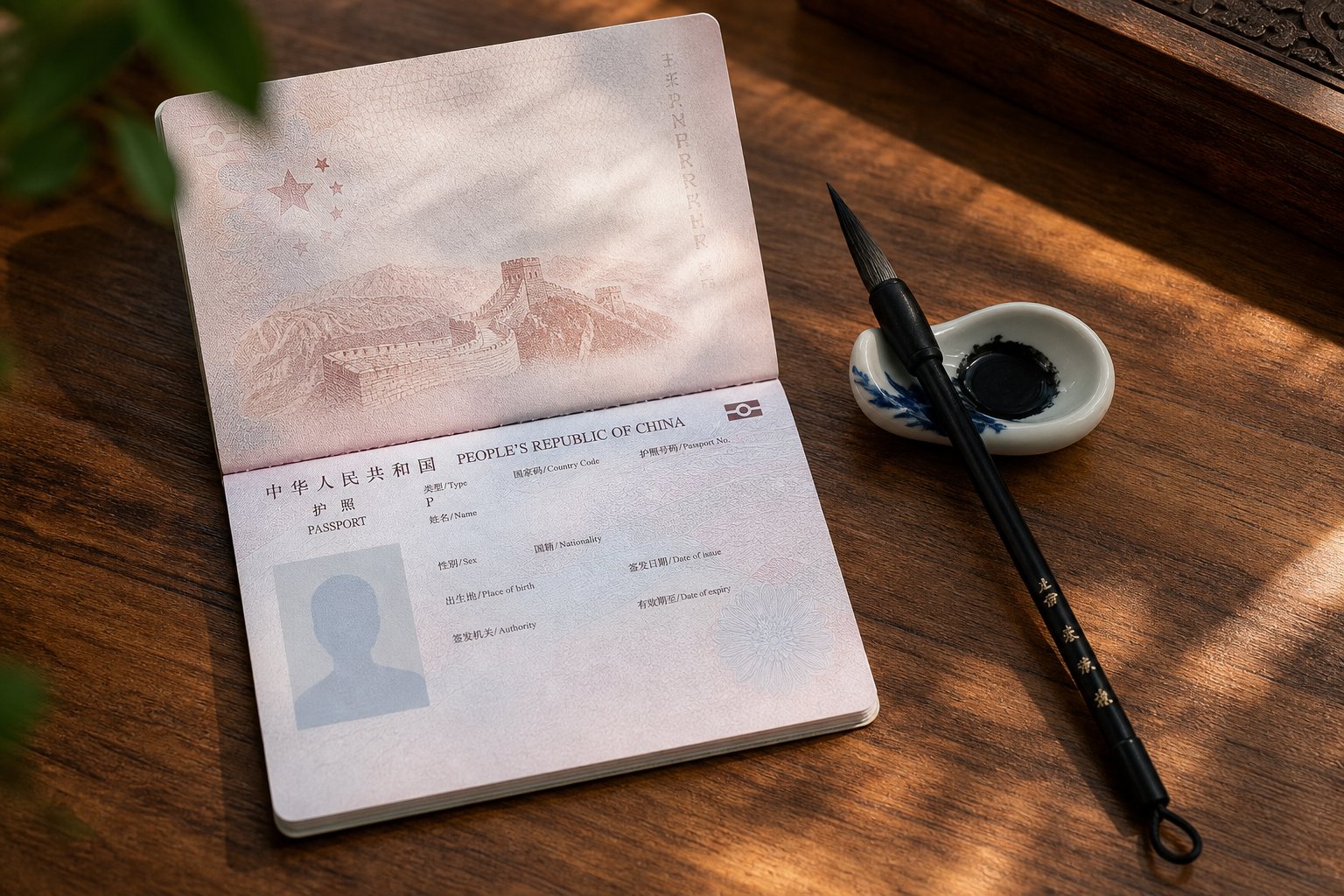
Of all the romanizations of 周, Zhou is the one you will encounter most often in international contexts today. It is the spelling produced by Hanyu Pinyin — the official romanization system for Standard Mandarin Chinese — and it dominates passports, academic journals, global databases, and diplomatic records. If you meet someone with the Zhou surname, there is a strong chance they or their family came from mainland China after the mid-20th century.
Zhou as the International Pinyin Standard
Pinyin was formally adopted by the People's Republic of China in 1958 and later became the international standard for romanizing Mandarin under ISO 7098 in 1982. Taiwan also officially adopted Hanyu Pinyin in 2009, though many Taiwanese families retain older spellings on personal documents. According to Taiwan's Ministry of Education guidelines, Hanyu Pinyin is the recommended system for romanization, though citizens may choose their own preferred spelling for personal names.
What this means practically: any mainland Chinese citizen born after Pinyin standardization almost universally carries the spelling Zhou on their passport and official documents. The system eliminated the guesswork that plagued earlier romanization methods. One character, one standardized spelling — at least for Mandarin speakers.
Zhou ranks as the 10th most common surname in mainland China, shared by approximately 25.2 million people as of 2013 census data. That makes it one of the most frequently encountered Chinese surnames in international settings, from university enrollment lists to corporate directories.
How to Pronounce Zhou Correctly
Here is where many English speakers stumble. How do you pronounce Zhou? It is not "zoo," not "zow" (rhyming with "cow"), and not "zoh." The zhou pronunciation sounds approximately like the English name "Joe" — but with a slightly retroflex initial consonant. Your tongue curls back just a touch at the start, producing a sound somewhere between "j" and "zh."
If someone asks you how to say Zhou in casual conversation, telling them "it sounds like Joe" gets them about 90% of the way there. The technical IPA transcription is [ʈʂóʊ], where that initial [ʈʂ] represents the retroflex affricate — a sound that does not exist in English but sits close to the "dr" in "drive" if you say it quickly.
A few practical tips for the pronunciation of Zhou:
- Start with your tongue curled slightly back, touching the roof of your mouth just behind the ridge
- Release into an "oh" sound that glides slightly toward "oo"
- The tone is first tone (high and flat) in Mandarin — Zhōu — meaning your pitch stays level and relatively high
- Avoid adding a "w" sound at the end; it is a smooth glide, not a sharp diphthong
You will notice that how do you pronounce Zhou is one of the most common questions people search for when encountering this surname. The confusion is understandable — English spelling conventions offer no intuitive guide for the "zh" combination.
The Zhou Dynasty Connection to the Surname
The surname 周 is not just any family name. It traces directly to one of the most significant dynasties in Chinese history. The Zhou dynasty (1046-256 BCE) was the longest-lasting dynasty in Chinese history, spanning nearly 800 years and laying the philosophical foundations — Confucianism, Daoism, Legalism — that shaped Chinese civilization for millennia.
So how did a dynasty become a surname? According to classical genealogical records, the royal house of Zhou originally carried the surname Ji (姬). After the Qin dynasty conquered Zhou in 256 BCE, descendants of King Ping of Zhou adopted the name 周 to honor their ancestral dynasty. Ji Yong, a descendant living in Runan (modern-day Henan province), changed his surname to Zhou to commemorate the merits and virtues of his forebears. Other descendants of the last Zhou emperor similarly took on the surname after the dynasty fell.
The zhou dynasty pronunciation in modern Mandarin is identical to the surname — both are "Zhōu" in first tone. This is not a coincidence; the surname literally means "of the Zhou dynasty" for many lineages. The character 周 itself carries meanings of "complete," "cycle," and "around," reflecting the dynasty's philosophical emphasis on cosmic order.
From Runan, the Zhou surname spread across China following a general pattern of west to east and north to south migration over centuries. Non-Han peoples also adopted the name — including the Xianbei nationality during the Northern Zhou period and Mongolian families during the Yuan dynasty — further expanding its reach.
Notable bearers of the Zhou spelling include Zhou Enlai (China's first Premier), Zhou Guanyu (Formula 1 driver), and Zhou Youguang (the linguist who helped develop the Pinyin system itself — a fitting connection).
Pros of the Zhou Spelling for Genealogy Research
- Unambiguous mapping — Zhou in Pinyin almost always represents the character 周, making database searches straightforward
- Largest pool of records — mainland China's digitized genealogical databases use Pinyin as the default romanization
- International recognition — libraries, academic institutions, and government systems worldwide index under Pinyin
- Consistent across documents — no variation between passport spelling, academic publications, and official records
Cons of the Zhou Spelling for Genealogy Research
- Relatively recent adoption — families who emigrated before the 1950s-1980s will not appear under "Zhou" in historical immigration records
- Does not reflect dialect heritage — a Cantonese-speaking family using Zhou on modern documents may have older records filed under Chow or Chau
- Rare character overlap — Zhōu can occasionally represent the uncommon characters 舟 (boat), 州 (prefecture), or 洲 (continent), though this is extremely rare as a surname
For anyone tracing ancestry through mainland Chinese records from the past few decades, Zhou is the most direct path. But families with roots in Hong Kong, Taiwan, or Southeast Asia will find their older documents filed under entirely different spellings — which is exactly where the Cantonese variant Chow enters the picture.

Chow in Cantonese – The Hong Kong Spelling
The Chow surname is the spelling most people associate with Hong Kong cinema, Cantonese restaurants, and the broader Cantonese-speaking diaspora. If Zhou is the modern international standard, Chow is its older, culturally rooted counterpart — a romanization born from Cantonese pronunciation and cemented by over a century of British colonial administration. The 2010 United States census recorded 17,059 people with the Chow family name, making it the 2,122nd most common surname in the country, with nearly 90% of bearers identifying as Asian.
Why Hong Kong Uses Chow Instead of Zhou
Imagine growing up in Hong Kong during the 1950s or 1960s. Your family speaks Cantonese at home, your school teaches in Cantonese, and the government — a British colonial administration — records your name using English phonetic conventions based on how you actually say it. Nobody is consulting a Mandarin-based romanization chart. The clerk at the registration office hears your surname in Cantonese and writes down what sounds closest in English letters.
This is exactly how the surname Chow became standard in Hong Kong. The city was never governed under PRC language policy. When mainland China adopted Pinyin in 1958 and made it the international standard in 1982, Hong Kong was still a British territory operating under its own systems. Cantonese — not Mandarin — was the language of daily life, government, and media. There was simply no institutional reason to switch to Pinyin.
Even after the 1997 handover, Hong Kong retained its own romanization conventions for personal names. Local identity, administrative continuity, and the practical reality that millions of documents already used Cantonese-based spellings made any wholesale change impractical. A person born in Hong Kong today can still register their surname as Chow on their HKSAR passport rather than adopting the Pinyin spelling Zhou.
The Cantonese Pronunciation Explained
So what does 周 actually sound like in Cantonese? In Jyutping (the standard Cantonese romanization system used by linguists), it is transcribed as zau1. In the older Cantonese Yale system, it appears as jau. The sound sits somewhere between English "joe" and "jow" — a rounded vowel with a glide that English speakers in the 19th century heard and transcribed as "Chow."
The chow pronunciation differs noticeably from the Mandarin "zhou." Where Mandarin uses a retroflex initial consonant (tongue curled back), Cantonese uses a flat alveolar sound closer to English "j" or "ts." The vowel is also more open and diphthongal — it glides from "a" toward "u" rather than sitting on a pure "oh" sound. English ears in colonial Hong Kong naturally reached for "ch" plus "ow" (as in "cow") to capture what they heard.
This phonetic gap explains why the two spellings look so different despite representing the same character. They are not arbitrary variations — they reflect genuinely different pronunciations of 周 in two distinct Chinese languages.
Warning – Chow Might Not Be 周 At All
Here is the critical complication that anyone researching the Chow last name needs to understand: not every person named Chow shares ancestry with Zhou families. In Cantonese, several completely different Chinese characters produce sounds that English speakers transcribed identically as "Chow."
The most common source of confusion involves the character 鄒 (Zou in Pinyin). In Cantonese, 鄒 is homophonous with 周 — both are pronounced zau1. This means a Chow family could descend from the ancient state of Zou rather than the Zhou dynasty. When researching zou meaning chinese name origins, you will find that 鄒 traces to a completely separate lineage rooted in the state of Zouyi during the Spring and Autumn period. Notable bearers of Chow whose actual character is 鄒 include film producer Raymond Chow (鄒文懷) and Canadian politician Olivia Chow (鄒至蕙).
The disambiguation challenge extends further. According to the Dictionary of American Family Names, Chow can also represent 曹 (Cao), 趙 (Zhao), 秋 (Qiu), 仇 (Qiu), and even 喬 (Qiao) depending on dialect and regional transcription conventions.
| Chinese Character | Pinyin | Meaning / Origin | How Common as "Chow" |
|---|---|---|---|
| 周 | Zhou | Zhou dynasty descendants | Most common |
| 鄒 | Zou | State of Zou lineage | Common (homophonous in Cantonese) |
| 曹 | Cao | Cao state / Three Kingdoms lineage | Occasional |
| 趙 | Zhao | Zhao state descendants | Rare |
| 秋 | Qiu | Autumn-related origin | Rare |
| 仇 | Qiu | Various origins | Rare |
The practical takeaway? If your surname is Chow and you are trying to connect with Zhou (周) families, you first need to confirm which character your family actually uses. Check older family documents, ancestral tablets, or ask relatives who can read Chinese. The zou meaning chinese name connection is a particularly common source of mistaken identity because the two characters are indistinguishable in Cantonese speech.
Pros of the Chow Spelling for Genealogy Research
- Strong connection to Hong Kong records — birth certificates, marriage records, and land documents from the colonial and post-colonial era use this spelling
- Well-represented in diaspora archives — immigration records in the US, UK, Canada, and Australia frequently list Cantonese-speaking families under Chow
- Cultural recognition — instantly signals Cantonese heritage, which narrows geographic and dialect origin
- Extensive notable bearer documentation — makes cross-referencing historical figures straightforward
Cons of the Chow Spelling for Genealogy Research
- Ambiguous character mapping — Chow can represent at least six different Chinese characters, requiring additional verification
- Not indexed in mainland Chinese databases — genealogical records from Guangdong province (ancestral homeland of most Cantonese speakers) now use Pinyin
- Potential confusion with the English surname Chow — which derives from Middle English "chowe" meaning jackdaw, an entirely unrelated origin
- Inconsistent across generations — younger Hong Kong residents may switch to Zhou for international documents while older records remain under Chow
The ambiguity built into the Chow spelling highlights a broader pattern: the further you move from Pinyin's one-to-one character mapping, the more detective work genealogy requires. This same challenge intensifies with older romanization systems — particularly the Wade-Giles spelling Chou, which dominated English-language texts for over a century before Pinyin existed.
Chou in Wade-Giles – The Historical Academic Spelling
Before Pinyin existed, before Zhou became the global default, there was Chou. For over a century, this was the standard English spelling of 周 in academic texts, diplomatic correspondence, and library catalogs worldwide. If you have ever read about the "Chou dynasty" in an older history book or encountered the name "Duke of Chou" in a philosophy text, you have already met this variant. The Chou last name remains common today among Taiwanese families and older diaspora communities whose documents predate Pinyin standardization.
Chou and the Wade-Giles Legacy
The spelling Chou comes directly from the Wade-Giles romanization system, developed in the mid-19th century by British diplomat Sir Thomas Francis Wade and later refined by Cambridge professor Herbert Allen Giles in his 1912 Chinese-English Dictionary. Wade-Giles became the preferred Chinese transliteration system among academics and nonspecialists in English-speaking countries for decades. It was also interpreted into Danish, Finnish, German, Italian, Norwegian, Spanish, Swedish, and Turkish — making it a truly international standard long before Pinyin arrived.
In the Wade-Giles conversion table, "chou" maps directly to the Pinyin "zhou." The system uses "ch" without an apostrophe to represent the unaspirated retroflex sound that Pinyin writes as "zh." So how to pronounce Chou? Exactly the same as Zhou — like the English name "Joe" with a slightly curled tongue at the start. The spelling looks different, but the intended sound is identical because both systems are romanizing the same Mandarin pronunciation.
This is a key point that confuses many people. Chou and Zhou are not different dialects or different pronunciations. They are two different systems writing down the exact same sound. Imagine two people transcribing the same spoken word using different spelling rules — that is precisely what happened here.
Wade-Giles had its quirks, though. The system relied heavily on apostrophes to distinguish aspirated from unaspirated consonants. "Chou" (no apostrophe) represents Pinyin "zhou," while "ch'ou" (with apostrophe) represents Pinyin "chou" — a completely different sound. Printers frequently dropped these apostrophes, creating confusion. As Britannica notes, the system contains like symbols representing different sounds, and different symbols expressing the same sound, making it confusing compared with more recent systems.
Why Taiwan Still Uses This Spelling
Mainland China officially replaced Wade-Giles with Pinyin in 1979. Taiwan did not. The island continued using a modified Wade-Giles-based system for personal names, and many Taiwanese families still spell their surname as Chou on passports and official documents.
Why the persistence? Taiwan was never governed under PRC language policy. While the Taiwanese government officially recommended Hanyu Pinyin for romanization around 2009, citizens retain the freedom to choose their own preferred spelling for personal names. Decades of institutional inertia, family tradition, and local identity keep Wade-Giles-derived spellings alive. A guide to Taiwanese name romanization illustrates this clearly: the Taiwanese pop star Zhou Ziyu (周子瑜) appears in English as "Chou Tzu-yu" — pure Wade-Giles convention.
In practice, Taiwanese romanization is not strict Wade-Giles either. It is a modified system that sits orthographically somewhere between Pinyin and Wade-Giles, with personal preferences and regional habits layered on top. You might encounter the same surname spelled Chou, Jou, or even Jhou depending on the individual's choice. But Chou remains the most historically established and widely recognized variant from Taiwan.
Connecting Chou Families to Zhou Ancestry
The Chou spelling carries particular significance for genealogy because it dominated English-language records during the peak era of Chinese emigration to the West. Families who immigrated to the United States, Canada, or Australia before the 1980s — regardless of their actual dialect background — often had their names recorded using Wade-Giles conventions. The NJ State Library's research guide on 19th-century Chinese immigrants confirms that the Wade-Giles system was widely used for transcribing Chinese names into official documentation, though not every record taker understood or consistently applied it.
This means a Cantonese-speaking family whose name "should" be Chow might appear as Chou in older American immigration records simply because the processing clerk used Wade-Giles. Similarly, references to the "Duke of Chou" (Duke Zhou, 周公) in classical texts and the "Chou dynasty" in older English-language histories all point to the same 周 character and the same ancestral lineage.
Pros of the Chou Spelling for Genealogy Research
- Direct connection to pre-1980s English-language records — immigration documents, academic texts, and library catalogs from this era index under Chou
- Unambiguous character mapping — like Zhou, Chou in Wade-Giles almost always represents 周 specifically
- Strong presence in Taiwanese records — birth certificates, household registration documents, and academic transcripts from Taiwan use this spelling
- Historical depth — connects to the oldest English-language scholarship on the Zhou dynasty of China, including foundational texts on Confucianism and Chinese philosophy
Cons of the Chou Spelling for Genealogy Research
- Declining international use — modern databases, academic journals, and government systems have largely switched to Pinyin
- Potential confusion with "ch'ou" — the aspirated Wade-Giles syllable representing a different Pinyin sound (chou), though this rarely causes surname-level confusion
- Not recognized by younger generations — people unfamiliar with Wade-Giles may not connect Chou to Zhou without explanation
- Limited to Mandarin-based records — does not appear in Cantonese or Hokkien community documents, which use their own dialect-based spellings
Chou occupies a unique middle ground: too old to be the modern standard, too Mandarin-specific to represent southern dialect communities, yet deeply embedded in a century of English-language scholarship and diaspora records. For families whose immigration story predates Pinyin — or whose roots run through Taiwan — it remains the spelling that unlocks the most historical doors. The further south you trace the dialect map, though, the more the spelling landscape shifts again, with variants like Chau emerging from entirely different colonial and linguistic traditions.
Chau – The Macau and Vietnamese Diaspora Variant
Chow is not the only English spelling that Cantonese speakers produced for 周. Travel a short distance from Hong Kong to Macau or trace migration routes into Vietnam, and the same Cantonese pronunciation gets written down differently: Chau. The sound is identical — Cantonese zau1 — but the hand holding the pen belonged to a different colonial tradition, and that made all the difference on paper.
Chau and Its Geographic Roots
The chau last name origin story begins with Portuguese Macau. While British administrators in Hong Kong heard zau1 and wrote "Chow," Portuguese officials in Macau applied their own phonetic logic. In Portuguese orthography, "au" naturally represents the diphthong sound in 周's Cantonese pronunciation — think of Portuguese words like "mau" or "pau." The result: families registered under Portuguese colonial systems ended up as Chau rather than Chow, despite speaking the same dialect and carrying the same character.
Vietnamese conventions reinforced this spelling through a parallel path. In Vietnam, the surname Chau (often written Châu with a circumflex in Vietnamese script) is the standard romanization for 周 among ethnic Chinese Vietnamese families. According to the Dictionary of American Family Names, Vietnamese Châu derives directly from the Chinese surname 周 (Zhou). Waves of ethnic Chinese emigration from Vietnam — particularly after 1975 — carried this spelling into diaspora communities across the United States, Australia, and France.
Regional distribution of the surname Chau reflects these colonial and migration patterns:
- Macau and Portugal — Portuguese-era registration documents and their descendants
- Vietnam — ethnic Chinese (Hoa) communities, especially in Ho Chi Minh City and the Mekong Delta
- United States — concentrated among Vietnamese-Chinese refugees; Ancestry records show Chau families appearing in US census data from 1840 onward, with the highest concentration in the 1920 census
- Australia and France — significant Vietnamese diaspora populations carrying this spelling
- Parts of Malaysia and Indonesia — where Portuguese linguistic influence historically overlapped with Cantonese-speaking communities
How Chau Connects to Chow and Zhou
If your surname is Chau, connecting to the broader 周 family network is straightforward in principle. The spelling represents the same Cantonese pronunciation as Chow, just filtered through a different European language's spelling rules. A Chau family from Macau and a Chow family from Hong Kong pronouncing their surname aloud would sound indistinguishable.
That said, the same disambiguation warning from the Chow section applies here. The Dictionary of American Family Names confirms that the surname Chau can also represent 鄒 (Zou), 巢 (Chao), 晁 (Chao), 趙 (Zhao), 招 (Zhao), 秋 (Qiu), 仇 (Qiu), and even 曹 (Cao) in its Hakka pronunciation. Verifying your actual Chinese character remains essential before assuming shared ancestry with Zhou (周) families.
Pros of the Chau Spelling for Genealogy Research
- Signals specific geographic origin — immediately narrows your search to Macau, Vietnam, or Portuguese-influenced communities
- Well-documented in Vietnamese refugee records — US, Australian, and French immigration archives from the 1970s-1990s contain extensive Chau entries
- Connects directly to Cantonese-language clan records through the same pronunciation as Chow
Cons of the Chau Spelling for Genealogy Research
- High character ambiguity — can represent even more characters than Chow due to overlapping Hakka and Mandarin variant readings
- Smaller global population than Chow or Zhou — fewer dedicated databases and community resources
- May be confused with unrelated Vietnamese surnames — not all Vietnamese families named Chau have Chinese ancestry
Macau and Vietnam represent just two stops on the southern dialect migration map. Push further into Hokkien, Teochew, and Hakka-speaking communities across Southeast Asia, and 周 transforms yet again — into spellings like Chu and Chiu that introduce an entirely new layer of complexity.

Chu and Chiu – Southern Dialect Romanizations
Hokkien, Teochew, and Hakka speakers pronounce 周 in ways that sound nothing like Mandarin "zhou" or Cantonese "jau." These southern Chinese dialects produce sounds closer to "chiu" or "chu" — and that is exactly how English-speaking clerks wrote them down. If your family carries the chu surname or the chiu surname and traces its roots to Taiwan, Malaysia, Singapore, or the Philippines, there is a real possibility your character is 周. But here is the catch: it might not be.
Chu and Chiu from Southern Dialects
In Hokkien (Min Nan), the character 周 is pronounced approximately chiu — transcribed in the Pe̍h-ōe-jī romanization system as "Chiu." The IPA notation is [tɕiu˦], a sound that starts with a palatal affricate (similar to English "ch") and glides into an "ee-oo" vowel combination. Teochew speakers produce a nearly identical sound. Hakka dialects, depending on the sub-variety, may render it closer to "Chew" or "Chu."
These pronunciations diverge sharply from both Mandarin and Cantonese because southern Chinese dialects preserved older phonological features that Mandarin lost over centuries. The initial consonant shifted, the vowel changed shape, and the result is a syllable that English speakers would never guess connects to "Zhou" or "Chow" without knowing the underlying character.
Geographic distribution tells the story clearly. The Chew Clan Jetty in Penang, Malaysia — a UNESCO World Heritage site — is named after Zhou (周) families from Tong'An, Xiamen, who spell their surname "Chew" following the regional Hokkien pronunciation. In the Philippines, Hokkien-speaking Chinese Filipino families commonly use Chu or Chiu. In Singapore and Malaysia, you will find both spellings alongside "Chew," depending on which sub-dialect the family speaks and which colonial administration recorded the name.
The chu last name origin in these communities is straightforward: a southern dialect pronunciation of 周, transcribed phonetically by English, Dutch, or Spanish colonial officials who had no standardized system to follow. The famous shoe designer Jimmy Choo (周仰傑), born in Penang, carries exactly this kind of Hokkien-derived romanization of 周.
The Disambiguation Challenge with Chu
Here is where the chu last name and chiu last name become genuinely tricky for genealogy. Unlike Zhou in Pinyin — which maps almost exclusively to 周 — the spellings Chu and Chiu can represent several completely different Chinese characters with unrelated ancestral origins.
The most common source of confusion with the Chu spelling:
- 朱 (Zhu in Pinyin) — the imperial surname of the Ming dynasty, one of China's most common family names. In Hokkien, 朱 is also pronounced "Chu," making it indistinguishable from 周 in romanized form.
- 褚 (Chu in Pinyin) — a less common surname with origins in the state of Song during the Spring and Autumn period. Its Mandarin pronunciation is already "Chu," and southern dialects produce similar sounds.
- 楚 (Chu in Pinyin) — derived from the ancient state of Chu, though rare as a modern surname.
The chiu surname faces a parallel problem. In Cantonese and Hakka romanization, Chiu can represent:
- 趙 (Zhao in Pinyin) — the zhao last name is one of the most prominent surnames in Chinese history, ranking first in the Hundred Family Surnames poem. In certain Cantonese and Hakka transcription systems, 趙 becomes "Chiu" — completely overlapping with the Hokkien romanization of 周. Anyone researching zhao chinese ancestry needs to be aware that "Chiu" in older records might point to this character rather than 周.
- 邱 (Qiu in Pinyin) — a common surname derived from the ancient state of Qi. Some Hokkien and Hakka transcriptions render 邱 as "Chiu" or "Khiu."
- 蕉 or 招 (Zhao/Jiao) — rare surnames that occasionally appear as "Chiu" in regional romanizations.
The last name Zhao (趙) is particularly important to flag because of its historical weight. Zhao chinese families descend from the royal house of the state of Zhao during the Warring States period — an entirely separate lineage from the Zhou dynasty. A person named Chiu whose actual character is 趙 has no ancestral connection whatsoever to Zhou (周) families, despite the identical English spelling.
| English Spelling | Possible Characters | Pinyin | Origin / Lineage | Dialect Context |
|---|---|---|---|---|
| Chu | 周 | Zhou | Zhou dynasty descendants | Hokkien, Hakka |
| Chu | 朱 | Zhu | Ming dynasty imperial surname | Hokkien, Hakka, Mandarin |
| Chu | 褚 | Chu | State of Song lineage | Mandarin, various |
| Chiu | 周 | Zhou | Zhou dynasty descendants | Hokkien, Teochew |
| Chiu | 趙 | Zhao | State of Zhao lineage | Cantonese, Hakka |
| Chiu | 邱 | Qiu | State of Qi lineage | Hokkien, Hakka |
How to Identify Your Actual Character
So you carry the Chu or Chiu spelling and want to know whether your family belongs to the 周 lineage. How do you find out? The romanized spelling alone cannot tell you — you need to look behind the English letters to the Chinese character itself.
Three key indicators will point you in the right direction:
- Family documents with Chinese characters — Ancestral tablets, clan association membership records, old letters, or any document where the surname appears in Chinese script. Even a single instance of the character 周 written by hand confirms your connection. If you see 朱 or 趙 instead, you have your answer — different lineage entirely.
- Ancestral village and province — Zhou (周) families trace their earliest roots to Runan (modern Henan province), with major branches spreading to Jiangsu, Zhejiang, Fujian, and Guangdong. Zhu (朱) families cluster heavily around Anhui and Jiangsu. Knowing your family's specific village of origin can narrow the possibilities significantly.
- Dialect background — If your family speaks Hokkien and comes from Fujian or Taiwan, both 周 (Chiu) and 朱 (Chu) are common. If your family speaks Hakka and the spelling is Chiu, the character could be 周, 趙, or 邱. The specific sub-dialect and geographic origin help disambiguate.
Clan associations in Southeast Asia can be particularly helpful here. The Chew (Zhou) Clan Jetty community in Penang, for example, maintains records specifically for 周 families from Tong'An. Similar associations exist in Singapore, Manila, and Jakarta — often organized by both surname character and ancestral village, which eliminates the romanization ambiguity entirely.
Pros of the Chu/Chiu Spelling for Genealogy Research
- Signals southern dialect heritage — immediately narrows your family's linguistic and geographic background to Hokkien, Teochew, or Hakka communities
- Strong presence in Southeast Asian records — Malaysian, Singaporean, Philippine, and Indonesian archives contain extensive documentation under these spellings
- Connects to active clan associations — southern dialect communities maintain some of the most organized genealogical networks in the Chinese diaspora
Cons of the Chu/Chiu Spelling for Genealogy Research
- High character ambiguity — Chu can represent at least three common surnames (周, 朱, 褚), and Chiu at least three (周, 趙, 邱)
- Requires additional verification before assuming Zhou (周) ancestry — the spelling alone is insufficient evidence
- Not indexed consistently across databases — different countries and eras used slightly different transcription conventions for the same sounds
- Confusion with Vietnamese "Chu" — in Vietnamese, Chu (朱) and Châu (周) are distinct, but English records may collapse them into a single spelling
The disambiguation challenge with Chu and Chiu underscores a pattern that runs through every variant we have examined: the further a romanization sits from Pinyin's one-to-one mapping, the more characters it could potentially represent. With all the major variants now laid out individually, the natural next step is seeing them side by side — a single reference that maps every spelling to its dialect, system, region, and level of character certainty.
All Zhou and Chow Variants Compared Side by Side
You have seen each spelling examined individually — its dialect roots, geographic home, and genealogical strengths and weaknesses. But when you are staring at a family document or trying to figure out whether a distant relative with a different spelling actually shares your lineage, you need everything in one place. This section consolidates every major romanization of 周 into a single reference designed to answer the question quickly: does this spelling connect to my family?
Complete Variant Comparison at a Glance
The table below maps each romanization to its source dialect, the system that produced it, where you are most likely to encounter it, and — critically — how confident you can be that it represents the character 周 rather than a different surname entirely.
| Spelling | Dialect | Romanization System | Primary Region | Character Certainty for 周 |
|---|---|---|---|---|
| Zhou | Mandarin | Hanyu Pinyin | Mainland China, international | Very high — almost always 周 |
| Chow | Cantonese | Hong Kong Government | Hong Kong, Cantonese diaspora | Moderate — can also be 鄒, 曹, or 趙 |
| Chou | Mandarin | Wade-Giles | Taiwan, pre-1980s diaspora records | High — nearly always 周 in Wade-Giles context |
| Chau | Cantonese | Portuguese / Vietnamese convention | Macau, Vietnam, Portuguese-influenced areas | Moderate — can represent 鄒, 趙, 巢, or others |
| Chew | Hokkien / Teochew | Local phonetic transcription | Singapore, Malaysia, Penang | Moderate-high — usually 周 in Hokkien context, but verify |
| Chiu | Hokkien / Teochew | Local phonetic transcription | Taiwan, Philippines, Southeast Asia | Low-moderate — can be 趙, 邱, or 周 |
| Chu | Hakka / Hokkien | Local phonetic transcription | Malaysia, Singapore, Philippines | Low — commonly represents 朱 or 褚 as well as 周 |
A few patterns jump out immediately. The last name Zhou in Pinyin offers the cleanest one-to-one mapping — if you see Zhou, it is almost certainly 周. The last name Chow sits in the middle: usually 周, but with enough ambiguity to warrant checking. Spellings like Chu and Chiu carry the highest uncertainty because multiple common surnames collapse into the same English letters.
Notice that the zhu last name (朱) creates the biggest confusion with Chu, while the zhao surname (趙) overlaps most with Chiu. These are not obscure edge cases — 朱 and 趙 are both top-ten Chinese surnames, meaning millions of people carry spellings that look identical to 周 variants in English.
Which Spellings Definitely Share Ancestry
So when can you confidently say two people with different spellings belong to the same 周 family? And when do you need to dig deeper?
Safe to assume shared ancestry (once character is confirmed as 周):
- Zhou and Chou — same Mandarin pronunciation, different romanization systems, same character
- Chow and Chau — same Cantonese pronunciation, different colonial transcription conventions, same character
- Chew and Chiu — same Hokkien/Teochew pronunciation, minor spelling variation, same character
- Any combination across the table — if both families can confirm their character is 周, they share the same ancestral surname regardless of spelling
Requires verification before assuming connection:
- Any Chow or Chau family that has not confirmed their character — could be 鄒 (Zou) instead of 周
- Any Chu family — the chu family name could represent 朱 (Zhu), 褚 (Chu), or 周 (Zhou)
- Any Chiu family — could be 趙 (Zhao), 邱 (Qiu), or 周 (Zhou)
- Families with anglicized or modified spellings (Joe, Jow, Jou) — these informal adaptations need character confirmation
Different English spellings do not mean different families. The same English spelling does not guarantee the same family. The Chinese character is the only reliable anchor for shared ancestry.
This is the core insight that the entire comparison comes down to. A Zhou family in Beijing and a Chew family in Penang whose ancestral tablets both show 周 are the same clan — separated by dialect and geography, but united by character and lineage. Meanwhile, two families both spelled Chow living on the same street in Vancouver might descend from entirely different ancestors if one carries 周 and the other carries 鄒.
The practical question, then, is not which spelling is "correct" but how to bridge these variants when tracing your family across borders and generations.
How to Connect Your Family Across Romanization Variants
Knowing that Zhou, Chow, Chou, Chau, and Chiu can all represent the same character is one thing. Actually bridging those spellings to reconnect with relatives or trace your zhou last name origin back to a specific village — that is the real work. Many diaspora families have been separated not just by oceans but by the accident of which clerk wrote down their name and which system that clerk happened to use.
The good news: the tools and methods for cross-romanization research are more accessible than ever. Here is how to start.
Steps to Trace Your Surname Across Spellings
Whether you are investigating a chow last name origin, a chiu last name origin, or any other variant, the process follows the same core logic — work backward from English letters to the Chinese character, then forward from the character to ancestral records.
- Search your home for documents with Chinese characters. Old letters, immigration certificates, ancestral tablets, tombstone photographs, even red envelopes from weddings — anything where the surname appears in Chinese script. A single confirmed instance of 周 written by hand settles the question permanently. As Legacy Tree Genealogists notes, all Chinese genealogy research starts with finding your ancestor's name in Chinese characters.
- Consult older relatives about dialect and ancestral village. Ask specifically: what dialect did the family speak at home? Which village or county did the family come from? Even vague answers like "somewhere near Canton" or "a village in Fujian" narrow the possibilities dramatically. Interview elderly relatives before these memories are lost — even fragments help.
- Identify which dialect your ancestor spoke. Historical immigration patterns offer clues when family memory runs thin. Most Californian Chinese came from the Siyi (Four Counties) region of Guangdong and spoke Taishanese or Cantonese. Most Filipino Chinese came from Quanzhou and Xiamen in Fujian and spoke Hokkien. Knowing the destination country and era of immigration often points to a specific dialect community.
- Cross-reference romanization variants in genealogical databases. Search under every plausible spelling of your surname. A family filed as "Chow" in 1920s San Francisco immigration records might appear as "Zhou" in modern mainland Chinese databases and "Chou" in older academic references. Tools like VillageDB (villagedb.friendsofroots.org) let you filter by surname character and county, bypassing romanization confusion entirely.
- Request official immigration files. In the United States, Chinese Exclusion Act case files held at NARA (National Archives) often contain detailed interrogation transcripts with village names, family descriptions, and sometimes hand-drawn maps. These files exist for nearly every Chinese person who entered the US between 1882 and 1943 — and they frequently record both the romanized name and the Chinese characters.
- Contact clan associations. Chinese clan associations organized by surname character — not English spelling — maintained membership records that cut across romanization variants. A 周 clan association in San Francisco, Penang, or Sydney may have records connecting Chow, Chew, Chiu, and Zhou families who all trace back to the same ancestral village.
When Different Spellings Still Mean Shared Family
Here is something that catches many people off guard: your own extended family might use three different spellings. Imagine a 周 family from Guangdong whose members emigrated to different countries across different decades. The branch that went to Hong Kong in the 1940s became Chow. A cousin who moved to Macau became Chau. Their grandchildren who relocated to mainland China for work now use Zhou on international documents. Same family, same character, same village — three spellings.
This is not hypothetical. It is the lived reality of millions of Chinese diaspora families. Understanding the last name Chow origin or any variant's origin is ultimately about understanding that romanization is a surface layer. The character beneath it — and the village, dialect, and lineage it connects to — is what defines shared ancestry.
Conversely, two families with identical English spellings may have no connection at all. Two Chu families living in the same city could descend from 周 (Zhou) and 朱 (Zhu) respectively — completely separate lineages that happen to sound alike in Hokkien.
Resources for Cross-Romanization Genealogy Research
A few starting points that handle the multi-spelling challenge well:
| Resource | What It Offers | Best For |
|---|---|---|
| VillageDB (friendsofroots.org) | 4,000+ villages searchable by surname character | Confirming ancestral village once you know your character |
| NARA Chinese Heritage Guide | Access to Chinese Exclusion Act case files | US immigration records with village-level detail |
| Wikipedia's List of Common Chinese Surnames | Romanization variants mapped to characters across dialects | Identifying which character your spelling might represent |
| Local Chinese clan associations | Membership records organized by character, not spelling | Connecting with families across romanization variants |
| Ancestry.com / FamilySearch | Indexed immigration records, CEA files | Searching under multiple spelling variants simultaneously |
The spelling on your passport or birth certificate is not a wall — it is a starting point. Whether your family carries Zhou, Chow, Chou, Chau, Chew, Chiu, or Chu, the path back to shared ancestry runs through the same character: 周. Find that character in your family's records, confirm it, and the romanization differences dissolve into what they always were — different ways of writing down the same sound, spoken by the same family, scattered across the same diaspora.
Frequently Asked Questions About Zhou and Chow Surnames
1. Are Zhou and Chow the same last name?
Yes, Zhou and Chow both represent the Chinese character 周. Zhou is the Mandarin Pinyin romanization used in mainland China and international contexts, while Chow is the Cantonese romanization common in Hong Kong and among Cantonese-speaking communities worldwide. The two spellings reflect different dialect pronunciations of the same ancestral surname tracing back to the Zhou dynasty (1046-256 BCE).
2. How do you pronounce the surname Zhou?
Zhou is pronounced approximately like the English name 'Joe' with a slightly retroflex initial consonant, where the tongue curls back just behind the ridge of the mouth before releasing into an 'oh' sound. It does not rhyme with 'zoo' or 'cow.' The tone in Mandarin is first tone, meaning the pitch stays high and level throughout the syllable.
3. How many different spellings exist for the Chinese surname 周?
The character 周 has at least seven common English spellings: Zhou (Pinyin), Chow (Cantonese/Hong Kong), Chou (Wade-Giles/Taiwan), Chau (Macau/Vietnamese), Chew (Hokkien/Malaysia), Chiu (Hokkien/Teochew), and Chu (Hakka/Southern dialects). Each reflects a specific dialect pronunciation, romanization system, or colonial-era transcription convention rather than a different family origin.
4. Does the surname Chow always mean the same as Zhou?
Not necessarily. While Chow most commonly represents 周 (Zhou), it can also represent other Chinese characters including 鄒 (Zou), 曹 (Cao), and 趙 (Zhao) because these characters sound similar in Cantonese. To confirm whether a Chow family shares ancestry with Zhou families, you need to verify the actual Chinese character through family documents, ancestral tablets, or older relatives who can read Chinese.
5. How can I find out which Chinese character my surname represents?
Start by searching for family documents containing Chinese characters, such as ancestral tablets, old letters, immigration certificates, or tombstone inscriptions. Consult older relatives about your family's dialect and ancestral village. You can also contact Chinese clan associations organized by surname character, check immigration case files at national archives, or use genealogical databases like VillageDB that allow searching by character rather than romanized spelling.