The Chinese Characters for Universe Reveal an Ancient Space-Time Theory
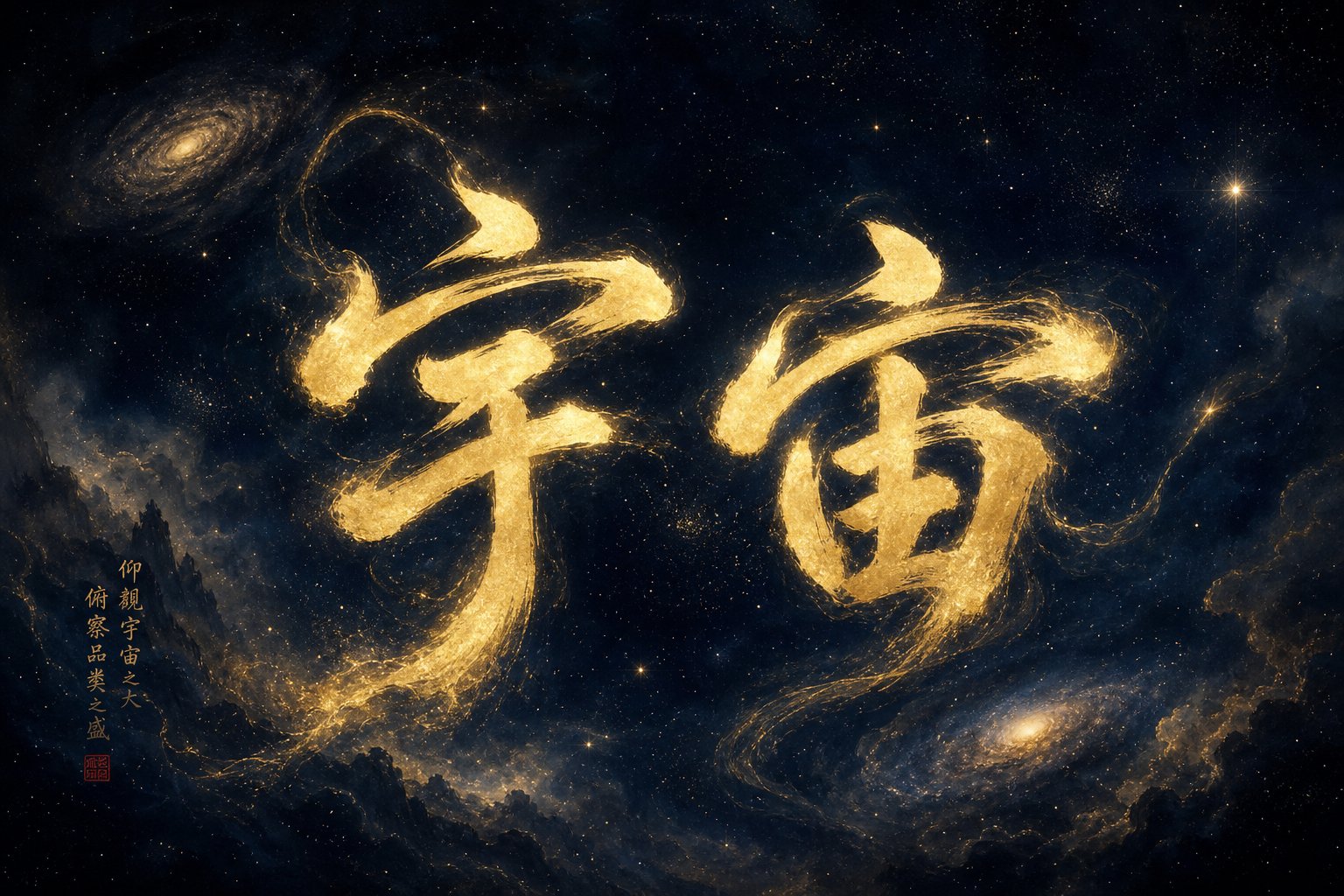
How do you say universe in Mandarin? The Chinese word is 宇宙 (yǔzhòu), and it carries a meaning far richer than a simple translation suggests. Where English gives us one word for everything that exists, the Chinese character for universe splits reality into two fundamental dimensions and names them separately: 宇 for space, 宙 for time.
What Does Universe Mean in Chinese Characters
The Chinese word for universe explained in its simplest form comes down to this: 宇宙 (yǔzhòu) is a compound of two characters, each representing one half of existence. Together, they define the totality of reality not as a single unified thing, but as the marriage of where and when.
宇 (yǔ) = boundless space extending in all directions. 宙 (zhòu) = the infinite stretch of time, past and future.
This definition traces back over two thousand years to classical Chinese philosophy, where thinkers articulated a vision of the cosmos that modern readers might find strikingly familiar.
Why 宇宙 Encodes Space and Time
Consider the Western etymology by comparison. The English word "universe" descends from Latin universum, which etymologically means "turned into one" — from unus (one) plus vertere (to turn). The Latin root emphasizes totality, oneness, everything folded together into a single whole.
Chinese takes the opposite approach. Rather than collapsing everything into unity, 宇宙 preserves a duality. It says: the universe is not just one thing. It is space and time, woven together but distinct. You'll notice this mirrors a pattern deeply embedded in Chinese thought — the comfort with complementary pairs, with two forces that define each other rather than dissolving into one.
This isn't a minor linguistic curiosity. The 宇宙 meaning in English might be rendered simply as "universe" or "cosmos," but the characters themselves encode a philosophical claim about the structure of reality. Space alone is not the universe. Time alone is not the universe. Only their union is.
What makes this even more remarkable is the age of the idea. The characters carry definitions formalized in texts written around 139 BCE — meaning Chinese thinkers were framing existence as a space-time continuum more than two millennia before that concept entered Western physics. The philosophy embedded in these two characters runs deep, and each one deserves a closer look.
Understanding 宇 as Boundless Space in Every Direction
The first half of the Chinese character for universe tells a story all on its own. 宇 (yǔ) is the spatial dimension — the character that captures every direction you could point, every distance you could travel, every corner of existence that occupies physical extension. But how does a single character manage to hold all of space within six brushstrokes?
Breaking Down 宇 — The Character for Space
Imagine a roof stretching over everything beneath it. That's the visual logic at the heart of 宇. The character is a phonosemantic compound built from two components stacked vertically: a meaning element on top and a sound element below.
| Component | Pinyin | Individual Meaning | Role in 宇 |
|---|---|---|---|
| 宀 | mián | Roof, shelter, canopy | Meaning component — suggests a structure covering what lies beneath |
| 于 | yú | At, in, to (a location) | Sound component — provides the pronunciation (yǔ) |
| 宇 | yǔ | House, eaves, space, universe | Combined meaning: all space sheltered under the cosmic canopy |
The roof radical 宀 (mián) appears across dozens of Chinese characters related to shelter, dwelling, and enclosure — words like 家 (jiā, home), 室 (shì, room), and 宫 (gōng, palace). In each case, it signals something contained beneath a protective structure. When placed atop 于, which carries a sense of location and spatial reference, the result is a character whose original meaning was simply "eaves" or "house." The ancient dictionary Shuowen Jiezi defines it plainly: 宇,屋邊也 — "宇 means the edge of a roof."
Sounds modest, right? A roof edge hardly seems cosmic. But here's where the meaning expands. Chinese thinkers took that image of a sheltering canopy and stretched it outward — past the eaves of any single building, past the horizon, past the sky itself — until 宇 came to represent all physical space in every direction. The roof became the vault of heaven, and everything beneath it became the universe's spatial dimension.
How 宇 Evolved from Seal Script to Modern Form
The visual history of 宇 traces a path from pictographic concreteness toward abstract simplicity. In its earliest recorded form — Bronze script from the Mid Western Zhou period, around 900 BCE — the character shows a more pictographic roof shape, with the shelter element rendered as a recognizable peaked structure hovering over the phonetic component below. The proportions are looser, the strokes more organic.
By the time of Seal script, preserved in the Shuowen dictionary compiled around 100 AD, the character had become more regularized. The roof element settled into a standardized form with cleaner curves, and the lower component 于 became more distinct as a separate unit. The overall shape grew taller and more symmetrical, reflecting the formalization of Chinese writing during the Qin and Han dynasties.
The shift to Clerical script during the Eastern Han dynasty (25–220 AD) brought the most dramatic visual change. Curved strokes flattened into angular ones. The flowing roof became the crisp, angular 宀 we recognize today — three strokes suggesting a peaked shelter. The phonetic element 于 likewise simplified into its modern rectangular form. From this point forward, the character's structure remained essentially stable through Regular script and into the modern form used today.
Six strokes. That's all it takes to write 宇 in its modern form — a character that began as a picture of a rooftop and grew to contain the entirety of physical space.
The Huainanzi Definition of Space
The philosophical weight of 宇 crystallized in the Huainanzi (淮南子), a text compiled around 139 BCE under the patronage of Liu An, King of Huainan. In its chapter on equalizing customs (齊俗訓), the text delivers a definition that has echoed through Chinese thought for over two thousand years:
四方上下謂之宇 — "The four directions plus up and down: this is called 宇."
Four cardinal directions — east, west, south, north — plus the vertical axis of up and down. Six directions total, covering every possible spatial orientation from any given point. The Huainanzi doesn't describe 宇 as a place or a container. It defines it as directionality itself — the pure fact that extension exists in all dimensions simultaneously.
This definition transforms the humble roof radical into something profound. The 宀 atop the character is no longer just a house's eaves. It becomes the cosmic canopy under which all spatial reality unfolds. And that same radical sits atop 宙 as well — the character for time — binding both dimensions under one shared shelter. That structural parallel is no accident, and it points directly to how Chinese script encodes the temporal half of the universe.
Understanding 宙 as the Endless Flow of Time
The cosmic canopy shelters more than space. Beneath that same roof radical sits 宙 (zhòu) — the Chinese character for time explained not as a clock ticking forward, but as the entire continuum of past flowing into future. If 宇 captures where, then 宙 captures when. Together they complete the universe, but 宙 on its own tells a fascinating story about how ancient Chinese thinkers visualized temporal infinity.
Breaking Down 宙 — The Character for Time
Like its spatial twin, 宙 is a phonosemantic compound — one component carries meaning, the other provides pronunciation. The structure stacks vertically: a semantic element on top, a phonetic element below.
| Component | Pinyin | Individual Meaning | Role in 宙 |
|---|---|---|---|
| 宀 | mian | Roof, shelter, canopy | Meaning component — the cosmic canopy covering all of time |
| 由 | you | From, through, cause, passage | Sound component — provides the pronunciation (zhou) and suggests movement through |
| 宙 | zhou | Time as concept, eternity, eon | Combined meaning: the passage of all time beneath the cosmic shelter |
The phonetic element 由 (you) officially serves as the sound indicator, but its semantic resonance is hard to ignore. 由 carries meanings of "from," "through," and "cause" — words that imply passage, origin, and movement from one state to another. Picture something passing through a gateway, one moment becoming the next. Under the cosmic canopy of 宀, that passage becomes time itself: the endless transit from what was to what will be.
The ancient dictionary Shuowen Jiezi offers a more concrete original definition: "宙,舟輿所極覆也" — roughly, "宙 is the farthest extent that boats and carriages can reach under cover." In other words, the original sense involved the limits of a sheltered journey. From there, the meaning expanded outward — just as 宇 grew from "eaves" to "all space" — until 宙 came to represent the farthest extent of temporal journey: eternity in both directions.
The Evolution of 宙 Through Chinese Script History
The visual history of 宙 stretches back further than many readers might expect. Oracle bone script examples dating to approximately 1250-1000 BCE show the character already present in the earliest Chinese writing system, with a recognizable roof form sheltering a more pictographic version of the lower element.
By the Seal script period, preserved in the Shuowen dictionary compiled around 100 AD, the character had taken on a more formalized appearance. The roof element became a smooth, curved canopy, and 由 beneath it settled into a rounded rectangular shape — a field or enclosure with a vertical line passing through it, visually reinforcing that sense of movement through a bounded space.
The transition to Clerical script during the Eastern Han dynasty (25-220 AD) flattened those curves into the angular strokes familiar to modern readers. The flowing roof became the crisp three-stroke 宀, and 由 resolved into its current form: a rectangle bisected by a vertical stroke, with a short line extending below. Eight strokes total in the modern Regular script — two more than 宇, as if time needed just slightly more ink to express.
The Classical Definition That Made 宙 Cosmic
The moment 宙 transcended its humble origins and became a term for infinite time can be traced to classical Chinese philosophy. The definition appears in texts including the Shizi (尸子), attributed to the philosopher Shi Jiao around 330 BCE, and later in the Huainanzi (淮南子, circa 139 BCE):
往古來今曰宙 — "From the ancient past to the arriving present: this is called 宙."
Feel the sweep of that definition. It doesn't describe time as a point or a moment. It describes time as a direction — two directions, actually. 往古 means "going toward the ancient," reaching backward into the deep past. 來今 means "arriving at the present," stretching forward into what comes next. 宙 is the entire river, not any single drop within it.
And here's the structural poetry that makes the Chinese character for time so elegant: both 宇 and 宙 share the same roof radical 宀. Space and time, sheltered under one canopy. Visually, the writing system itself declares that these two dimensions belong together — twin aspects of a single cosmic architecture. Swap the lower component and you shift from spatial infinity to temporal infinity, but the overarching structure remains unified.
This shared radical is not a coincidence of linguistic evolution. It reflects a deliberate conceptual pairing embedded in the script: wherever you look in the universe, you find space and time inseparable, covered by the same sheltering principle. The philosophers who formalized these definitions understood something profound about the structure of existence — and the texts where those definitions first appeared reveal just how deep that understanding ran.
Philosophical Origins in Ancient Chinese Texts
The definitions of 宇 and 宙 didn't emerge in isolation. They crystallized within a broader intellectual tradition — one where Daoist cosmology shaped how thinkers understood the structure of reality itself. To trace the origin of 宇宙 in classical texts is to step into a world where philosophy, cosmology, and language were inseparable pursuits.
Classical Roots of 宇宙 in the Huainanzi and Zhuangzi
The earliest known use of 宇宙 as a unified concept appears in the Zhuangzi (莊子), the foundational Daoist text attributed to the philosopher Zhuang Zhou around the 4th century BCE. In its chapter "Knowing Wandered North" (知北遊), the text explores the nature of existence beyond sensory perception — asking what lies outside the boundaries of the knowable world. Here, 宇宙 surfaces as a term for the totality that contains all things and all moments, a boundless context within which the Dao operates.
The Zhuangzi concept of universe is characteristically elusive. Rather than pinning down rigid definitions, Zhuangzi uses 宇宙 to gesture at what cannot be fully grasped — the infinite backdrop against which all transformation unfolds. Time and space are not separate topics of inquiry for Zhuangzi. They are the medium through which the Dao flows, and 宇宙 names that medium.
But it was the Huainanzi (淮南子), compiled around 139 BCE under the patronage of Liu An, King of Huainan, that delivered the most systematic definition. This encyclopedic text drew on Daoist, Confucian, and Legalist thought to create a comprehensive cosmological framework. In its chapter on equalizing customs (齊俗訓), the Huainanzi presents both halves of the universe in a single, crystalline passage:
四方上下謂之宇,往古來今謂之宙 — "The four directions plus up and down: this is called 宇. From the ancient past to the arriving present: this is called 宙."
Two sentences. Fourteen characters in the original Chinese. And within them, a complete cosmological framework: space defined as six-directional extension, time defined as bidirectional flow, and both unified under the single term 宇宙. This Huainanzi universe definition became the authoritative statement on ancient Chinese spacetime philosophy for the next two thousand years.
How Daoist Philosophy Shaped the Chinese Concept of Universe
Why did this definition emerge from Daoist cosmology specifically? Consider what Daoism emphasizes: the interplay of complementary forces, the rejection of rigid boundaries, and the understanding that reality operates through dynamic pairs rather than static absolutes. Yin and yang. Stillness and motion. Being and non-being.
Space and time fit naturally into this framework. They are not separate substances in Daoist thinking — they are complementary dimensions of a single unfolding reality. The Dao itself is described in the Daodejing as existing before heaven and earth, operating silently through all space and all time. When Daoist thinkers needed a word for "everything that exists," they reached for a compound that preserved this complementary structure rather than collapsing it into a single undifferentiated whole.
Here's what makes this remarkable from a modern perspective. In 1905, Albert Einstein's theory of special relativity formally unified space and time into a single four-dimensional continuum — spacetime. This was considered a revolutionary insight in Western physics, overturning centuries of Newtonian thinking that treated space and time as independent, absolute frameworks.
Chinese thinkers arrived at a structurally similar insight more than two millennia earlier. This is not to claim scientific equivalence — the Huainanzi was philosophy, not physics, and it made no mathematical predictions about the behavior of light or gravity. But the philosophical sophistication is undeniable. The very vocabulary of everyday Mandarin encodes an understanding that space and time are not separate categories but twin dimensions of a single reality. Every time a Chinese speaker says 宇宙, they invoke a conceptual framework that Western science took until the 20th century to formalize.
That gap — between ancient philosophical intuition and modern scientific formalization — raises a deeper question. If the Chinese and Western traditions both arrived at a space-time unity, they did so through radically different paths and with radically different emphases. Those differences reveal something fascinating about how language itself shapes our understanding of the cosmos.
How Chinese and Western Languages Conceptualize the Universe Differently
The paths diverge right at the root. When Latin speakers coined universum and Chinese thinkers paired 宇 with 宙, they weren't just naming the same thing in different sounds. They were encoding fundamentally different assumptions about what "everything" actually is. Comparative linguistics reveals that the Chinese vs Western concept of universe reflects two distinct philosophical temperaments — and those temperaments still shape how each culture approaches reality.
Chinese 宇宙 Versus Latin Universum
Start with the Western side. The English word "universe" descends from Latin universum, which Merriam-Webster traces to universus, meaning "entire" or "whole" — literally "turned into one," from uni- (one) plus versus (turned toward, from vertere, to turn). The etymological image is vivid: everything in existence rotated, folded, compressed into a single unity. Multiplicity dissolved into oneness.
The Chinese term works in the opposite direction. Rather than collapsing plurality into a singular whole, 宇宙 preserves a structural duality. It says the universe is composed of two irreducible dimensions — spatial extension and temporal flow — and names each one explicitly. Nothing gets folded together. Nothing gets "turned into one." The two halves remain visible, distinct, and complementary.
This isn't a trivial difference in word construction. It reflects a deep divergence in how each tradition answers the question: what is the most fundamental way to describe totality?
| Feature | Chinese 宇宙 (yǔzhòu) | Western Universe (universum) |
|---|---|---|
| Etymology | Compound of two characters: 宇 (space) + 宙 (time) | Latin uni- (one) + versus (turned toward) |
| Root Meaning | "Space and time together" | "Turned into one" / "the whole" |
| Conceptual Emphasis | Duality — two complementary dimensions | Unity — totality collapsed into oneness |
| Structural Logic | Preserves internal distinction (space ≠ time) | Erases internal distinction (all = one) |
| Philosophical Tradition | Daoist complementarity (yin-yang pairs) | Greek-Christian monism (single absolute) |
| First Systematic Use | Huainanzi, circa 139 BCE | Latin texts, classical period |
What Etymology Reveals About Cultural Worldviews
Why does this matter beyond linguistics? Because the words a culture uses to name its largest concepts tend to mirror the logic it applies everywhere else.
Western intellectual history gravitates toward unified absolutes. One God. One truth. One universal law. From Plato's Forms to monotheism to Newton's universal gravitation, the Western tradition repeatedly seeks a single principle that explains everything. The Latin universum — "turned into one" — is a perfect linguistic expression of that impulse. Even the cultural differences in universe meaning point back to this: the West wants a master key, a theory of everything, a final unity beneath apparent diversity.
Chinese intellectual history is more comfortable with complementary pairs that never fully merge. Yin and yang. Heaven and earth. Stillness and motion. Hard and soft. These aren't opposites waiting to be resolved into synthesis — they're permanent partners whose interaction generates reality. As Alberto Castelli's comparative study observes, while Western thinking considers change within a unique linear process, Eastern thinking conceives change within a process that holds together repetition and transformation — a dialectic of opposition without synthesis, yet guaranteeing the balance of the universe.
The yin-yang complementary worldview shows up directly in how Chinese names the cosmos. 宇宙 doesn't seek to resolve space and time into something higher or more unified. It lets them stand side by side, each with its own character, its own radical structure, its own definition — yet bound together under one shared canopy (宀). The relationship is partnership, not absorption.
You'll notice this pattern extends beyond cosmology. Chinese medicine pairs 气 (qi, vital energy) with 血 (blood). Chinese geography pairs 山 (mountain) with 水 (water). Chinese governance pairs 文 (civil) with 武 (martial). In each case, the pair is the fundamental unit of meaning — not either element alone, and not some higher unity that dissolves both. The universe itself, in Chinese, follows this same grammar of complementary duality.
What's striking is that both etymologies — the Latin and the Chinese — arrive at a functional concept of "everything that exists." They just get there through opposite logical moves. The West turns many into one. China holds two together as two. And both approaches, remarkably, have proven productive for understanding reality. Einstein's spacetime unified space and time mathematically, vindicating the Western instinct for unity. But the Chinese formulation had already named those two dimensions separately, vindicating the Eastern instinct for preserving meaningful distinctions within the whole.
This cross-cultural lens doesn't just illuminate the universe chinese character meaning — it reveals how deeply language shapes thought. The words we inherit for our biggest concepts quietly constrain how we imagine reality. And when you look beyond 宇宙 to the broader family of cosmological vocabulary in Chinese, you find an entire constellation of terms, each capturing a different slice of existence with its own distinct logic.
Related Chinese Characters for Stars, Planets, and the Cosmos
Chinese doesn't offer just one way to talk about the cosmos. An entire constellation of terms exists, each framing existence from a different angle — physical, spiritual, mythological, or observational. Understanding how these terms relate to 宇宙 sharpens your grasp of what makes the universe characters unique. It also opens up a rich vocabulary for anyone interested in Chinese characters for stars and planets.
Stars, Planets, and Cosmos in Chinese Characters
Imagine looking up at the night sky. The Chinese character for star is 星 (xīng) — a character built from 日 (sun/light) at the top and 生 (birth/life) at the bottom. Stars are, literally, "born light" — points of radiance generated in the heavens. When you want to talk about a planet or celestial body, Chinese uses 星球 (xīngqiú), combining "star" with "sphere." A planet is a star-sphere, a luminous object given physical roundness.
Then there's 天 (tiān), one of the most fundamental characters in the language. It means heaven, sky, or the natural order — the vast dome above. Its companion is 地 (dì), earth or ground, the solid plane beneath your feet. Together, 天地 (tiāndì) forms a pair meaning "heaven and earth" — the visible, physical world as experienced from a human vantage point.
For a more literary or classical register, Chinese offers 乾坤 (qiánkūn). These characters come from the Yijing (Book of Changes): 乾 represents heaven, the creative, yang force; 坤 represents earth, the receptive, yin force. When paired, 乾坤 evokes the cosmos in its dynamic, generative aspect — not just a place, but a process of creation and transformation.
And then there's 世界 (shìjiè), the everyday word for "world." Originally a Buddhist term, 世 refers to generations or temporal succession, while 界 means boundary or realm. So 世界 literally means something like "the bounded realm across generations" — the human-scale world of lived experience, not the infinite cosmos.
How 宇宙 Differs from 天地 and 世界
So how do you say cosmos in Chinese? The answer depends on what you mean. Each term carves reality at a different joint:
| Term | Pinyin | Literal Meaning | Scope | Usage Context |
|---|---|---|---|---|
| 宇宙 | yǔzhòu | Space + Time | All of existence across infinite space and time | Science, philosophy, cosmology |
| 天地 | tiāndì | Heaven + Earth | The physical world as seen from the ground — sky above, earth below | Classical literature, poetic expression |
| 世界 | shìjiè | Generations + Boundary | The human world, a bounded realm of lived experience | Everyday speech, geography, Buddhism |
| 乾坤 | qiánkūn | Heaven (creative) + Earth (receptive) | The cosmos as dynamic interplay of yin and yang forces | Classical poetry, martial arts, Yijing philosophy |
| 星 | xīng | Born light | Individual celestial point — a star | Astronomy, everyday language |
| 星球 | xīngqiú | Star + Sphere | A celestial body, planet, or world | Science, science fiction |
| 天 | tiān | Heaven, sky, nature | The sky or the natural/divine order | Philosophy, religion, daily speech |
| 地 | dì | Earth, ground | The physical ground or terrestrial realm | Geography, philosophy, daily speech |
The 天地 vs 宇宙 difference is especially worth noting. 天地 is observational — it describes what you see when you stand on the ground and look around. Sky up there, earth down here. It's bounded by human perception. 宇宙, by contrast, is conceptual — it describes what exists whether or not anyone is there to observe it. Infinite spatial extension in all directions, infinite temporal flow in both directions. You can stand within 天地. You cannot stand outside 宇宙.
The 世界 vs 宇宙 meaning difference runs along a similar line. 世界 has boundaries — the word 界 literally means "border" or "limit." It's the world as a contained domain, often the human social world. 宇宙 has no boundaries. It is, by definition, the unbounded totality. When Chinese speakers want to talk about "the world" in a practical, human-centered sense, they reach for 世界. When they want to invoke the full sweep of cosmic reality, they reach for 宇宙.
What emerges from this vocabulary map is a layered system. Chinese doesn't use one catch-all term for everything beyond the ground. It offers a spectrum — from the single star (星) to the observable sky (天), from the human world (世界) to the dynamic cosmos (乾坤), and finally to the absolute totality of space-time (宇宙). Each term occupies its own conceptual niche, and 宇宙 sits at the widest end of the spectrum precisely because it alone encodes both spatial and temporal infinity.
These characters don't just sit in dictionaries, though. They combine and recombine in modern Mandarin to form the vocabulary of space exploration, science fiction, and everyday life — compound words where the ancient meanings of 宇 and 宙 continue to do active work.
Modern Chinese Words for Stars, Planets, and Space Travel
Characters that were defined by philosophers in 139 BCE now appear on rocket fuselages, in science fiction novels, and across social media feeds. The classical meanings of 宇 (space) and 宙 (time) haven't faded into historical curiosity — they've become the building blocks of modern Chinese space vocabulary. Every time someone talks about astronauts, spaceships, or distant planets in Mandarin, they're activating the same conceptual framework the Huainanzi laid down over two millennia ago.
Modern Words Built from Universe Characters
How do you say astronaut in Chinese? What's the Chinese word for spaceship? The answers reveal how classical character meanings persist in contemporary compound words. In Mandarin, new vocabulary is typically built by combining existing characters — each one contributing its established meaning to the new term. When space exploration entered the modern lexicon, Chinese didn't borrow foreign words wholesale. It reached back into its own philosophical vocabulary and assembled new compounds from ancient parts.
Here are the key Chinese compound words with 宇宙 that you'll encounter in modern usage:
- 宇宙 (yǔzhòu) — Space + Time = universe, cosmos. The foundational compound itself, used in scientific, philosophical, and everyday contexts to mean the totality of existence.
- 宇航员 (yǔhángyuán) — Space + Navigate + Person = astronaut. Literally a "space-voyage-person." The character 宇 contributes its meaning of boundless space, 航 means navigation or voyage (originally by ship), and 员 means a person in a role. China's astronauts carry the ancient concept of cosmic space in their job title.
- 宇宙飞船 (yǔzhòu fēichuán) — Universe + Fly + Ship = spaceship. The full compound literally reads "universe flying vessel." Notice that the Chinese word for spaceship invokes the entire space-time cosmos, not just the physical void between planets. The ship doesn't merely fly through emptiness — it traverses 宇宙 itself.
- 宇航局 (yǔhángjú) — Space + Navigate + Bureau = space agency. The term used for organizations like NASA (美国宇航局). Again, 宇 anchors the compound in its classical meaning of spatial infinity.
- 宇宙观 (yǔzhòuguān) — Universe + View = worldview, cosmological outlook. This term describes a person's fundamental understanding of how reality works — their philosophy of existence. The character 观 means "to observe" or "perspective," so 宇宙观 is literally "one's view of space-time."
- 宇宙射线 (yǔzhòu shèxiàn) — Universe +射 (shoot) + 线 (line/ray) = cosmic rays. Scientific terminology that pairs the ancient philosophical term with modern physics vocabulary.
- 宙斯 (Zhòusī) — A phonetic borrowing: 宙 + 斯 = Zeus. When Chinese needed to transliterate the Greek god's name, it selected 宙 for its "zhòu" sound. The result is a happy accident of meaning — Zeus, king of the gods and ruler of the heavens, gets a character that means "time" or "eternity" as the first syllable of his Chinese name.
You'll notice a pattern. When 宇 appears in compounds, it consistently contributes the meaning of physical space or spatial traversal. When 宇宙 appears as a unit, it signals the full cosmic scale — not just distance, but the complete space-time totality. The classical definitions haven't been overwritten. They've been inherited, intact, into the vocabulary of rocket science.
Star and Planet Vocabulary in Everyday Mandarin
Beyond the 宇宙 family, modern Chinese space vocabulary draws heavily on 星 (xīng, star) — the character for "born light" introduced earlier. This single character generates an entire branch of celestial terminology that shows up in contexts ranging from astronomy textbooks to entertainment news.
- 星星 (xīngxīng) — Star + Star = stars (colloquial). The reduplication creates a softer, more casual tone. This is how you'd refer to stars in everyday conversation — "look at the 星星 tonight" — rather than in a scientific paper.
- 星球 (xīngqiú) — Star + Sphere = planet, celestial body. The 星球 planet in Chinese characters combines luminosity with physical shape. Any spherical celestial object — planet, moon, or distant world — can be called a 星球. Science fiction uses this term constantly: 星球大战 (Star Wars, literally "star-sphere great war").
- 明星 (míngxīng) — Bright + Star = celebrity, star (figurative). Here the astronomical vocabulary crosses into pop culture. A 明星 is a "bright star" — someone who shines in the public eye. The metaphor works identically in English and Chinese, but the Chinese version makes the visual logic explicit through its characters.
- 星座 (xīngzuò) — Star + Seat/Position = constellation, zodiac sign. The stars arranged in their celestial "seats." This term dominates horoscope culture in modern China.
- 卫星 (wèixīng) — Guard + Star = satellite. A satellite is a "guarding star" — a smaller body that orbits and attends a larger one. Both natural moons and artificial satellites use this term.
- 星际 (xīngjì) — Star + Between = interstellar. The space between stars. 星际旅行 (xīngjì lǚxíng) means interstellar travel.
- 恒星 (héngxīng) — Constant + Star = fixed star (as opposed to a planet). Planets were historically called 行星 (xíngxīng, "moving stars") because they wandered across the sky, while true stars remained fixed.
- 行星 (xíngxīng) — Moving + Star = planet (astronomical term). The formal scientific word for planet, distinguishing wandering celestial bodies from fixed stars.
What's remarkable about this modern Chinese space vocabulary is how transparent it remains. English speakers need to know Greek and Latin roots to decode words like "astronaut" (star-sailor), "planet" (wanderer), or "satellite" (attendant). In Chinese, the meanings sit right on the surface. An astronaut is a space-voyage-person. A planet is a moving-star. A spaceship is a universe-flying-vessel. The characters do the explaining for you.
This transparency isn't just convenient for language learners — it reveals something about how Chinese maintains continuity between ancient philosophy and modern science. The 宇 that the Huainanzi defined as "the four directions plus up and down" is the same 宇 that appears in 宇航员 when a Chinese astronaut launches into orbit. The 星 that ancient sky-watchers used to name points of light is the same 星 that appears in 星际 when physicists discuss interstellar distances. Classical meaning flows directly into contemporary usage without rupture or reinvention.
These compound words aren't museum pieces. They appear in news broadcasts, movie titles, children's textbooks, and the names of China's own space missions. The ancient characters have found a second life in an era of actual space exploration — a cultural moment where the philosophical vocabulary of 宇宙 meets the engineering reality of leaving Earth.
The Universe Characters in Modern Culture and Space Exploration
A word coined by philosophers doesn't always survive contact with the modern world. Sometimes ancient vocabulary gets replaced by loanwords, technical jargon, or slang. But 宇宙 has done something rare — it has grown more culturally relevant with time, not less. China's space program, its booming science fiction scene, and its pop culture landscape have all amplified the presence of these characters in daily life, giving a 2,000-year-old philosophical term fresh emotional weight.
How the Space Program Revived Ancient Character Meanings
When China launched its first crewed spacecraft in 2003, the mission wasn't just a technological milestone. It was a linguistic event. Suddenly, the China space program Chinese characters — 宇航员, 宇宙飞船, 航天 — flooded news broadcasts, classroom textbooks, and dinner table conversations. Characters that many people encountered only in philosophy class became the vocabulary of national pride.
The program's official name is 中国航天 (Zhōngguó Hángtiān) — literally "China Sky-Navigation." Its crewed missions fall under the Shenzhou (神舟, "Divine Vessel") program. The astronauts themselves are called 航天员 (hángtiānyuán) in official contexts or 宇航员 (yǔhángyuán) in popular usage — that second term placing the ancient character 宇 directly into the job description of people who physically leave Earth's atmosphere.
China's space station, Tiangong (天宫, "Heavenly Palace"), carries another classical cosmological character in its name. The lunar exploration program is called Chang'e (嫦娥), after the moon goddess. The Mars rover is Zhurong (祝融), named for the god of fire. Each mission name reaches back into classical Chinese mythology and philosophy, creating a feedback loop: ancient characters gain modern prestige, and modern achievements gain mythological resonance.
For younger generations especially, this connection matters. A child watching a Shenzhou launch on television absorbs the character 宇 not as an abstract dictionary entry but as something real — something that carries people into orbit. The philosophical meaning of boundless space becomes tangible when actual humans travel through it under that character's banner.
宇宙 in Chinese Science Fiction and Pop Culture
If the space program gave 宇宙 institutional prestige, science fiction gave it imaginative depth. No author has done more to embed these characters in the contemporary Chinese imagination than Liu Cixin (刘慈欣), whose Three-Body Problem trilogy (三体) became a global phenomenon. Liu Cixin's 宇宙 usage throughout the series is relentless and deliberate — the word appears hundreds of times across the three novels, each instance invoking the full philosophical weight of space-time totality.
In Liu's fiction, the universe isn't a passive backdrop. It's an active, dangerous, rule-governed system where civilizations rise and fall across cosmic timescales. His concept of the "Dark Forest" (黑暗森林) — the idea that the universe is a hostile environment where detection means destruction — depends on readers feeling the full scope of 宇宙 as both spatially infinite and temporally deep. The terror of the Dark Forest works precisely because 宇宙 means not just "space out there" but "all of space and all of time, with nowhere to hide in either dimension."
Beyond Liu Cixin, the universe in Chinese science fiction has become a thriving genre. Authors like Hao Jingfang (郝景芳), whose novella Folding Beijing won a Hugo Award, and Wang Jinkang (王晋康) regularly deploy 宇宙 and its compound words to explore themes of cosmic scale, temporal paradox, and humanity's place within infinite dimensions.
Chinese pop culture universe references extend well beyond literature:
- Music: Mandopop artists frequently use 宇宙 in song titles and lyrics to evoke vastness, loneliness, or romantic infinity. The word carries emotional resonance — calling someone "my universe" (我的宇宙) implies they are your entire space and time.
- Branding: Tech companies and startups adopt 宇宙 for its connotations of limitless possibility. The Chinese term for "metaverse" is 元宇宙 (yuán yǔzhòu) — literally "origin-universe" or "meta-universe" — placing the ancient compound directly into cutting-edge tech discourse.
- Film and television: Chinese sci-fi cinema has surged since The Wandering Earth (流浪地球, 2019), a Liu Cixin adaptation that became one of China's highest-grossing films. Its sequel continued the trend, normalizing 宇宙-related vocabulary in mainstream entertainment.
- Social media: Phrases like 宇宙的尽头 ("the end of the universe") became viral internet slang, used humorously to describe the ultimate destination or final form of something — a meme that only works because speakers intuitively grasp 宇宙 as the absolute boundary of existence.
- Education: Planetariums, science museums, and children's programming across China use 宇宙 as an anchor term for STEM engagement, connecting young learners to both scientific concepts and cultural heritage simultaneously.
What's happening here is a cultural reinforcement cycle. The space program makes 宇宙 feel real and achievable. Science fiction makes it feel vast and emotionally charged. Pop culture makes it feel personal and omnipresent. And all three channels keep the ancient philosophical meaning alive — the idea that the universe is not just empty space but the inseparable unity of where and when.
The term 宇宙 in modern Chinese media carries a density that its English translation "universe" simply cannot match. English speakers hear a single word with a vague sense of "everything." Chinese speakers encounter two visible characters, each with its own radical structure, its own classical definition, its own philosophical lineage — and both now charged with the excitement of a civilization actively reaching beyond its planet. The ancient meaning hasn't been replaced by the modern one. They coexist, layered together, each enriching the other.
This layering — philosophy beneath science, mythology beneath engineering, classical etymology beneath pop culture slang — points to something broader about how Chinese characters function. They don't just communicate meaning. They accumulate it. And what 宇宙 has accumulated over two millennia offers a final insight into the relationship between language, thought, and how we understand our place in existence.
What the Universe Characters Reveal About Language and Worldview
Two characters. One shared roof. An entire cosmology embedded in ink and brushstrokes. The Chinese writing system worldview doesn't just label reality — it diagrams it. When you learn to read 宇宙, you're not memorizing a translation. You're absorbing a philosophical argument about the structure of existence, compressed into fourteen strokes.
What 宇宙 Teaches Us About Language and Thought
Every writing system makes choices about what to show and what to hide. Alphabetic scripts show sound. Chinese characters show meaning — and in the case of 宇宙, they show relationships between meanings. The shared 宀 radical visually declares that space and time belong together. The distinct lower components (于 and 由) preserve their individuality. Structure becomes philosophy. Philosophy becomes structure. As the Middle Way Society's exploration of embodied meaning in Chinese characters suggests, these visual compositions aren't arbitrary — they recapitulate how humans build abstract concepts from concrete, bodily experience. A roof becomes a cosmic canopy. A sense of location becomes infinite space. A feeling of passage becomes eternal time.
How Chinese characters encode philosophy is visible not just in 宇宙 but across the entire script system. Yet few examples demonstrate it as elegantly as the universe compound — where two millennia of cosmological thinking sit quietly inside a word people use every day without pausing to notice.
Key Takeaways for Language Learners and Culture Enthusiasts
Whether you're studying Mandarin, practicing Chinese calligraphy universe characters, or simply curious about how different cultures frame existence, here's what 宇宙 offers:
- Characters carry philosophy, not just pronunciation. Learning Chinese characters for universe means learning a worldview — one where space and time are named as complementary dimensions, not collapsed into a single abstraction.
- Radicals are conceptual clues. The roof radical 宀 connects 宇 and 宙 visually and philosophically. Recognizing shared radicals across characters accelerates learning and deepens comprehension.
- Etymology is alive in modern usage. The same 宇 defined by the Huainanzi in 139 BCE appears in 宇航员 (astronaut) today. Classical meaning flows into contemporary vocabulary without interruption.
- Cross-cultural comparison sharpens understanding. Knowing that Latin universum means "turned into one" while Chinese 宇宙 preserves a duality helps you see what each language reveals — and conceals — about reality.
- Writing systems shape thought. The structure of 宇宙 isn't neutral packaging for a concept. It actively frames how speakers imagine the cosmos — as two inseparable dimensions rather than one undifferentiated whole.
The next time you encounter 宇宙 — in a science article, a song lyric, a spacecraft name, or a calligraphy scroll — look past the translation. Look at the characters themselves. Two shelters. Two interiors. One universe, built from the marriage of where and when. That's not just a word. That's a way of seeing everything there is.
Frequently Asked Questions About the Chinese Characters for Universe
1. What is the Chinese character for universe?
The Chinese word for universe is 宇宙 (yuzhou), a compound of two characters. 宇 (yu) represents boundless space extending in all directions, while 宙 (zhou) represents the infinite flow of time from past to future. Together they express the totality of existence as the union of spatial and temporal dimensions, a concept formalized in the Huainanzi text around 139 BCE.
2. Why does Chinese use two characters for universe instead of one?
Chinese uses two characters because the language conceptualizes the universe as two complementary dimensions rather than a single unified whole. This reflects a broader pattern in Chinese thought rooted in Daoist philosophy, where reality is understood through complementary pairs like yin and yang. By contrast, the Latin root 'universum' means 'turned into one,' collapsing everything into unity. The Chinese approach preserves the distinction between space (宇) and time (宙) while binding them together under a shared roof radical (宀).
3. What is the difference between 宇宙, 天地, and 世界 in Chinese?
These three terms represent different scopes of existence. 宇宙 (yuzhou) is the most expansive, covering all of infinite space and time. 天地 (tiandi, heaven and earth) describes the observable physical world from a human vantage point, limited to what you can see above and below. 世界 (shijie, world) is the most bounded term, referring to the human-scale realm of lived experience across generations. Each occupies a distinct conceptual niche in Chinese cosmological vocabulary.
4. How do you say astronaut and spaceship in Chinese?
Astronaut in Chinese is 宇航员 (yuhangyuan), literally meaning 'space-voyage-person,' combining the ancient character 宇 (space) with 航 (navigate) and 员 (person). Spaceship is 宇宙飞船 (yuzhou feichuan), meaning 'universe flying vessel.' These modern compound words demonstrate how classical philosophical vocabulary from over 2,000 years ago remains actively embedded in contemporary Chinese scientific terminology.
5. What does the roof radical in 宇宙 symbolize?
The roof radical 宀 (mian) appears atop both 宇 and 宙, visually unifying them as twin dimensions sheltered under one cosmic canopy. Originally meaning a roof or shelter, this radical expanded metaphorically to represent the overarching structure of the cosmos itself. Its presence in both characters is a deliberate structural choice in the writing system, declaring that space and time belong together as inseparable aspects of a single cosmic architecture.