The Chinese Symbol for Wisdom 智 and What It Truly Means
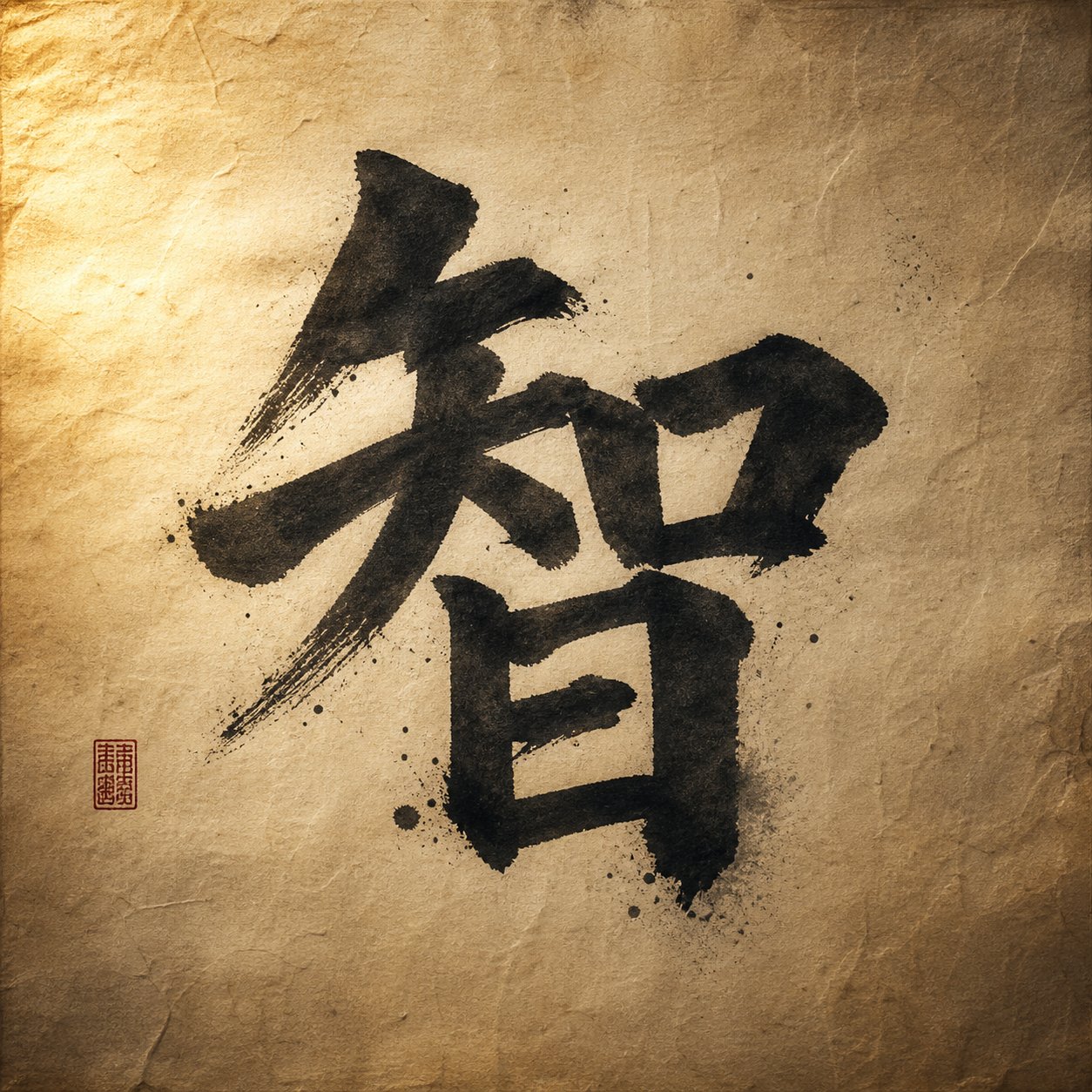
You searched for the wisdom Chinese symbol meaning, and the short answer is this: the Chinese character for wisdom is 智 (zhì), pronounced with a falling fourth tone. But here is what most translations leave out — 智 does not simply mean "smart" or "knowledgeable." It represents the ability to understand, judge, and act correctly. That distinction matters more than you might expect.
智 (zhì): The Chinese character for wisdom. Pronounced "juh" with a sharp falling tone (fourth tone in Mandarin). It conveys discernment, sound judgment, and the capacity to apply knowledge wisely — not mere intelligence or information recall.
What Does the Chinese Wisdom Symbol 智 Mean
At its core, 智 points to practical wisdom — the kind that shows up in decisions, not just test scores. In English, "smart" covers everything from quick comebacks to solving puzzles. In Chinese, 智 leans specifically toward clear thinking and choosing well. You'll find it inside words like 智慧 (deep wisdom), 智者 (wise person), 理智 (rational judgment), and 智谋 (strategic intelligence). Each compound preserves that central idea: wisdom is something you do, not just something you have.
The character itself is composed of 12 strokes and remains identical in both simplified and traditional Chinese — a rarity that hints at how stable and essential this concept has been across centuries of script reform.
Why This Character Matters Beyond a Simple Translation
Here is a common misconception worth clearing up early. Many Western readers assume Chinese characters are simple pictographs — little pictures that directly illustrate their meaning. That is very far from true. The Chinese writing system is far more complex than a series of pictorial symbols. Characters like 智 are ideographic compounds, meaning they combine multiple meaningful components to build a layered concept. In this case, 智 fuses elements related to knowledge, speech, and illumination into a single written form.
This structural complexity mirrors the philosophical weight the character carries. Across Confucianism, Daoism, and Buddhism, 智 occupies a central role — but each tradition interprets it differently. Confucius treated it as moral discernment. Laozi warned it could be dangerous without naturalness. Buddhist texts paired it with 慧 (intuitive insight) to describe a more complete awakening.
What follows is a layered exploration: from the hidden radicals inside the character, to its evolution across thousands of years of script history, to the philosophical traditions that shaped its meaning, and finally to the modern Chinese words it still powers today. Each layer reveals something a dictionary definition simply cannot capture.
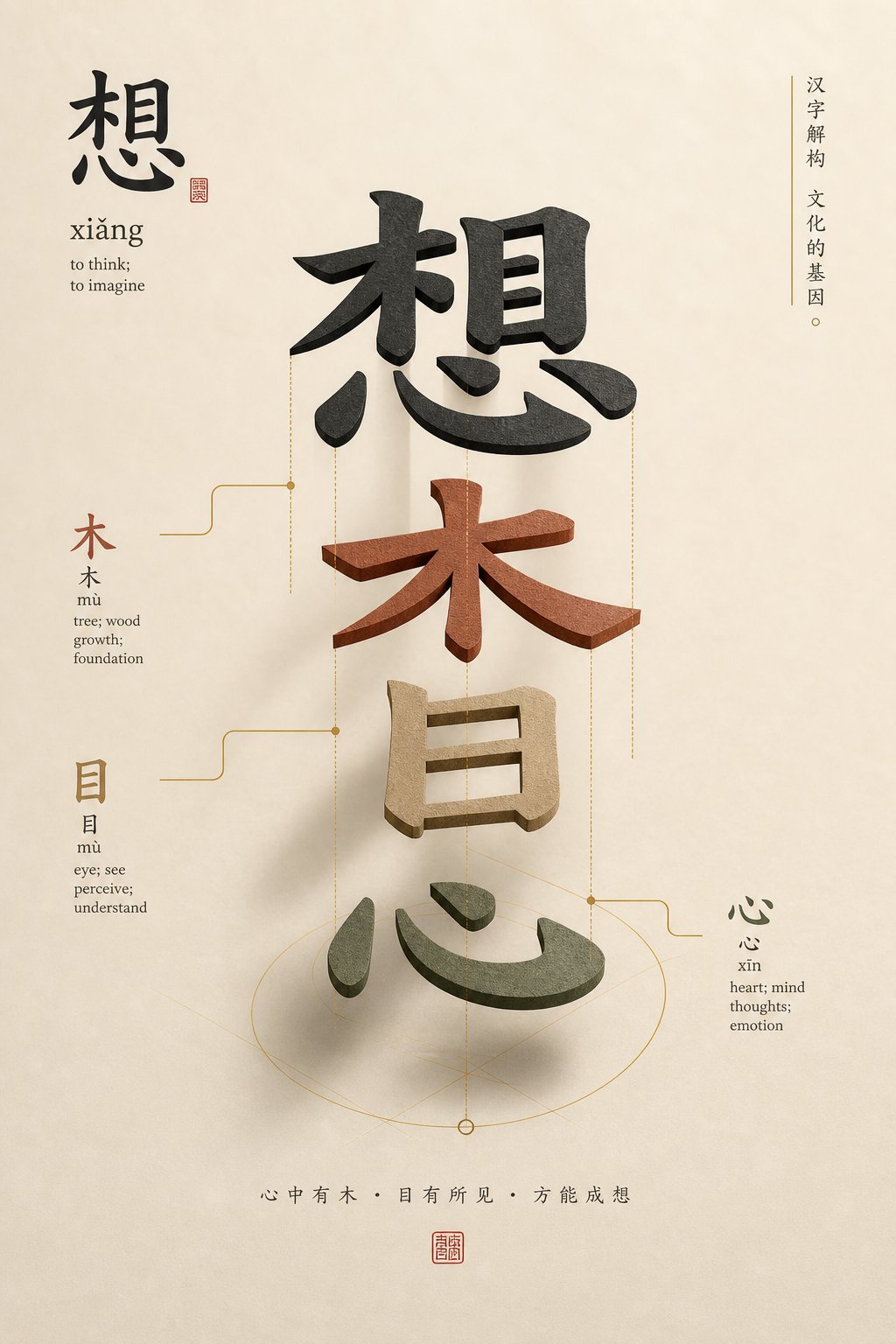
Anatomy of the Wisdom Character and Its Hidden Radicals
Every Chinese character tells a story through its structure. When you look at 智, you are not seeing a single symbol — you are seeing a small argument about what wisdom actually requires. The same is true for its close companion 慧. Together, these two characters offer a complete chinese wisdom character radicals breakdown that reveals how ancient thinkers understood the mind.
Breaking Down 智 — Arrow, Mouth, and Sun
The character 智 is built from two stacked sections, each contributing a distinct layer of meaning. The upper portion is 知 (zhī), meaning "to know." The lower portion is 日 (rì), meaning "sun" or "day." Understanding the components of the character zhi in Chinese means pulling apart each piece to see what it contributes.
Start with 知 itself. This character is also a compound, made from two radicals:
- 矢 (shǐ) — an arrow or dart. It represents directness, precision, and also carries the connotation of an oath or vow. Think of it as speech that flies straight to its target.
- 口 (kǒu) — a mouth. It represents speech, communication, and verbal expression.
Together, 矢 and 口 form 知 — speaking in an accurate or precise manner, having the knowledge to say what is true. This is not vague awareness. It is the ability to articulate reality clearly and directly, like an arrow hitting its mark.
Below 知 sits the third component:
- 日 (rì) — the sun, or day. It suggests illumination, clarity, and daily practice. Knowledge brought into the light. Wisdom exercised not once but every day.
The full picture? 智 expresses the ability to speak correctly every day — a lifetime of clear judgment, not a single flash of insight. As the Epoch Times explains, the combination of 知 and 日 symbolizes "a lifetime of wisdom, intelligence, learning, and good judgment." The sun does not illuminate once and disappear. It returns daily. That is the kind of wisdom 智 describes.
Inside 慧 — The Broom That Sweeps the Heart Clear
If 智 is wisdom built from precise knowledge and daily illumination, 慧 (huì) takes a completely different path. This character points toward intuitive clarity — the kind that comes not from accumulating facts but from clearing away what obscures understanding.
The structure of 慧 divides into two sections:
- 彗 (huì) — the upper portion. This component means "broom" or "comet" (a comet was seen as a celestial broom sweeping across the sky). It also provides the character's pronunciation. The image is one of sweeping, clearing, removing clutter.
- 心 (xīn) — the lower portion. This is the radical for "heart" or "mind." In Chinese thought, 心 is not merely the emotional heart — it is the seat of consciousness, perception, and inner knowing.
Imagine a broom sweeping dust from the surface of a mirror. That is 慧. It is the wisdom that emerges when confusion, distraction, and delusion are cleared away from the heart-mind. You do not gain 慧 by adding more information. You gain it by removing what blocks your natural clarity.
This is why 慧 became the preferred character for spiritual wisdom in Chinese Buddhist texts. It maps closely to the Sanskrit concept of prajña — transcendent insight that sees through illusion. The character structure explained here is not accidental. It encodes a specific philosophical claim: true insight requires inner stillness, not just intellectual effort.
Side by side, these two characters reveal a striking contrast in how Chinese thought approaches the mind. 智 builds wisdom upward — arrow-sharp speech, illuminated by daily practice. 慧 clears wisdom inward — sweeping the heart until its natural brightness shines through. One is constructed. The other is uncovered. And when Chinese pairs them together as 智慧, it asks for both at once.
智 vs 智慧 and When Each Form of Wisdom Applies
So 智 and 慧 each carry distinct philosophical weight. But in practice, when do you actually use 智 by itself, and when does Chinese call for the full compound 智慧? This is the exact confusion most people hit when searching for the wisdom Chinese symbol meaning — and the difference between zhi and zhihui in Chinese is more than just length.
When Chinese Uses 智 Alone
In modern Mandarin, 智 rarely stands on its own as a complete word in everyday speech. Instead, it functions as a building block inside other compounds, where it contributes its core meaning of strategic, practical, or intellectual wisdom. You will find it in terms like:
- 智谋 (zhìmóu) — strategy, shrewdness
- 机智 (jīzhì) — quick-witted, resourceful
- 理智 (lǐzhì) — rational, level-headed
- 智商 (zhìshāng) — IQ, intelligence quotient
- 斗智 (dòuzhì) — to match wits
Notice the pattern. When 智 appears inside a compound, the emphasis lands on applied intelligence — thinking that leads to action, decisions, or measurable outcomes. The term 斗智 has been in use for over 2,000 years. Liu Bang famously declared "I'd rather match wits than strength" against his rival Xiang Yu, and that exact phrase still works in modern Chinese today.
In classical philosophical texts, 智 also appears independently as one of the Five Constant Virtues in Confucianism, alongside benevolence, righteousness, propriety, and integrity. Here it carries the weight of moral discernment — the ability to distinguish right from wrong.
When 智慧 Is the Right Choice
When you want to express wisdom as a complete, standalone concept in conversation or writing, 智慧 is the natural choice. This is what people actually say. The 智慧 meaning in modern Chinese blends the practical judgment of 智 with the intuitive clarity of 慧, producing a word that feels whole and balanced.
Think of it this way: if someone asks you to describe a wise person, you would say 他很有智慧 (he has wisdom), not 他很有智. The single character sounds incomplete in this context — like saying "he has intelli-" and stopping mid-word. Chinese has a strong preference for two-character words in natural speech, and 智慧 satisfies that rhythm while also carrying richer meaning.
A quotation attributed to Mao Zedong illustrates this perfectly: "群众中蕴藏着无穷的智慧和力量" — Great wisdom and strength lie latent among the masses. Here, only 智慧 would work. The sentence calls for the full, holistic concept of wisdom, not just one facet of it.
Practical Examples in Sentences
Seeing both forms in context makes the distinction click. Here are chinese wisdom word usage examples showing when to use 智 vs 智慧:
| Dimension | 智 (zhì) | 智慧 (zhìhuì) |
|---|---|---|
| Core meaning | Strategic, intellectual wisdom | Holistic wisdom (intellect + insight) |
| Formality | Appears in formal compounds and classical texts | Natural in both spoken and written modern Chinese |
| Typical context | Inside compound words; philosophical or technical usage | Standalone noun in conversation, literature, and media |
| Example phrase | 这个决定很明智。(This decision was sensible.) | 她是一个充满智慧的人。(She is a person full of wisdom.) |
| Emphasis | Thinking clearly, choosing strategically | Deep understanding, balanced judgment and insight |
The practical takeaway is straightforward. If you are building a compound word or referencing a specific type of intelligence, 智 is your component. If you are talking about wisdom as a quality someone possesses — the kind you admire, aspire to, or describe in a person — 智慧 is what sounds natural and complete.
This distinction also hints at something deeper about how the concept evolved over time. The fact that modern Chinese settled on a two-character compound suggests the culture came to see wisdom as inherently dual — never just intellect alone, never just intuition alone, but always both working together. That evolution did not happen overnight. It unfolded across thousands of years of script history, philosophical debate, and shifting dynasties.
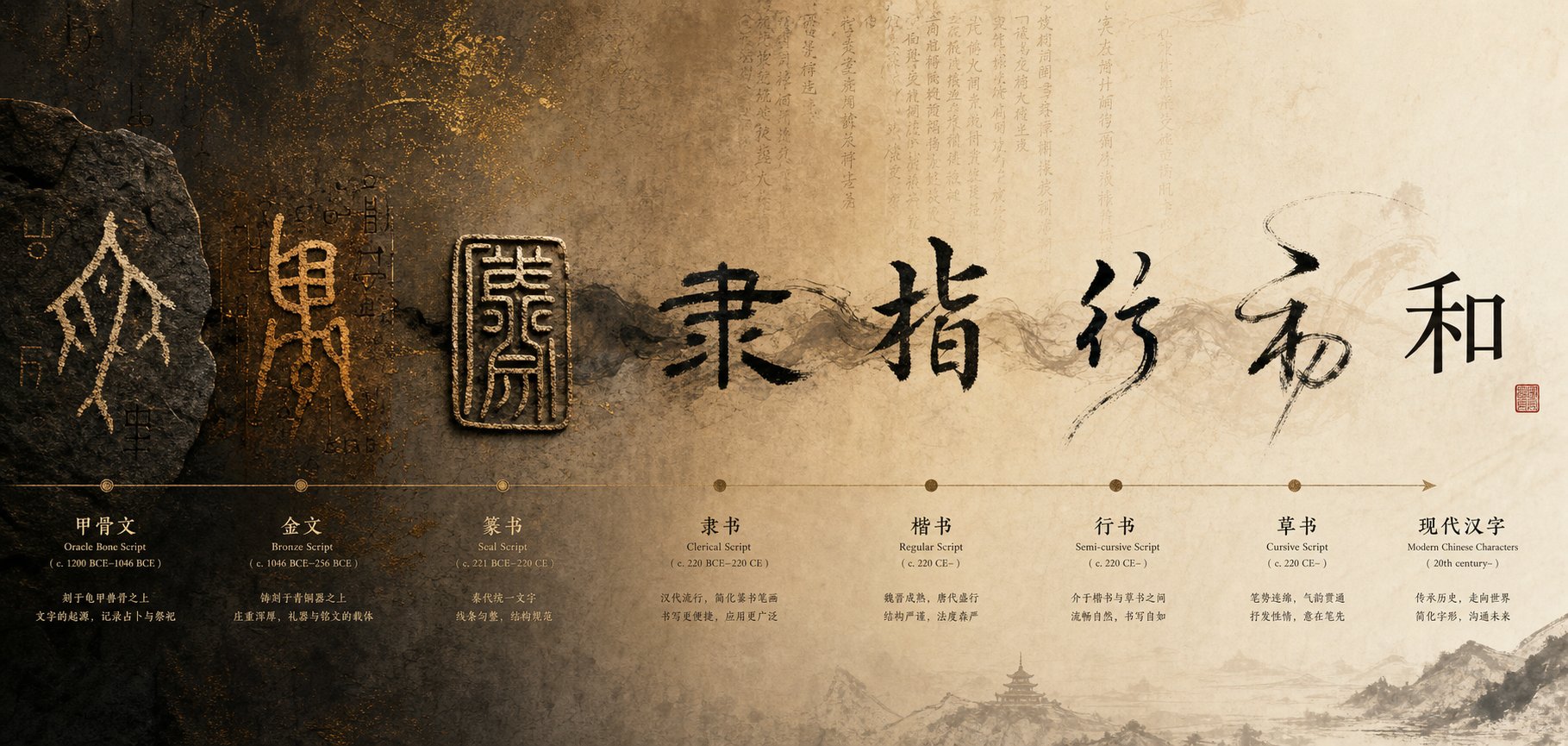
How the Wisdom Character Evolved Across Thousands of Years
The components inside 智 did not always look the way they do today. Like most Chinese characters, 智 passed through several distinct script stages over more than three millennia — and each stage reshaped the character's visual form in ways that reflect shifting cultural priorities. Understanding the history of the Chinese wisdom character means watching an idea crystallize in real time, stroke by stroke, dynasty by dynasty.
From Oracle Bones to Bronze — Wisdom in Ancient China
The earliest known forms of 智 appear in oracle bone inscriptions (甲骨文), dating to roughly 1250-1000 BC during the late Shang dynasty. These were carved into turtle shells and animal bones for divination purposes. In this ancient form, the character looked far more pictographic than its modern descendant. You could see the arrow (矢) and mouth (口) components of 知 rendered as recognizable images — a pointed shaft above an open square — with the lower element still loosely resembling its meaning component.
Bronze script (金文) versions from the late Shang dynasty (around 1100 BC) show the character cast into ritual vessels. At this stage, the strokes became slightly rounder and more fluid, shaped by the process of casting metal rather than scratching bone. The structural logic remained the same — knowledge components stacked above a meaning element — but the visual weight shifted. The character began to look less like a drawing and more like a symbol.
What is striking about these ancient forms of the zhi character is what they reveal about early Chinese thinking. Even at this earliest stage, wisdom was not depicted as a single image (like "eye" or "tree" might be). It was already a compound — an abstract concept built from multiple meaningful parts. The oracle bone script wisdom character evolution shows that Chinese thinkers were encoding philosophical complexity into their writing system from the very beginning.
Seal Script Through Modern Forms — How 智 Settled Into Its Current Shape
The next major transformation came with seal script (篆書), preserved in the Shuowen Jiezi dictionary compiled around 100 AD but reflecting forms standardized during the Qin dynasty. Seal script 智 is elegant and symmetrical, with each component balanced within an imaginary square. The strokes are uniform in width, curved rather than angular. This was the script of official seals and imperial documents — formality encoded in every line.
The Shuowen Jiezi, China's first comprehensive character dictionary, analyzed 智 with the definition "識詞也" — roughly, "the ability to recognize and discern words/matters." This tells us that by the Han dynasty, the character's meaning had settled firmly into the territory of discernment and judgment rather than raw knowledge.
Clerical script (隸書), which emerged during the Qin dynasty (221-206 BC), flattened the character dramatically. Curved strokes became angular. Vertical emphasis gave way to horizontal spread. This was a practical revolution — scribes needed to write faster on bamboo strips and silk, so they traded elegance for efficiency. The character 智 in clerical script looks noticeably wider and squatter than its seal script ancestor.
Finally, regular script (楷書) — the form used today — standardized 智 into its current 12-stroke structure. Each stroke has a defined direction, thickness, and relationship to its neighbors. The character became optimized for clarity at small sizes, whether written with a brush or printed in a book. How Chinese characters changed over time is visible in this single example: from carved pictographic elements on bone, through cast bronze and formal seals, to the crisp geometry of modern print.
One detail worth noting: unlike many Chinese characters that were simplified during the 20th-century script reforms, 智 remained unchanged. Its traditional and simplified forms are identical. The character was already efficient enough — 12 strokes carrying thousands of years of philosophical weight without needing reduction.
That stability across script reforms mirrors something about the concept itself. The form of wisdom adapted to new tools and new eras, but its core structure — knowledge illuminated, judgment applied — persisted. The philosophical traditions that shaped this character's meaning, however, were anything but uniform. Confucians, Daoists, and Buddhists each claimed 智 for their own purposes, and their interpretations diverged in fascinating ways.
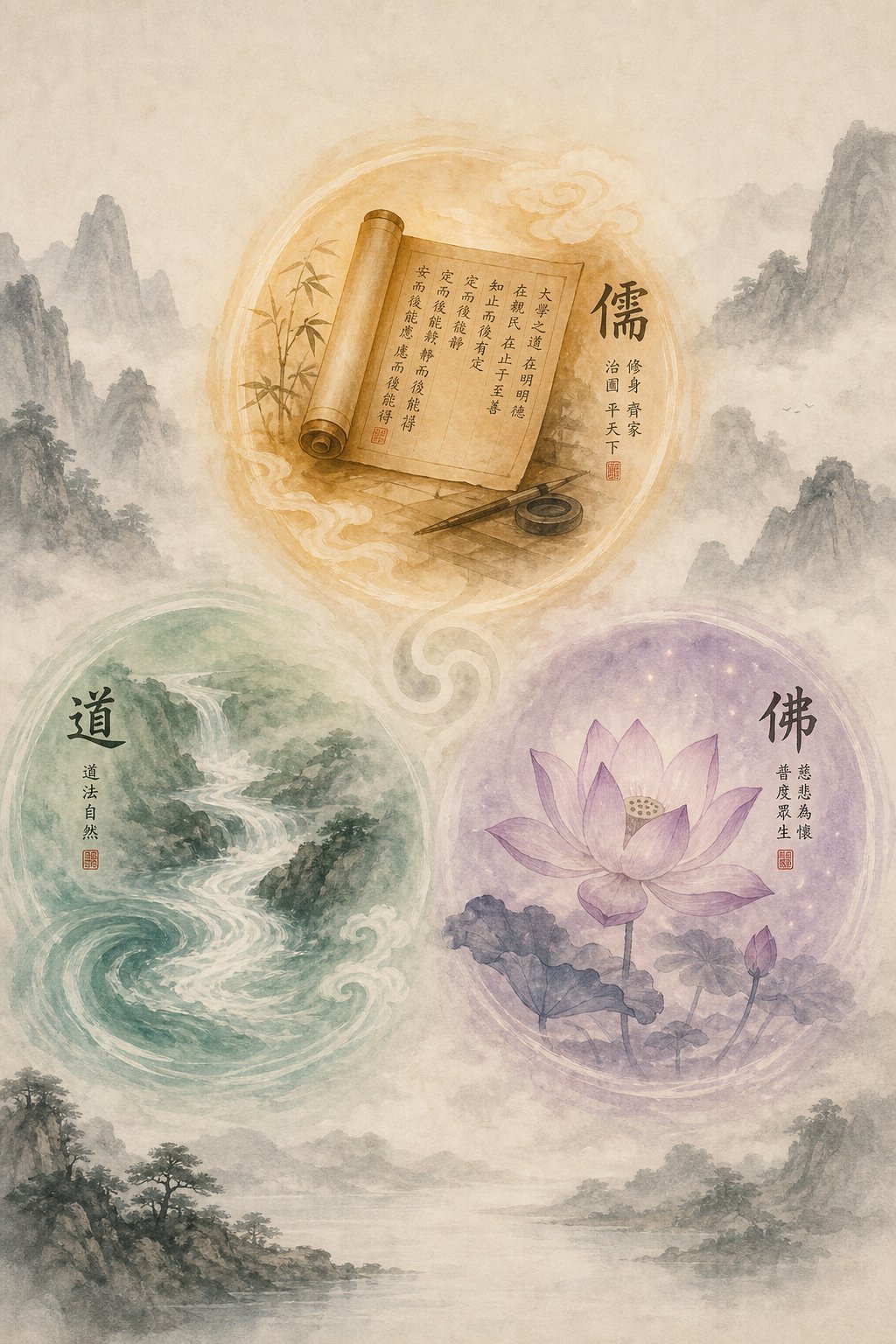
Wisdom Across Confucianism, Daoism, and Buddhism
Three philosophical traditions shaped the Chinese philosophy of wisdom explained through a single character — and they could not disagree more about what it means to be wise. Confucianism treats 智 as a moral duty. Daoism warns it can be a trap. Buddhism redefines it entirely. Each tradition pulls the character in a different direction, and understanding all three is what separates a surface-level translation from genuine comprehension.
Confucian Wisdom — 智 as Moral Discernment
In Confucian thought, 智 holds a position of structural importance. It is one of the Five Constant Virtues (五常, wuchang) — the ethical framework that guides personal cultivation and social harmony. The full set runs: 仁 (ren, benevolence), 义 (yi, righteousness), 礼 (li, propriety), 智 (zhi, wisdom), and 信 (xin, trustworthiness).
What does wisdom mean inside this system? Not cleverness. Not book learning. The confucian five virtues wisdom meaning positions 智 as the capacity to distinguish right from wrong — moral discernment applied to real situations. A wise person in the Confucian sense sees through confusion to identify what is just, what is appropriate, and what serves the greater good.
Confucius himself framed it this way in the Analerta (论语):
知者不惑。(Zhī zhe bu huo.) — The wise are free from doubt.
This is not a claim that wise people know everything. It means they have cultivated enough discernment to act decisively when it matters. They are not paralyzed by uncertainty because their moral compass is calibrated. As Confuciuspedia explains, "a wise person can distinguish between right and wrong and deal with various complicated problems" through continuous learning and reflection.
Notice how this connects to the character's structure — the arrow of directness, the mouth of clear speech, the sun of daily practice. Confucian 智 is wisdom you build through discipline, not wisdom that arrives in a flash.
Daoist Wisdom — The Paradox of Knowing Without Striving
Laozi takes the same character and flips it on its head. In the Dao De Jing (道德经), the daoist concept of wisdom Laozi presents is deeply suspicious of the very thing Confucius celebrates. Where Confucius says "cultivate 智," Laozi essentially asks: what if 智 is the problem?
Chapter 65 of the Dao De Jing makes this explicit:
民之难治,以其智多。故以智治国,国之贼。(Min zhi nan zhi, yi qi zhi duo. Gu yi zhi zhi guo, guo zhi zei.) — People are difficult to govern when they have too much cunning. To rule by cleverness is to rob the state.
The word 智 here carries a sharp edge. Laozi is not attacking wisdom itself — he is warning that strategic intelligence without naturalness becomes manipulation. When people accumulate too much cleverness, they game systems, exploit loopholes, and lose touch with the organic flow of life. The sage, by contrast, appears foolish. True wisdom in Daoism looks like simplicity.
This creates a genuine paradox. The Daoist sage possesses deep understanding but does not display it. Wisdom in this tradition means knowing when not to act, when not to speak, when not to intervene. It is wisdom expressed through restraint rather than demonstration — what the Dao De Jing calls "Mysterious Virtue" (玄德, xuande), a quality that "moves contrary to the common way, but leads ultimately to great harmony."
Buddhist Wisdom — 慧 and the Path to Enlightenment
When Buddhism arrived in China, translators faced a challenge. The Sanskrit term prajña (般若, boruo) described a form of wisdom that did not map neatly onto either the Confucian or Daoist use of 智. It was not moral discernment. It was not strategic restraint. It was something closer to direct perception of reality — seeing things as they truly are, stripped of illusion.
The solution? Chinese Buddhist texts gravitated toward 慧 (hui) as the preferred translation for this transcendent insight. The Encyclopedia of Buddhism notes that prajña is rendered in Chinese as both 般若 (a phonetic transliteration) and 慧 (a semantic translation), with the term carrying the meaning of "discernment," "insight," or "wisdom" depending on context.
Why 慧 over 智? Recall the character's structure — a broom sweeping the heart-mind clear. Buddhist prajna wisdom in Chinese is not about accumulating knowledge or making better decisions. It is about removing delusion until the mind's natural clarity shines through. The Abhidharma-samuccaya defines it precisely: "prajña fully differentiates the qualities of things to be investigated. It has the function of removing doubt."
In practice, Buddhist wisdom unfolds through three progressive stages:
- 闻慧 (wenhuì) — wisdom from listening and learning
- 思慧 (sīhuì) — wisdom from critical reflection
- 修慧 (xiūhuì) — wisdom from meditative cultivation
Each stage deepens the practitioner's insight. The first recognizes disturbing emotions. The second overcomes them temporarily. The third conquers them completely. This is wisdom as a path, not a possession — something you walk rather than something you hold.
The Mahayana tradition adds another layer: prajñaparamita (般若波罗蜜多), the "perfection of wisdom," which must be developed alongside karuna (compassion). Wisdom without compassion is incomplete. This echoes, in a different key, the Confucian insistence that 智 cannot stand alone — it needs the other four virtues to function properly.
All three traditions agree on one point, even as they disagree on nearly everything else: wisdom in Chinese thought is never purely intellectual. It always connects to something larger — moral character, natural harmony, or spiritual liberation. The character 智 carries all of these meanings simultaneously, which is precisely why no single English word can capture it. And this layered complexity only multiplies when you consider the other Chinese characters that orbit the same conceptual space — each one carving out its own distinct territory within the broader landscape of what it means to be wise.
Related Wisdom Characters in Chinese and Their Distinct Meanings
Chinese does not have one word for wisdom. It has at least six — and they are not interchangeable. When you search for the wisdom Chinese symbol meaning, you are likely encountering several different chinese characters for wisdom without realizing they point in very different directions. One describes the sharpness of a quick mind. Another describes the stillness of deep insight. A third captures the sudden flash of awakening. Confusing them is like confusing "clever," "wise," and "enlightened" in English — except the distinctions run even deeper.
Here is a systematic breakdown of the six characters most commonly associated with wisdom in Chinese, along with what makes each one unique.
Six Chinese Characters for Wisdom and How They Differ
Each of these characters occupies its own conceptual territory. Some overlap at the edges, but their cores are distinct. When comparing chinese words for intelligence and wisdom, the differences become clear once you see them side by side.
- 智 (zhi, fourth tone) — Strategic and intellectual wisdom. This is the character we have explored in depth: judgment, discernment, the ability to choose well. It belongs primarily to Confucian thought, where it functions as one of the Five Constant Virtues. You will find it in compounds like 智慧 (wisdom), 智谋 (strategy), 智商 (IQ), and 智者 (wise person). The emphasis falls on applied thinking — wisdom that leads to action.
- 慧 (hui, fourth tone) — Intuitive and spiritual wisdom. Where 智 builds upward through knowledge, 慧 clears inward through insight. It is the preferred term in Chinese Buddhist texts for transcendent understanding. Common compounds include 智慧 (holistic wisdom), 慧根 (innate spiritual capacity), 慧眼 (the eye of insight), and 聪慧 (intelligent and perceptive). The hui vs zhi wisdom meaning difference comes down to this: 智 is constructed through effort, while 慧 is uncovered through clarity.
- 聪 (cong, first tone) — Cleverness and sensory acuity. The character contains the ear radical (耳), pointing to its original meaning: sharp hearing, keen perception. Over time it expanded to mean quick-witted and mentally agile. Compounds include 聪明 (clever/smart), 聪慧 (intelligent), and 聪颖 (bright and gifted). This is the chinese character for cleverness vs wisdom — 聪 describes raw mental speed, not depth of judgment. A child who figures out how to negotiate extra screen time is 聪明. A child who pauses to cool down before reacting is closer to 智.
- 明 (ming, second tone) — Clarity and insight. Composed of 日 (sun) and 月 (moon), this character literally means "bright" — the combined illumination of day and night. When applied to the mind, it means clear-sighted, perceptive, able to see through confusion. You will find it in 明智 (sensible/wise), 聪明 (clever), 明白 (to understand), and 明察 (to perceive clearly). It belongs to general philosophical usage rather than any single tradition, and it emphasizes the seeing aspect of wisdom — cutting through fog to perceive what is actually there.
- 睿 (rui, fourth tone) — Sagacity and foresight. This is a more formal, literary character often reserved for describing leaders, elders, or people of exceptional depth. It carries connotations of far-sightedness and penetrating judgment. Compounds include 睿智 (wise and insightful), 睿哲 (sagacious), and historically 睿 appeared in imperial titles. If 智 is the wisdom of good decisions, 睿 is the wisdom of seeing what others cannot — anticipating consequences, reading situations at a deeper level.
- 悟 (wu, fourth tone) — Enlightenment and awakening. The character combines 心 (heart/mind) with 吾 (I/self), suggesting a moment when the self and the heart-mind align in sudden understanding. This is the character for breakthrough insight — the "aha" moment, the flash of realization. It is central to Chan (Zen) Buddhism, where 顿悟 (dunwu, sudden enlightenment) describes the instantaneous awakening to one's true nature. Other compounds include 觉悟 (to awaken/realize), 领悟 (to comprehend deeply), and 感悟 (to gain insight through experience). Unlike 智 or 慧, which can be cultivated gradually, 悟 often implies a discontinuous leap.
Choosing the Right Wisdom Character for Your Context
The table below maps all six characters across the dimensions that matter most — meaning, tradition, usage, and common compounds. If you are choosing a character for a tattoo, a name, a piece of calligraphy, or simply trying to understand a Chinese text more precisely, this comparison will help you land on the right one.
| Character | Pinyin | Core Meaning | Philosophical Tradition | Common Compounds | Usage Context |
|---|---|---|---|---|---|
| 智 | zhi (4th) | Strategic wisdom, judgment | Confucianism (Five Virtues) | 智慧, 智谋, 智商, 智者, 明智 | Decision-making, moral discernment, applied intelligence |
| 慧 | hui (4th) | Intuitive insight, spiritual clarity | Buddhism (prajna) | 智慧, 慧根, 慧眼, 聪慧 | Spiritual practice, inner perception, transcendent understanding |
| 聪 | cong (1st) | Cleverness, mental acuity | General usage | 聪明, 聪慧, 聪颖, 失聪 | Describing quick-wittedness, natural talent, sensory sharpness |
| 明 | ming (2nd) | Clarity, clear-sightedness | General / Confucian-Daoist | 明智, 聪明, 明白, 明察 | Perceiving truth, understanding situations, cutting through confusion |
| 睿 | rui (4th) | Sagacity, foresight | Literary / Imperial | 睿智, 睿哲, 睿见 | Formal praise, describing leaders or elders, deep foresight |
| 悟 | wu (4th) | Awakening, sudden realization | Buddhism (Chan/Zen) | 觉悟, 顿悟, 领悟, 感悟 | Spiritual breakthroughs, moments of deep comprehension |
A few patterns emerge from this comparison. The characters rooted in Buddhist tradition (慧 and 悟) tend toward inner experience — they describe states of mind rather than observable behavior. The characters with Confucian associations (智 and, to some extent, 明) lean toward practical application — wisdom you can see in someone's choices and conduct. And 聪 stands apart as the most "neutral" of the group, describing cognitive ability without any particular moral or spiritual weight.
This is why a simple English translation of "wisdom" always falls short. When a Chinese text uses 睿智, it is saying something different from 智慧, which is saying something different from 觉悟. Each word activates a different philosophical register, a different set of expectations about what wisdom looks like and where it comes from.
The practical implication? If you are choosing a character for personal meaning — whether for art, study, or self-reflection — consider what kind of wisdom resonates with you. The quiet foresight of 睿? The sudden clarity of 悟? The daily discipline of 智? The swept-clean stillness of 慧? Each one is a valid answer to the question "what is wisdom?" — and each one leads somewhere different.
These ancient distinctions are not just philosophical relics. They live on in modern Chinese vocabulary, where 智 in particular has adapted to describe everything from artificial intelligence to smart cities. The character that Confucius used to describe moral discernment now labels the technology of the future — and that continuity tells its own story.
Modern Chinese Words Built on the Ancient Wisdom Character
A character that Confucius used to describe moral discernment now labels smartphones, AI systems, and urban infrastructure. That is not a contradiction — it is proof that 智 remains a living piece of the language, not a museum artifact. The common chinese compounds using wisdom character reveal how deeply the ancient concept of applied intelligence still shapes the way Chinese speakers talk about the modern world.
智 in Technology and Science
Technology borrows from philosophy more often than you might expect. When Chinese needed words for the digital age, it reached back to 智 — and the fit was surprisingly natural. After all, if 智 means the capacity to judge, discern, and act effectively, then a device that mimics those abilities deserves the same label.
- 智能 (zhìnéng) — Literally "wisdom-ability" or "intelligent capability." Originally referring to human intellect, this term now describes any technology that operates as if it possesses human-like judgment. You will find it in 智能手机 (smartphone), 智能音箱 (smart speaker), and 智能家居 (smart home devices). The 智能 meaning in chinese technology carries a specific claim: these devices do not merely compute — they discern, adapting responses to context the way a wise person would. The full term for artificial intelligence on mainland China is 人工智能 (réngōng zhìnéng), literally "human-made wisdom-ability." In Taiwan and much of the broader Sinophone world, the preferred term is 人工智慧 (réngōng zhìhuì), using the more holistic compound instead. Both versions anchor the concept of AI in the ancient character for wisdom — a fascinating choice that frames machine learning not as mere calculation but as something approaching discernment.
- 智商 (zhìshāng) — Literally "wisdom quotient." This is the chinese word for artificial intelligence wisdom's human counterpart: IQ. The character 商 here means "quotient" (as in a mathematical ratio), so the compound translates directly to "intelligence quotient." Intelligence tests (智力测验) measuring 智商 are common in Chinese school admissions and job interviews, reinforcing the cultural emphasis on measurable intellect from an early age.
- 智慧城市 (zhìhuì chéngshì) — "Wisdom city" or "smart city." This compound pairs the full 智慧 (holistic wisdom) with 城市 (city) to describe urban environments integrated with data-driven infrastructure — traffic systems that adapt, energy grids that self-optimize, public services that anticipate demand. The choice of 智慧 over 智能 here is deliberate. A smart city is not just automated; it is meant to be wise — responsive, balanced, and forward-thinking.
智 in Everyday Modern Chinese
Beyond technology, modern chinese words with zhi character show up in contexts ranging from personal ability to political strategy. These compounds preserve the ancient emphasis on applied judgment while fitting seamlessly into contemporary conversation.
- 智力 (zhìlì) — Literally "wisdom-power" or "intellectual ability." This refers to general mental capacity — the raw cognitive horsepower behind problem-solving, learning, and reasoning. You will encounter it in phrases like 智力开发 (intellectual development) and 益智玩具 (intelligence-boosting toys). Where 智商 measures a number, 智力 describes the underlying ability itself.
- 智囊 (zhìnáng) — Literally "wisdom-bag" or "brain trust." Imagine a sack full of clever strategies — that is the image this compound evokes. It refers to a think tank, an advisory group, or a trusted strategist. The term dates back centuries in Chinese political language, describing the advisors who supplied rulers with plans and solutions. Today it appears in contexts like 智囊团 (think tank group) and carries a tone of respect for behind-the-scenes strategic minds.
- 智者 (zhìzhě) — "Wise person" or "sage." The suffix 者 (zhě) means "one who," making this the most direct compound: one who possesses 智. It appears in classical proverbs like 仁者见仁,智者见智 (the benevolent see benevolence, the wise see wisdom) — a saying that remains common in modern Chinese to express that people interpret things through the lens of their own strengths.
What connects all of these compounds is a single thread: 智 never drifts far from its original meaning. Whether describing a smartphone's adaptive algorithms or a political advisor's strategic mind, the character still points to the same core idea — the capacity to assess a situation and respond with discernment. The technology is new. The vocabulary is ancient. And the fact that Chinese speakers reach for a 3,000-year-old character to name their most cutting-edge innovations says something profound about how deeply this concept is woven into the culture's understanding of what it means to think well.
Of course, knowing what the character means and knowing how to write it are two different skills. For those who want to move from understanding to practice — brush in hand, ink on paper — the physical act of writing 智 carries its own lessons about structure, balance, and tradition.
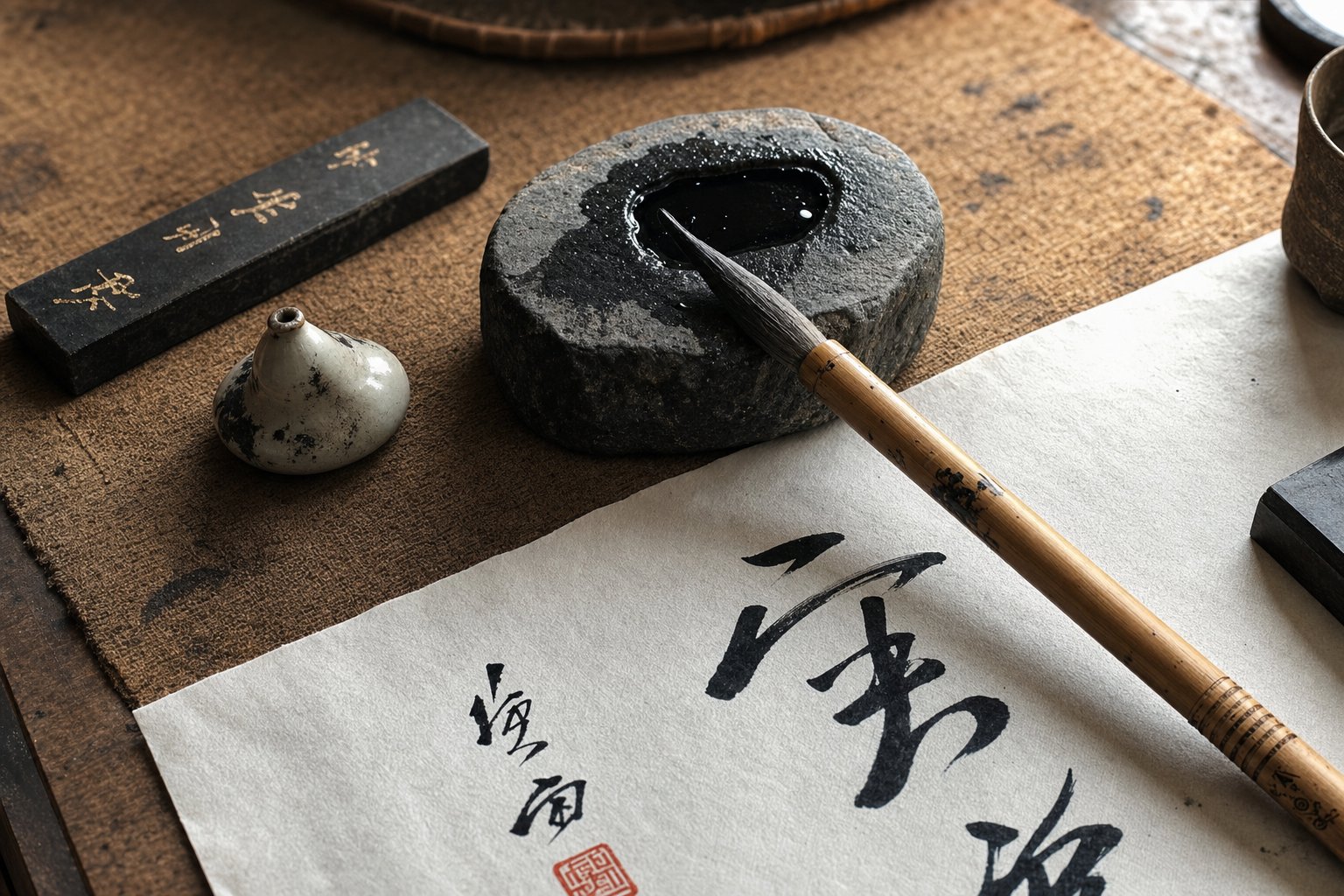
How to Write the Wisdom Symbol in Chinese Calligraphy
Understanding a character's meaning is one thing. Picking up a brush and writing it — feeling the balance between its upper and lower halves, sensing where the weight falls — is something else entirely. Writing 智 step by step teaches you about structure, proportion, and the physical logic of Chinese script in a way that reading alone never can.
Writing 智 Step by Step in 12 Strokes
The character 智 has an upper-lower structure (上下结构), with 知 sitting on top and 日 resting below. You'll write the entire upper component first, then move to the bottom — following the fundamental rule of top to bottom. Within 知, the left element 矢 (arrow) comes before the right element 口 (mouth), honoring the left-to-right principle.
Here is the stroke sequence broken into its three component groups:
- Strokes 1-5 — 矢 (arrow, upper left): Begin with the short left-falling stroke (撇) at the top. Follow with the long horizontal (横), then a shorter horizontal below it. Next comes the long left-falling stroke sweeping down, and finally a dot (点) to the lower right.
- Strokes 6-8 — 口 (mouth, upper right): Write the left vertical (竖), then the horizontal-turn stroke (横折) forming the top and right side, and close with the bottom horizontal.
- Strokes 9-12 — 日 (sun, bottom): Start with the left vertical, add the horizontal-turn for the top and right side, draw the middle horizontal, and finish with the bottom horizontal to close the frame.
A few principles to keep in mind as you practice. Horizontal strokes come before vertical ones that cross them. Enclosing strokes (like the frame of 日) get sealed last. And the overall balance should feel "top tight, bottom loose" — keep 知 compact and allow 日 slightly more breathing room below. The center axes of both halves must align vertically, or the whole character tilts off balance.
The Wisdom Character in Four Calligraphy Styles
The 12-stroke version you just learned is 楷書 (kǎishū) — Standard Script. But 智 takes on dramatically different personalities depending on which calligraphy tradition renders it. The Song Dynasty calligrapher Su Shi captured the relationship between three of these styles perfectly: "Standard Script is like standing, Running Script is like walking, and Cursive Script is like running." Each style shifts the character's visual weight, speed, and emotional register.
| Style | Chinese Name | Character | Best For |
|---|---|---|---|
| Standard Script | 楷書 (kǎishū) | Square, upright, every stroke distinct | Learners, printed text, official documents |
| Running Script | 行書 (xíngshū) | Fluid, strokes slightly connected, relaxed | Daily handwriting, personal notes, signatures |
| Cursive Script | 草書 (cǎoshū) | Abstract, rapid, highly expressive | Artistic display, emotional expression, advanced calligraphers |
| Seal Script | 篆書 (zhuànshū) | Symmetrical, curved, uniform stroke width | Decorative seals, traditional art, ceremonial use |
Standard Script (楷書) is where most people start. Its golden age was the Tang Dynasty, and its defining quality is clarity — each of the 12 strokes occupies a precise position within an imaginary square. Famous Tang masters like Yan Zhenqing and Ouyang Xun each rendered 智 with slightly different proportions, but always with that sense of disciplined structure. If you are learning to write the character, this is your foundation.
Running Script (行書) loosens the rules. Strokes begin to connect — the dot at the end of 矢 might flow directly into the first stroke of 口 without lifting the brush. The character feels alive, breathing, as if caught mid-motion. This is the style most native Chinese speakers actually use when writing by hand, and it is arguably the most technically demanding to master because its flexibility allows for so many personal variations.
Cursive Script (草書) pushes further still. Here, 智 might become nearly unrecognizable to untrained eyes — strokes merge, abbreviate, and transform into sweeping gestures. Speed and emotion drive the brush. Ancient calligraphers sometimes wrote cursive while drinking wine to free their spirit. The result is raw and improvisational, but governed by a conventional system of forms (草法) that practitioners must memorize. It is not sloppiness — it is controlled explosion.
Seal Script (篆書) takes you in the opposite direction — back in time. In this ancient style, 智 appears with uniform stroke widths, gentle curves, and left-right symmetry. There are no sharp corners, no dramatic thick-thin variations. The character looks almost like a drawing, closer to its oracle bone ancestors than to its modern form. Seal Script is still used today for personal name seals (印章) and decorative calligraphy, lending 智 a ceremonial gravity that no other style quite matches.
Each style reveals a different facet of the character's personality. Standard Script shows its logic. Running Script shows its life. Cursive Script shows its passion. Seal Script shows its age. Together, they demonstrate that writing 智 is not just a mechanical exercise — it is an act of interpretation, shaped by the calligrapher's intent and the tradition they choose to honor.
That interplay between form and meaning extends beyond aesthetics. The philosophical traditions behind 智 did not merely define the character — they also warned about its limits. Wisdom without virtue, several classical thinkers argued, is not wisdom at all. It is something far more dangerous.
Classical Quotations and the Deeper Philosophy of 智
A character with 12 strokes, thousands of years of history, and three philosophical traditions pulling it in different directions — and yet one theme runs through all of them like a single thread. Wisdom in Chinese thought is never self-sufficient. It always answers to something beyond itself. Confucius bound it to virtue. Laozi bound it to naturalness. Buddhism bound it to compassion. Strip those bonds away, and 智 becomes something the classical thinkers feared: cleverness without conscience.
The Warning — Wisdom Without Virtue
Imagine someone brilliant enough to manipulate any situation, sharp enough to outmaneuver anyone — but guided by nothing beyond self-interest. Chinese philosophy has a name for this. It is not wisdom. It is 奸智 (jianzhì) — cunning, treacherous cleverness. The distinction between wisdom and virtue in chinese thought is not academic. It is the difference between a leader who serves and a tyrant who schemes.
Confucius made this boundary explicit. In his framework, 智 cannot function in isolation. It requires 仁 (benevolence) as its anchor. Without moral feeling, discernment becomes manipulation. Without compassion, strategic thinking becomes exploitation. The Analects return to this point repeatedly — wisdom is only wisdom when it serves what is good.
Laozi pushed the warning further. In the Dao De Jing, he argued that when society elevates cleverness above simplicity, the result is not progress but decay. People learn to game systems rather than live authentically. The more 智 a population accumulates without corresponding virtue, the harder it becomes to govern justly. This is not anti-intellectualism — it is a caution against intelligence divorced from integrity.
Buddhist thought arrives at the same conclusion from a different angle. Prajna (慧) without karuna (compassion) is incomplete. A practitioner who develops penetrating insight but lacks care for other beings has missed the point entirely. The Mahayana tradition insists that wisdom and compassion must develop together — two wings of the same bird, neither capable of flight alone.
Classical Voices on True Wisdom
The classical chinese wisdom sayings with translation below capture this integrated vision. Each quotation comes from a foundational text, and each insists that wisdom means more than thinking clearly — it means living rightly.
知之为知之,不知为不知,是知也。(Zhi zhi wei zhi zhi, bu zhi wei bu zhi, shi zhi ye.) — To know what you know and know what you do not know — that is true wisdom. — Confucius, Analerta 2:17
This is perhaps the most famous of all confucius quotes on wisdom in chinese. It redefines wisdom not as the accumulation of knowledge but as honest self-awareness. The wise person does not pretend. They recognize the boundaries of their understanding — and that recognition itself is the highest form of knowing.
知人者智,自知者明。(Zhi ren zhe zhi, zi zhi zhe ming.) — Knowing others is intelligence; knowing yourself is true wisdom. — Laozi, Dao De Jing, Chapter 33
Laozi draws a sharp line between outward cleverness and inward clarity. You can study people, predict their behavior, and outmaneuver them — that is 智 in its limited sense. But turning that same discernment inward, seeing your own patterns and illusions without flinching — that requires something deeper. The character 明 (clarity) here signals a wisdom that illuminates rather than strategizes.
学而不思则罔,思而不学则殆。(Xue er bu si ze wang, si er bu xue ze dai.) — Learning without thinking is useless. Thinking without learning is dangerous. — Confucius, Analerta 2:15
This passage captures the Confucian insistence on balance. Knowledge without reflection produces confusion. Reflection without grounding in study produces recklessness. True 智 lives in the tension between the two — always learning, always questioning, never settling into either pure theory or pure action.
三思而行。(San si er xing.) — Think thrice before acting. — Confucius, Analerta 5:20
Four characters. An entire philosophy of deliberation. The number three in Confucian thought represents completeness — considering all implications before committing to a course of action. This is 智 as patience, as restraint, as the refusal to let impulse override judgment.
知者乐水,仁者乐山。(Zhi zhe yao shui, ren zhe yao shan.) — The wise delight in water; the benevolent delight in mountains. — Confucius, Analerta 6:23
Why water? Because wisdom, like water, is adaptive — it flows around obstacles, finds the path of least resistance, and never stops moving. This chinese philosophy quote about wisdom pairs 智 with 仁 as complementary forces: the wise are fluid and responsive, the benevolent are steady and enduring. Neither quality is complete without the other.
Together, these quotations paint a consistent picture. Wisdom in the Chinese tradition is not a trophy you display. It is not a score you measure. It is a way of being — humble enough to admit ignorance, reflective enough to question assumptions, patient enough to think before acting, and grounded enough to serve something beyond personal advantage.
That is what the wisdom Chinese symbol meaning ultimately points toward. Not a single English word. Not a dictionary entry. An entire philosophical worldview compressed into 12 strokes — one that insists you cannot separate how you think from how you live.
Frequently Asked Questions About the Chinese Wisdom Symbol
1. What is the Chinese symbol for wisdom and how is it pronounced?
The primary Chinese symbol for wisdom is 智 (zhi), pronounced with a falling fourth tone in Mandarin, sounding roughly like 'juh.' It carries 12 strokes and remains identical in both simplified and traditional Chinese. Rather than meaning simple intelligence, 智 conveys discernment, sound judgment, and the capacity to apply knowledge wisely in real situations. It often appears alongside 慧 (hui) to form 智慧, the most common standalone word for holistic wisdom in modern Chinese.
2. What is the difference between 智 and 智慧 in Chinese?
智 (zhi) alone emphasizes strategic, practical, or intellectual wisdom and typically functions as a building block inside compound words like 智商 (IQ) or 智谋 (strategy). 智慧 (zhihui) is the natural two-character word Chinese speakers use when referring to wisdom as a complete quality someone possesses. It blends the practical judgment of 智 with the intuitive clarity of 慧, making it appropriate for both spoken and written contexts when describing deep, balanced understanding.
3. How many Chinese characters mean wisdom and how do they differ?
Chinese has at least six characters associated with wisdom, each with distinct meanings. 智 refers to strategic judgment, 慧 to intuitive spiritual insight, 聪 to cleverness and mental speed, 明 to clarity and perception, 睿 to sagacity and foresight, and 悟 to sudden awakening or enlightenment. They belong to different philosophical traditions and are not interchangeable. Choosing the right one depends on whether you mean practical decision-making, spiritual clarity, raw intelligence, or a moment of breakthrough realization.
4. What do the radicals inside the Chinese wisdom character 智 mean?
The character 智 combines three meaningful components. The upper section is 知 (to know), itself made from 矢 (arrow, representing directness and precision) and 口 (mouth, representing speech). Below sits 日 (sun or day), suggesting illumination and daily practice. Together, these radicals encode the idea that wisdom is the ability to speak truth precisely, practiced consistently like the sun returning each day — not a single flash of insight but a lifetime of clear judgment.
5. What role does the wisdom character play in Chinese philosophy?
In Confucianism, 智 is one of the Five Constant Virtues, representing moral discernment and the ability to distinguish right from wrong. Daoism takes a cautionary stance, with Laozi warning that strategic cleverness without naturalness becomes manipulation. In Buddhism, 慧 (hui) became the preferred term for transcendent wisdom (prajna), describing insight that sees through illusion. All three traditions agree that wisdom must be paired with virtue, compassion, or naturalness to be genuine — intelligence alone is never enough.