Why the Xing vs Shi Distinction Still Matters Today
When you hear the word "surname" in Chinese, you probably think of a single concept. Ask someone in Mandarin what their last name is and they'll answer with one character, one identity marker. Simple enough. But here's the thing: the modern Chinese term for surname, 姓氏 (xingshi), is actually two words fused together. Those two characters, 姓 (Xing) and 氏 (Shi), once referred to entirely separate systems operating side by side for over a thousand years.
Why Xing and Shi Are Not the Same Thing
Most introductions to Chinese surnames treat Xing and Shi as interchangeable labels. They are not. Xing identified your ancient maternal clan, a broad bloodline stretching back to prehistoric origins. Shi, on the other hand, marked a specific branch or lineage within that clan, tied to land grants, political titles, or noble houses. Think of it this way: Xing told people which river you came from, while Shi told them which tributary. One was fixed and inherited across generations. The other could be created, changed, or granted by a ruler. Among asian family names, this dual-layer structure is unique to early Chinese civilization and has no direct parallel in other naming traditions.
Today's single "surname" concept was once a dual system: Xing for clan blood, Shi for lineage rank. The modern word 姓氏 is a linguistic fossil preserving both halves long after they merged into one.
What Modern Readers Gain From This Distinction
Understanding the xing vs shi distinction in ancient Chinese surnames unlocks three practical benefits. First, it clarifies why historical figures sometimes appear under different names in different texts. Second, it reveals the deeper meaning behind common chinese last names you encounter every day, names like Wei, Zhao, and Zhou that trace back to specific political events rather than abstract clan origins. Third, for anyone researching chinese family names or building a genealogy, knowing whether a surname descends from an original Xing or a derived Shi determines how far back you can trace the line and which historical records to consult.
This article lays out six key distinctions between Xing and Shi, drawn from classical sources and organized from foundational concepts to hands-on research applications. Each distinction builds on the last, revealing how one of the oldest asian family names systems in the world evolved from a dual structure into the single-surname format used by over a billion people today. The story begins with etymology, specifically the radical hidden inside the character 姓 that points directly to its matrilineal origins.
Sources and Selection Criteria for Key Distinctions
A dual naming system that operated for over a millennium demands more than casual explanation. To map the differences between Xing and Shi with precision, you need reliable classical texts, not modern summaries built on assumptions. The six distinctions explored in this article draw directly from three foundational works that scholars have relied on for centuries to decode how each chinese surname functioned in its original context.
Historical Sources Behind This Analysis
Three primary texts anchor this analysis:
- Shiji (史记) by Sima Qian — Written during the early Han dynasty, this monumental historical record traces royal genealogies back to legendary ancestors. Its "Hereditary Houses" and "Basic Annals" sections document how specific Shi names branched from original Xing clans, making it indispensable for understanding surname in chinese genealogical tradition.
- Zuozhuan (左传) — A narrative commentary on the Spring and Autumn Annals covering events from the 8th to 5th centuries BCE. It captures Zhou-era naming conventions in real time, showing exactly how men and women were recorded differently by Shi and Xing in diplomatic, military, and ritual contexts.
- Tongzhi (通志) by Zheng Qiao — Specifically the "Clan Studies" (氏族略) chapter, compiled during the Song dynasty. Zheng Qiao systematically classified the origins of thousands of surnames, categorizing them by how each Shi was formed: from fiefs, official titles, ancestral names, or geographic features.
Together, these sources span from the Zhou dynasty through the Song, giving a layered view of how the system evolved over two thousand years.
How We Structured These Key Differences
The distinctions ahead follow a deliberate sequence. They begin with etymology and linguistic roots, move through social rules governing gender and class, then trace the historical branching and eventual merger of the two systems. The final sections address practical applications for reading classical texts and conducting genealogy research. Each builds on the previous one, so a reader unfamiliar with the topic can follow the logic step by step.
One formatting note: Chinese characters appear alongside pinyin romanization throughout (for example, 姓 Xing, 氏 Shi, 姬 Ji). This ensures clarity whether you are reading for cultural interest, academic research, or tracing your own family line through historical records. Where a surname 中文 character contains visual clues to its meaning, those are highlighted as well.
With these sources and structure in place, the logical starting point is the character 姓 itself, where a single radical reveals the matrilineal world that gave birth to the entire system.
Etymological Origins and the Matrilineal Connection
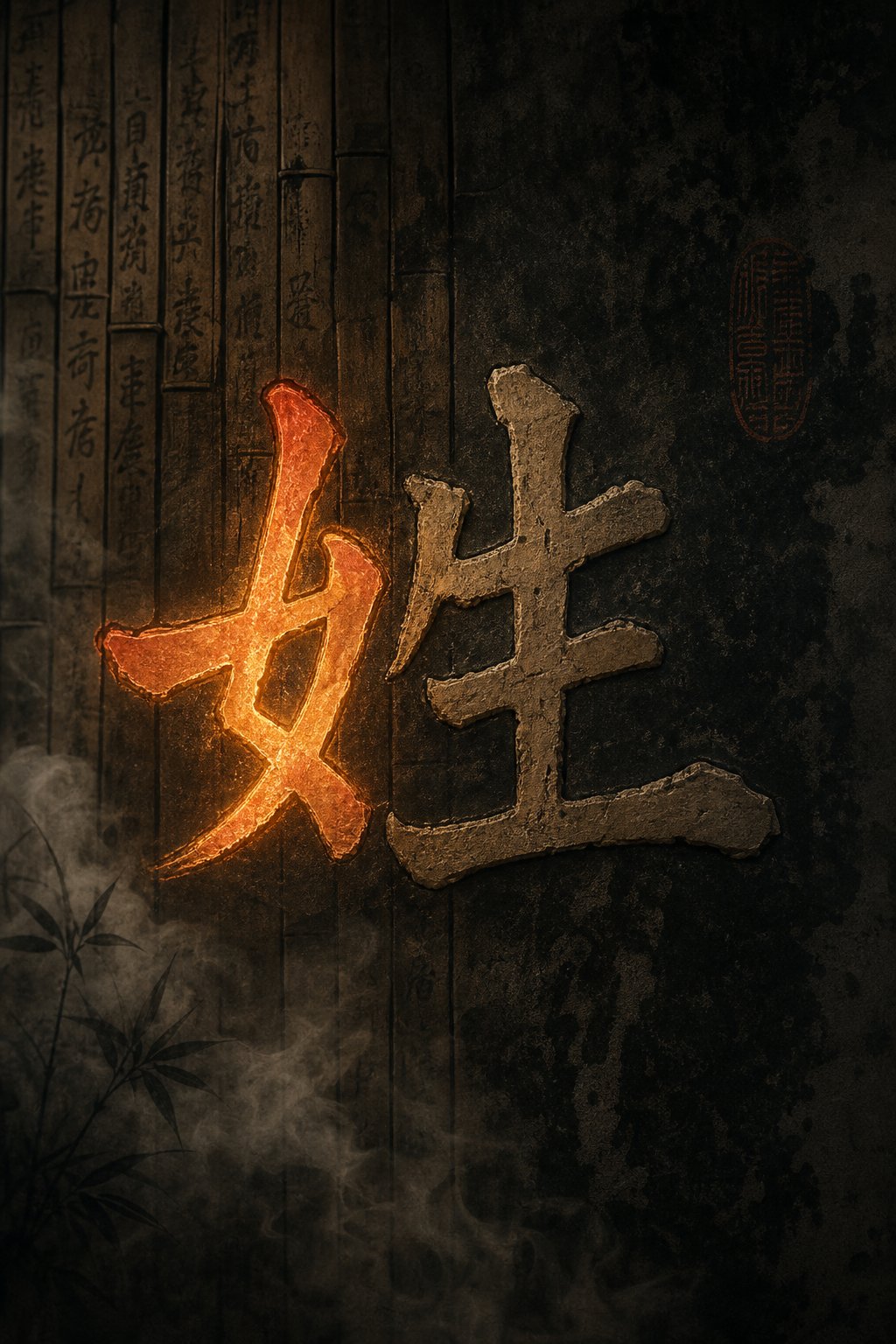
Look closely at the character 姓 (Xing). On its left side sits the radical 女, meaning "woman" or "female." This is not decorative. It is a direct artifact of prehistoric Chinese society, where kinship was traced through the mother. The meaning of chinese last names often hides in plain sight within the characters themselves, and 姓 is the clearest example: it literally combines 女 (woman) with 生 (to be born), telling you that your Xing came from the woman who bore you.
The Female Radical in Xing Reveals Matrilineal Roots
In the earliest periods of Chinese civilization, before written records and centralized states, communities organized around maternal lineage. Children belonged to their mother's clan. The Xing was the identifier for that entire clan, a large group sharing common female ancestry stretching back generations. It functioned less like a modern surname and more like a tribal marker, binding hundreds or even thousands of people under one bloodline identity.
Shi (氏), by contrast, carries no female radical. It emerged later, during a period when clans had grown so large that a single Xing could no longer distinguish one branch from another. As society shifted toward patrilineal structures and political hierarchies, men needed a way to signal which specific lineage they belonged to within the broader clan. Shi filled that role. It was a branch label, created when a son received a fief, founded a new state, or held a distinct office. Where Xing was ancient and fixed, Shi was newer and flexible.
Imagine a massive river system. The Xing is the river's name at its source. The Shi names are the tributaries that split off downstream, each one named for the territory it flows through. You can trace every tributary back to the same source, but each has its own identity shaped by geography and history. That is the relationship between these two layers of ancient chinese names.
The Eight Original Xing Clans of Ancient China
How many original Xing existed? Scholars drawing from texts like the Shiji and Tongzhi identify eight great ancestral surnames from Chinese antiquity. These are the root clans from which thousands of later Shi branched. Notice how nearly every one contains the 女 radical, reinforcing their matrilineal origin:
- 姬 (Ji) — the royal surname of the Zhou dynasty, and the single most prolific source of later surnames
- 姜 (Jiang) — associated with the legendary Yan Emperor and the state of Qi
- 姒 (Si) — linked to the Xia dynasty and the sage king Yu the Great
- 嬴 (Ying) — the ancestral surname of the Qin ruling house
- 妘 (Yun) — connected to the fire god Zhurong's descendants
- 妫 (Gui) — tied to the sage king Shun and the state of Chen
- 姞 (Ji) — a less common but documented ancient clan (sometimes listed as 妊 Ren in alternate sources)
- 姚 (Yao) — also linked to Shun, one of the few ancient Xing still common as a modern surname
You'll notice the pattern immediately. Six of these eight characters visibly carry the 女 radical on their left side. Even 嬴 (Ying) contains 女 within its more complex structure. During the earliest Chinese antiquity, family names passed from women to their children, and these characters preserve that reality in their very composition. When exploring chinese surname meanings, this visual clue is the first and most reliable indicator that you are looking at a true ancestral Xing rather than a later Shi.
Today, very few people carry one of these original eight as their actual family name. Yao and Jiang remain relatively common, but surnames like Yun, Si, and Gui have become exceedingly rare. The vast majority of modern Chinese surnames descend not from these root Xing directly, but from the Shi branches that split off from them, a process driven by political events, territorial grants, and social rank. How exactly that branching worked, and who had the right to carry a Shi at all, depended entirely on where you stood in the Zhou dynasty's rigid social hierarchy.
Gender-Based Naming Rules in the Zhou Dynasty
That rigid social hierarchy did more than determine who could hold a surname. It also dictated which surname you used based on whether you were a man or a woman. During the Zhou dynasty, the Xing and Shi systems split along gender lines in a way that might seem strange to modern readers but served a very specific biological and political purpose.
Women Used Xing to Prevent Same-Clan Marriage
Here is the core rule: women were identified by their Xing (clan name), while men were addressed by their Shi (lineage name). Why the split? It comes down to one critical function. Xing existed to regulate marriage. People sharing the same Xing were considered blood relatives regardless of how many generations separated them, and same-surname marriage was strictly forbidden among Zhou nobility.
Think about how do chinese names work in this context. A woman marrying into another family needed her Xing to remain visible so that everyone, her husband's clan included, could verify she came from a different bloodline. If two families shared the Xing 姬 (Ji), no marriage could take place between them even if their Shi names had diverged centuries earlier. The prohibition was absolute. A woman's Xing was her identity marker in marriage negotiations, diplomatic alliances, and ritual records.
This is why, when you read the Zuozhuan, wives are almost always recorded by their Xing rather than personal names. A woman from the Jiang (姜) clan married into the state of Lu would appear in records as "Jiang shi" (meaning "the woman of Jiang Xing"), not by her given name or her husband's lineage. Her chinese name meaning in the historical record was, above all, a declaration of clan origin for the purpose of marriage legitimacy.
Men Used Shi to Signal Political Lineage
Men operated in a different sphere. Their Shi announced political affiliation, territorial holdings, and rank within the feudal hierarchy. A nobleman's Shi told you which state he governed, which branch of the royal house he descended from, or which office his ancestors held. In diplomatic and military contexts, that information mattered far more than ancient clan blood.
Consider how common chinese full names appear in the Zuozhuan. The text records a lord of the state of Jin not by his ancestral Xing (姬 Ji, shared with dozens of other states) but by his Shi and title. His wife, however, appears under her natal Xing. The pattern is consistent across hundreds of entries:
"In the Zuozhuan, men are recorded by Shi to mark their political house, while women are recorded by Xing to mark their clan blood. The husband's lineage name signals where power sits; the wife's clan name signals that the marriage is legitimate."
This gendered division meant that the two systems were not redundant. They operated in parallel, each carrying information the other could not. Shi told you about politics and rank. Xing told you about blood and marriage eligibility. Remove either one and the social order lost a critical safeguard.
The practical result? A single historical figure might be connected to both a Xing and a Shi, but only one would appear in any given record depending on context and gender. This layered approach also meant that access to these names was not universal. Not everyone in Zhou society had the privilege of carrying both identifiers, and for the lowest classes, neither label applied at all.
Social Class and Who Could Claim a Surname
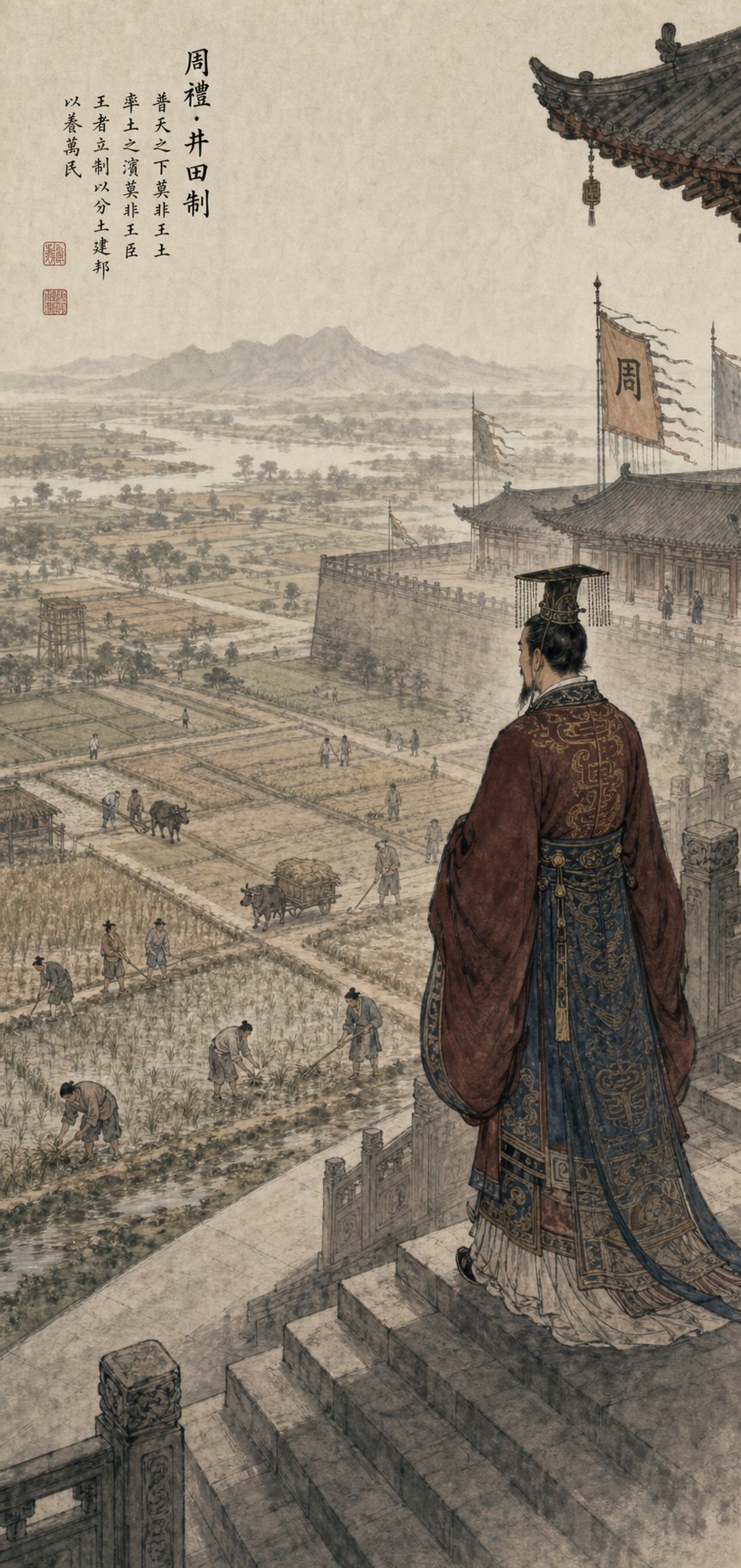
Not everyone in ancient China had the right to a name in the formal sense. During the Western Zhou period, surnames were not universal identifiers. They were privileges, reserved for those with political standing. If you were a farmer, a craftsman, or a laborer, you moved through life without either a Xing or a Shi attached to your identity. Understanding where surnames originate from in this system means confronting an uncomfortable fact: for most of early Chinese history, the majority of people simply had no surname at all.
Nobility Held Both Xing and Shi While Commoners Had Neither
The dual system of Xing and Shi operated exclusively within the aristocratic class. Nobles inherited their Xing from the ancient maternal clan and received or created a Shi based on their fief, title, or political role. These two layers gave the ruling class a precise way to track both deep ancestry and current rank. Commoners, by contrast, existed outside this framework entirely. As historical records from the pre-Qin period confirm, ordinary people did not have surnames or given names, and only the nobles possessed both.
This means that many rare last names surviving today, particularly those traceable to a specific Zhou-era Shi, likely point back to noble origins. If your surname matches an ancient lineage branch tied to a fief or state, your ancestors were probably part of the ruling class. Conversely, surnames that emerged later through occupations, geographic features, or adopted names often reflect the eventual spread of the naming system to common people.
How Surnames Extended to Common People During the Warring States
The feudal order did not hold forever. As Zhou authority weakened and rival states competed for dominance, rigid class boundaries began dissolving. Surnames gradually extended downward through society in a process spanning several centuries:
- Western Zhou (1046–771 BCE) — Only the royal house and enfeoffed nobles held Xing and Shi. Commoners were identified by occupation or location alone.
- Spring and Autumn period (770–476 BCE) — Lower-ranking nobles and shi (士, the scholar-warrior class) began adopting Shi names, expanding the pool beyond the highest aristocracy.
- Warring States period (475–221 BCE) — Social mobility increased dramatically. Merchants, soldiers, and educated commoners started claiming surnames, often derived from their trades, home villages, or a lord they served.
- Qin and Han dynasties (221 BCE–220 CE) — After unification, the merged surname system became standard for all free citizens. People with some education generally had their own surnames and given names, no longer limited to nobility.
- Song dynasty (960–1279 CE) — People from all social levels could hold surnames and even style names without restriction, completing the democratization of the naming system.
This chronological expansion explains why some last names are uncommon while others are shared by millions. Surnames originating from powerful Zhou-era states, like Ji-derived names such as Wang (王) or Zhang (张), spread widely because those lineages had large populations and political reach. Meanwhile, Shi names tied to minor fiefs or short-lived offices produced uncommon surnames that remain rare to this day. The scarcity of certain names is itself a historical fingerprint, pointing to a small noble branch that never grew into a large population.
The class-based restriction also shaped how the system eventually collapsed. When political power no longer depended on feudal land grants, the functional reason for distinguishing Xing from Shi evaporated. One royal Xing could produce dozens or even hundreds of Shi branches, and tracing that branching process reveals exactly how a single clan name multiplied into the vast landscape of modern Chinese surnames.
From One Xing to Dozens of Shi Surnames
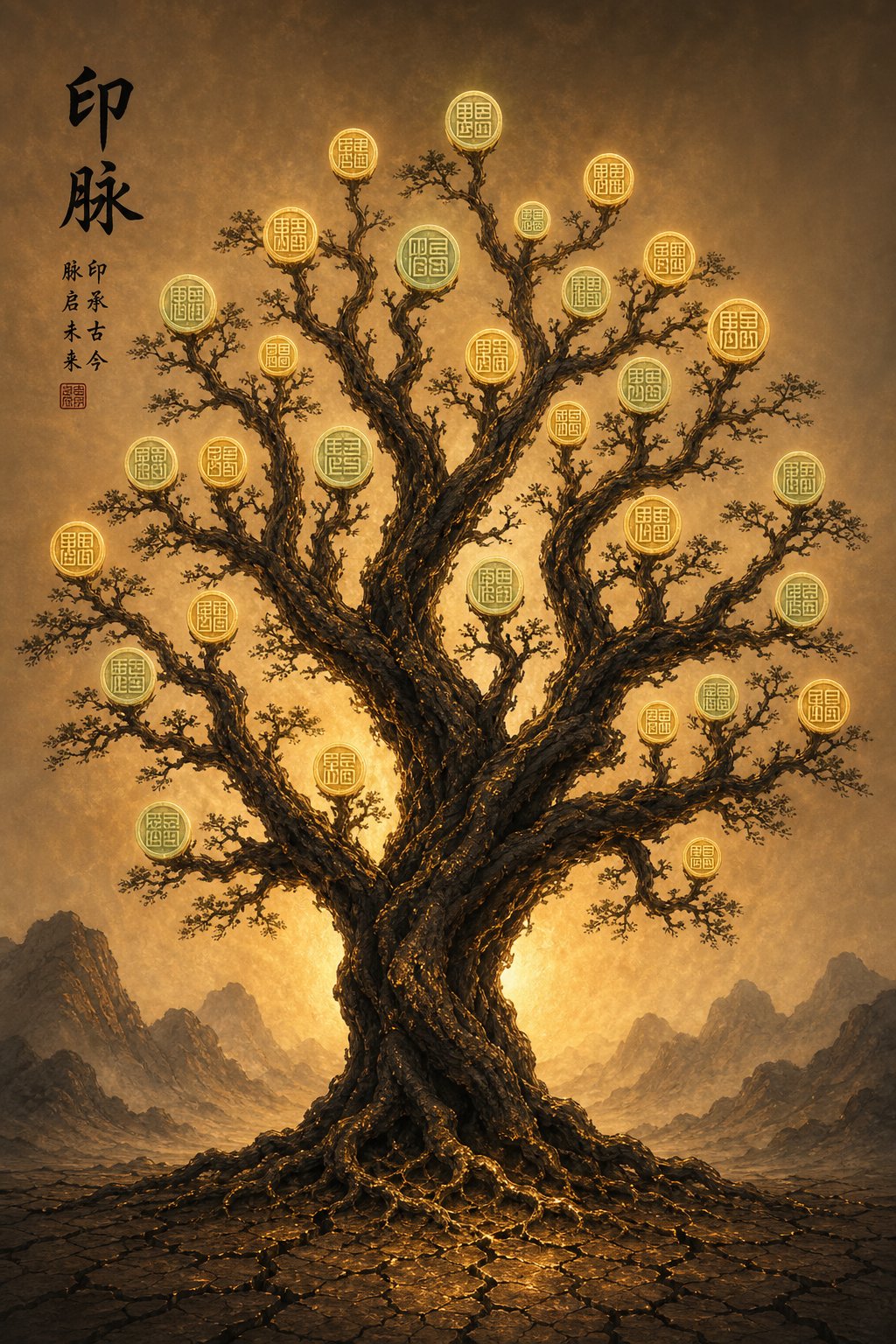
That multiplication process was not random. Each new Shi emerged from a specific political event: a king granting territory, a prince founding a state, or a minister inheriting an office. The result is that many of the most common chinese last names you encounter today, names like Wang, Zhou, Wu, and Zheng, trace back to a single ancestral Xing through documented historical branching. The clearest example is Ji (姬), the royal surname of the Zhou dynasty, which produced more derivative surnames than any other clan in Chinese history.
How Ji Produced More Than 100 Modern Surnames
Ji (姬) was the Xing of the Zhou royal house. When King Wu of Zhou overthrew the Shang dynasty around 1046 BCE, he and his successors parceled out territory to relatives, allies, and descendants. Each recipient governed a new state, and over time, the people of that state adopted its name as their Shi. One Xing, dozens of fiefs, dozens of new surnames.
Consider the scale. Zheng Qiao's Tongzhi records that Ji alone gave rise to over 100 distinct Shi names. Some became the most common chinese surnames still in use today. Others faded into obscurity as their states were conquered or absorbed. Here are the major branches and the specific reasons each Shi was created:
- Wei (魏) — The Bi clan, descendants of King Wen of Zhou's son Bi Gong Gao, were granted the fief of Wei. Their descendants founded the state of Wei during the Warring States period.
- Han (韩) — A branch of the Jin state's ruling family received the territory of Han. After the Partition of Jin in 403 BCE, they established the independent state of Han.
- Zhao (赵) — Zaofu, a descendant of the Zhou royal line through the Ying branch, was granted the city of Zhao (present-day Hongtong, Shanxi) by King Mu of Zhou for his service as a charioteer. His descendants took Zhao as their Shi.
- Zhou (周) — After the fall of the Zhou dynasty itself, members of the royal house adopted the dynasty's name as their surname, preserving their identity under new rulers.
- Wu (吴) — Taibo and Zhongyong, elder brothers of King Wen's father, voluntarily ceded their succession rights and migrated south to establish the state of Wu in the Yangtze Delta region.
- Zheng (郑) — King Xuan of Zhou enfeoffed his younger brother, Duke Huan, with the territory of Zheng. The state survived through the Spring and Autumn period, and its people carried Zheng as their Shi.
- Lu (鲁) — The Duke of Zhou's son, Bo Qin, was granted the state of Lu in present-day Shandong. Lu became the cultural heartland of Confucianism, and its ruling family's Shi spread widely.
Each of these names started as a geographic or political label for one branch of the Ji clan. Over centuries, as states rose and fell, those labels hardened into permanent family identifiers. Today, if you carry the surname Wei, Han, or Zhou, you likely share a common ancestor with everyone surnamed Wu or Lu, all flowing from the same Ji source. That is why Ji is sometimes called the "mother of surnames" in Chinese genealogical tradition.
A Family Tree Showing Xing-to-Shi Branching
Seeing the pattern in table form makes the branching logic clearer. Below is a structured view of how one Xing produced multiple Shi, with the mechanism that created each branch:
| Original Xing | Derived Shi (Modern Surname) | Reason for Branch Formation | Approximate Period |
|---|---|---|---|
| 姬 (Ji) | 魏 Wei | Fief of Wei granted to descendant of King Wen | Western Zhou |
| 韩 Han | Territory of Han granted to Jin branch family | Spring and Autumn | |
| 周 Zhou | Royal house adopted dynasty name after its fall | Eastern Zhou / Qin | |
| 吴 Wu | State founded by elder brothers who ceded succession | Western Zhou | |
| 郑 Zheng | Fief granted to King Xuan's younger brother | Western Zhou | |
| 鲁 Lu | State granted to Duke of Zhou's son | Western Zhou | |
| 王 Wang | Descendants of Zhou kings identified by title "king" | Eastern Zhou | |
| 嬴 (Ying) | 秦 Qin | Fei Zi enfeoffed in Qin territory by King Xiao of Zhou | Western Zhou |
| 赵 Zhao | Zaofu granted city of Zhao for chariot service | Western Zhou | |
| 黄 Huang | Descendants enfeoffed in Huang state (destroyed by Chu) | Spring and Autumn | |
| 马 Ma | General Zhao She granted fief of Mafu for military merit | Warring States | |
| 梁 Liang | Youngest son of Qin Zhong enfeoffed at Liang Mountain | Spring and Autumn | |
| 廉 Lian | Named after Da Lian, eldest son of Bo Yi | Xia dynasty |
The Ying (嬴) example is particularly striking. According to historical records documenting the Ying lineage, this single Xing produced what scholars call the "Fourteen Clans of the Ying Surname," including Qin, Zhao, Huang, Liang, Ma, Ge, Gu, Miao, Xu, Jiang, Lian, Zhong, Fei, and Qu. The Shiji records that after Bo Yi received the Ying surname from Emperor Shun, his descendants were enfeoffed across different territories over the following millennia. Fei Zi received the Qin fief for his skill in horse breeding. Zaofu earned the Zhao fief for his chariot driving. Each grant created a new Shi that eventually became an independent surname.
What makes this branching significant for modern readers? It means that many of the most common chinese last names are actually cousins. Zhao, Qin, Huang, and Ma all descend from the same Ying root. Wei, Han, Zhou, and Wu all descend from Ji. When you look at a list of the most common chinese surnames today, a large proportion trace back to just a handful of original Xing clans, with Ji and Ying accounting for a disproportionate share.
This also explains a paradox: if only eight original Xing existed, how did China end up with thousands of surnames? The answer is that virtually every modern surname is a former Shi. The original Xing names themselves, like Si (姒), Yun (妘), and Gui (妫), are now extremely rare. The Shi names, born from political events and territorial grants, are what survived and multiplied. The most common chinese last name in the world today, Wang (王), is itself a Shi derived from Ji, created when descendants of Zhou kings were identified simply by the title "king."
This branching process operated for roughly eight centuries before the feudal system that sustained it collapsed. When Qin Shi Huang dissolved the old states and abolished hereditary fiefs, the engine that generated new Shi names stopped running, and the two-layer system began its final merger into the single surname format still used today.
The Qin Dynasty Merger That Created Modern Surnames
When Qin Shi Huang unified China in 221 BCE, he did not just conquer rival states. He dismantled the entire feudal architecture that had given Shi its meaning for centuries. Hereditary fiefs were abolished. Noble titles tied to land were stripped away. The old states of Wei, Han, Zhao, Chu, Qi, and Yan ceased to exist as political entities. Without fiefs to grant and noble ranks to inherit, there was simply no mechanism left to generate new Shi names or maintain the distinction between them and Xing.
How Qin Unification Collapsed the Dual System
Imagine the feudal system as a tree that kept producing new branches. Each branch was a Shi, fed by the political soil of territorial grants and hereditary offices. Qin Shi Huang cut that tree at the root. He replaced feudal lords with appointed bureaucrats who served at the emperor's pleasure and could be reassigned or dismissed. No permanent fief meant no new lineage name. No hereditary rank meant no reason to distinguish your branch from the broader clan.
The former nobility of the conquered states faced an even harsher reality. Many were forcibly relocated to the Qin capital, stripped of their titles, or reduced to commoner status. As historical accounts of the period document, these defeated aristocrats were often unable or prohibited from using their original Xing. Meanwhile, commoners who had never held either a Xing or Shi began adopting surnames for the first time, typically taking whatever name identified their family locally, whether that was a former Shi, a place name, or an occupation.
By the Han dynasty, the merger was complete. Every chinese last name functioned the same way: a single hereditary identifier passed from father to children. The word 姓氏 (xingshi) survived as a compound term, but the two halves no longer pointed to separate systems. What people called their "surname" was, in almost every case, a former Shi that had outlived the political structure that created it. The common chinese names we recognize today, Li, Wang, Zhang, Liu, Chen, all descend from this post-merger landscape where lineage branches became permanent family identifiers.
Qu Yuan as a Case Study of the Complete Ancient Name
To see the full pre-merger naming system in action, consider Qu Yuan, the famous poet of the Warring States period. His name structure preserves all three layers that existed before unification collapsed them into one:
Qu Yuan's full ancient name: Xing (clan name): 芈 Mi | Shi (lineage name): 屈 Qu | Ming (given name): 平 Ping. He is remembered as "Qu Yuan" (屈原) using his Shi, not his Xing, because by the late Warring States period, Shi had already become the primary identifier for men.
His Xing, Mi (芈), was the ancestral clan name of the Chu royal house. His Shi, Qu (屈), identified the specific noble branch descended from a Chu prince who had been enfeoffed at a place called Qu. His Ming, Ping (平), was his personal given name, while Yuan (原) was his courtesy name (zi). When people today refer to him as "Qu Yuan," they are using his Shi plus his zi, exactly the convention that applied to men of rank during that era.
This matters for understanding chinese last name meanings. The surname Qu (屈) does not trace to the original eight Xing clans. It traces to a territorial grant within the Chu state, making it a Shi derived from the Xing Mi. Anyone surnamed Qu today carries a name born from a specific political event in the Chu kingdom, not from the deep matrilineal past. The same logic applies to the vast majority of modern surnames.
After the Qin-Han merger, no new figure would ever carry this three-layer structure again. The system simplified into what we recognize today: one surname, one given name. But the old complexity did not vanish cleanly from the historical record. It left behind a trail of confusion that still trips up readers of pre-Qin texts, where the same person can appear under entirely different names depending on which source you consult.
Reading Ancient Texts and Tracing Genealogy
That trail of confusion is not a flaw in the historical record. It is a feature of the dual system operating exactly as designed. When you open the Shiji or Zuozhuan and find the same person referred to by one name in one passage and a completely different name in another, you are seeing the Xing-Shi distinction at work. Recognizing this pattern is the difference between productive research and hours of frustration.
Why Historical Figures Appear Under Multiple Names
Consider a nobleman from the state of Chen during the Spring and Autumn period. In a passage about marriage alliances, he might appear under his Xing, 妫 (Gui), because the text is establishing that the union does not violate same-clan marriage rules. In a military record two chapters later, the same man appears under his Shi, 陈 (Chen), because the context is political. If you are researching the chen last name origin, this dual appearance is not two different people. It is one person recorded through two different lenses.
The same logic applies across dozens of figures. Shang Yang, the famous Qin reformer, appears as "Wei Yang" (魏鞅) in some sources because his Shi was Wei, derived from his home state. In others he is "Gongsun Yang" (公孙鞅) because Gongsun was an alternate Shi indicating descent from a duke. One person, multiple valid names, each reflecting a different facet of his identity within the old system.
This pattern also explains puzzles around the chang name origin. The surname Chang (常) traces to a Shi derived from the state of Wei, where descendants of a minister named Kang Shu adopted it. Yet in some early texts, these same ancestors appear under the Xing Ji (姬) because they belonged to the Zhou royal clan. Without understanding the dual system, a genealogy researcher might assume these are separate family lines rather than the same lineage recorded at different levels of specificity.
Using the Xing-Shi System for Genealogy Research
For anyone tracing chinese roots through historical documents, the Xing-Shi distinction is a practical research tool. It lets you push your family line further back by connecting a known Shi to its parent Xing. Here are concrete steps for applying this knowledge:
- Identify whether your surname is a Xing or a Shi. If it matches one of the eight ancient clan names (Ji, Jiang, Si, Ying, Yun, Gui, Ji, Yao), you hold an original Xing. If not, your surname is almost certainly a derived Shi, and you can trace it upstream to its parent clan.
- Cross-reference names across sources. When a figure appears under different names in the Shiji versus the Zuozhuan, check whether one is a Xing and the other a Shi. This often resolves apparent contradictions.
- Use Zheng Qiao's Tongzhi classification. The "Clan Studies" chapter categorizes Shi by formation type: from fiefs, official titles, ancestral given names, or geographic features. Knowing your surname's category tells you which type of historical record to search next.
- Look for the wong last name origin pattern. Surnames like Wong (王, a Cantonese romanization of Wang) trace to the Shi meaning "king," adopted by descendants of Zhou royalty. Identifying the romanization system (Cantonese, Hokkien, Mandarin) helps you connect diaspora surnames back to their original character and Shi origin.
- Check marriage records for Xing clues. Pre-Qin texts recording marriages almost always name the bride by Xing. If your research hits a dead end on the Shi side, marriage entries may reveal the deeper clan affiliation.
Understanding the chang name origin or any other surname's backstory follows the same method: locate the Shi in historical records, identify its parent Xing, then use that connection to access older genealogical layers that predate the surname itself. Each step backward through the system opens a wider window into your family's place within ancient Chinese society.
With these practical tools in hand, the six key distinctions between Xing and Shi can be consolidated into a single reference framework, one that places every difference side by side for quick comparison.
Side-by-Side Comparison of Xing and Shi
Six distinctions, eight centuries of parallel operation, and one eventual merger. That is a lot of ground to hold in your head at once. The table below pulls every key difference into a single reference point, organized by category so you can compare the two systems at a glance. Whether you are interpreting a passage in the Zuozhuan or trying to classify your own surname chinese character, this framework gives you the quick-lookup structure to do it.
Complete Xing vs Shi Comparison Table
| Category | 姓 Xing (Clan Name) | 氏 Shi (Lineage/Branch Name) |
|---|---|---|
| Origin Period | Prehistoric matrilineal era (before recorded history) | Patrilineal era, primarily Western Zhou dynasty (c. 1046 BCE onward) |
| Etymology | Contains 女 (woman) + 生 (born): "born of a woman" | No female radical; character originally meant "clan branch" or "stem" |
| Gender Association | Primarily identified women in Zhou-era records | Primarily identified men in Zhou-era records |
| Social Function | Regulated marriage by marking shared blood origin (same Xing = no marriage) | Signaled political rank, territorial holdings, and noble lineage |
| Inheritance Pattern | Fixed and unchanging across all generations | Could be created, granted, or changed with new fiefs or offices |
| Number of Original Examples | Eight ancient clans (Ji, Jiang, Si, Ying, Yun, Gui, Ji, Yao) | Thousands, generated continuously throughout the Zhou period |
| Who Could Hold One | All members of a clan, but formally recorded only for nobility | Only nobility during Western Zhou; extended to commoners by Warring States |
| Modern Legacy | Very few survive as common surnames today (Jiang, Yao are exceptions) | The vast majority of modern Chinese surnames are former Shi names |
| Key Historical Sources | Shiji (genealogical annals), Tongzhi (Clan Studies chapter) | Zuozhuan (naming conventions in context), Tongzhi (Shi classification system) |
The Proportional Legacy in Modern Surnames
Here is the number that puts everything in perspective. Of the thousands of common chinese surnames in use today, the overwhelming majority descend from Shi rather than original Xing. Research drawn from Zheng Qiao's classification and modern demographic data shows that surnames derived from the Yellow Emperor's Ji Xing alone cover roughly 86% of the major surnames among contemporary Chinese people. Those are not people surnamed Ji. They are people carrying one of the hundreds of Shi branches that split off from Ji over eight centuries of feudal grants.
Think about what that means for surnames in asia more broadly. When you look at the top 100 Chinese surnames by population, names like Li, Wang, Zhang, Zhou, Wu, and Zheng, nearly all of them are former Shi names tied to specific states, fiefs, or offices. The original eight Xing are almost invisible in modern usage. Si (姒), Yun (妘), and Gui (妫) have become so rare that most Chinese people have never met someone carrying one. Even Ying (嬴), the ancestral Xing of the Qin dynasty, is uncommon today because its descendants long ago adopted their various Shi branches as permanent identifiers.
The proportional legacy breaks down like this: original Xing names account for a tiny fraction of the modern surname chinese population, while derived Shi names account for nearly everything else. The system that was designed to be temporary and flexible, the branch labels that could be created or changed, ended up becoming the permanent layer. The system that was designed to be eternal and fixed, the deep clan markers, faded into near-obscurity once the marriage regulations that kept them visible stopped being enforced.
This inversion is the final piece of the puzzle. It explains why tracing your surname back to an original Xing requires multiple steps through historical records, why so many unrelated families share the same surname today, and why the distinction between Xing and Shi still matters for anyone serious about understanding where their name actually came from.
Final Recommendations for Understanding Chinese Surnames
Six distinctions. Two systems. One merger that reshaped how over a billion people identify themselves today. The dual structure of Xing and Shi is not just an academic curiosity. It is the key that unlocks chinese last names and meanings at their deepest historical layer, connecting modern identities to prehistoric clans, feudal politics, and marriage laws that shaped Chinese civilization for a millennium.
Key Takeaways for Surname Researchers
Here are the six core distinctions to carry with you when exploring chinese names, reading classical texts, or building a family tree:
- Etymology: Xing contains the female radical 女, pointing to matrilineal clan origins. Shi carries no such marker and emerged from patrilineal political structures.
- Gender usage: Women were recorded by Xing to regulate marriage. Men were recorded by Shi to signal rank and territory.
- Social access: Only nobility held both Xing and Shi during the Western Zhou. Commoners gained surnames gradually through the Warring States and Han periods.
- Branching mechanism: One Xing produced dozens or hundreds of Shi through fief grants, state foundations, and office inheritance.
- Historical merger: Qin unification destroyed the feudal system that sustained the distinction, collapsing both into a single surname by the Han dynasty.
- Modern legacy: Nearly all surviving chinese family names and meanings trace to former Shi branches, not original Xing clans.
Next Steps for Exploring Chinese Surname Origins
If you want to go deeper, three practical paths are worth pursuing. First, read the Hundred Family Surnames (百家姓), a Song-dynasty text listing common surnames. It does not explain origins, but it gives you a working inventory to cross-reference against Zheng Qiao's classifications. Second, consult regional jiapu (clan genealogy books) held by family associations, ancestral halls, or digitized collections. These records often trace a Shi back to its founding ancestor and parent Xing. Third, identify whether your own surname descends from one of the eight original Xing or from a derived Shi. That single determination tells you which historical period and which type of source will be most productive for your research.
The dual system may have merged two thousand years ago, but its fingerprints remain in every chinese family name carried today. Knowing how to read those fingerprints transforms a simple surname into a story stretching back to the origins of Chinese civilization itself.
Frequently Asked Questions About Xing vs Shi in Ancient Chinese Surnames
1. What is the difference between Xing and Shi in Chinese surnames?
Xing (姓) was an ancient matrilineal clan name shared by a large group tracing common female ancestry, while Shi (氏) was a patrilineal branch identifier created when clans grew too large. Xing regulated marriage by preventing unions between people of the same bloodline, whereas Shi signaled political rank, territorial holdings, and noble lineage. During the Zhou dynasty, women were recorded by Xing and men by Shi. The two merged into a single surname system after Qin unification in 221 BCE.
2. What are the eight original Xing surnames in ancient China?
The eight ancestral Xing clans are Ji (姬), Jiang (姜), Si (姒), Ying (嬴), Yun (妘), Gui (妫), Ji (姞), and Yao (姚). Most of these characters contain the female radical 女, reflecting their matrilineal origins. Ji was the royal surname of the Zhou dynasty and produced over 100 modern surnames. Today, only Jiang and Yao remain relatively common, while others like Yun and Gui have become extremely rare because their descendants adopted derived Shi names centuries ago.
3. Why do historical Chinese figures appear under different names in different texts?
Before the Qin dynasty merger, a person could be recorded by their Xing (clan name) in one context and their Shi (lineage name) in another. Marriage-related passages typically used Xing to verify bloodline legitimacy, while political and military records used Shi to indicate rank and territory. For example, Shang Yang appears as both 'Wei Yang' and 'Gongsun Yang' in different sources because each name reflects a different Shi associated with his identity. Recognizing this dual-recording system prevents researchers from mistaking one person for two separate individuals.
4. When did Chinese commoners first get surnames?
During the Western Zhou period (1046-771 BCE), only royalty and enfeoffed nobles held Xing and Shi. Commoners had no formal surname at all. The system gradually expanded during the Spring and Autumn period to lower-ranking nobles, then spread to merchants, soldiers, and educated commoners during the Warring States era (475-221 BCE). By the Han dynasty, the merged single-surname system became standard for all free citizens, completing a democratization process that took roughly 800 years.
5. How can I trace my Chinese surname back to its original Xing clan?
Start by determining whether your surname is one of the eight original Xing or a derived Shi. If it is a Shi (which applies to the vast majority of modern surnames), consult Zheng Qiao's Tongzhi classification to identify how it was formed, whether from a fief, official title, ancestral name, or geographic feature. Then trace it upstream to its parent Xing using genealogical records like the Shiji or regional jiapu (clan genealogy books). Cross-referencing marriage records in pre-Qin texts can also reveal deeper clan affiliations that standard political records omit.