What Is a Chinese Courtesy Name
Imagine watching a Chinese historical drama and hearing three different characters refer to the same person by three completely different names. One says Kongming, another says Zhuge Liang, and a third calls him Master Crouching Dragon. Confusing? Welcome to the layered world of traditional Chinese naming, where a single individual could carry multiple names, each governed by strict social rules about who could use it and when.
At the heart of this system sits the courtesy name, a concept with no direct equivalent in Western culture.
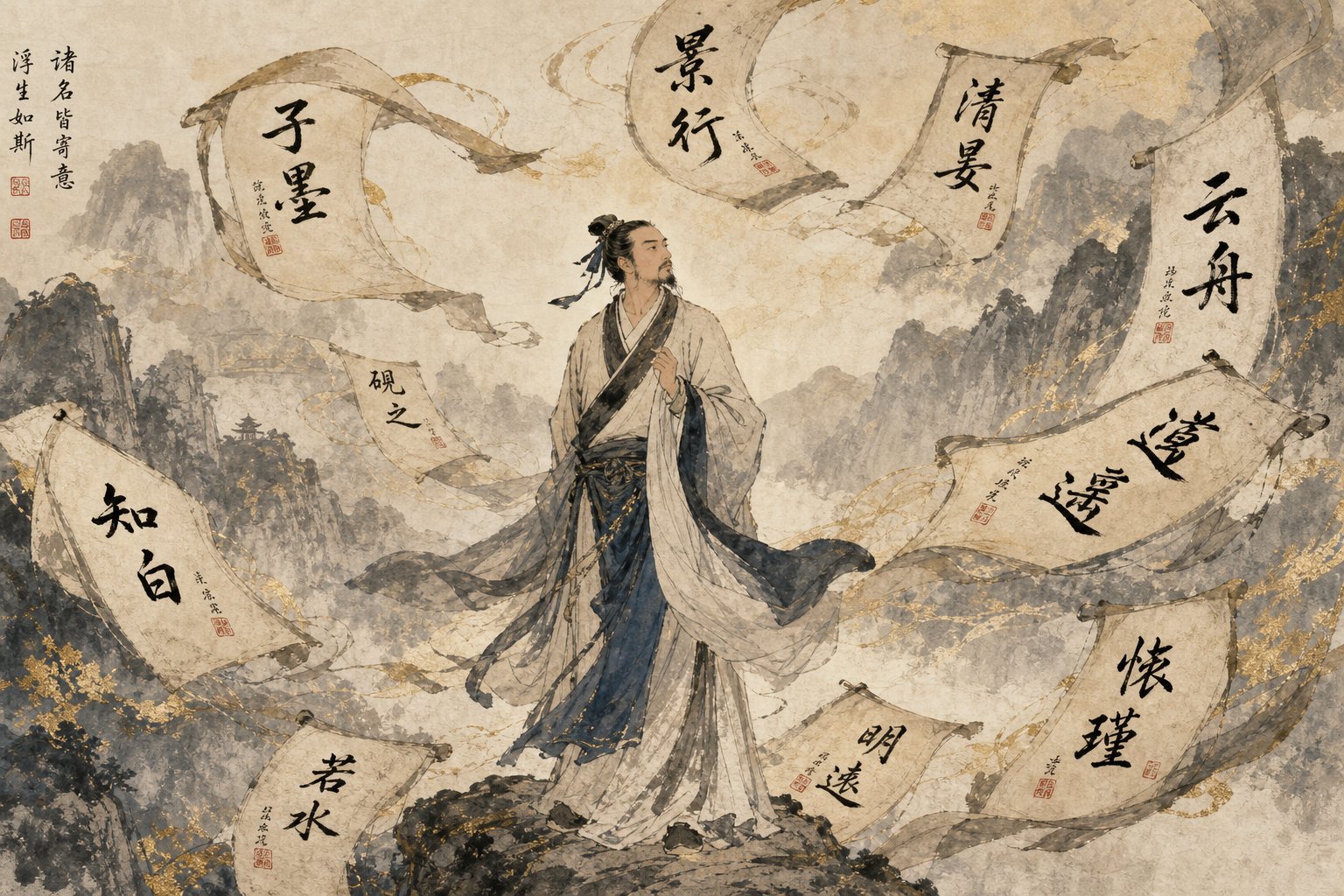
A Chinese courtesy name (字, zi) is a formal name bestowed upon a person at their coming-of-age ceremony, typically around age twenty for men and fifteen for women. It served as the standard form of address in social interactions, used by peers, colleagues, and acquaintances to show respect, while the birth name (名, ming) remained reserved for elders and the individual themselves.
Defining the Courtesy Name in Chinese Culture
The distinction between a given name and a courtesy name is fundamental. Your given name (名, ming) was intimate, private, almost sacred. According to the classical character dictionary Shuowen Jiezi, the original function of ming was to announce one's identity when encountering someone in the dark of evening. It belonged to your parents and your family. Calling someone by their ming in public was considered deeply disrespectful, an act so offensive that even sworn enemies avoided it.
The courtesy name, by contrast, was your public identity. It was the name your friends used, the name your colleagues knew you by, and the name that appeared in polite correspondence. When searching for the term courtesy 中文, you'll find that the modern Chinese word for "name" is actually 名字 (mingzi), combining both concepts into one. But in traditional society, these were two entirely separate things with distinct social functions.
Why Courtesy Names Mattered in Social Interactions
Think of it this way. In many Western workplaces, you might address your boss as "Mr. Chen" rather than "David." A Chinese courtesy name operated on a similar principle of formality, but it ran much deeper. It wasn't just polite. It was a moral obligation woven into the fabric of Confucian social order.
Here's how the usage rules worked in practice:
- Elders and superiors could call you by your given name (ming) — this was their privilege.
- Peers and acquaintances used your courtesy name (zi) — this showed mutual respect.
- You referred to yourself by your own given name — this demonstrated humility.
Confucius himself consistently called himself Qiu (his ming) in front of his students, modeling the self-deprecating etiquette expected of a gentleman. His students, in turn, would never have dared use that name to address him.
The courtesy name wasn't chosen randomly, either. It carried meaning that extended, complemented, or even contrasted with the given name. The famous strategist Zhuge Liang (亮, meaning "bright") received the courtesy name Kongming (孔明, meaning "exceedingly bright"), reinforcing and amplifying the original name's meaning. This generative relationship between ming and zi followed identifiable patterns that reveal how deeply the Chinese valued linguistic precision and moral aspiration in personal identity.
What follows is a complete exploration of this lost tradition: its origins in Zhou Dynasty ritual texts, the ceremonies that bestowed these names, the rules governing their creation, famous examples spanning two millennia, and the cultural forces that ultimately swept them away in the twentieth century.
Historical Timeline from Zhou Dynasty to Late Imperial China
These naming conventions didn't appear overnight. The system of ancient China names evolved across more than two thousand years, shaped by ritual texts, dynastic politics, and shifting cultural values. Tracing that evolution reveals how a simple social custom hardened into one of the most enduring traditions in Chinese civilization.
Zhou and Han Dynasty Origins
The earliest documented evidence of courtesy names appears in the Zhou Dynasty (1046-256 BCE). The Yili (儀禮, "Etiquette and Rites"), one of the Three Ritual Classics, dedicates its very first chapter to the capping ceremony (士冠禮, Shiguanli) that formally bestowed the zi upon young men. Alongside it, the Liji (禮記, "Book of Rites") and the Zhouli (周禮, "Rites of Zhou") codified the rules governing when and how these names were assigned. Together, these texts established the framework that every subsequent dynasty inherited.
During the Zhou period, courtesy names served a practical function within the feudal aristocracy. Nobles needed a way to address one another without violating the intimacy of the given name, and the zi filled that gap. By the Han Dynasty (206 BCE-220 CE), the practice had become fully formalized across the scholar-official class. Han-era courtesy names were frequently a single character, sometimes preceded by a ranking marker like Bo (伯, eldest), Zhong (仲, second), Shu (叔, third), or Ji (季, youngest) to indicate birth order within the family. The historian Ban Gu (班固), for example, carried the courtesy name Mengjian (孟堅), where Meng signals his position as the eldest son.
Evolution Through Tang, Song, Ming, and Qing
A gradual shift occurred after the Han. Two-character courtesy names became the dominant format, and the semantic relationship between the ancient chinese name (ming) and the zi grew more sophisticated. Tang Dynasty poets and officials favored literary allusions in their courtesy names, drawing from classical poetry and philosophy. By the Song Dynasty, the practice reached its cultural peak. Scholars like Su Shi (courtesy name Zizhan 子瞻) chose names that reflected deep engagement with Confucian and Buddhist thought.
Through the Ming and Qing dynasties, the tradition persisted largely unchanged in structure, though it spread somewhat beyond the strict scholar-gentry class. The chinese old name system remained intact until the early twentieth century, when political revolution finally disrupted what ritual texts had preserved for millennia.
| Dynasty | Period | Typical Format | Key Characteristics |
|---|---|---|---|
| Zhou | 1046-256 BCE | 1-2 characters | First codification in ritual classics; practice limited to aristocracy |
| Han | 206 BCE-220 CE | 1 character (often with birth-order prefix) | Formalized across scholar-official class; single-character zi common |
| Tang | 618-907 CE | 2 characters | Literary allusions favored; all emperors received temple names, expanding naming culture |
| Song | 960-1279 CE | 2 characters | Peak cultural importance; deep philosophical and poetic references standard |
| Ming | 1368-1644 CE | 2 characters | Practice spread beyond strict elite; generational characters sometimes used |
| Qing | 1644-1911 CE | 2 characters | Tradition maintained until dynasty's fall; Manchu rulers adopted Chinese naming conventions |
What's striking about this timeline is how stable the core principle remained. Across every dynasty, the courtesy name served the same social function: it protected the intimacy of the given name while providing a respectful form of public address. The format evolved, the literary sophistication deepened, but the underlying logic held firm for over two thousand years. That consistency raises a natural question: how did the courtesy name fit within the broader ecosystem of Chinese personal names, where a single person might carry half a dozen different designations?
The Complete Chinese Naming System Explained
A single person in traditional China could accumulate five, six, or even more names over the course of a lifetime. Each one belonged to a different stage of life, a different social context, or a different audience. Understanding Chinese naming conventions means seeing how all these layers fit together, with the courtesy name occupying one very specific slot in a much larger architecture.
Milk Names, School Names, and Given Names
A child's first name chinese families assigned was the milk name (乳名, ruming). This was an informal, often deliberately humble or even ugly-sounding nickname given at birth. Parents believed that an unattractive name would ward off evil spirits and keep the child safe during vulnerable early years. Historical records show aristocrats named things like "Black Shoulder" or "Black Buttocks," chosen precisely because they lacked elegance.
When the child entered school, they typically received a school name (学名, xueming), sometimes also called a training name (训名, xunming). This was a more respectable name suitable for public use in educational settings. It replaced the milk name in formal contexts but still wasn't the adult identity the person would carry through life.
The given name (名, ming), sometimes called the "true name" (讳, hui), was the formal birth name recorded in family registers. This was the name that carried weight, the one protected by strict taboos. Using someone's ming in public was considered a grave insult, something even sworn enemies avoided. Only elders, parents, and the emperor had the social standing to use it.
Courtesy Names Versus Literary Names and Posthumous Titles
The courtesy name (字, zi) arrived at adulthood and became the standard form of address among peers. But it wasn't the final layer. Many scholars also adopted a literary name or pseudonym (号, hao). If you're wondering about the hao meaning in English, it translates roughly to "art name" or "alias," functioning as a self-chosen creative identity. The poet Tao Yuanming called himself "Mr. Five Willows" after the trees near his home. The scholar Ouyang Xiu styled himself "The Hermit of Six Ones." These names were expressive, personal, and entirely voluntary.
By the sobriquets definition most scholars use, the hao fits neatly into that category: a descriptive name chosen to reflect personality, philosophy, or circumstance rather than assigned by social obligation. Unlike the courtesy name, which was bestowed by an elder during a formal ceremony, the hao belonged entirely to the individual.
Beyond personal names, rulers accumulated additional designations after death. Posthumous names (谥号, shihao) were evaluative titles assigned to emperors and high officials based on their conduct during life. Temple names (庙号, miaohao) were shorter titles used for ancestor worship in imperial grand temples, typically consisting of just two characters. Era names (年号, nianhao) designated the reign period of an emperor and were used for dating purposes rather than personal address.
The table below maps out this entire chinese naming convention system in one place:
| Name Type | Chinese Term | Pinyin | Who Assigned It | When Used | Who Could Use It |
|---|---|---|---|---|---|
| Milk Name | 乳名 | ruming | Parents or grandparents | Infancy through childhood | Close family members |
| School Name | 学名 | xueming | Parents or teacher | Upon entering school | Teachers, classmates, formal contexts |
| Given Name | 名 | ming | Parents (often with divination) | From birth; recorded in family registers | Elders, parents, the emperor, oneself (in humility) |
| Courtesy Name | 字 | zi | Respected elder or mentor at capping ceremony | From adulthood onward | Peers, colleagues, acquaintances |
| Literary Name | 号 | hao | Self-chosen | Any time after adolescence | Anyone; no restrictions |
| Posthumous Name | 谥号 | shihao | Court officials after death | After death, for historical reference | Historians, descendants, official records |
| Temple Name | 庙号 | miaohao | Successor emperor | After death, for ancestral worship | Court rituals, historical texts |
| Era Name | 年号 | nianhao | The emperor himself | During reign, for calendar dating | Everyone (for dating documents and events) |
You'll notice a clear pattern here. The more intimate the name, the fewer people had permission to use it. The milk name belonged to the nursery. The given name belonged to the family. The courtesy name belonged to society. And the literary name belonged to the individual alone. Each layer expanded the circle of who could address you, while simultaneously protecting the layers beneath it.
This hierarchy wasn't arbitrary. It reflected the Confucian principle that relationships carry obligations, and that language itself must honor those obligations. The courtesy name sat at the exact intersection of private identity and public life, which is precisely why its bestowal required a formal ritual, a ceremony that marked the boundary between childhood and adult responsibility.
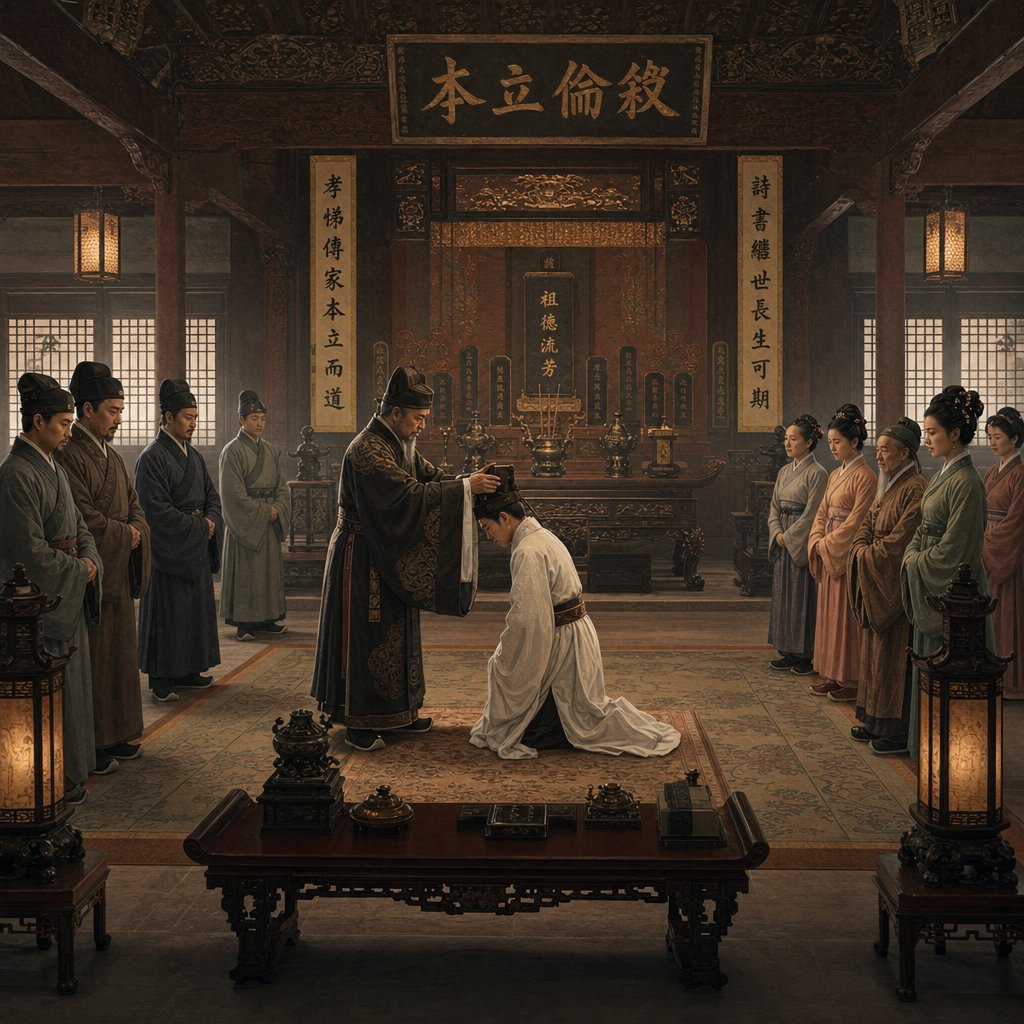
The Capping and Hairpin Ceremonies That Bestowed the Name
That formal ritual was no small affair. The moment a young person received their courtesy name was one of the most significant events in their life, comparable in weight to a wedding or a funeral. The Liji (Book of Rites) called the capping ceremony "the beginning of all rites," placing it at the very foundation of Chinese adulthood. Without it, a person remained socially incomplete, unable to fully participate in the obligations and privileges of adult society.
The Male Capping Ceremony Step by Step
The Guanli (冠礼) was performed when a young man reached the age of twenty. His father or elder brother hosted the event, but the central role belonged to a principal guest, a respected elder or mentor chosen specifically for his moral standing. This guest performed the actual capping and, crucially, bestowed the courtesy name. The ceremony took place in the family's ancestral temple, reinforcing the connection between the individual, his lineage, and his ancestors.
As documented in the Yili's opening chapter on the Capping Ceremony for Scholars, the ritual followed a precise sequence:
- Divination and preparation. An auspicious day was selected through divination. The host invited the principal guest and prepared offerings for heaven, earth, and the ancestors.
- Announcement to ancestors. At dawn, the father led the young man into the ancestral temple to formally report the occasion.
- The first capping (Black Cloth Crown). The principal guest placed a cap of black hemp cloth on the youth's head, symbolizing his qualification to participate in governance. The blessing recited: "Abandon your childish aspirations and follow your adult virtues."
- The second capping (Pibian, leather cap). A white deer-skin military cap was added, representing the duty to defend the state. The blessing: "Respect your demeanor, be prudent in your virtue."
- The third capping (Juebian, ceremonial cap). A reddish-black cap used in sacrificial rites was placed, granting eligibility to participate in major ceremonies. The blessing: "To complete your virtue."
- Bestowal of the courtesy name. The principal guest formally announced the young man's zi, selecting a name that reflected moral aspiration and complemented the given name.
- Paying respects. The newly capped adult visited his mother, brothers, aunts, and elder sisters, then traveled to pay respects to local officials and village elders, publicly announcing his new status.
Each successive cap carried greater honor. The progression moved from civil responsibility to military duty to sacred ritual, mapping out the full scope of what adult life demanded. The importance of names in this context went far beyond labeling. Receiving the zi meant the young man now possessed social dignity. From that day forward, only his elders could call him by his given name. Everyone else used the courtesy name, acknowledging him as a full participant in society.
The Female Hairpin Ceremony and Its Differences
The Jili (笄礼) served the same transitional purpose for young women, though it differed in timing, symbolism, and scope. Girls underwent the ceremony at fifteen, five years earlier than their male counterparts. Instead of a cap, the ritual centered on pinning up the hair with a ceremonial hairpin (笄, ji), symbolizing adulthood and readiness for betrothal.
Where the male ceremony emphasized civic, military, and ritual responsibilities, the hairpin ceremony marked a woman's transition into eligibility for marriage and her formal entry into household duties. After the Jili, noblewomen typically received further education in the "four virtues": fude (妇德, moral character), fuyan (妇言, proper speech), furong (妇容, dignified appearance), and fugong (妇功, domestic skills).
The ceremony was simpler in structure, lacking the triple progression of the Guanli, but it carried equal weight as a rite of passage. A woman who had undergone the Jili was considered an adult, and her courtesy name, once bestowed, signaled that she had crossed the threshold from girlhood into the responsibilities of womanhood.
Both ceremonies shared a core principle: the courtesy name was not something you chose for yourself. It was given to you by someone whose moral authority you respected, at a moment designed to impress upon you the gravity of what adult life required. That external bestowal raises a fascinating question. If you didn't pick your own zi, what logic governed how it was created? The answer lies in a set of elegant linguistic patterns that connected the courtesy name to the given name through meaning itself.
Rules and Patterns Behind Courtesy Name Creation
The relationship between a given name and a courtesy name was never random. It followed identifiable rules, a generative logic that anyone literate in classical Chinese could read and appreciate. Understanding these patterns transforms what looks like an arbitrary collection of stylized personal names into a coherent system with its own internal grammar.
Five primary patterns governed how a zi was constructed from a ming. Each one created a different kind of semantic bridge between the two names, revealing the chinese meaning of names at a deeper level than surface translation alone can capture.
Synonymous and Complementary Name Patterns
The most common approach was synonymous pairing: the courtesy name echoed or amplified the meaning of the given name. Zhuge Liang's name Liang (亮) means "bright." His courtesy name Kongming (孔明) means "exceedingly bright," reinforcing the same concept with greater intensity. The two names of different styles point in the same semantic direction, one simply louder than the other.
Complementary names worked differently. Instead of repeating the meaning, they extended it, completing a thought the given name only started. Yue Fei (岳飞), the Song Dynasty general, had a given name meaning "to fly." His courtesy name Pengju (鹏举) means "the great roc rises," drawing on the mythical bird from Zhuangzi's philosophy to give the concept of flight a grander, more literary dimension. The zi didn't echo the ming. It finished its sentence.
Antonymous, Allusive, and Generational Patterns
Antonymous pairing was rarer but striking. The Tang Dynasty literary giant Han Yu (韩愈) carried a given name meaning "to advance" or "to surpass." His courtesy name Tuizhi (退之) means "to retreat," a deliberate opposite. The tension between the two names expressed a Confucian ideal: ambition tempered by modesty, progress balanced by restraint.
Allusive names referenced classical texts or natural imagery rather than directly engaging with the ming's meaning. Zhao Yun (赵云), the Three Kingdoms general whose given name means "cloud," received the courtesy name Zilong (子龙, "young dragon"). In Chinese cosmology, dragons emerge from clouds, so the allusion connects the two names through cultural symbolism rather than direct definition.
Finally, generational markers embedded birth order directly into the courtesy name. Characters like bo (伯, eldest), zhong (仲, second), shu (叔, third), and ji (季, youngest) appeared as the first character of the zi. Sun Jian's four sons illustrate this perfectly: Sun Ce was Bofu (伯符), Sun Quan was Zhongmou (仲谋), Sun Yi was Shubi (叔弼), and Sun Kuang was Jizuo (季佐). Reading the courtesy names in sequence tells you exactly who was born first, second, third, and last.
| Pattern Type | Explanation | Historical Example |
|---|---|---|
| Synonymous | Courtesy name shares or amplifies the meaning of the given name | Zhuge Liang (亮, bright) → Kongming (孔明, exceedingly bright) |
| Complementary | Courtesy name extends or completes the concept introduced by the given name | Yue Fei (飞, to fly) → Pengju (鹏举, the great roc rises) |
| Antonymous | Courtesy name expresses the opposite meaning, creating philosophical tension | Han Yu (愈, to advance) → Tuizhi (退之, to retreat) |
| Allusive | Courtesy name references classical texts or natural symbolism connected to the given name | Zhao Yun (云, cloud) → Zilong (子龙, young dragon; dragons emerge from clouds) |
| Generational | First character indicates birth order among male siblings (伯, 仲, 叔, 季) | Sun Quan (权, second son) → Zhongmou (仲谋; 仲 marks him as second-born) |
These patterns weren't mutually exclusive. A single courtesy name could combine generational markers with synonymous meaning, or layer allusion on top of complementary logic. The system rewarded literary creativity within a structured framework, which is why the best courtesy names read like miniature poems, dense with meaning and elegant in construction.
Knowing the rules is one thing. Seeing them applied across two thousand years of history, from Han Dynasty historians to Ming Dynasty philosophers, reveals just how versatile and expressive this naming art could be in practice.

Famous Courtesy Names Across Chinese Dynasties
The patterns described above weren't abstract theory. They produced some of the most recognizable ancient chinese names in history, names that still appear in literature, philosophy, and popular culture today. While Three Kingdoms figures tend to dominate online discussions, the tradition stretched far wider. From Han Dynasty historians to Ming Dynasty philosophers, each era produced courtesy names that reveal the courtesy name meaning system in action.
Han and Three Kingdoms Era Examples
Sima Qian (ca. 145-ca. 90 BCE), the father of Chinese historiography, carried the given name Qian (迁), meaning "to move forward" or "to progress." His courtesy name Zichang (子長) means "young and enduring," suggesting continuous growth. The relationship is complementary: forward movement implies a journey that extends over time. Sima Qian's life embodied that meaning. Despite suffering castration under Emperor Wu for defending a disgraced general, he pressed forward to complete the Records of the Historian, China's first comprehensive biographical history.
Cao Cao (155-220 CE), the warlord and poet of the Three Kingdoms era, offers a synonymous pairing. His given name Cao (操) means "conduct" or "moral integrity." His courtesy name Mengde (孟德) means "first in virtue," with Meng (孟) indicating eldest status and De (德) meaning "virtue" or "moral power." Both names point toward the same concept of ethical character, though history would judge whether Cao Cao lived up to that aspiration. Resources like chinaknowledge document how this synonymous pattern was especially popular during the Han and Three Kingdoms periods, when single-concept names dominated.
Zhuge Liang's case, already familiar from earlier sections, remains the textbook synonymous example: Liang (亮, bright) paired with Kongming (孔明, exceedingly bright). It's worth noting precisely because its simplicity makes the pattern unmistakable.
Tang, Song, and Ming Dynasty Examples
The Tang Dynasty produced ancient asian names of extraordinary literary elegance. Li Bai (701-762), arguably China's most celebrated poet, had the given name Bai (白), meaning "white" or "pure brightness." His courtesy name Taibai (太白) means "great whiteness," also the Chinese name for the planet Venus. The relationship is synonymous but elevated: ordinary brightness becomes cosmic radiance. The name suited a poet whose verse was said to have been composed while drunk under moonlight.
Du Fu (712-770), often paired with Li Bai as China's other supreme poet, carried the given name Fu (甫), an archaic character meaning "great" or "just beginning manhood." His courtesy name Zimei (子美) means "young and beautiful" or "young excellence." The complementary logic connects the idea of a man entering his prime with the beauty and refinement that prime should produce. Born into a scholarly family, Du Fu received a traditional Confucian education that shaped both his moral seriousness and his unmatched mastery of regulated verse.
Su Shi (1037-1101), the Song Dynasty polymath, demonstrates an allusive pattern. His given name Shi (轼) refers to the crossbar at the front of a carriage, the rail a rider leans on to gaze into the distance. His courtesy name Zizhan (子瞻) means "young and far-seeing." The connection is spatial and metaphorical: the crossbar enables the act of looking far ahead. His father Su Xun deliberately chose names for both sons that worked as a set. Su Shi's brother Su Zhe (辙, "wheel track") received the courtesy name Ziyou (子由, "young and free-roaming"), connecting the path a wheel carves with the freedom of travel.
Wang Yangming (1472-1529), the Ming Dynasty Neo-Confucian philosopher and general, was born Wang Shouren (守仁). Shouren means "to guard benevolence," expressing the Confucian duty to protect and cultivate ren (仁), the cardinal virtue. His courtesy name Bo'an (伯安) means "eldest and peaceful," with Bo (伯) marking him as the firstborn and An (安) meaning "peace" or "stability." The complementary logic is clear: one who guards benevolence creates peace. Wang's philosophy of the "unity of knowledge and action" would later influence thinkers across East Asia, and chinaknowledge resources note that he remains one of the most studied figures in Confucian intellectual history.
| Historical Figure | Given Name Meaning | Courtesy Name | Courtesy Name Meaning | Pattern |
|---|---|---|---|---|
| Sima Qian (司馬遷) | Qian 迁: to move forward, progress | Zichang 子長 | Young and enduring | Complementary |
| Cao Cao (曹操) | Cao 操: conduct, moral integrity | Mengde 孟德 | First in virtue | Synonymous |
| Zhuge Liang (諸葛亮) | Liang 亮: bright | Kongming 孔明 | Exceedingly bright | Synonymous |
| Li Bai (李白) | Bai 白: white, pure brightness | Taibai 太白 | Great whiteness (Venus) | Synonymous |
| Du Fu (杜甫) | Fu 甫: great, beginning manhood | Zimei 子美 | Young and beautiful | Complementary |
| Su Shi (蘇軾) | Shi 轼: carriage crossbar | Zizhan 子瞻 | Young and far-seeing | Allusive |
| Wang Shouren (王守仁) | Shouren 守仁: to guard benevolence | Bo'an 伯安 | Eldest and peaceful | Complementary |
What emerges from this cross-dynasty survey is how consistently the system rewarded intellectual depth. The best courtesy names weren't just labels. They were arguments, compressed into two characters, about who a person was meant to become. Yet this tradition belonged overwhelmingly to one segment of society: educated men from the scholar-gentry class. How women and commoners related to this naming art tells a very different story.

Gender and Social Class in Courtesy Name Traditions
The examples above share something in common beyond their literary elegance: they all belong to men from privileged, educated families. That's not a coincidence. Chinese naming customs surrounding the zi were shaped by deep structural inequalities in who had access to classical education, public life, and formal ritual. Gender and class determined not just what courtesy name you received, but whether you received one at all.
How Women Received and Used Courtesy Names
Women did receive courtesy names in traditional China, but the process looked fundamentally different. The Book of Rites states plainly: "A son at twenty is capped, and receives his appellation... When a daughter is promised in marriage, she assumes the hair-pin, and receives her appellation." Notice the distinction. A man's zi arrived at a fixed age, marking his entry into adult society. A woman's zi arrived at betrothal, tying her adult identity to her relationship with a future husband rather than to independent social participation.
In earlier periods, this meant a woman's courtesy name was essentially private. It circulated within the household and among close relatives rather than functioning as a public form of address the way a man's zi did. A woman who never married might never receive a formal courtesy name at all. Even when the hairpin ceremony was performed at fifteen as a standalone coming-of-age rite, the social sphere in which a woman could use her zi remained far more restricted than a man's.
By the Tang and Song dynasties, elite women from literary families sometimes received courtesy names that reflected the same sophisticated patterns as men's. Poets and scholars occasionally recorded their daughters' zi in family documents. But these cases were exceptions rather than the norm. The chinese name first name relationship that governed men's public interactions simply didn't extend to women in the same way, because women were largely excluded from the public arenas where courtesy names served their social function.
Social Class Boundaries and the Scholar-Gentry Monopoly
Class drew an equally sharp line. The courtesy name tradition required two things that most of China's population lacked: literacy in classical Chinese and access to someone qualified to perform the capping ceremony. A farmer, a merchant, or an artisan might possess a given name and a milk name, but without classical education, the entire semantic system connecting ming to zi was inaccessible. You can't create a courtesy name that alludes to Zhuangzi if you've never read Zhuangzi.
Throughout the Han, Tang, and Song dynasties, the practice remained overwhelmingly confined to the scholar-official class and the landed gentry. These were families who could afford tutors, owned books, and participated in the examination system. Chinese honorifics and naming rituals reinforced their social position, marking them as culturally distinct from the laboring majority.
By the Ming and Qing dynasties, the boundaries softened somewhat. Prosperous merchants who invested in their sons' education, successful artisans who entered literati circles, and families climbing the social ladder through the imperial examination system all adopted the practice. The spread of printing made classical texts more accessible, and the expansion of local academies brought Confucian education to a wider audience. Still, the courtesy name never became universal. It remained tied to literacy, to classical learning, and to participation in a social world where Confucian etiquette governed daily interactions.
This class dimension helps explain why the tradition disappeared so completely in the twentieth century. It wasn't just an ancient custom. It was a marker of elite identity, and when revolutionary movements targeted traditional hierarchies, the courtesy name became an easy symbol of the old order to discard. The forces that swept it away were political as much as cultural, and they arrived with startling speed.
Common Misconceptions About Chinese Courtesy Names
Before the tradition vanished, it had already become misunderstood. Western readers encountering the concept for the first time often map it onto familiar categories that don't quite fit. The result is a set of persistent misconceptions that flatten a sophisticated social system into something far simpler than it actually was.
They Are Not Nicknames or Secret Names
The two most common errors involve casualness and secrecy, neither of which applies. Some English-language sources describe courtesy names as styled nicknames, but this gets the formality exactly backward. A nickname chinese culture recognizes (like a milk name or a playful childhood label) is informal and intimate. The zi was the opposite: public, dignified, and governed by strict etiquette. Calling it a nickname is like calling a judge's title a pet name.
The secrecy myth likely arises from confusion with the given name. Because the ming was protected by taboo and restricted to elders, Western readers sometimes assume the zi carried similar restrictions. It didn't. The courtesy name was designed for broad social circulation. Everyone in your professional and social world knew it and used it daily.
They Did Not Replace Given Names or Function Like Middle Names
Equally misleading is the idea that the zi replaced the ming entirely, or that it worked like a Western middle name sitting quietly between first and last. Both names coexisted throughout a person's life, each with clearly defined usage rules. The ming didn't disappear at twenty. It simply became restricted to specific relationships.
Here are the five most common misconceptions, corrected:
- Misconception: Courtesy names are nicknames. Correction: They are formal names used in polite address. Nicknames in chinese tradition (milk names, playful labels) are casual and private. The zi is neither.
- Misconception: Courtesy names were secret. Correction: They were public and used constantly. It was the given name (ming) that carried privacy restrictions, not the zi.
- Misconception: Courtesy names replaced given names. Correction: Both coexisted with strict rules. Elders still used the ming; peers used the zi. Neither name disappeared.
- Misconception: Anyone could choose their own courtesy name. Correction: The zi was typically bestowed by a respected elder or mentor during the capping ceremony. Self-selection was the norm for the hao (literary name), not the zi.
- Misconception: Courtesy names are like Western middle names. Correction: A middle name is rarely used in daily address and carries no social protocol. The zi was the primary form of address among peers, governed by Confucian etiquette, and semantically linked to the given name through deliberate literary patterns.
The confusion is understandable. English lacks a direct equivalent, so the mind reaches for the closest available category. But treating the zi as styled nicknames or dormant middle names strips away precisely what made the system meaningful: its active, daily role in regulating social relationships through language. The courtesy name wasn't decorative. It was functional, and its function was respect.
That function endured for over two thousand years. So what finally killed it? The answer involves not just changing fashion but deliberate political destruction, a story that begins with student protesters in 1919 and ends with a cultural landscape almost unrecognizable to the scholars who came before.

Why Courtesy Names Vanished and Their Modern Legacy
A tradition that survived dynastic collapses, foreign invasions, and centuries of social upheaval was dismantled in barely two generations. The disappearance of the courtesy name wasn't a gradual fading. It was a deliberate rejection, driven by intellectuals who saw the entire Confucian naming system as a relic of feudal oppression.
The May Fourth Movement and Republican-Era Reforms
The killing blow landed in 1919. The May Fourth Movement was an intellectual revolution that attacked traditional Confucian ideas and championed Western science and democracy. Young reformers like Chen Duxiu and Hu Shi didn't just want political change. They wanted to dismantle the social hierarchies embedded in everyday life, including the elaborate naming rituals that reinforced status distinctions between elders and juniors, scholars and commoners, men and women.
The movement's push for vernacular writing (baihua) over classical Chinese struck directly at the courtesy name's foundation. If you're abandoning the classical literary tradition, the entire semantic system connecting ming to zi loses its cultural oxygen. You can't craft an allusive courtesy name referencing Zhuangzi when the educational establishment is pivoting away from classical texts.
Republican-era reforms accelerated the collapse. The new civil registration systems required a single legal name. The capping ceremony, already declining among urban families, lost its institutional support. By the 1930s and 1940s, younger generations in cities simply stopped receiving courtesy names. The practice lingered in rural areas and among traditionally educated families, but its social necessity had evaporated. When everyone addresses everyone by a single name, the question of what is a courtesy name in China becomes purely historical.
After 1949, Communist-era policies finished what the May Fourth intellectuals started. The new government promoted simplified naming as part of broader campaigns against "feudal" customs. Class struggle rhetoric made the courtesy name doubly suspect: it was both Confucian and elitist, a marker of the scholar-gentry class that the revolution aimed to abolish. Within a single generation, a two-thousand-year tradition became functionally extinct.
Modern Legacy in Media, Fiction, and Cultural Memory
The practice is gone from daily life, but it thrives in fiction. Historical dramas set in the Han, Tang, or Song dynasties use courtesy names constantly, and audiences understand the social dynamics they encode. Xianxia and wuxia novels, enormously popular in Chinese-language publishing and streaming, build entire character relationships around naming etiquette. When a character in a fantasy novel shifts from using someone's zi to their ming, readers recognize the intimacy or the insult immediately.
Gaming has amplified this cultural memory further. Titles like Dynasty Warriors and Romance of the Three Kingdoms strategy games present players with both given names and courtesy names for every character, teaching millions of young players the old system through gameplay. The courtesy中文 tradition lives on as narrative infrastructure even if no one practices it socially.
Do any modern Chinese people still use courtesy names? A handful. Calligraphers, traditional scholars, and practitioners of Confucian revival movements sometimes adopt zi as a conscious cultural statement. But these cases are rare and self-conscious, more like historical reenactment than living tradition.
What's more interesting is the modern parallel. Why do chinese people have english names? The Culture Trip notes that until the mid-1900s, Chinese people routinely carried multiple names (ming, zi, and hao) for different social contexts. When that system collapsed, a gap opened. English names, adopted after China's Reform and Opening Up in the late 1970s, fill a surprisingly similar function. They provide a separate identity for a separate social sphere, one used with foreign colleagues and international contacts rather than family. As one writer put it, English names are "informal haos that represent another layer of identity."
The courtesy name is gone. But the human impulse behind it, the desire to carry different names for different relationships, to mark the boundary between intimate and public, to signal respect through what you call someone, persists in new forms. The art of earning your true name may have vanished from Chinese ritual life, but its logic echoes every time someone introduces themselves by one name at home and another in the wider world.
Frequently Asked Questions About Chinese Courtesy Names
1. What is a Chinese courtesy name and how is it different from a given name?
A Chinese courtesy name (字, zi) is a formal name bestowed at a coming-of-age ceremony, typically at age 20 for men and 15 for women. It served as the standard form of address among peers and acquaintances. The key difference is that the given name (名, ming) was intimate and restricted to elders and family, while the courtesy name was public and used daily in social and professional interactions. Using someone's given name in public was considered deeply disrespectful in traditional Chinese society.
2. How were Chinese courtesy names chosen or created?
Courtesy names were not self-chosen. They were bestowed by a respected elder or mentor during the capping ceremony. The name followed specific linguistic patterns connecting it to the given name: synonymous (amplifying the same meaning), complementary (extending the concept), antonymous (expressing the opposite for philosophical balance), allusive (referencing classical texts or natural symbolism), or generational (embedding birth order). For example, Zhuge Liang's name meaning 'bright' was paired with the courtesy name Kongming meaning 'exceedingly bright,' a synonymous pattern.
3. Why did Chinese courtesy names disappear in modern times?
The tradition collapsed primarily due to the May Fourth Movement of 1919, which rejected Confucian social hierarchies and promoted vernacular writing over classical Chinese. Republican-era civil registration systems required a single legal name, eliminating the need for separate formal address names. After 1949, Communist-era campaigns against 'feudal' customs further dismantled the practice. Within two generations, a tradition spanning over two thousand years became functionally extinct in daily life, though it persists in historical fiction, dramas, and gaming.
4. Did women and commoners receive courtesy names in ancient China?
Women could receive courtesy names, but the process differed significantly. A woman's zi was often bestowed at betrothal rather than at a fixed coming-of-age, tying her adult identity to marriage rather than independent social participation. For commoners, the practice was largely inaccessible because it required literacy in classical Chinese and access to someone qualified to perform the capping ceremony. The tradition remained concentrated among the scholar-gentry class, though it spread somewhat to prosperous merchants and educated families by the Ming and Qing dynasties.
5. What is the difference between a courtesy name (zi) and a literary name (hao)?
The courtesy name (字, zi) was formally bestowed by an elder during a coming-of-age ceremony and governed by strict social etiquette about who could use it. The literary name (号, hao) was entirely self-chosen and had no usage restrictions. Anyone could use someone's hao freely. While the zi was semantically linked to the given name through deliberate patterns, the hao was a creative pseudonym reflecting personal philosophy, circumstances, or artistic identity. For instance, the poet Tao Yuanming chose 'Mr. Five Willows' as his hao after the trees near his home.