Unlocking the Hidden Meanings Behind Every Name
Imagine picking up a novel where every single character name is a spoiler, a philosophical statement, and a pun rolled into one. That is exactly what Wu Cheng'en built into his sixteenth-century masterpiece. Journey to the west character names are not arbitrary labels. They are compressed narratives, each Chinese character carrying religious symbolism, wordplay, and foreshadowing that most English translations simply cannot preserve.
For English-speaking readers who encounter these names through translations, video games like Black Myth: Wukong, anime adaptations, or academic study, the names can feel like an impenetrable wall of syllables. This article works as a decoder ring. You will get literal meanings, pronunciation guides, aliases, and cross-adaptation references for every major figure in the story.
Why Character Names Matter in Journey to the West
The novel spans 100 chapters and features hundreds of named characters. The journey to the west cast includes Buddhist monks, Daoist immortals, celestial generals, shape-shifting demons, and dragon kings. Wu Cheng'en did not name any of them casually. He drew from four distinct naming systems:
- Buddhist dharma names bestowed at moments of spiritual commitment (like Sanzang, meaning "Three Scripture Collections")
- Daoist titles reflecting cultivation rank and cosmic function
- Demon epithets that reveal animal form, elemental power, or geographic domain
- Celestial rank designations encoding a character's exact position in the heavenly bureaucracy
Even a brief journey to the west summary reveals how tightly names connect to plot. Disciples receive new names at the exact moment they join the pilgrimage, marking spiritual rebirth. Demons carry names that telegraph their weaknesses to attentive readers.
How Names Function as Storytelling Devices
Understanding a character's name in Journey to the West often reveals their fate or spiritual role before the plot does, turning every introduction into a moment of foreshadowing.
This pattern runs through all journeys to the west, from the original novel to modern adaptations. The journey to the west characters you will meet in the sections ahead each carry multiple names, titles, and aliases that shift as their stories unfold. What follows is a full breakdown: the four pilgrims and their layered identities, Sun Wukong's many titles, celestial naming hierarchies, demon naming patterns, pronunciation guides across romanization systems, and a master reference table connecting original names to their adaptation counterparts.
The Four Pilgrims and Their Layered Names
Each of the journey to the west main characters carries a name that functions like a compressed biography. Strip the characters apart, and you find former celestial titles, Buddhist vows, and hints about each pilgrim's spiritual deficiency. Guanyin herself bestows most of these names at precise turning points in the narrative, making the act of naming a plot event rather than background detail.
Tang Sanzang and the Golden Cicada Reincarnation
The monk who leads the pilgrimage is known by several names, each pointing to a different layer of his identity. His most common title, Tang Sanzang (唐三藏), breaks down character by character:
- 唐 (Tang) - his clan surname, linking him to the Tang Dynasty that sponsors his quest
- 三 (San) - three
- 藏 (Zang) - pitaka, meaning "basket" or "scripture collection"
Together, Sanzang means "Three Baskets of Scripture," the Chinese rendering of the Sanskrit term Tripitaka. This is his dharma name, and it tells you his mission before he takes a single step westward. Tripitaka in Journey to the West is not just a monk; his very name declares him the living vessel for the Buddhist canon.
Behind this earthly identity lies something older. The novel reveals that Tang Sanzang is the tenth reincarnation of 金蝉子 (Jinchan zi), Master Golden Cicada, the Buddha's second disciple. According to chapter 12 of the novel, "Gold Cicada was his former divine name. As heedless he was of the Buddha's talk, he had to suffer in this world of dust." The celestial fell asleep during a sermon, and for this lapse, the Buddha banished his spirit to endure ten pious lives on Earth.
Why a cicada? The symbolism is deliberate. Real cicadas spend years underground before emerging, shedding their shells, and taking flight. In chapter 98, Tripitaka literally sheds his mortal body while crossing a heavenly river, his old corpse floating away downstream. The name Golden Cicada foreshadows this final metamorphosis across the entire span of the novel's journey to the west chapters.
Zhu Bajie and Sha Wujing Name Translations
The journey to the west pig character is one of literature's great comic creations, and his name lays bare exactly why. Zhu Bajie (猪八戒) splits into three parts:
- 猪 (Zhu) - pig, his animal form after being cast from heaven
- 八 (Ba) - eight
- 戒 (Jie) - precepts or prohibitions
The "Eight Precepts" refer to the Buddhist lay vows: no killing, no stealing, no sexual misconduct, no lying, no intoxicants, no eating after noon, no entertainment or cosmetics, and no luxurious beds. The joke is built into the name itself. Bajie is a creature of appetite and laziness who constantly violates the very precepts he is named for. Before his fall, he held the celestial title Marshal Tianpeng (天蓬元帅), commander of the heavenly naval forces. He was banished for drunkenly flirting with the Moon Goddess and accidentally reincarnated into a pig's womb.
Sha Wujing (沙悟净) carries a quieter but equally revealing name:
- 沙 (Sha) - sand, taken from the Flowing Sand River where he lived as a man-eating monster
- 悟 (Wu) - awakened to, or aware of
- 净 (Jing) - purity or cleanliness
His name reads as "Awakened to Purity," a spiritual aspiration given by Guanyin when she recruited him in chapter 8. Before this, he was the Curtain-Lifting General (卷帘大将, Juan Lian Dajiang), a palace attendant responsible for raising the curtains of the Jade Emperor's carriage. His crime? Breaking a crystal cup at the Immortal Peach Festival. For this, he received 800 blows and exile to the mortal realm, where a flying sword pierced his chest every seven days. The naming pun runs deeper than it first appears: "entering the door of sand" (入沙门) is a homophone for entering Buddhist monkhood, which is why Arthur Waley simply translated his name as "Sandy."
Notice the shared character 悟 (wu, "awakened to") in both Wujing and Wukong's names. Guanyin gave all three disciples names beginning with this character, binding them together as seekers on the same path. What each pilgrim must awaken to differs: Kong (emptiness) for the monkey, Neng (ability) for the pig in some versions, and Jing (purity) for the sand monk.
| Character | Chinese Name | Literal Translation | Dharma Name | Former Title | Chapter Named |
|---|---|---|---|---|---|
| Tang Sanzang | 唐三藏 | Three Scripture Collections of Tang | Tripitaka | Master Golden Cicada (金蝉子) | Ch. 12 |
| Sun Wukong | 孙悟空 | Monkey Awakened to Emptiness | Wukong | Bima Wen / Great Sage Equal to Heaven | Ch. 1 |
| Zhu Bajie | 猪八戒 | Pig of the Eight Precepts | Wuneng (悟能) | Marshal Tianpeng (天蓬元帅) | Ch. 19 |
| Sha Wujing | 沙悟净 | Sand Awakened to Purity | Wujing | Curtain-Lifting General (卷帘大将) | Ch. 8 |
What makes these names more than trivia is the timing. Guanyin does not hand out Buddhist names in advance. She meets each future disciple at their lowest point, exiled and suffering, and the new name marks the exact moment they commit to redemption. The naming is the conversion. By the time the pilgrims assemble, their names already tell you who they were, what they lost, and what they must become to earn their way back to heaven.
Sun Wukong's Many Names and What They Reveal
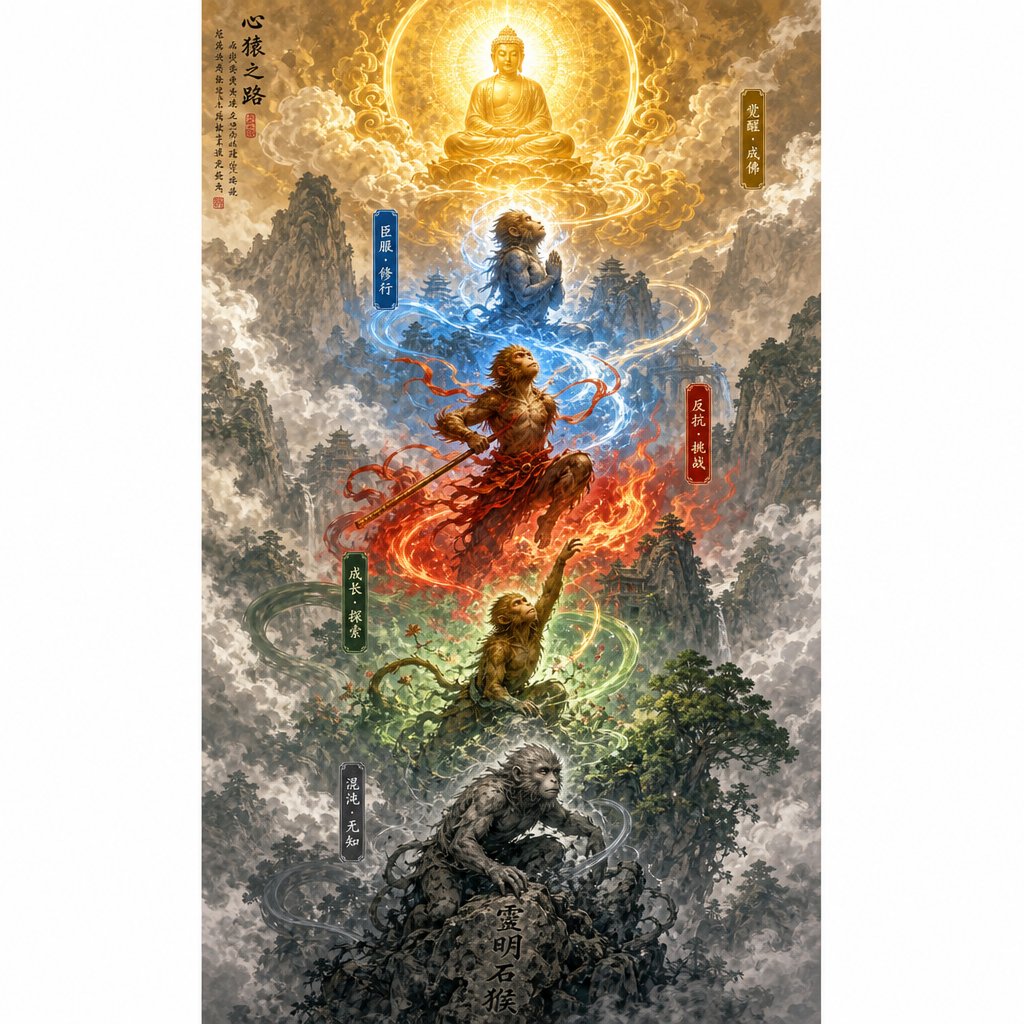
The shared character 悟 (wu) links the three disciples together, but Sun Wukong stands apart in one striking way: no other character in the novel accumulates as many names, titles, and epithets. Each one marks a turning point. Track them in order, and you are reading his entire spiritual biography, from raw stone to Buddhahood, compressed into a sequence of labels.
For anyone researching journey to the west wukong through translations or adaptations, the sheer number of aliases can be disorienting. Any wukong wiki entry will list half a dozen titles without explaining why they exist or when they appear. The reason is structural. Wu Cheng'en uses naming as a narrative device: every time Sun Wukong gains or loses a title, his relationship to power, identity, and enlightenment shifts.
Every Title Sun Wukong Earns Throughout the Novel
Here are his major names in the order the story bestows them, each tied to a specific chapter and a specific giver:
- Shihou (石猴, Stone Monkey) - Chapter 1. His first identity, used by the narrative itself. He is born from a divine stone on the Mountain of Flowers and Fruit, and the name simply describes what he is: a monkey made from rock. No ego, no aspiration, just origin.
- Mei Hou Wang (美猴王, Handsome Monkey King) - Chapter 1. Self-proclaimed after he leads his troop of monkeys into the Water-Curtain Cave. This is his first act of self-naming, and it reveals budding vanity. The character 美 means "beautiful" or "handsome," a choice that already hints at pride.
- Sun Wukong (孙悟空, Monkey Awakened to Emptiness) - Chapter 1. Given by Patriarch Subhuti, his first master. The surname Sun (孙) is derived from the character for monkey (猻) with the animal radical removed, leaving 子 (child) and 系 (lineage), which the Patriarch connects to the Daoist "Doctrine of the Baby Boy" and the holy embryo of immortality. Wu (悟) means "awakened to," and Kong (空) means "emptiness," the core Buddhist concept that Subhuti himself is named for. The name encapsulates his entire arc: attaining Daoist immortality first, then Buddhist enlightenment last.
- Bimawen (弼马温, Keeper of Horses) - Chapter 4. Assigned by the Jade Emperor as a minor stable-keeping post. The title is a deliberate insult disguised as an appointment. It puns on 避马瘟 ("ward off horse plague"), referencing the folk practice of placing monkeys in stables to prevent equine sickness. When Sun Wukong discovers the rank is the lowest in heaven, his rage ignites the rebellion.
- Qitian Dasheng (齐天大圣, Great Sage Equal to Heaven) - Chapter 4. Self-proclaimed during his revolt against the celestial bureaucracy. The title is seditious by design: 齐天 means "equal to heaven," a direct challenge to the Jade Emperor's supremacy. This is peak arrogance, the monkey king journey to west at his most defiant. He demands recognition not through service but through force.
- Sun Xingzhe (孙行者, Pilgrim Sun) - Chapter 14. Given by Tang Sanzang when Sun Wukong becomes his disciple and protector. Xingzhe (行者) means "one who practices" or "pilgrim," denoting a Buddhist layperson committed to spiritual discipline. This is the name used most frequently throughout the novel, appearing over 4,000 times in the original text. It signals submission: the rebel becomes a servant of the dharma.
- Dou Zhansheng Fo (斗战胜佛, Victorious Fighting Buddha) - Chapter 100. Bestowed by the Tathagata Buddha at the journey's end. The title does not erase his warrior nature. Instead, it sanctifies it. 斗战 means "fighting in battle" and 胜 means "victorious." His combativeness, once a flaw, becomes his path to transcendence.
The Spiritual Progression Hidden in His Names
Read the list again and you will notice a pattern. The early names are self-given: Handsome Monkey King, Great Sage Equal to Heaven. They express ego, ambition, and defiance. The later names are given by others: Wukong by a master, Pilgrim by a monk, Buddha by the Tathagata. Each externally bestowed name requires Sun Wukong to accept something: discipline, humility, service.
The journey to the west Sun Wukong undertakes is not just geographic. It moves from self-proclamation to submission, from demanding titles to earning them. His final name does not reject his fighting spirit. It reframes it. The monkey who once declared himself equal to heaven ends the story as a Buddha whose very title honors his combative nature, now channeled toward protecting the dharma rather than challenging it.
This is why Sun Wukong notable aliases matter beyond trivia. They are the plot. The novel could almost be retitled "How a Stone Monkey Earned Seven Names," because each renaming is the story's real climax, the moment where identity breaks and reforms. Even the title supreme inspector wukong, used in some game adaptations, follows this logic of names encoding rank and function.
The journey west monkey king carries one more name worth noting: Xinyuan (心猿), or "Mind Monkey." This is not a title any character bestows. It appears in chapter headings and allegorical poems throughout the novel, identifying Sun Wukong as the embodiment of the restless, undisciplined mind that Buddhist practice seeks to tame. It is the meta-name, the one that explains why all the other names exist. Every title he gains or loses is a stage in taming that mind.
His names do not just belong to the original novel, either. They ripple outward into every adaptation, translation, and game that draws from this source. How those names travel across languages and media is its own story, one that begins with the celestial hierarchy he once tried to overthrow.
Celestial Beings and Divine Title Structures
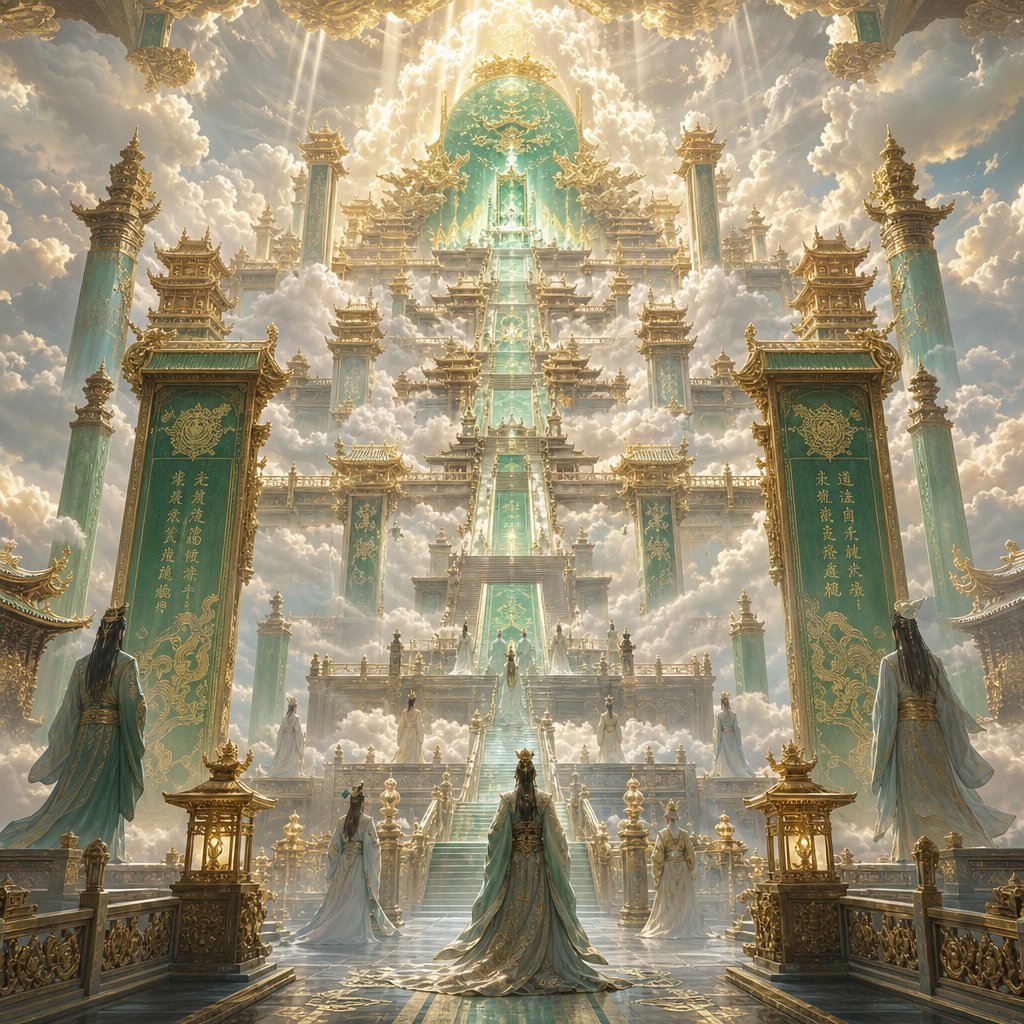
The celestial court Sun Wukong stormed is not a loose collection of gods. It is a bureaucracy, and every title within it encodes precise rank, domain, and function. When you encounter characters in kingdom of heaven scenes throughout the novel, their names tell you exactly where they stand in the cosmic chain of command before they speak a single line of dialogue.
The Jade Emperor and Celestial Rank Naming
At the apex sits the Jade Emperor, or Yu Huang Dadi (玉皇大帝). Break the name apart and you find a political theology compressed into four characters:
- 玉 (Yu) - jade, the most sacred stone in Chinese cosmology, symbolizing moral perfection and heavenly authority
- 皇 (Huang) - sovereign or emperor
- 大 (Da) - great
- 帝 (Di) - supreme ruler, a term reserved for the highest cosmic authority
Why jade specifically? In Chinese tradition, jade represents incorruptibility. Unlike gold jade does not tarnish, and unlike gems it does not shatter easily. It is tough, luminous, and enduring. Naming the supreme deity after this stone declares that heavenly rule is permanent and morally pure. The Jade Emperor presides over a divine bureaucracy modeled on the Chinese imperial government, with bureaus, reports, and a strict chain of command flowing downward from his throne.
This bureaucratic structure is not just background flavor. It drives the plot. Sun Wukong's rebellion begins precisely because the celestial hierarchy assigns him the lowest possible rank. The naming system is the insult: Bimawen is a title that places him beneath generals, beneath marshals, beneath star lords. His rage is a rage against the naming order itself.
Below the jade king of heaven, celestial titles follow a strict descending hierarchy. Each rank carries its own naming conventions:
- 佛 (Fo) - Buddha: The highest attainment. Titles include Tathagata (如来佛祖, Rulai Fozu) and the various Buddhas of specific domains.
- 菩萨 (Pusa) - Bodhisattva: Enlightened beings who delay full Buddhahood to help others. Named with a Sanskrit-Chinese hybrid pattern.
- 天王 (Tianwang) - Heavenly King: Guardians of the four cardinal directions. Named by compass point (e.g., Northern Heavenly King Duowen).
- 元帅 (Yuanshuai) - Marshal: Military commanders of celestial armies. Marshal Tianpeng (Zhu Bajie's former title) belongs here.
- 大将 (Dajiang) - General: Officers beneath marshals. The Curtain-Lifting General (Sha Wujing's former rank) sits at this level.
- 星君 (Xingjun) - Star Lord: Deities governing individual stars or constellations, like the Twenty-Eight Lunar Mansions who fight Sun Wukong.
Every demotion or promotion in the novel moves a character along this ladder, and the name change makes the shift visible. When Zhu Bajie falls from Marshal to pig, or when Sun Wukong rises from stable boy to Buddha, the title tells the story.
Bodhisattvas and Their Sanskrit-Chinese Hybrid Names
The bodhisattva naming pattern deserves special attention because it blends two linguistic traditions. Guanyin (观音) is the most prominent example. Her full title is Guanshiyin Pusa (观世音菩萨), meaning "Bodhisattva Who Observes the Sounds of the World." The name is a Chinese translation of the Sanskrit Avalokiteshvara:
- 观 (Guan) - to observe, to perceive
- 世 (Shi) - world (sometimes dropped for brevity)
- 音 (Yin) - sounds, cries
"She who observes all sounds of suffering in the world" is the meaning embedded in those characters. In Journey to the West, Guanyin is the architect of the entire pilgrimage. She recruits each disciple, bestows their Buddhist names, and intervenes at critical moments. Her name is not decorative. It defines her narrative function: she perceives suffering and responds.
Bodhisattva Lingji (灵吉菩萨) follows the same hybrid pattern. His name breaks into 灵 (ling, "spirit" or "efficacious") and 吉 (ji, "auspicious"), making him the "Spiritually Auspicious Bodhisattva." He appears in chapter 21 to subdue the Yellow Wind Demon with a divine needle, and again later in the story. The naming logic is consistent: the Chinese portion describes the bodhisattva's specific quality or domain, while 菩萨 (pusa) marks their rank.
Erlang Shen (二郎神) operates outside this Buddhist hierarchy entirely, which his name makes clear. Er (二) means "second," Lang (郎) means "son" or "young man," and Shen (神) means "god." He is literally "Second Son God," a reference to his mythological origin as the nephew of the Jade Emperor. The rivalry between Erlang Shen and Wukong in chapters 6 and 7 is one of the novel's great set pieces. Their battle works narratively because Erlang Shen is the one celestial warrior whose power matches the Monkey King's, and his name signals independence from the bureaucratic ladder. He holds no bureau title. He is simply a god by blood, not by appointment.
Even minor celestial figures like the jade princess Yaoji, Erlang Shen's mother in some mythological traditions, carry names that encode their place in this system. The naming conventions never break. Whether a character holds the rank of Buddha or the lowliest star lord, their title tells you their power, their domain, and their relationship to the cosmic order that the pilgrims must navigate on their way west.
This rigid celestial structure creates an interesting contrast with the novel's antagonists. Demons do not receive titles from heaven. They name themselves, and their self-given names follow an entirely different logic, one rooted in animal nature, elemental power, and territorial claims.
Demons and Antagonists Named by Nature
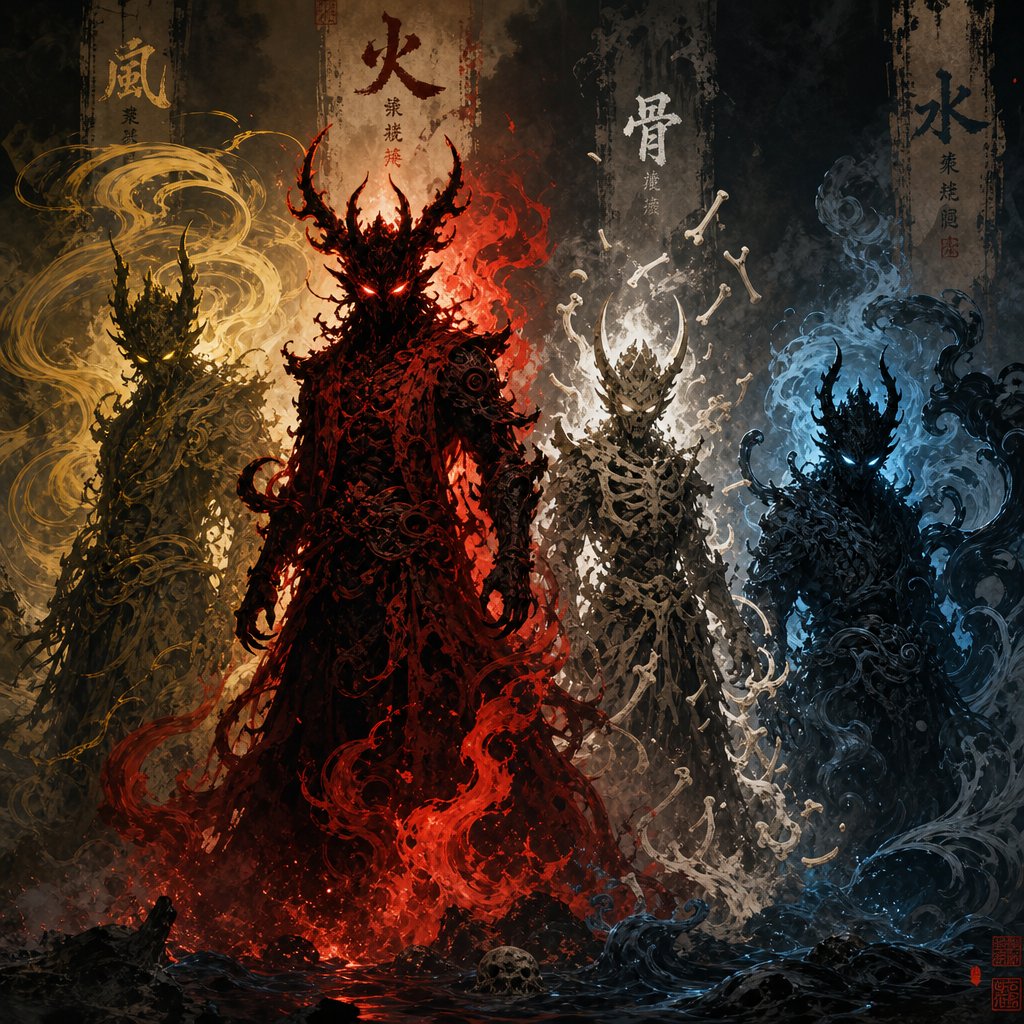
Celestial beings receive their titles from above. Demons name themselves from below. That single difference shapes an entirely separate naming system in the novel, one built on animal instinct, elemental power, and raw territorial ambition rather than bureaucratic rank. When you encounter a demon's name in Journey to the West, you are usually looking at a compressed field guide entry: what the creature is, what it can do, and where it lives.
Demon Naming Patterns in the Novel
Most demon names follow a recognizable formula. You will notice a color, an element or physical feature, and a creature type stacked together. Think of it as a three-part code:
- Color - often signals elemental affinity (red for fire, yellow for wind or earth, white for bone or purity inverted, black for water or darkness)
- Element or Feature - the demon's primary weapon, power, or distinguishing trait
- Creature Type - the suffix that marks them as supernatural: 精 (jing, spirit), 怪 (guai, monster), 魔 (mo, devil), or 王 (wang, king)
This formula is not random. It serves a narrative purpose. Wu Cheng'en gives readers all the information they need to predict how a demon will fight and how it will be defeated. The name is the clue.
Demon names in Journey to the West often telegraph their weakness to attentive readers. A fire demon will be quenched by water. A wind demon will be pinned by weight. A bone spirit has no flesh to protect her. The name tells you the solution before the hero finds it.
Beyond this formula, many demons operate with a dual-name system. They have a "true name" that reflects their actual animal form, and a self-styled title that inflates their status. The Bull Demon King (牛魔王, Niu Mo Wang) is the clearest example. His true form is a giant white bull, but he styles himself a "king" (王), borrowing the language of sovereignty. He is not appointed by heaven. He crowns himself. This pattern of self-naming mirrors Sun Wukong's early arrogance when he declared himself Great Sage Equal to Heaven, and it marks these demons as beings who refuse to accept their place in the cosmic order.
Red Boy, Yellow Wind Sage, and Color-Coded Villains
The color-coding system becomes vivid when you line up the novel's most famous characters with horns, fangs, and fire. Each one demonstrates how the naming formula works in practice.
Red Boy (红孩儿, Hong Hai'er) appears in chapters 40 through 42. His name literally means "Red Child," and the color is not cosmetic. He breathes Samadhi fire, flames so intense that even Sun Wukong cannot withstand them. His self-styled title is even more revealing: Divine Infant Great King (圣婴大王, Shengying Dawang). He calls himself a king and a divine infant, combining celestial language with childlike identity. He is the son of Bull Demon King and Princess Iron Fan, whose signature weapon is the thunder princess fan (铁扇, literally "iron fan") capable of extinguishing or stoking flames. The family connection is encoded in their shared fire motif. Red Boy's weakness? Water, specifically Guanyin's divine water from her jade vase, which finally subdues him.
Yellow Wind Sage (黄风怪, Huang Feng Guai) terrorizes travelers in chapters 20 and 21. His name translates directly as "Yellow Wind Monster." The color yellow points to his elemental domain: he commands the True Wind of Samadhi, a supernatural gale that blinds and disorients. His true form is a yellow marten (黄毛貂鼠) who originally lived beneath Vulture Peak, the Buddha's own mountain. He fled after stealing lamp oil from the sacred hall. The Tiger Vanguard (虎先锋, Hu Xianfeng) serves as his military captain, a vanguard demon whose name plainly states his tiger form and his role as the advance guard. Lingji Bodhisattva ultimately defeats the Yellow Wind Sage with a divine needle called the Flying Dragon Staff, pinning the wind with a fixed point. Again, the name telegraphs the solution: wind is overcome by stillness.
White Bone Demon (白骨精, Bai Gu Jing) is among the novel's most iconic antagonists, appearing in chapter 27. Her name is starkly literal: 白 (white), 骨 (bone), 精 (spirit). She is a skeleton demon, a pile of ancient bones that has cultivated spiritual power. Her true form is revealed as "a pile of flour-white skeletal bones" with the name "Lady White Bone" (白骨夫人) engraved on her spine. Unlike demons who fight with brute force, she relies on shapeshifting, disguising herself three times as a young woman, an elderly mother, and an old father. Her name tells you she has no flesh, no physical power. Her weapon is deception, and her weakness is perception. Sun Wukong's golden eyes see through every disguise because bones cannot perfectly imitate living tissue. The name gives away the game.
Nine-Headed Bug (九头虫, Jiu Tou Chong) appears in chapters 62 and 63 as the son-in-law of the Wansheng Dragon King. This nine headed demon in Journey to the West carries a name that is pure physical description: nine heads, one creature. His title "Nine-Headed Prince Consort" (九头驸马) adds a political dimension, claiming royal status through marriage rather than birth. He is one of the rare demons who escapes alive. Erlang Shen's Howling Celestial Hound bites off one of his heads, but the creature flees with eight remaining. His name, unlike most demon names, does not telegraph a clear elemental weakness. It signals overwhelming multiplicity instead, a threat that cannot be fully contained.
The black white elephant pattern appears in the Lion Camel Ridge arc (chapters 74-77), where three demons of different colors and animal forms cooperate: the Azure Lion (blue-green), the Golden Winged Great Peng (gold), and the Yellow Toothed Elephant (yellow). Their names encode a color, a distinguishing feature, and their beast form. Together they represent a spectrum of threats that requires three different bodhisattvas to resolve, each reclaiming their own escaped mount.
| Demon Name | Chinese Characters | Literal Meaning | True Form | Chapter Appearance |
|---|---|---|---|---|
| Red Boy | 红孩儿 | Red Child | Fire-breathing demon child (son of Bull Demon King) | Ch. 40-42 |
| Yellow Wind Sage | 黄风怪 | Yellow Wind Monster | Yellow marten from Vulture Peak | Ch. 20-21 |
| White Bone Demon | 白骨精 | White Bone Spirit | Ancient skeleton / pile of white bones | Ch. 27 |
| Nine-Headed Bug | 九头虫 | Nine-Headed Creature | Nine-headed bird-like beast | Ch. 62-63 |
| Bull Demon King | 牛魔王 | Bull Demon King | Giant white bull | Ch. 59-61 |
| Tiger Vanguard | 虎先锋 | Tiger Vanguard | Tiger spirit | Ch. 20 |
| Golden Horned King | 金角大王 | Golden Horn Great King | Servant of Taishang Laojun | Ch. 32-35 |
| Scorpion Demoness | 蝎子精 | Scorpion Spirit | Giant pipa-sized scorpion | Ch. 55-56 |
Notice how the table reveals the system at work. Famous characters with horns like the Golden Horned King and Silver Horned King (金角大王, 银角大王) carry their distinguishing physical feature right in their names. The horns are not incidental. They mark these demons as creatures of Taishang Laojun's household, where horned beasts serve as attendants. Their names are their identity papers, readable to anyone who knows the code.
The demon naming system also reveals something about the novel's moral architecture. Celestial names are given. Demon names are taken. The act of self-naming is itself a form of rebellion against the cosmic order, a refusal to accept the identity that heaven would assign. Every demon who styles himself a "king" or "great sage" is performing the same transgression Sun Wukong once committed. The difference is that Wukong eventually accepts a name given by others. Most demons never do, and that refusal is what keeps them outside the path to redemption.
These Chinese names carry so much meaning in their original characters that translation becomes a genuine challenge. Different English editions, romanization systems, and adaptation languages handle them in wildly different ways, which is why the same demon can appear under three or four different spellings depending on where you encounter them.
Pronunciation Guide and Romanization Differences
The same monkey hero appears as Sun Wukong, Sun Wu-k'ung, Suen Ng-hung, and Son Goku depending on which book, subtitle track, or game you pick up. This is not careless inconsistency. It is the result of multiple romanization systems competing across a century of English-language publishing. If you have ever searched for journey to the west in chinese and gotten confused by conflicting spellings, this section will clear the fog.
Pinyin Pronunciation for Major Characters
Hanyu Pinyin is the standard romanization system used in mainland China and adopted internationally. It is what you will find in Anthony C. Yu's revised translation, in academic papers, and in most modern media. The original novel's Chinese title is Xiyouji (西游记), sometimes spaced as Xi You Ji, meaning "Record of the Journey to the West."
Pinyin uses four tones, marked by diacritics over vowels. Sounds complex? Here are phonetic approximations for readers unfamiliar with the tone system:
- Sun Wukong (Sūn Wùkōng) - "Soon Woo-kohng" with a falling stress on "Woo"
- Tang Sanzang (Táng Sānzàng) - "Tahng Sahn-dzahng"
- Zhu Bajie (Zhū Bājiè) - "Joo Bah-jyeh" (the "zh" sounds like the "j" in "judge")
- Sha Wujing (Shā Wùjìng) - "Shah Woo-jing"
- Guanyin (Guānyīn) - "Gwahn-yeen"
One essential vocabulary word for any reader of the novel is yaoguai (妖怪, yāoguài). The yaoguai meaning breaks into two parts: 妖 (yāo) means "demon" or "strange supernatural entity," and 怪 (guài) means "monster" or "weird creature." Together they form the generic term for the demons and spirits the pilgrims battle throughout the xiyouji. You will encounter this word constantly in Chinese-language discussions, games, and adaptations.
Why the Same Character Has Different Spellings
Before Pinyin became standard in the 1950s, English-language works used Wade-Giles romanization, which relies on apostrophes to mark aspirated consonants and uses letter combinations like "hs" and "ts" that Pinyin does not. Arthur Waley's classic 1942 abridgement Monkey uses Wade-Giles era conventions and translates names freely: Sun Wukong becomes simply "Monkey," Tang Sanzang becomes "Tripitaka," Zhu Bajie becomes "Pigsy," and Sha Wujing becomes "Sandy." William Jenner's complete translation uses Pinyin (Wukong, Sanzang, Zhu Bajie, Wujing). Yu's original 1983 edition used Wade-Giles, but his 2012 revision switched to Pinyin, reflecting the global shift in scholarly standards.
The monk's name causes the most confusion. Depending on the source, you will see:
- Xuanzang - his historical name in Pinyin (the real seventh-century monk)
- Hsuan-tsang - the same name in Wade-Giles
- Tripitaka - his Sanskrit dharma title, meaning "Three Baskets"
- Tang Seng - Cantonese-influenced romanization meaning "Tang Monk"
- Sanzang - the Chinese translation of Tripitaka, used in Pinyin
These are all the same person. The spelling depends on whether the source prioritizes his historical identity, his religious title, or his fictional surname.
| Character | Pinyin with Tones | Wade-Giles | Phonetic Approximation | Common Alternate Spellings |
|---|---|---|---|---|
| Sun Wukong | Sūn Wùkōng | Sun Wu-k'ung | Soon Woo-kohng | Son Goku (JP), Son Ogong (KR) |
| Tang Sanzang | Táng Sānzàng | T'ang San-tsang | Tahng Sahn-dzahng | Tripitaka, Hsuan-tsang, Tang Seng |
| Zhu Bajie | Zhū Bājiè | Chu Pa-chieh | Joo Bah-jyeh | Pigsy (Waley), Pig (Jenner), Cho Hakkai (JP) |
| Sha Wujing | Shā Wùjìng | Sha Wu-ching | Shah Woo-jing | Sandy (Waley), Friar Sand (Jenner), Sa Gojong (KR) |
| Guanyin | Guānyīn | Kuan-yin | Gwahn-yeen | Kannon (JP), Quan Am (VN) |
| Yaoguai | Yāoguài | Yao-kuai | Yow-gwhy | Yokai (JP, different meaning) |
The practical takeaway: when you see syllables starting with "hs," "ts," or containing apostrophes, you are looking at Wade-Giles. When you see syllables starting with "x," "zh," "q," or "b," you are reading Pinyin. Knowing this one distinction lets you identify which system any source uses and mentally map it back to the same characters. The xi you ji you read in one translation is the Hsi-yu Chi you find in another. Same novel, same names, different century of scholarship.
How Character Names Translate Across Adaptations
Knowing the difference between Pinyin and Wade-Giles helps when reading translations, but most people today first encounter these names through something other than a book. Video games, anime, television dramas, and toy lines have carried journey to the west character names into dozens of languages, and each adaptation makes its own choices about what to keep, what to translate, and what to reinvent entirely.
From Sun Wukong to Son Goku and Beyond
The most globally recognized transformation is also the oldest. When Chinese characters (kanji) entered Japan between the 3rd and 7th centuries, Japanese speakers adopted approximated Chinese pronunciations called on'yomi. The kanji 孫悟空 are read as "Son Goku" in Japanese, not because anyone translated the meaning, but because Japanese codified older Chinese pronunciations into its own reading system. The word for "monkey" (猴) was pronounced closer to "kou" in Middle Chinese, which became "goku" through the same phonetic drift that turned 木 (muk) into "moku."
This is why Akira Toriyama named his Dragon Ball protagonist Son Goku. The connection between journey to the west and Dragon Ball is not subtle. Toriyama's Goku starts as a monkey-tailed boy with a magic staff and a flying cloud, direct references to Sun Wukong's Ruyi Jingu Bang and somersault cloud. The character Tien Shinhan maps to Erlang Shen's third eye. Oolong is Zhu Bajie. The entire first arc of Dragon Ball is a loose retelling of the pilgrimage, filtered through shonen adventure conventions. The journey to the west Dragon Ball connection runs so deep that Japanese audiences recognized it instantly, while Western viewers often discovered the source material years later.
The same on'yomi system transforms every character: Zhu Bajie becomes Cho Hakkai (猪八戒), Sha Wujing becomes Sa Gojo (沙悟浄), and Tang Sanzang becomes Genjo Sanzo (玄奘三蔵). These are not translations. They are the same written characters read through a different phonetic lens. Korean follows a parallel path: Sun Wukong becomes Son Ogong (손오공), Zhu Bajie becomes Jeo Palgye (저팔계). Vietnamese uses Sino-Vietnamese readings, producing Ton Ngo Khong (Tôn Ngộ Không) from the same characters. Research into these cross-linguistic readings reveals that even the title "Handsome Monkey King" (美猴王) may have sounded closer to "Mihou Wang" (Macaque King) in Middle Chinese, a pun that only becomes visible when you compare pronunciations across languages and centuries.
Character Names in Black Myth Wukong and Modern Games
Black Myth: Wukong takes a different approach. The game uses original Chinese names and draws its 107 bosses from specific chapters and episodes of the novel, including many that casual readers have never encountered. The Tiger Vanguard (虎先锋) appears as a Chapter 2 boss, pulled directly from the Yellow Wind Sage arc. The Yellow Wind Sage himself serves as that chapter's climactic fight. Red Boy appears in Chapter 5. Erlang Shen bookends the game as both prologue and endgame opponent.
What makes the game's naming interesting is how it handles obscure characters. Bosses like Lingxuzi, Guangzhi, and Guangmou are minor yaoguai from the novel's early chapters, elevated to full boss encounters. The tiger vanguard wukong players face in Chapter 2 even returns later in the Kingdom of Sahali, demonstrating how the game reuses names to show narrative progression. Players curious about black wukong when meet the snake lady in which chapter will find the Violet Spider and related spider demons concentrated in Chapter 4's Webbed Hollow, drawn from the novel's Silk Cave episode (chapters 72-73).
The game also introduces its own naming conventions that follow the novel's logic. "Yaoguai Chief" and "Yaoguai King" are rank designations for bosses, mirroring the celestial hierarchy's distinction between generals and kings. Even invented characters like "Mother of Stones" and "Father of Stones" use the novel's pattern of naming demons by their elemental nature.
LEGO Monkie Kid (LMK) takes yet another path. The toy and animated series creates original characters but names them using Journey to the West conventions. The protagonist MK (Qi Xiaotian) inherits Sun Wukong's staff and powers. The lmk Sun Wukong appears as a retired mentor figure, still carrying his original name. Villains like the Demon Bull King and Princess Iron Fan retain their novel names, while new characters like Macaque and the Lady Bone Demon follow the novel's demon-naming formula: animal form plus supernatural suffix.
Television adaptations add another layer. The landmark Journey to the West 1996 TVB series from Hong Kong used Cantonese pronunciations, while the iconic mainland Chinese adaptation (often called Journey to the West 96 by fans referencing its continued production run) used Mandarin. The journey to the west actors in these productions became so associated with their roles that Liu Xiao Ling Tong, who played Sun Wukong in the 1986 CCTV series, is still recognized by that character name decades later. These live-action versions cemented specific visual and vocal interpretations that later anime and donghua adaptations either reference or deliberately subvert.
Journey to the west anime adaptations from Japan, China, and Korea sometimes create entirely original characters while following the source material's naming rules. A fire-themed villain will get a red-coded name. A monkey-adjacent hero will carry the "Sun" surname or the "Wu" awakening character. The naming conventions have become a genre grammar that creators can deploy even when inventing new stories, signaling to audiences that a character belongs to this mythological universe.
- Dragon Ball (Japan, 1984-present): On'yomi readings. Son Goku, Cho Hakkai (Oolong), Sa Gojo (Yamcha's desert bandit origin).
- Black Myth: Wukong (China, 2024): Original Mandarin Pinyin names. Boss names drawn from specific novel chapters.
- LEGO Monkie Kid (International, 2020-present): Mix of English translations and original Chinese names. New characters follow novel naming conventions.
- Saiyuki (Japan, 1997-present): On'yomi readings with altered kanji. Genjo Sanzo, Son Goku, Cho Hakkai, Sha Gojyo.
- Korean dramas (Hwayugi, 2017): Sino-Korean readings. Son Ogong, Jeo Palgye, Sa Gojong.
- Vietnamese adaptations: Sino-Vietnamese readings. Tôn Ngộ Không, Trư Bát Giới, Sa Tăng.
- The New Legends of Monkey (New Zealand, 2018): English names with Pinyin for the protagonist. Tripitaka gender-swapped, Monkey used as primary name.
The pattern across all these adaptations reveals something fundamental about how journey to the west character names function. They are modular. The meaning layer (Awakened to Emptiness), the sound layer (Wukong / Goku / Ogong), and the visual layer (孫悟空) can each be preserved or swapped independently. A Japanese game might keep the kanji but change the pronunciation. An English cartoon might translate the meaning but drop the Chinese sounds entirely. Each choice creates a different relationship between the adaptation and its source, and knowing which layer was preserved tells you how that adaptation positions itself relative to the original novel.
With so many versions circulating, readers and players often need a single consolidated reference that maps every name, alias, and adaptation variant back to one character. That is exactly what the final section provides.
Master Reference of All Names and Aliases
Every adaptation preserves a different layer of the original names, which means readers moving between sources constantly encounter the same character under unfamiliar labels. This section consolidates every major journey to the west character into a single cross-reference, organized by narrative role, so you can map any name you encounter back to its source regardless of language or medium.
Complete Character Alias Cross-Reference
Before the table, one often-overlooked pilgrim deserves attention. Most discussions of monkey king characters focus on the four travelers who walk, but a fifth member carries Tang Sanzang on his back for the entire journey: the White Dragon Horse (白龙马, Bai Long Ma).
His story is easy to miss. Originally the Third Prince Ao Lie of the Western Sea Dragon King, he was sentenced to death for accidentally burning a pearl gifted by the Jade Emperor. Guanyin intervened, sparing his life on the condition that he serve as Tang Sanzang's celestial steed. In chapter 15, he swallows the monk's original horse, then transforms permanently into a white horse to carry the pilgrim westward. At the journey's end, he is ordained as the Babu Tianlong Guangli Bodhisattva (八部天龙广力菩萨), the "Celestial Dragon Extensive-Strength Bodhisattva of the Eight Legions," and wraps his restored dragon body around a pillar in the Great Leiyin Temple.
If you try to define noble steed in the context of this novel, the White Dragon Horse is the answer. He is not merely a mount. He is an immortal dragon serving penance in equine form, a prince disguised as transportation. The question "are dragons demons?" comes up frequently among readers encountering him for the first time. In the novel's cosmology, dragons are celestial beings with their own royal courts and heavenly ranks. They are not yaoguai. Ao Lie's crime was carelessness, not malice, and his punishment is service rather than destruction. He occupies a unique space: a dragon prince who becomes a horse, then ascends to bodhisattva status.
The concept of the turtle dragon also appears in the novel's mythology. In chapter 99, a giant white turtle carries the pilgrims across the Tongtian River, only to dump them into the water when they forget to ask the Buddha a question on his behalf. This creature blends turtle and dragon symbolism, representing longevity and aquatic power without holding celestial rank. It is a reminder that not every supernatural creature in the story fits neatly into the demon-or-deity binary.
| Role | Primary Name (Pinyin) | Chinese Characters | English Translation | Common Aliases | Adaptation Names |
|---|---|---|---|---|---|
| Pilgrim (Leader) | Tang Sanzang | 唐三藏 | Three Scriptures of Tang | Tripitaka, Tang Monk (Tangseng), Xuanzang, Golden Cicada (Jinchanzi) | Genjo Sanzo (JP), Hyeon Jang (KR), Duong Tang (VN) |
| Pilgrim (First Disciple) | Sun Wukong | 孙悟空 | Monkey Awakened to Emptiness | Stone Monkey, Handsome Monkey King, Great Sage Equal to Heaven, Pilgrim Sun, Victorious Fighting Buddha | Son Goku (JP), Son Ogong (KR), Ton Ngo Khong (VN) |
| Pilgrim (Second Disciple) | Zhu Bajie | 猪八戒 | Pig of Eight Precepts | Zhu Wuneng, Marshal Tianpeng, Pigsy, Pig, Idiot (Daizi) | Cho Hakkai (JP), Jeo Palgye (KR), Tru Bat Gioi (VN) |
| Pilgrim (Third Disciple) | Sha Wujing | 沙悟净 | Sand Awakened to Purity | Sha Monk (Shaseng), Curtain-Lifting General, Sandy, Friar Sand | Sa Gojo (JP), Sa Gojong (KR), Sa Tang (VN) |
| Pilgrim (Steed) | Bai Long Ma | 白龙马 | White Dragon Horse | Third Prince Ao Lie, Jade Dragon (Yu Long), Eight Legions Dragon Horse | Hakuryu (JP), Baek Yong Ma (KR), Bach Long Ma (VN) |
| Celestial Patron | Guanyin | 观音菩萨 | Bodhisattva Who Perceives Sounds | Guanshiyin, Avalokiteshvara, Goddess of Mercy | Kannon (JP), Quan Am (VN), Gwan-eum (KR) |
| Celestial Patron | Rulai Fozu | 如来佛祖 | Tathagata Buddha | Shakyamuni, The Buddha, Patriarch Buddha | Nyorai (JP), Yeorae (KR) |
| Celestial Patron | Yu Huang Dadi | 玉皇大帝 | Jade Emperor | Jade Emperor, Heavenly Grandfather | Gyoku Kotei (JP), Ok Hwang Sangje (KR) |
| Celestial Rival | Erlang Shen | 二郎神 | Second Son God | Yang Jian, True Lord Erlang, Illustrious Sage | Jiro Shin (JP), Yi-rang Sin (KR) |
| Recurring Antagonist | Niu Mo Wang | 牛魔王 | Bull Demon King | Great Sage Flattening Heaven, Demon Bull King | Gyumao (JP), Wu Ma Wang (KR) |
| Recurring Antagonist | Bai Gu Jing | 白骨精 | White Bone Spirit | Lady White Bone (Baigujing), Lady Bone Demon | Hakkotsu no Sei (JP) |
| Recurring Antagonist | Hong Hai'er | 红孩儿 | Red Child (Red Boy) | Divine Infant Great King (Shengying Dawang) | Kougaiji (Saiyuki JP), Red Son (LMK) |
| Converted Demon | Hong Hai'er (post-conversion) | 善财童子 | Sudhana Boy | Boy of Wealth, Shancai Tongzi | Zenzai Douji (JP) |
| Converted Demon | Hei Xiong Jing | 黑熊精 | Black Bear Spirit | Heifeng Guai (Black Wind Monster), Guardian of Luojia Mountain | Kokuyu Sei (JP) |
Which Name to Use in Different Contexts
With so many aliases per character, which name should you actually use? The answer depends on your audience and medium:
- Academic papers and scholarly discussion: Use Pinyin with tone marks on first mention, then Pinyin without tones thereafter. "Sun Wukong" not "Monkey." "Tang Sanzang" not "Tripitaka." Cite the Anthony C. Yu translation (2012 revised edition) as the standard English reference.
- Casual English conversation and blog posts: English translations work fine. "Monkey King," "Pigsy," "Sandy," and "Tripitaka" are all immediately understood by English-speaking audiences familiar with the story.
- Game and anime communities: Use the adaptation-specific name. Dragon Ball fans say "Goku," not "Wukong." Black Myth players say "Destined One" for the protagonist and use Chinese boss names. LEGO Monkie Kid fans say "MK" and "Macaque." Mixing systems within a fandom creates confusion.
- Cross-cultural or comparative discussion: Lead with Pinyin, then provide the adaptation name in parentheses. "Sun Wukong (Son Goku in Dragon Ball)" bridges both audiences without privileging one system.
The characters in journey to the west have survived seven centuries of retelling precisely because their names are so densely packed with meaning that every new language and medium finds something fresh to extract. A Japanese reader hears different phonetic echoes in 孙悟空 than a Mandarin speaker does. A game designer reads "Yellow Wind Sage" and sees a boss mechanic. A Buddhist scholar reads 悟空 and sees a doctrinal statement about the nature of reality.
That layered quality is what makes these names more than labels. They are the novel's smallest unit of storytelling, each one a compressed narrative waiting to unfold the moment you learn to read it. Whether you came to this material through a video game, a manga, a television drama, or a university course, the names themselves are the thread connecting every version back to Wu Cheng'en's original vision: a story where identity is never fixed, where names are earned and lost and transformed, and where the act of naming someone is itself an act of power.
Frequently Asked Questions About Journey to the West Character Names
1. What does Sun Wukong's name mean in Chinese?
Sun Wukong (孙悟空) translates to 'Monkey Awakened to Emptiness.' The surname Sun (孙) derives from the character for monkey with the animal radical removed, given by Patriarch Subhuti. Wu (悟) means 'awakened to,' and Kong (空) means 'emptiness' or 'void,' referencing the core Buddhist concept of sunyata. The name encapsulates his entire spiritual arc from Daoist immortality training to eventual Buddhist enlightenment as the Victorious Fighting Buddha.
2. Why does the same Journey to the West character have different names in different translations?
Multiple romanization systems create spelling variations for the same characters. Wade-Giles (used before the 1950s) produces spellings like 'Sun Wu-k'ung,' while modern Hanyu Pinyin gives 'Sun Wukong.' Arthur Waley's translation uses English nicknames like 'Monkey' and 'Pigsy,' while Anthony Yu's edition uses Pinyin. Japanese on'yomi readings of the same kanji produce 'Son Goku,' and Korean Sino-Korean readings yield 'Son Ogong.' All refer to the same character written as 孙悟空.
3. How many names does Sun Wukong have in Journey to the West?
Sun Wukong accumulates seven major names and titles throughout the novel's 100 chapters: Stone Monkey (his birth identity), Handsome Monkey King (self-proclaimed), Sun Wukong (given by Patriarch Subhuti), Bimawen or Keeper of Horses (assigned by the Jade Emperor), Great Sage Equal to Heaven (self-proclaimed during his rebellion), Pilgrim Sun or Xingzhe (given by Tang Sanzang), and Victorious Fighting Buddha (bestowed by the Tathagata at journey's end). He also carries the allegorical name Xinyuan, meaning 'Mind Monkey.'
4. What is the naming pattern for demons in Journey to the West?
Demon names typically follow a three-part formula: a color indicating elemental affinity, a feature describing their power or distinguishing trait, and a creature-type suffix like 精 (jing, spirit), 怪 (guai, monster), or 王 (wang, king). For example, White Bone Demon (白骨精) combines white + bone + spirit. This pattern often telegraphs a demon's weakness. Fire demons are defeated by water, wind demons by stillness, and bone spirits by perception that sees through their disguises.
5. What is the connection between Journey to the West and Dragon Ball character names?
Dragon Ball's Son Goku is the Japanese on'yomi reading of the same kanji 孙悟空 (Sun Wukong). When Chinese characters entered Japan, they received approximated Chinese pronunciations. Akira Toriyama deliberately named his protagonist after the Monkey King, and the early Dragon Ball arcs loosely retell the pilgrimage story. Other characters map similarly: Oolong represents Zhu Bajie (Cho Hakkai in Japanese), and Tien Shinhan references Erlang Shen's third eye.